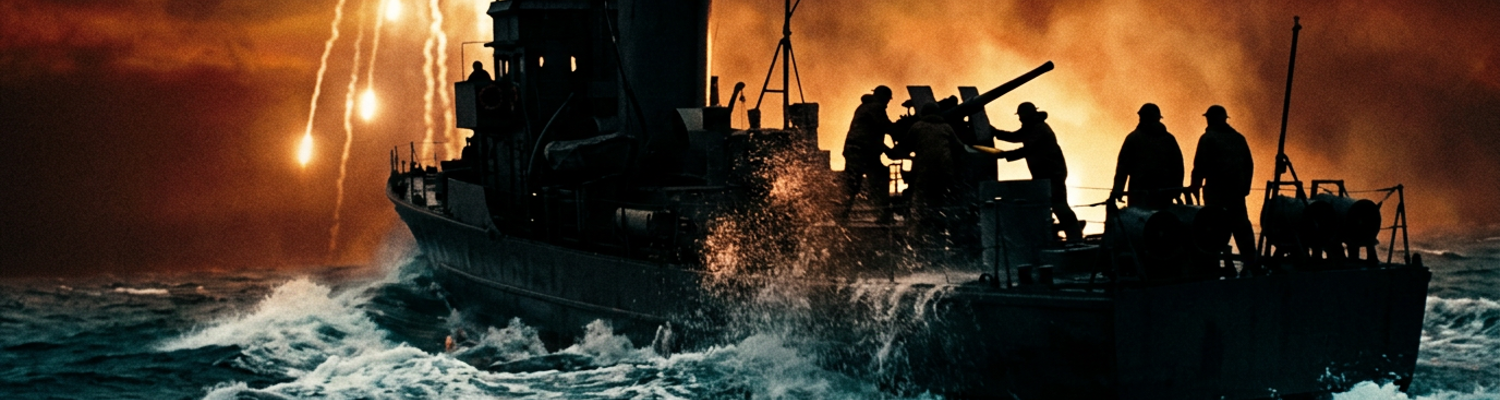

Radio Jamming and Offshore Patrol Isolation
Winds whipped freezing spray across the open bridge of the submarine chaser. The shallow waters off the Anzio beachhead created short, steep waves that repeatedly slammed against the hull and strained the ship seams. Dense winter cloud cover blotted out the moon and stars, plunging the Italian coastline into total blackness to prevent enemy artillery spotters on the high ground from tracking offshore movements. Cold salt-laden air seeped through wool uniforms and oilskin jackets, numbing the fingers of lookouts as they scanned the tumbling surf for floating mines and submerged sandbars. Sudden shifts in coastal depths forced the helmsman to wrestle with the wheel to hold course against strong littoral currents. The radio receiver on the bridge bulkhead began to hiss with shrill electrical noise.
Headsets clamped over the radioman ears erupted with a harsh pulsating drone that drowned out incoming tactical traffic. German electromagnetic jamming severed tactical radio communication between Anzio roadstead patrols and Allied naval headquarters in Naples. The operator rapidly adjusted the tuning knobs across multiple high-frequency channels, but powerful German transmitters along the coast flooded the band with relentless static and distorted tones. This disruption instantly isolated the small steel patrol craft from the fleet admirals and air-defense coordinators directing the amphibious campaign from eighty miles to the south. Urgent queries regarding enemy convoy movements, Luftwaffe air raids, and surface torpedo threats vanished into the electromagnetic interference. The pilothouse lost all external guidance and stood entirely alone in the dark.
Charts inside the cramped chart house remained empty of the centralized tracking reports normally broadcast by fleet command ships. Operating without central radar plot direction forced subchasers to maintain autonomous defensive sectors in pitch darkness. The skipper bent over his nautical charts by the dim glow of a hooded red lamp, recalculating the patrol boundaries without the benefit of shore-based radar sweeps or warning advisories. Pitch darkness enveloped the roadstead, hiding adjacent American patrol vessels that were patrolling assigned defensive lanes only a few miles away. Lookouts stared into the black water, knowing that any unannounced contact sliding through the swells could be an Allied patrol boat or an enemy raider closing at attack speed. The skipper relied strictly on magnetic compass headings and calculated engine revolutions to keep the ship inside its patrol box and avoid accidental collisions.
Diesel engines thrummed through the steel deck frames as the engineer throttled back to maintain a steady crawl along the outer screen. The acoustic operator in the small sonar cubicle lowered the QC sound head into the churning water beneath the keel, adjusting his receiver dials to listen for the faint hum of enemy electric motors. German shore batteries in the distant hills hurled sporadic star shells and heavy artillery toward the transport anchorages behind the patrol line. Flares briefly illuminated distant silhouettes before burning out over the bay. The skipper stepped onto the windward bridge wing, raised his binoculars toward the open sea, and ordered the deck crew to strip the canvas covers from the forward depth charge racks. Gunners readied the machine guns for immediate action along the port and starboard rails.
Kriegsmarine K-Flotilla 175 Infiltration Tactics
Deckhands yanked the stiff frozen canvas off the twin machine-gun mounts and checked the release levers on the stern depth charge tracks to ensure the safety pins slid freely. Lookouts racked drums of twenty-millimeter ammunition along the bulwarks while the skipper watched the black water for tiny surface wakes. The Kriegsmarine committed K-Flottille 361, operating under the cover designation Marineeinsatzkommando 75, in April 1944 to deploy Neger human torpedoes against the Anzio beachhead. German naval engineers constructed these peculiar weapons by joining two standard electric G7e torpedoes together, one above the other. The upper torpedo carried no explosive warhead, serving instead as a cramped cockpit where a lone pilot sat behind a tiny plexiglass dome. The pilot breathed from a rebreather apparatus while steering the assembly at less than four knots.
Torpedoes suspended directly below the pilot carried a live high-explosive warhead designed to be released toward an anchored hull once the craft closed within point-blank firing range. Transport hulls crammed with high-octane aviation fuel and heavy ammunition presented stationary targets across the shallow roadstead. Piloted midget craft launched from northern coastal positions near Torre Vaianica targeted anchored Allied Liberty ships and LSTs, relying on the southward coastal current to drift silently past the outer picket line. German shore crews slid the narrow craft off sandy beaches under the cover of night, sending the volunteer operators southward across twelve miles of contested water. These lone drivers endured suffocating conditions inside their cockpits, where moisture condensed on the inside of the viewing domes. Carbon dioxide accumulated rapidly inside the tiny enclosures whenever the chemical air purifiers faltered.
Pilots who lost consciousness from lack of oxygen left their craft to drift blindly until they washed ashore or ran out of battery power in the surf. Operators who remained alert relied on the craft's fixed positive buoyancy so that only the curved top of the plexiglass bubble broke the surface. This created an almost invisible profile against the rolling waves that defeated conventional detection methods. Radar antennas atop the subchaser mast failed to register these low-slung domes because rising wave crests scattered the radio beams back into the receiver as blinding sea clutter. The sound operator inside the sonar hut listened through his headphones to the rhythmic pulse of the QC sound gear, but the shallow bay distorted every return. High-frequency pings bounced violently off underwater sandbars, sunken wrecks, and cold coastal water layers.
Reverberation buried the faint whir of small electric torpedo motors under layers of false echoes. The skipper pressed his forehead against the damp bridge coaming, knowing that standard deep-water hunting tactics could not resolve a target that displaced less than three tons and operated just inches below the surface. A standard depth charge dropped in thirty feet of water risked blowing the bottom out of the subchaser itself before damaging the tiny raider. Visual detection by bloodshot human eyes remained the only reliable defense, forcing the bridge watch to stare unblinkingly into the foaming crests for the pale wake of a human torpedo. Searchlight crews on the flying bridge stood with their hands poised over the carbon-arc lamp switches, ready to flood the water with intense white beams. Gunners rested their fingers against the triggers of fifty-caliber machine guns.
Sailors standing off-watch lined the rail gripping Thompson submachine guns and Springfield rifles to form an improvised defensive perimeter. These small arms were chosen specifically to puncture the thin plexiglass cockpits from close range without setting off the massive warhead slung beneath the German pilot. Exploding an eight-hundred-pound torpedo warhead alongside the subchaser would instantly shatter the vessel hull frames and sink the patrol craft in seconds. The skipper reached for the engine order telegraph, easing the brass handles to dead slow. This quieted the diesel exhaust and kept his own ship from charging past a low-profile intruder in the dark. The patrol craft crept forward through the swells while the crew waited for a target to materialize.
Sonar Degradation and Littoral Acoustic Interference
Propeller shafts slowed their rotation immediately, reducing the mechanical roar that normally masked faint underwater noises. US Navy 173-foot steel patrol craft including PC-558, PC-626, and PC-545 maintained continuous shallow-water anti-submarine screens along the outer perimeter of the anchorage. These vessels kept station despite the total loss of fleet communications. Steel hulls groaned against the short swells as these patrol craft swept back and forth across designated five-mile lanes. Sound operators used their hull-mounted QC sonar to search for submerged targets while sitting inside cramped, unventilated compartments below the main deck. Operators gripped the manual training handwheels to aim the sonic projectors through thirty-degree search arcs.
Sound pulses radiated through the shallow water every few seconds, but the returning sound pulses grew muffled and unstable as the acoustic waves hit varying water depths near the coastline. Watch officers peered into the black spray from the bridge wings, relying entirely on the sonar men below to detect German raiders before the intruders reached the crowded transport anchorages. Seawater in the Tyrrhenian littoral had separated into distinct layers after days of calm sun followed by bitter winter rain. This created sharp thermal stratification that severely distorted the QC sonar pulses. Warm surface water rested over dense cold bottom currents, forming an acoustic boundary layer. This layer bent the outgoing sound beams downward toward the seabed instead of letting them travel in straight lines.
Shoals protruding from the shoreline narrowed the navigable channel and trapped the sonic energy in constricted water corridors. Sound waves struck these underwater sandbars and bounced in unpredictable directions, creating wide acoustic blind spots. Approaching craft could maneuver through these blind spots without reflecting a single pulse back to the receiver. Operators swept the transducer back and forth across the blind sectors, but the dials registered only weak scattered returns. These scattered returns gave no clear indication of range or bearing to the bridge. Sandbars, sunken landing craft, and shell-torn seafloor debris created intense bottom backscatter that flooded the sonar receivers with pervasive false contacts.
Echoes of sharp metallic noise repeatedly crackled in the operator headphones, mimicking the distinctive return of an electric motor or a steel hull only two hundred yards off the bow. Sonar men called out target bearings to the pilothouse with rising urgency. The skipper altered helm headings and ordered the deck guns trained on empty patches of dark water. Lookouts fired star shells and swept searchlights across the targeted sectors, only to reveal tumbling whitecaps over empty sand shoals. Constant false alarms drained the physical stamina of the crew. Pervasive acoustic clutter disguised the tiny real signatures of German midget torpedoes creeping through the littoral shoals.
Skippers on PC-558, PC-626, and PC-545 adapted their tactical doctrine to counter the degraded sonar conditions by running continuous coordination along the patrol line. Engineers adjusted the cooling water intake valves to quiet pump cavitation. Helmsmen held the patrol craft at minimum steerageway to prevent hull turbulence from blinding the sound heads. Sound operators worked their training handwheels in five-degree increments, cross-checking ambiguous returns against the known positions of shallow coastal shoals plotted on their navigation charts. Deck gunners stood beside their loaded twenty-millimeter cannons with safety catches off, maintaining visual watches along the boundaries of each acoustic blind spot. Depth charge crews along the stern tracks reset their hydrostatic pistols to the shallowest possible settings.
Artillery Bombardment and Tactical Vulnerability
Pistol mechanisms set to shallow depths forced the bridge watch to calculate their vessel speed with extreme precision. Skippers kept their steel subchasers crawling forward at barely four knots because higher speeds flooded the hull sonar domes with water turbulence. This turbulence drowned out the subtle electric hum of incoming midget torpedoes. Minimal steerageway allowed the acoustic operator below deck to sweep his sound beam with maximum clarity. This slow crawl left the patrol craft moving at a vulnerable pace along the inner edge of the roadstead. Lookouts clung to the bridge rails as German artillery spotters launched parachute flares and white star shells directly over the coastal picket lines.
Magnesium light illuminated the narrow gray hulls across the flat water, stripping away the night cover the patrol craft needed to survive. German heavy artillery batteries and long-range railway guns opened fire on the illuminated roadstead the instant the flares exposed the picket lines. High-explosive shells weighing hundreds of pounds plunged down from the mountain ridges. Sonic shockwaves rattled the steel hull plates before the detonations even impacted the sea. Battery spotters used the bright flare light to adjust their fire, bracketing subchasers operating close inshore with rapid salvos. Geysers of freezing seawater erupted along both beams of the patrol craft as incoming rounds exploded closer in fifty-yard increments.
Splinters of jagged steel sliced through the air and struck the subchaser decks, severing halyards and gouging deep furrows into the bridge coaming. Steel fragments embedded in the deck framing underscored the deadly operational trade-off between hunting underwater targets and surviving coastal bombardment. Standard naval doctrine dictated that small combatants run at flank speed and make erratic evasive turns when caught under observed artillery fire. Accelerating away from the shore batteries would create an enormous stern wake and throw thick clouds of diesel smoke from the exhaust ports. High speeds would saturate the QC sonar receiver with deafening propeller wash and blind the acoustic operators. Turning the ship away would also open a wide gap in the defensive perimeter, giving German human torpedoes an open lane to steer into the crowded transport anchorage.
Skippers had to hold their ships at minimal crawl speeds right inside the fall of shot. Helmsmen kept steady headings while heavy artillery shells exploded in the surrounding water. Shockwaves from these underwater shell bursts hammered against the subchaser keel and threw the sound operator forward against his metal receiver console. Each nearby artillery explosion overloaded the sensitive headphones with loud static. This static temporarily deafened the acoustic watch and wiped out legitimate sonar echoes for several seconds at a time. Crewmen on the open bridge wiped stinging salt spray and shell soot from their eyes, scanning the disturbed water around each splash for air bubbles or periscope tubes.
Lookouts loaded fresh twenty-millimeter ammunition into the bridge guns while the skipper kept one hand on the telegraph and his eyes fixed on the illuminated surf line. The helmsman nudged the rudder wheel just enough to counteract the current. This action held the bow directly toward the German battery flash points to present the narrowest possible silhouette to the guns ashore. Artillery shells continued to crash into the bay around the patrol vessels. The crew maintained their slow patrol speed despite the constant threat of a direct hit. The subchaser absorbed the concussive blows and continued sweeping the acoustic blind spots for midget submarines.
Weapon Modifications for Shallow-Depth Engagements
Battery flashes from the distant ridgeline silhouetted the foredeck where weapons crews huddled over their ordnance in the dark. Coastal depths inside the roadstead dropped to barely sixty feet, turning standard anti-submarine doctrine into a lethal hazard for the patrol craft. Factory settings on standard depth charges detonated hundreds of pounds of high explosives far too deep for the shelf. Deep detonations bounced catastrophic hydrostatic shockwaves straight off the seafloor and back into the ship hull. Torpedomen knelt beside the stern roll tracks with spanner wrenches and flashlights shielded with red lens tape to alter the firing mechanisms by hand. Subchaser crews recalibrated Mark 6 depth-charge hydrostatic pistols for shallow fathoms to avoid rupturing their own thin steel hull plates.
Gunners dialed the tension springs down to trigger at thirty feet. Crews calculated that a shallower burst would break the pressure hull of a sneaking German craft while allowing their own ship just enough room to escape the blast concussion. Blast shockwaves at such short ranges still threatened to pop rivets and spring underwater seams if the engines hesitated for even three seconds. Rolling depth charges off the stern also required the ship to run directly over the target. This maneuver proved impossible when dealing with midget submersibles carrying live warheads slung beneath their keels. Lookouts needed a forward-firing weapon that could destroy an incoming pilot cockpit before the craft ever reached the patrol vessel.
Rocket rails mounted on both sides of the forecastle held 7.2-inch Mousetrap projectiles. These factory rockets required significant water pressure or a direct heavy impact against thick steel plating to detonate. Crews modified forward Mousetrap rocket projectors with altered contact fuzes to effectively strike surface-skimming midget submersibles. Gunners filed down the internal firing pins and fitted sensitive nose switches. These switches ensured the warheads would detonate instantly upon clipping the thin plexiglass dome or shallow hull of a Neger. Ordnancemen completed these delicate modifications on the pitching forecastle while icy spray washed over their boots and sea salt crusted their bare hands.
Rockets armed with hair-trigger fuzes terrified the deck crew in the rolling swells because a heavy wave striking an armed launcher could set off all four projectiles simultaneously. Deck officers ordered the loading crews to secure canvas blast shields around the rocket cages. Crews lashed each wooden safety block until the sound operator called out an active contact. Exhausted sailors checked the electrical firing leads with pocket meters. Men shielded the tiny test bulbs inside their heavy pea coats to prevent showing light to the shore gunners. Wire connections verified, the weapons officer signaled up to the pilothouse that both the forward launchers and the recalibrated stern charges were ready for immediate release.
Telephones buzzed on the bridge bulkhead as the skipper acknowledged the combat status of his modified battery. Tactical choices on the bridge were now locked to these altered firing limits, narrowing the engagement range to a lethal knife fight inside two hundred yards. Helmsmen kept their eyes glued to the dark water directly ahead of the bow. Any black shape cutting through the foam required an immediate salvo from the hair-trigger rockets before the German pilot could release his underslung torpedo. Lookouts leaned out past the splinter shields with their hands gripping the firing cords of the bridge searchlights. Engineers below held their throttles steady at dead slow, listening for the sudden bell from the bridge that would unleash the modified explosives into the shallow surf.
Crew Fatigue and Sustained Night Screening
Steel deck plates shivered under the boots of the watch standers as the idling diesel shafts sent a continuous low-frequency tremor up through the hull framing. Personnel maintained grueling twelve-hour night watches in condition-one combat readiness amid persistent diesel vibrations and sleep deprivation. Every crewman remained locked at his battle station from dusk until well after daybreak. Sailors wore heavy life preservers and steel helmets that pressed into sore necks hour after hour. Men could not leave their guns, depth charge racks, or engine throttles to seek warm bunks or hot meals below deck. Salt spray caked across their eyelids, and bitter wind stripped heat from exposed skin.
Vibrations from the idling shafts rattled through their bones until muscular fatigue turned into a constant dull ache. Bridge officers leaned against the pelorus stand to keep their balance. These officers forced their drooping eyes back toward the black waters of the defensive screen. Sonar operators endured the sharpest mental toll as they sat hunched inside windowless sound shacks. Operators strained their ears against heavy rubber headphones to track elusive acoustic targets under threat of silent electric torpedoes. This sensory strain caused widespread psychological exhaustion among the sound crews.
German G7e electric motors and battery-powered midget hulls produced no telltale trail of exhaust bubbles. These craft generated virtually no acoustic signature compared to conventional steam-driven torpedoes. Sound men had to separate tiny whispering whines of submerged electric screws from the loud background noise of breaking surf, hull slap, and thermal echoes bouncing off the shallow seabed. Missing a single faint scrape of a propeller blade meant an eight-hundred-pound warhead could slam into the steel hull without warning. This intense unbroken auditory concentration overwhelmed the operators. Ears began ringing after hours of listening to static, creating imaginary propeller noises that brought the entire deck crew to panic.
Deck gunners repeatedly slammed their weapon bolts forward and tracked shadows in the dark whenever an operator called out an unconfirmed sound bearing. Adrenaline surged through tired bodies at each false alarm. This chemical rush left the men deeper in physical collapse once the contact vanished into the surf. Severe sleep deprivation steadily eroded the visual judgment of bridge lookouts after midnight. Staring into unbroken blackness under the stress of imminent torpedo attack triggered visual hallucinations. Sailors began to see periscope shears and cockpit domes in ordinary wave crests or floating drift timber.
Gunners gripped the grips of their twin fifty-caliber machine guns so hard that their fingers seized in the freezing damp. Men stood ready to open fire on shadows as their exhaustion mounted. Each surge of panic drained the crew of what little stamina remained. Watch officers struggled to keep their gunners from discharging weapons at friendly patrol craft crossing the sector boundaries. Skippers rotated lookouts between exposed bridge wings and sheltered deck coamings every twenty minutes to prevent men from collapsing on watch. Watch standers gulped bitter black coffee from chipped tin mugs and wiped burning saltwater from their eyes with damp sleeve cuffs.
Officers moved continuously along the open bridge, physically nudging helmsmen and gunners to ensure no sailor slipped into dangerous micro-sleeps. Mechanical breakdowns inside the engine spaces added to the burden. Grease-stained machinists patched leaking fuel lines and pumped bilge water while breathing diesel fumes in the hot hold. The subchaser remained on its narrow screening lane until dawn broke over the mountains. Every man stayed clamped to his station as the morning tide brought another wave of acoustic clutter into the bay. The crew braced themselves for the final hours of the watch as the sky slowly lightened.
Roadstead Interdiction and Strategic Beachhead Defense
Lookouts on PC-558 spotted the narrow wake of an incoming Neger cutting through the morning tide barely four hundred yards off the port bow. General quarters bells clattered throughout the vessel as the bridge watch shouted orders through the brass voice tube. The skipper brought the ship around into an immediate intercept heading. Gun crews swung their twin twenty-millimeter mounts onto the bearing, tracking the tiny plexiglass dome as it bobbed amid the steep coastal chop. Armor-piercing tracers ripped across the gray surface in continuous deliberate bursts. The heavy rounds punctured the pilot cockpit and severed the electrical control cables before the craft could aim its underslung torpedo at the anchorage.
Gunnery and depth-charge attacks by PC-558 and PC-626 destroyed multiple Neger craft before they breached the fleet perimeter. Detonations from the pierced battery compartments threw violent geysers of salt spray across the subchaser foredeck. The disabled assembly slid down through the water column and vanished beneath the waves. PC-626 surged through the resulting debris field at twelve knots. The crew rolled a pattern of shallow-set depth charges off its stern tracks over a second submerged contact. Explosive shockwaves slammed against the shallow seafloor sixty feet below, lifting the subchaser hull out of the water and rupturing the steel casing of the second human torpedo.
Concussion waves sent loose tools and empty ammunition casings skittering across the iron deck plating. The acoustic operator gripped his console to stay upright as the ship shuddered from the blast. Deckhands lined the bulwarks with rifles and submachine guns. Sailors fired controlled bursts into the rising air bubbles and heavy fuel slicks to ensure the enemy pilot could not deploy his secondary release mechanism. Watch officers swept binoculars across the smoking foam, confirming the destruction of the craft. Twisted metal frames and severed propulsion gear bobbed to the surface amid the spreading oil.
Patrol craft maintained continuous sweeping runs back and forth across the outer roadstead. These sweeps verified that no stragglers from K-Flottille 361 remained within striking distance of the fleet. Neutralizing the asymmetric midget submarine threat secured critical maritime supply lines essential for the Allied breakout toward Rome. Deep-draft Liberty ships and Landing Ships, Tank had remained pinned against the shallow roadstead for weeks. These cargo vessels were vulnerable to clandestine night strikes that could have severed the flow of shells and fuel to frontline units. Coastal picket lines kept the shipping lanes entirely clear, enabling Allied cargo masters to offload thousands of tons of heavy artillery ammunition, tanks, and infantry replacements across the docks without loss.
Logistics officers ashore integrated these uninterrupted maritime reserves into the offensive stockpiles needed to puncture the German defensive lines along the Alban Hills. Engineers below the deck plates of the patrol craft eased their throttles back to cruising speed. Machinists nursed overheating cylinder heads and checked cooling lines that had strained under hours of continuous combat maneuvers. Bridge watches logged the exact coordinates of the underwater wreckage. This navigational record warned incoming cargo convoys away from the submerged obstructions. Lookouts wiped salt residue and cordite soot from their optical lenses, keeping their stations on the flying bridge as the morning light spread over the distant coastline.
Deck officers on the subchaser marked the cleared shipping channels on their navigation charts. Signalmen flashed harbor control to resume inbound transport movements. The steel patrol craft turned back toward its designated patrol box to begin another sweep. Sailors secured their weapons and began clearing the spent brass casings from the deck plates. The subchaser held the line against the unseen threats lurking in the Italian littoral. The crew prepared to face another grueling night watch as the sun climbed higher over the Mediterranean.