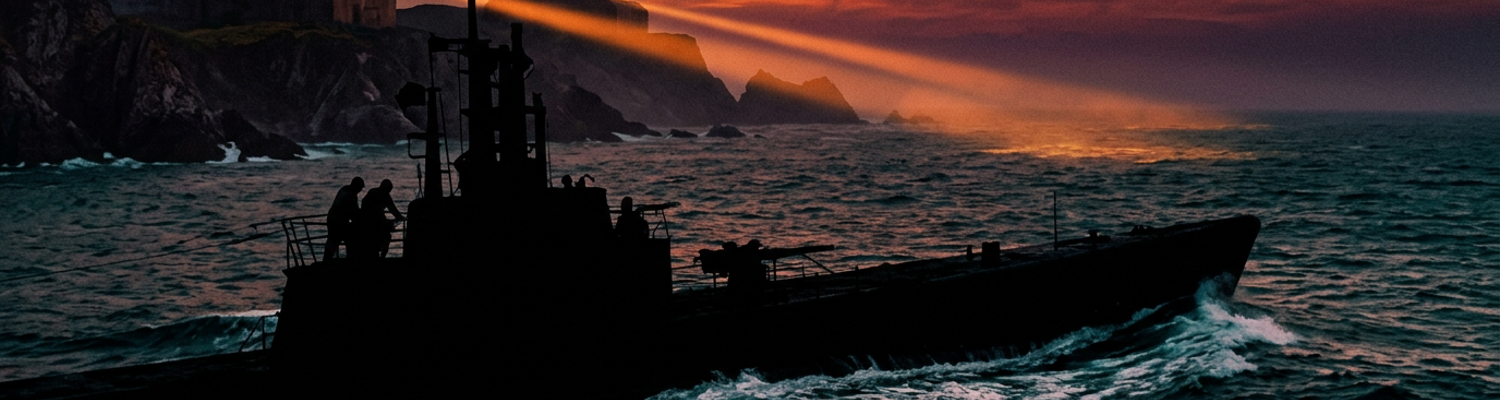

Imperial Japanese Defenses in the Tsushima Strait
Headsets crackled into dead static as the scheduled radio transmission from Pacific Fleet command cut out completely, leaving the submarine bridge crew cut off from fresh operational orders. Officers gathered around the chart table in the darkened control room, knowing that waiting for a repaired communication link would waste their remaining hours of nighttime darkness. Intelligence maps spread across the plotting board detailed the grim physical geography of their target area, where the Sea of Japan served as the heavily defended inner redoubt of the enemy empire. Heavy transports hauled coal, iron ore, and food grains across those sheltered waters every day to sustain the Japanese war industry, making the closed sea the primary supply corridor linking the home islands to mainland resources in Manchuria and Korea. Standard operating procedures strictly forbade entering such heavily monitored enemy bottlenecks without verified support from surface escorts. Crewmen secured the radio room, dogging the watertight doors as the skipper ordered the boat forward into the contested channel on his own authority.
Motors spun the drive shafts under battery power, pushing the submarine directly into the fortified approaches of the Tsushima and Korea straits. Japanese minelayers had anchored thousands of explosive steel contact spheres at varying depths across the continental shelves, creating overlapping underwater barriers designed to crush any submerged hull on impact. Coastal gunners stood watch inside reinforced concrete bunkers along Tsushima Island, zeroing in massive twelve-inch and sixteen-inch rifled cannons that covered the surface waters across every open channel. Armed picket boats and converted fishing vessels swept the surface lanes with radar antennas and hydrophone listening gear, maintaining an unbroken listening perimeter from shore to shore. American naval intelligence analysts had calculated the probability of surviving an unassisted passage through these interlocking defenses at less than twenty percent, keeping Allied submarines barred from the basin for over eighteen months.
Technicians monitored their sonar dials as the submarine slipped beneath periscope depth to challenge those twenty percent odds. Sound listeners adjusted their brass tuning wheels, straining to identify the high-pitched scrape of moored steel cables sliding against the outer casing of the hull. Standing orders from naval headquarters required an immediate abort if an unescorted boat met unexpected mine lines without clear pathways, creating sharp doubt among the officers about proceeding deeper into the narrows. Calculations on the navigation pad proved that executing a wide turn to escape would expose the submarine broadside to enemy hydrophones and increase the chance of drifting into a mine mooring. Slicing directly through the central deep-water channel at dead slow speed offered the only viable mathematical path through the barrier, even though the risk of striking an explosive horn remained constantly high. The commander accepted the extreme hazard of the maneuver, ordering the helmsman to hold the exact compass bearing charted through the middle trench.
Navigators plotted each depth sounding and acoustic reflection onto their waterproof grid paper, recording the exact boundaries of the Japanese minefields as the boat edged ahead. Compressed air hissed quietly into the trim tanks as the diving officer held the vessel at a precise depth beneath the cold thermal layer, shielding the hull from surface radar pulses. Listening gear detected the rhythmic thrum of three Japanese patrol boat propellers passing less than eight hundred yards above the submerged deck. Crewmen held their breath and gripped overhead pipes in total silence while the submarine drifted directly beneath the enemy formation. Rudders guided the boat beyond the reach of the Tsushima shore batteries, carrying the vessel past the final barrier line and into the deep interior of the inner sea.
Hydrographic Intelligence and the JANIS 75 Compilation
Navigators unfolded heavy paper chart folios across the wardroom plotting table to cross-check the boat dead-reckoning position against the deep waters of the newly entered basin. Joint Intelligence Study Publishing Board researchers had issued JANIS 75-1 in April 1945, synthesizing pre-war hydrographic surveys, aerial reconnaissance, and captured Imperial Japanese Navy documents into a single operational guide. Analysts in Washington had spent months translating seized Japanese harbor charts, studying pre-war commercial shipping routes, and examining high-altitude photographs taken by Allied aircraft over the home islands. The resulting compendium gave submarine commanders their first systematic breakdown of Japanese water depths, tidal variations, and seasonal water temperatures across the heavily protected inner sea. Crewmen gathered around the table, examining the densely layered pages to see whether the intelligence predictions matched the dark, uncharted depths now pressing against their steel hull.
Diagrams inside JANIS 75 mapped coastal artillery firing arcs, radar picket station locations, and seabed topography throughout the Tsushima and Korea straits to identify potential transit avenues for American forces. Red ink overlays plotted the lethal reach of twelve-inch and sixteen-inch Japanese shore rifles, demonstrating that any surface transit would face instant destruction from coastal fortresses. Black symbols indicated the patrol boxes of radar-equipped picket boats, leaving only narrow corridors where a submerged vessel might slip between acoustic sweep sectors. Mathematical estimates included in the study assigned specific survival percentages to each potential path, but every route required steering perilously close to submerged reefs and heavily mined channels. Officers debated the figures in low voices, calculating whether the fuel and battery reserves could survive the prolonged creeping speeds demanded by these narrow hydrographic channels.
Currents surging through these undersea passages often ran two knots faster than standard naval charts indicated, threatening to sweep the boat off course into moored mine arrays. Sounding gear registered a depth of forty fathoms, which differed by several yards from the bathymetric soundings recorded in the April intelligence report. Skippers had to decide whether this discrepancy came from shifting bottom sediments or from an error in the pre-war Japanese survey data copied into the American book. Turning away to re-check the entrance would drain the main battery and risk detection by patrol hydrophones, while pressing forward meant betting the lives of eighty men on paper calculations compiled thousands of miles away. The commanding officer resolved the doubt by accepting the intelligence data as their primary guide, ordering the helmsman to maintain the heading directly through the center of the strait.
Helmsmen eased the brass steering wheel two degrees to starboard, aligning the submarine with the safe deep-water channel outlined in JANIS 75. Technicians adjusted the water ballast in the auxiliary tanks, using the specific gravity charts in the intelligence volume to balance the boat inside the cold, dense lower water layer. Lookouts at the periscope raised the optical tube for a brief two-second look, confirming that the dark ridgeline of Tsushima matched the coastal elevation profiles printed in the manual. Sonar listeners tracked the distant, rhythmic pulses of Japanese shore radar sweeping uselessly across the empty sea surface high above the submerged hull. Electric motors drove the boat forward at four knots along the charted corridor, carrying the reconnaissance patrol deeper into the contested waters of the Sea of Japan.
Operational Planning for the Operation Barney Infiltration
Commander Submarine Force Pacific planners under Vice Admiral Charles Lockwood analyzed JANIS 75 bathymetric cross-sections to design transit corridors for Operation Barney, translating the reconnaissance boat depth soundings into fleet-wide operational tracks. Draftsmen laid out millimeter-grid paper across wooden plotting tables at Pearl Harbor, comparing pre-war Japanese survey depths with raw sonar readings to locate the exact contours of underwater trenches. Lockwood recognized that entering the inland sea demanded an all-or-nothing gamble, because any vessel disabled in the mined shallows would face immediate depth-charge counterattacks without any surface support nearby. Staff officers matched each seabed depression against the estimated anchor depths of moored Japanese contact mines, searching for thin layers of water where a submarine hull could squeeze beneath the explosive horns without scraping bottom rocks. Lead weights and draft gauges confirmed that only a forty-foot vertical window existed between the lowest swinging mine cases and the jagged granite pinnacles rising from the seabed. Pencil lines marked two distinct submerged tracks through the eastern and western channels of Tsushima Strait, giving skippers specific compass headings and depth limits for their dangerous approach runs.
Lockwood organized nine fleet submarines into three wolfpacks under Task Group 17.7, commanded by Commander Earl Hydeman, to conduct the coordinated penetration along these newly marked transit lanes. Hydeman took personal command of the lead wolfpack aboard the submarine Sea Dog, dividing the remaining vessels into two supporting groups under experienced pack commanders. Mechanics at submarine base repair facilities fitted every boat with experimental frequency-modulated mine-detection sonars, bolting spherical acoustic transducers onto the bows to spot moored mine cables in the black water. Shipyard workers reinforced the hull penetrations around the acoustic cables, ensuring that high water pressure at deep creeping depths would not blow out the watertight fittings. Crews rehearsed their silent-running procedures for weeks in deep Hawaiian training waters, training sonarmen to pick out the high-pitched acoustic ringing of steel mine casings against the background noise of churning sea currents.
Submarine navigators calculated depth margins and charted courses specifically to avoid Japanese coastal artillery coverage while threading underwater mine lines, applying their specialized training to the tactical approach plots. Plotting officers determined that holding the hulls between eighty and one hundred twenty feet beneath the waves kept the vessels below the reach of surface mine horns, even though that depth placed the keel within twenty feet of uncharted bottom reefs. Navigators penciled zig-zag legs to route the submarines directly through blind spots between Japanese radar towers on Tsushima Island, bypassing the pre-registered kill zones of twelve-inch and sixteen-inch coastal guns mounted in reinforced cliffside bunkers. Diving officers verified salinity and water temperature gradients from the JANIS 75 tables, calculating the exact amount of water needed in the trim tanks to keep the boats neutrally buoyant beneath the cold thermal layer. Hydeman ordered his pack commanders to hold dead-reckoning speeds below three knots throughout the passage, trading battery endurance for acoustic silence so that Japanese coastal hydrophones could not track their submerged screws.
Hydeman delivered sealed operational orders to each submarine skipper during the final tactical conference at Guam, laying out the exact staggered timetable for the breakout. Wolfpack units received designated departure windows, with the Hellcats scheduled to breach the strait first, followed at twenty-four-hour intervals by the Bobcats and the Polecats. Skippers accepted strict contingency instructions that required any damaged submarine inside the minefield to manage its own survival, preventing rescue attempts that would alert Japanese patrols to the other boats. Electricians tested the backup circuits on steering motors and gyrocompass repeaters, ensuring that no sudden power loss would throw a creeping boat off its narrow channel. Diesel engines coughed to life across the harbor at Apra as the nine submarines cast off their mooring lines, turning their bows north toward the mined approaches of the Tsushima Strait.
Technical Integration of Experimental QLA Sonar
Sonarmen crouched inside the forward sound shacks as the nine submarines sped north from Apra, running diagnostic checks on their newly installed detection gear. The operation relied on the experimental QLA frequency-modulated mine-detection sonar, which translated mine contact reflections into audible frequency shifts. Planners accepted this extreme tactical gamble against established submarine doctrine, calculating that transmitting active acoustic pulses was the only way to reveal stationary mooring cables and floating explosive spheres. The QLA unit sent continuous frequency-swept sound waves into the dark water ahead, causing echoes from solid metal objects to shift in pitch and generate distinct chiming tones in operator headphones. Skippers staked the survival of their crews on these auditory pitch shifts, knowing that an undetected contact mine would breach the pressure hull before anyone could order evasive maneuvers.
Moisture accumulated across the interior bulkheads as the submarines plunged into cold northern waters, jeopardizing the fragile electronic components that the crews depended on for survival. The QLA system operated with delicate electronic vacuum-tube circuits that suffered frequent degradation in high-humidity submarine environments. Warm air from the crowded crew compartments condensed against the chilled steel hull plates, creating steady trickles of water that ran down structural ribs. Water droplets collected on unsealed junction boxes and soaked into the wiring bundles connected to the QLA chassis cabinets. Glass vacuum tubes generated intense heat inside their tight metal housings, and the constant exposure to damp air caused ceramic tube bases to crack and bleed electrical current into the mounting frames. Short circuits and fluctuating voltages degraded the sensitive audio amplifiers, turning the chiming tones into ragged static bursts.
Submarine technicians conducted continuous manual tuning and recalibration of malfunctioning receiver circuits during submerged operations to prevent the sonar gear from failing at critical depths. Crewmen squeezed into the narrow spaces behind the sound consoles with screwdrivers and analog test meters, tracking down electrical leaks while the boat crept forward in total silence. Technicians replaced burnt vacuum tubes with fresh spares kept in dry cloth, resetting potentiometer dials to rebalance the frequency sweep across the receiver circuits. Adjustments had to be made every few minutes because shifting battery voltages and rising cabinet temperatures threw the delicate tuning out of alignment. Every restored circuit brought the ringing bell tones back into the operator headphones, giving the control room an accurate acoustic picture of the water column ahead.
Operators translated those restored acoustic chimes into precise compass bearings, feeding real-time target ranges directly to the plotting team. Navigators marked each audio contact on their grease-pencil plots, calculating that a submarine advancing at three knots had less than ninety seconds to avoid a detected mine cable. Skippers stood beside the sound room door to evaluate every tone shift, separating false echoes off bottom rocks from the clear ringing signatures of tethered explosive spheres. Helmsmen applied delicate rudder corrections of only two or three degrees, steering the narrow hulls through sixty-yard gaps between detected mooring lines. Electric motors turned the bronze propellers at silent-running speeds as the boats slid past the first line of submerged Japanese mines without brushing against the mooring cables.
Task Group 17.7 Transit Through Mine Barriers
Task Group 17.7 initiated its submerged ingress into Tsushima Strait on June 4 and 5, 1945, operating directly beneath Japanese fortress artillery emplacements as the wolfpacks pushed past that opening line into the heavily mined core of the passage. Strong tidal rips created turbulent currents in the eastern and western channels, pushing the submerged boats sideways and requiring helmsmen to fight the drift with small, deliberate rudder corrections while holding speeds below three knots. Shore-based gunners stood watch inside reinforced concrete bunkers along the high Tsushima cliffs, manning heavy fortress artillery pieces that commanded the surface water for miles in every direction. Coastal radar towers swept the foggy surface channels continuously, but the high-frequency radar beams bounced off the water swells without detecting the American fleet submarines creeping eighty feet below the surface. Navigators leaned over their plotting boards in the dim red battle light, cross-referencing depth-finder soundings with the bathymetric profiles in the JANIS 75 handbook to ensure that the vessels stayed inside the safest deep-water channels. Skippers enforced total silent running inside every compartment, directing crewmen to wrap tool handles in rags, step softly across the deck plates in stocking feet, and communicate through hand signals to keep mechanical noise from alerting Japanese listening stations ashore.
Sonar operators monitored continuous audio returns as the submarines navigated through multiple parallel lines of moored contact mines, steering along acoustic bearing plots while hull cables occasionally scraped moored mine tethers. Loud, screeching rasps traveled through the forward pressure hulls whenever the outer safety wires, bow planes, or periscope shears brushed directly against the steel cables anchoring the buoyant explosive spheres. Control room crews gripped bulkheads and pipe supports in absolute silence during these close encounters, aware that a single hard strike against an explosive chemical horn would detonate hundreds of pounds of explosive compound and rupture the steel hull instantly. Helmsmen held the steering wheels with steady hands, turning the narrow rudders by fractions of a degree to maneuver the three-hundred-foot fleet boats through gaps between detected mine moorings. Plotting teams plotted each acoustic contact onto waterproof tracking sheets, translating the high-frequency sonar pings into precise physical bearings so skippers could calculate their clearance margins to the nearest yard. Electricians monitored the electrical distribution panels in the maneuvering spaces, trimming power output to maintain bare steerageway while preventing electrical surges that could generate acoustic noise in the water.
Batteries drained toward low reserve levels as the drive motors pushed the nine vessels through the northern boundary of the Japanese defensive network. Sonar listeners tracked the steady drop-off of the seabed as the shallow waters of the strait gave way to the deep, cold interior basin of the target area. All nine submarines successfully negotiated the Tsushima Strait minefields to reach their assigned attack sectors inside the Sea of Japan, completing the infiltration without losing a single vessel or alerting Japanese coastal forces. Commander Earl Hydeman guided the Hellcats wolfpack into the western shipping lanes, while the Bobcats and Polecats fanned out toward designated hunting grounds along the Korean coastline and the northern coast of Honshu. Navigators verified their new dead-reckoning positions against coastal landmarks, noting that the physical soundings perfectly matched the predicted depth contours from the joint intelligence study. Submarine skippers brought their boats up to periscope depth to verify that the surrounding waters were free of patrol craft, blew their main ballast tanks to break the surface in the darkness, and started the diesel engines to recharge their depleted batteries for upcoming offensive strikes.
Strategic Consequences of the Sea of Japan Incursion
Exhaust gases streamed from surface mufflers as commanders pointed their bows toward the primary shipping routes linking mainland Asian ports to the industrial centers of Honshu. Torpedo crews loaded Mark 18 electric torpedoes into the forward tubes while deck lookouts scanned the coastal horizon through high-magnification night binoculars for darkened cargo vessels. Japanese merchant captains sailed along regular commercial tracks without naval escorts, zigzag steering maneuvers, or nighttime blackout restrictions, believing their home waters remained completely secure from Allied undersea penetration. Task Group 17.7 operated inside the Sea of Japan for sixteen days, sinking twenty-eight merchant vessels and one naval escort vessel. Torpedo detonations and deck-gun barrages shattered the coastal transport network, destroying fifty-seven thousand tons of vital cargo that carried Manchurian coal, Korean iron ore, and grain supplies toward mainland factories. Submarine skippers pressed their attacks directly into shallow anchorages along the Honshu and Korean coastlines, pursuing freighters that attempted to shelter behind protective offshore reefs.
USS Bonefish navigated past coastal headlands into Toyama Bay on the western coast of Honshu, hunting Japanese freighters sheltering in the enclosed anchorage. Commander Lawrence Edge secured tactical permission from wolfpack leader John Pierce aboard USS Tunny to carry out a daylight submerged reconnaissance inside the heavily guarded bay to sink two anchored cargo ships. Japanese coastal defense ships and subchasers rushed to the inner bay after torpedo strikes destroyed an enemy merchant hull, sealing off the deep-water exit channel before the submarine could reach open water. USS Bonefish was lost with all hands in Toyama Bay on June 18, 1945, following a coordinated Japanese depth-charge attack. Multiple escort vessels dropped dozens of explosive canisters across the acoustic contact point, generating massive underwater concussions that ruptured the pressure hull and brought oil, wood planks, and air bubbles to the surface. Consort submarine USS Tunny patrolled outside the bay entrance for two days waiting for Bonefish to surface at the scheduled rendezvous point, recording heavy underwater explosions on sound gear before steering north toward the designated extraction route.
Commander Earl Hydeman marshaled the surviving boats of Task Group 17.7 toward the northern exit corridor between Hokkaido and Sakhalin Island to escape converging Japanese search groups. Navigators plotted high-speed transit tracks through turbulent surface currents and dense fog banks, calculating safe hull depths over underwater reefs while electronic technicians monitored enemy search radars sweeping from coastal capes. The surviving eight submarines exited through the northern La Perouse Strait, demonstrating that Japan had lost control over its last secure sea lines of communication. Imperial Japanese Navy air patrols and coastal craft deployed into the passage hours behind the wolfpacks, arriving only after the American vessels had already cleared the mine barriers and entered the open waters of the Sea of Okhotsk. Submarine crews secured their battle stations and began maintenance on salt-encrusted diesel engines, having proven that bathymetric intelligence and experimental frequency-modulated sonar could pierce the most heavily mined defensive barriers of the Japanese Empire. Navigators marked new steering headings southeast toward Midway and Pearl Harbor, leaving Japanese military commanders cut off from continental coal, iron, and grain as home island industries faced immediate collapse.