
Fonte Plateau Strategic Terrain and Japanese Defenses
Inside an M4A2 Sherman tank moving up the lower trails above Asan, the planetary final drive gear sheared three consecutive teeth under sustained torque. Hydraulic fluid sprayed across the interior steel bulkhead. A ruptured high-pressure steel line dropped system pressure from twelve hundred pounds per square inch to zero in under four seconds.
The left track locked instantly.
The thirty-ton hull slid sideways into a chalky ravine. General Motors 6046 twin diesel engines sputtered against the seized transmission shaft. Acrid smoke filled the crew compartment. The driver kicked open the escape hatch into the mud.
The armor could climb no higher.
A close review of operational logs indicates that Major General Allen H. Turnage recognized the high ground as the decisive geographic feature of the sector before his men cleared the sand. Turnage designated the Fonte Plateau as the key terrain dominating the Asan beachhead. He knew that any force holding that seven-hundred-foot volcanic bulge could drop observed artillery and mortar fire onto the landing beaches. American troops had landed between Asan Point and Adelup Point on July 21. They established a shallow littoral footprint barely fifteen hundred yards deep.
From the crest of Fonte, Japanese forward observers possessed unobstructed sightlines over the entire divisional supply tail. This included ammunition dumps, aid stations, and the reef transfer lines.
Orders dispatched to regimental commanders demanded an immediate push inland toward the plateau rim.
Japanese naval command elements under Lieutenant General Takeshi Takashina established fortified subterranean redoubts across the ridge. Takashina directed both the 29th Division and local Imperial Japanese Navy personnel of the 54th Naval Guard Force. They transformed the natural limestone formation into an interconnected defensive labyrinth. Deep beneath the plateau surface, Japanese engineers excavated reinforced command chambers, field hospitals, and ammunition storehouses. Dozens of narrow, hand-carved tunnels linked these spaces.
Concrete pillboxes featuring twelve-inch embrasures were sunk directly into the coral rock.
These positions were camouflaged with local scrub. They provided interlocking fields of fire across every natural defile. Archival evidence shows that these subterranean complexes possessed self-contained ventilation shafts and reinforced steel blast doors. These doors shielded heavy machine guns and Type 41 mountain guns from naval gunfire salvos. The naval shells repeatedly pulverized the jungle cover overhead.
No air strike could penetrate the coral ceiling.
On July 25, 1944, the 3rd Marine Division launched assaults up the steep limestone terrain. They faced heavily integrated bunker complexes that defied standard infantry tactics. Marines of the 9th and 21st Regiments scrambled up sixty-degree razorback slopes. They hauled Bangalore torpedoes, satchel charges, and water cans through narrow limestone draws. Pre-sighted Nambu machine-gun fire swept these approaches.
Japanese defenders stayed concealed inside reverse-slope caves until American mortar barrages lifted. They emerged behind the advancing platoons to seal off supply routes with knee mortars and fragmentation grenades.
Company-level assaults disintegrated into isolated squad actions among jagged karst outcroppings. The sharp rock shredded field uniforms and severed communication wires. Every advance against a visible firing slit revealed another mutually supporting concrete emplacement thirty yards away. Marine riflemen burned out each position using hand-delivered chemical incendiary devices and satchel explosives.
Subterranean Depot Detonation and Chemical Discharge
Combat engineers from Company C, 19th Marine Regiment moved forward along the limestone spine of Hill 40 on the morning of July 26. Second Lieutenant Raymond V. Miller directed a four-man demolition team to eliminate a recessed firing position. This position was situated beneath an overhanging coral ledge near coordinate 1482-Y.
Standard-issue M1A1 satchel charges had repeatedly bounced down the sheer rock face.
The engineers constructed an improvised breaching rig in a defile thirty yards below the crest. Miller taped three eight-pound blocks of Composition C-2 plastic explosive around a shortened Bangalore torpedo casing. He packed two five-pound nitrostarch blocks into the gaps to maximize shattering force against the coralline stone. Corporal Thomas Finch crawled within eight yards of the target aperture. He drove the fifty-pound assembly into a narrow geologic fissure using an iron piton.
Finch pulled the mechanical friction igniter.
The four-second delay fuse burned down. The charge generated over three thousand pounds of blast pressure per square foot. Coral fractured across a fifteen-foot radius. The shock wave tore away the outer rock crust. A four-foot jagged opening blew open into an unmapped karst cavern system descending sixty feet under Fonte Ridge.
The limestone shelf caved inward.
This breached opening led directly into an auxiliary subterranean ordnance gallery used by the 48th Independent Mixed Brigade. Japanese supply personnel had packed this dry limestone chamber with over four hundred wooden crates. These crates contained Type 98 75mm high-explosive artillery shells loaded with compressed picric acid. The Imperial Japanese Army designated this material as shimose powder. Each shell contained a base-detonating brass fuze and 1.5 pounds of explosive filler.
Stacked directly against these artillery crates were dozens of Type 94 and Type 98 red toxic smoke candles.
These munitions were factory-packed with solid chemical mixtures of diphenylcyanoarsine and thermal dispersal fuel. The detonation of the C-2 package generated a superheated shock wave. This pressure immediately cracked several thin-walled artillery casings. Molten picric acid flashed. A rapid sympathetic detonation propagated through the entire cache.
Subterranean gas expansion shattered forty yards of interior limestone walls.
Natural ventilation tubes blew out across the ridge. Over six tons of shimose powder exploded in a fraction of a second. The munitions crates disintegrated. The diphenylcyanoarsine canisters vaporized in an enclosed, high-pressure thermal pocket.
Every wooden crate and metal casing inside the depot disintegrated in the fireball.
The resulting vapor formed an oily, reddish-yellow plume. This gas blasted forty yards out of the fractured fissure before cooling against the moist sea air. The diphenylcyanoarsine condensed almost instantly from gas into a concentrated micro-particulate aerosol. This sternutator agent mixed with toxic picric acid smoke. An eight-knot thermal breeze blowing along the crest swept this chemical cloud northeastward.
The wind drove the particulate mixture over the ridge lip.
It dropped down the reverse slope into the two-man fighting holes of Company G, 9th Marines. Troops possessed no warning. The microscopic sternutator particles penetrated the canisters of standard M3-10A1-6 lightweight service gas masks. The chemical attacked the respiratory tracts of the riflemen within fifteen seconds of exposure. Marines suffered violent, involuntary sneezing fits, acute nausea, and heavy pulmonary burning.
Corrosive picric acid particulates compounded the damage.
Men ripped their gas masks from their faces to vomit inside their muddy fighting positions. They were entirely disoriented as the yellow-tinted aerosol lingered in the stagnant air of the reverse slope.
Company G reported forty-seven severe chemical casualties within thirty minutes of the underground explosion.
Respiratory Casualties and NBC Decontamination Failures
The dense particulate cloud sank directly into the two-man fighting holes occupied by the 2nd Battalion, 9th Marines along the reverse slope. Coral revetments and mud-filled sandbags enclosed these six-foot excavations. They acted as natural sumps for the heavy arsenic smoke. Riflemen of Fox and Golf Companies inhaled micro-crystals of diphenylcyanoarsine suspended in toxic picric acid fumes.
Physiological collapse occurred within the confined spaces.
Involuntary sneezing fits struck the men with extreme violence. Several suffered fractured rib cartilage and torn intercostal muscles. Uncontrollable coughing paroxysms followed within seconds. Men expelled blood-flecked mucous into discarded canvas ponchos. The chemical agent dissolved rapidly in eye moisture. This reaction formed caustic acidic solutions that ulcerated the cornea and produced temporary blindness.
Stagnant air trapped the gas beneath low overhead cover.
The Marines endured rapid chemical denudation of their bronchial tracts. Agonizing pulmonary burns swelled throat passages. Airflow blocked completely. Riflemen clawed at their own necks in panic while retching uncontrollably into the mud.
Arsenic dust saturated their wet uniforms.
Field decontamination procedures failed along the entire company front. Mechanical gear broke down under tropical conditions. Divisional chemical personnel attempted to deploy portable M2 chemical decontamination apparatus up the razorback trail. The devices arrived unusable. High humidity and corrosive volcanic grit had gummed the brass discharge valves on the fifty-gallon cylinder tanks. Internal rubber pressure gaskets had rotted in the heat.
The tanks leaked the compressed nitrogen required to spray neutralizing slurry.
The dry calcium hypochlorite bleach stored in 50-pound metal-reinforced drums had absorbed moisture during weeks aboard transport hulls. The active powder transformed into solid, calcified bricks. These hardened masses jammed the manual mixing augers. Even if the pumps had functioned, the Marines lacked water. Japanese Type 1 47mm anti-tank guns positioned near the Fonte crossroads had destroyed three amphibious LVT water trailers on the Asan supply corridor.
The ridge was completely isolated.
Forward rifle platoons subsisted on an emergency ration of half a canteen of brackish drinking water per man each day. No commander could spare a single pint to neutralize blistering picric acid on contaminated skin. They could not wash chemical crystals from scorched corneas or cleanse weapons coated in caustic residue.
Every manual spray nozzle seized.
Navy hospital corpsmen attached to 2nd Battalion established an emergency aid post forty yards down a limestone fissure. They converted an unventilated natural ravine revetment into a triage point. Japanese mortar batteries repeatedly targeted the rim overhead. The medical teams operated in absolute darkness under rain-soaked shelter halves to prevent sniper observation. Corpsmen held red-filtered flashlights between their knees.
They treated riflemen suffering from blast amputations, compound fractures, and severe pulmonary edema side by side in the damp rock cut.
Stagnant air inside the revetment grew thick with vomit, cordite, and settling chemical particulates. The dust drifted down from the ridge crest. Routine trauma protocols failed. Corpsmen had to withhold standard morphine syrettes from soldiers suffering from deep respiratory chemical burns. They knew the narcotic would suppress failing bronchial drives and accelerate asphyxiation.
Men blinded by the arsenic compound thrashed violently on the rocky floor.
They tore out intravenous plasma needles placed in wounded Marines alongside them. Corpsmen resorted to strapping delirious chemical casualties to wooden litters. They used canvas equipment suspenders, cartridge belts, and telephone wire to keep the unventilated shelter functional.
Battalion aid logs recorded seventy-two mixed blast and toxic casualties processed through the single ravine station before nightfall.
Logistical Interdiction Along the Chorito Cliff Corridor
The single pack trail climbing the northern rock face of Chorito Cliff formed an inescapable bottleneck for American supply lines. Rising almost vertically behind Asan Point, this exposed limestone shelf provided the only route between the beach depots and the upper tactical sectors. Japanese artillery observers on the high crest zeroed Type 97 81mm smoothbore mortars and Type 97 90mm heavy mortars onto every bend in the track.
Crews positioned behind reverse-slope revetments near coordinate 1583-W used pre-set deflection stakes.
They dropped high-angle barrages across the path at ninety-second intervals. Steel fragmentation bombs struck the sheer rock wall. The blasts triggered rockfalls that swept away telephone wire and shattered wooden supply sleds. Continuous cratering broke eighty yards of the exterior trail shoulder away. Hundreds of tons of stone dropped into the ravine below.
Explosions pulverized the narrow footpaths.
Jagged rock shelves were left exposed to constant interlocking grazing fire from concealed Nambu positions.
The primary replenishment route to the beachhead ceased to exist.
Pioneer carrying parties and medical details attempted to climb the broken face on foot once the trail collapsed. Marine volunteers shouldered fifty-pound wooden crates packed with eight-round en-bloc clips for standard M1 Garand rifles. They scaled seventy-degree slopes alongside stretcher-bearers hauling canvas satchels filled with sulfa powder, bandages, and blood plasma. Japanese mortar crews spotted the climbs from elevated observation positions.
They corrected their fires with airburst fuzes.
Splintering steel ripped through stretchers and punctured glass plasma containers. Medical fluid spilled over chalky boulders. Four-man litter teams carrying delirious chemical burn casualties downward were caught in pre-sighted killing zones. They took over fifty percent casualties on the lower shelves. Bearers dropped the litters into open crevices to seek cover.
Exposed wounded riflemen absorbed concussive shock and flying rock shards.
Upward movement stalled entirely as mortar bursts walked up and down the limestone escarpment. Critical rifle clips and morphine syrettes were buried beneath feet of pulverized limestone dust.
Wounded men piled up without treatment along the cliff base.
The forward rifle companies of the 9th and 21st Marines held rocky foxholes along the upper Fonte perimeter completely cut off from logistical support. Riflemen in Company E and Company F of the 9th Marines searched dead bodies for loose eight-round Garand clips. They distributed single .30-06 cartridges by hand across the line. Platoons of the 21st Marines holding the right flank ran completely out of Mk II fragmentation grenades.
Surviving men were rationed down to one grenade per two-man position.
Water discipline broke under ninety-degree heat as canteens ran dry. Men licked condensation from coral surfaces inside their weapon pits. Crews operating M1919A4 light machine guns fired controlled three-round bursts to prevent warped barrels. They lacked spare cooling fluid or replacement bolt assemblies.
Radio operators on the ridge reported that 2nd Battalion had fewer than forty rounds of rifle ammunition per surviving man.
They possessed zero intact blood plasma units and four functional battery-powered field radios by three in the afternoon.
Japanese infantry assembled for a counterattack three hundred yards to the north.
Marine Corps Photographic Section Emergency Response
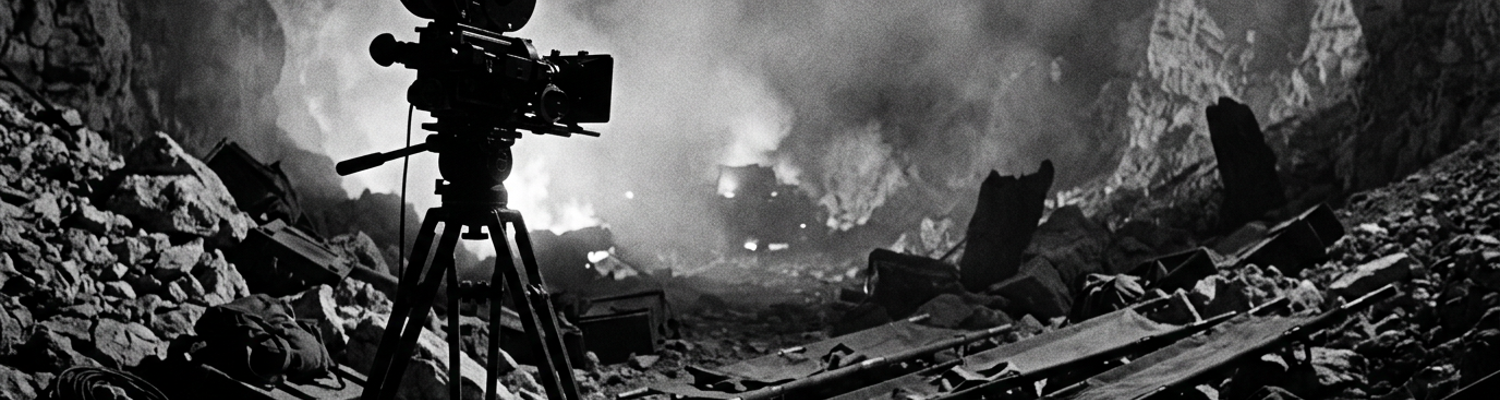
Combat cameramen assigned to the Marine Corps Photographic Section were operating along the forward crest of Fonte Ridge when the subterranean blast occurred. Equipped with standard Bell and Howell Eyemo Model 71 35mm motion picture cameras, these teams had moved behind the lead assault squads of the 9th Marines. They intended to record bunker clearance operations on film. Weighing twelve pounds unloaded, each spring-wound Eyemo featured a rotating three-lens turret, a heavy stamped-aluminum body, and external hundred-foot daylight film spools.
The equipment required two hands and precise mechanical care to operate amid coral grit. A single grain of volcanic sand could jam the internal film transport claw.
As the toxic particulate plume swept down the reverse slope, the photographers stripped off their equipment harnesses. They shoved their cameras into rocky crevices. Abandoning their primary assignment, the cameramen hauled standard folding canvas litters directly into the fumigating impact zone. They dragged prostrated riflemen out of contaminated foxholes.
Four-man litter teams negotiated eighty-degree rocky scree under direct mortar fire.
They carried choking casualties downward toward the lower aid stations. Navy corpsmen had run completely out of stretcher bearers.
Cameras lay abandoned in the mud.
Surviving field logbooks recorded by section personnel documented the sudden collapse of unit cohesion caused by the choking chemical haze. Grease-pencil notations scrawled in water-damaged pocket record books detailed the event. The yellow-tinted arsenic cloud wiped out squad integrity across Company F and Company G within twelve minutes of contact. Riflemen blinded by microscopic sternutator crystals broke out of their fighting pits in agony.
They stumbled through limestone defiles while tearing at their swollen throats.
NCOs attempted to shout orders through rubber facepieces. Paroxysmal coughing fits and vomiting rendered verbal commands completely unintelligible across the line. Runners dispatched to re-establish contact with the battalion command post collapsed in transit. Dense picric acid smoke trapped in the stagnant draws overcame them.
The logbooks noted that within thirty minutes of exposure, three front-line rifle platoons had ceased to function as cohesive combat formations.
Their personnel dispersed into small clusters of disoriented men clinging to the wet rock.
Organized company maneuvers ceased entirely.
Photographers utilized personal sidearms to reinforce threatened revetment perimeters while treating blistering and flash-blinded Marines. Japanese infiltration patrols advanced through the lingering smoke from coordinate 1482-Z. Cameramen drew their standard-issue Colt M1911A1 .45-caliber semi-automatic pistols and M1 carbines. They held the rim of an unroofed limestone aid revetment.
They fired sustained rounds at enemy skirmishers closing within thirty yards.
Between engagements, the photographic personnel assisted surviving medical orderlies inside the pit. Cameramen cut away chemical-drenched dungarees with pocketknives. They sponged caustic picric acid residue from blistering arms and chests using sulfur-tainted canteen water. Men whose corneas were scorched by arsenic dust received improvised eye washes.
Photographers held swollen eyelids open to flush alkaline dust.
They taped sterile gauze compresses across flash-blinded eyes. By four in the afternoon, two cameramen had expended their entire basic allowance of eighty-four rounds of .45-caliber ammunition. They fired every round to keep the aid post from being overrun.
Empty pistol brass littered the limestone shelf.
Perimeter Breaches and Ammunition Depletion
Localized Japanese reconnaissance elements exploited the chemical haze along the Fonte perimeter within two hours of the underground depot detonation. Squad-sized assault units from the 48th Independent Mixed Brigade crept up reverse-slope ravines near coordinate 1582-X. They used the lingering diphenylcyanoarsine aerosol as concealment against blinded Marine observation posts. Rifle platoons belonging to the 2nd Battalion, 9th Marines opened cyclic fire into the mist.
They used their remaining M1 Garand rifles and Browning Automatic Rifles.
Men discharged eight-round en-bloc clips at indistinct shadows barely twenty paces away. They fired without visual confirmation through swollen, weeping eyes. By 1730 hours, individual cartridge counts plummeted across the entire company line. Front-line squads expended their final emergency bandoliers of .30-06 ball M2 ammunition.
They repelled three consecutive probing attacks against their exposed left flank.
Empty steel clips pinged against the coral limestone. Silence followed as operating rods locked open on dry chambers across twenty separate weapon pits.
No resupply party reached the ridge before nightfall.
Isolated Marines stripped steel M1905 bayonets from canvas scabbards. They locked the sixteen-inch blades onto the mounting lugs of empty Garands. Hand-to-hand skirmishes erupted in the dark. Japanese infiltration teams jumped directly into the American fighting excavations. Lacking working firearm ammunition, riflemen from Company F crawled across exposed parapets.
They scavenged weapons from enemy dead lying outside the parapet lips.
Marines recovered bolt-action Type 99 and Type 38 Arisaka rifles. They pried leather ammunition pouches from Japanese webbing and pocketed loose clips of 7.7x58mm and 6.5x50mm ammunition. Weapon pits operated as isolated redoubts. American infantry chambered captured foreign rounds through unfamiliar Mauser-pattern bolt actions.
Men cleared jammed Arisaka extractors in total darkness.
They maintained perimeter security with fixed bayonets pressed against the trench rims. They held fractured individual foxholes against repeated bayonet charges.
Company runners crawled through jagged coral draws under direct machine-gun fire.
Tactical paralysis persisted for nearly forty-eight hours. Front-line units struggled to coordinate overlapping fields of fire across the jagged Fonte crest. Chemical blindness and continuous coughing fits prevented platoon leaders from establishing physical contact between adjacent fighting positions. Only thirty yards of karst terrain separated these pits. Field telephone wires had been sheared by mortar fragments.
Dense chemical smoke neutralized visual pyrotechnic signaling from company command posts.
Without observation, forward observers could not register defensive mortar barrages. Doing so risked friendly-fire strikes on Marine positions scattered across the reverse slope. Automatic weapon sectors collapsed into isolated forward arcs. This left twenty-yard dead spaces in the limestone depressions. Japanese infiltrators penetrated these gaps with hand grenades.
Platoon commanders could neither maneuver their depleted squads nor realign heavy machine guns to cover gaps.
The entire forward line froze in place through the morning of July 28.
By noon on July 28, battalion headquarters listed twelve distinct frontline fighting positions whose exact status could not be verified by radio.
Naval Star Shells and Tactical Stabilization
Offshore destroyers operating two miles off Asan Point received urgent fire-support calls from Marine shore fire control teams at 2115 hours. USS Ellet and USS Dewey rotated their twin-mount 5-inch/38-caliber guns toward the darkened limestone folds of Fonte Ridge. They fed mechanical powder hoists with Mark 27 illumination rounds. Gun crews set Mark 18 mechanical time fuzes to burst fifteen hundred feet above the terrain.
Each fired shell expelled an eighty-pound canister.
The canister contained a compressed barium nitrate and magnesium candle. It deployed a twenty-foot silk parachute that drifted slowly westward on thermal updrafts. Burning with over one million candlepower, the brilliant white chemical flares cast harsh, moving shadows across the fractured topography. They burned for sixty seconds before plunging into the scrub.
No shadow in the karst gullies survived the magnesium glare.
This sustained aerial illumination penetrated the deepest ravine dead-spaces. Japanese infantry had gathered there out of sight. Observers on the ridge rim spotted massing assault echelons of the Japanese 29th Division. They were packing into the dry stream beds and limestone draws southwest of coordinate 1582-X. Lieutenant General Takeshi Takashina had committed three infantry battalions from the 18th and 38th Regiments.
They prepared to strike the boundary between the 9th Marines and the 21st Marines.
Japanese soldiers stood shoulder-to-shoulder in the draws. They carried Type 99 rifles, demolition satchels, and pole-mounted magnetic mines. Company commanders intended to exploit the gaps torn across the American line by respiratory chemical casualties. They planned to drive through the reverse slope to seize the division command post at Asan.
The Japanese counterattack force found itself trapped in broad daylight under burning parachutes.
Tactical surprise evaporated within three minutes.
Forward observers from the 1st Joint Assault Signal Company capitalized immediately on the visual fix. They transmitted target coordinates directly to the offshore gunline over SCR-284 radio sets. Destroyers shifted from star shells to Mark 35 high-explosive projectiles. These shells were fitted with mechanical point-detonating and variable time radio fuzes. Within ninety seconds, five-inch shells tore into the rocky assembly pockets.
They detonated in jagged limestone crevices.
Concurrently, the organic 81mm mortar platoons belonging to the 2nd and 3rd Battalions opened rapid cyclic fire from reverse-slope emplacements. They expelled dozens of high-explosive M56 fragmentation shells per minute. The combined naval and battalion bombardment bracketed the crowded ravines with interlocking blast patterns. Cavern overhangs collapsed. Hundreds of tons of pulverized coral rained across the packed Japanese formations.
Blast pressure detonated Japanese demolition packs in sympathetic chain reactions.
The lead assault waves disintegrated before riflemen could fix bayonets or deploy across open terrain.
The main counterattack broke apart in the gully beds.
Surviving Japanese infantry elements attempted to reform in the lower draws. Pre-registered mortar barrages walked down each natural defile at thirty-yard increments. Marine machine-gun teams on the ridge perimeter swept the exposed chalk slopes with grazing fire. They caught disorganized squads as they attempted to withdraw toward the Fonte crossroads. By 0430 hours on July 29, the Japanese counterattack had collapsed completely.
Over nine hundred dead lay across the draw bottoms.
The battered defensive perimeter of the 3rd Marine Division stabilized without surrendering a single yard of the high ground.
Strategic Repercussions for Pacific Chemical Readiness
The Fonte Ridge catastrophe forced an emergency reassessment of chemical doctrine across the entire Pacific Fleet. Admiral Chester W. Nimitz and his joint staff at Pearl Harbor discovered a major flaw. Standard NBC protocols assumed open-air mustard gas or phosgene dispersion delivered via aerial bombs or naval shells. Fleet directives contained zero guidance for toxic aerosol discharges caused by demolitions inside enclosed coral caverns.
The lightweight M3-10A1-6 service gas masks lacked mechanical particulate pre-filters. Their internal canisters relied on activated charcoal and sodalime.
They were incapable of blocking sub-micron diphenylcyanoarsine crystals mixed with vaporized picric acid. Navy medical officers examining casualties from Company G identified systemic respiratory collapse. Thermal updrafts had pushed heavy arsenic particulates out of cracked cave apertures and down into friendly foxholes. Joint training doctrines had never instructed front-line infantry to identify the chemical contents of Japanese ammunition caches before placing demolition charges.
Task Force 53 action reports formally noted twenty-eight Marines incapacitated by this oversight.
Assault teams had treated underground munitions chambers as conventional structural bunkers rather than active hazardous materials depots.
Standard naval gas masks were useless against pulverizing underground shock waves.
Fleet Marine Force Pacific immediately rewrote tactical demolition field manuals ahead of planned landings in the Palaus. Headquarters issued operational directive 44-B. This order stripped assault units of the authority to detonate unmapped cavern mouths with arbitrary packages of Composition C-2 or nitrostarch. Engineers were required to conduct standoff chemical reconnaissance before setting demolition fuzes. Marine Corps pioneer battalions received newly standardized M9A1 chemical agent detector kits mounted on ten-foot collapsible wooden poles.
Specialists crawled within five yards of subterranean fissures.
They inserted rubber aspiration bulbs and chemical reagent test tubes into the opening. They tested for arsenic, chlorine, and cyanogen compounds before any satchel charge could be positioned. Breaching squads had to establish sixty yards of cleared reverse-slope standoff distance prior to triggering mechanical delay friction igniters. Platoon leaders were ordered to seal underground galleries using low-velocity soil tamping or tractor-mounted bulldozer blades whenever tests registered toxic signatures.
Sympathetic high-explosive detonations were explicitly barred.
They risked blowing chemical clouds into friendly assault corridors.
High explosives were no longer permitted against untested cave systems.
The logistics staff of the 5th Amphibious Corps restructured invasion supply manifests to solve the catastrophic water and decontamination failures seen on Hill 40. For the upcoming assault on Peleliu, planners reconfigured the cargo decks of Landing Vehicle Tracked models. They installed built-in five-hundred-gallon baffled freshwater tanks. This eliminated the fragile towed trailers that Japanese 47mm anti-tank fire had destroyed on the Asan corridor.
Transport quartermasters replaced wooden bleach casks with hermetically sealed steel drums.
These drums contained dry calcium hypochlorite treated with moisture-resistant silica gel packets. Each assault transport allocated fifteen tons of fresh wash water strictly reserved for casualties suffering toxic skin exposure. Fleet supply depots rushed modified M4 chemical decontamination apparatus fitted with neoprene gaskets and stainless-steel pressure valves to forward staging areas in the Russell Islands. This guaranteed that pressurized spray nozzles would not seize up from tropical humidity. Division manifests for subsequent operations in the Volcano Islands allocated forty gallons of decontaminating solution and twelve spare particulate filters directly to every front-line company supply echelon.