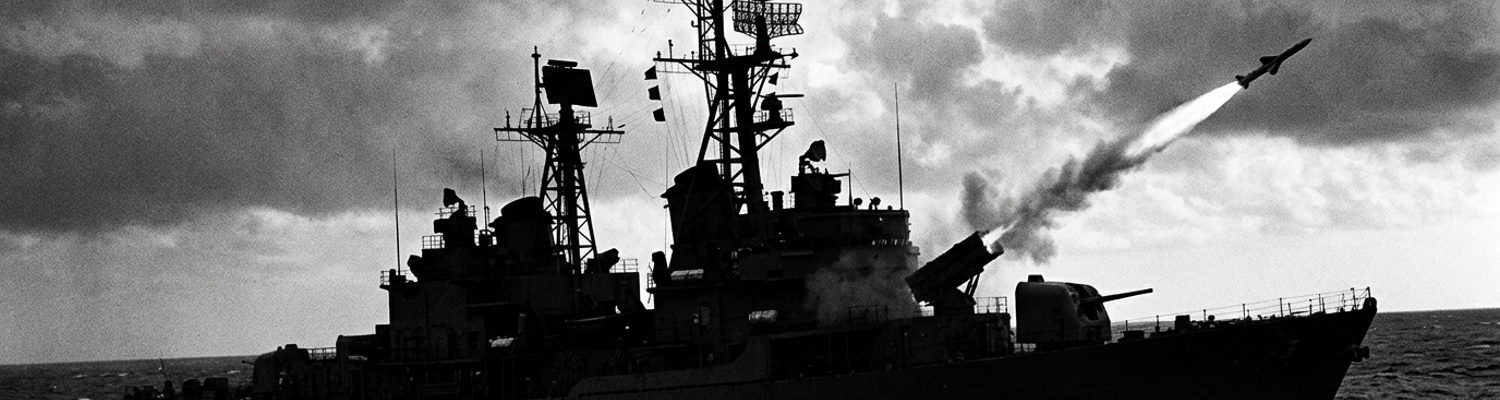

Pacific Fleet Terrier Missile Logistics
Archival evidence shows forward-deployed inventories of RIM-2D Terrier missiles faced severe supply bottlenecks across Pacific Fleet ammunition depots. At Naval Magazine Subic Bay in the Philippines and Naval Ordnance Facility Sasebo in Japan, weapon handling crews struggled with round-the-clock replenishment demands during the sudden escalation of Operation Freedom Train in early April. Depot personnel unpacked, inspected, and recertified the two-stage, solid-fuel missiles before transferring them to ammunition ships like USS Pyro and USS Flint.
Many RIM-2D rounds arriving from long-term storage at Naval Magazine Guam displayed cracked solid-propellant sustainer grains.
Corroded nitrogen purge valves and degraded internal desiccant bags required complete teardowns of the forward guidance sections. Gantry cranes at Subic Bay broke down under continuous eighty-hour work cycles. Stevedores hand-rigged forty-foot transfer lighters in rough harbor swells. Cruisers like USS Sterett operating on positive identification radar advisory zone stations off North Vietnam burned through missile stocks faster than regional staging bases could recertify depleted assemblies.
Weapons ships waited at anchor for days to receive single-digit missile allocations.
When examining the historical record of naval ordnance production audits from early 1972, documentation confirms significant delivery shortfalls stemming from domestic manufacturing labor and housing deficits. Defense contractors supplying the Convair division at Pomona, California, failed to maintain assembly lines for legacy Terrier components. This included the fragile continuous-rod warhead assemblies and klystron tubes required for beam-riding guidance radars.
Machinists and specialized electrical solderers abandoned aerospace centers in Los Angeles County due to an acute shortage of affordable family housing.
This created skilled labor deficits that exceeded twenty-five percent across key supplier plants. Subcontractors building the Terrier steering actuators faced eighty-day delivery delays when machining shops in Pomona operated at half-capacity. Hercules Incorporated operated under federal ordnance contracts for solid-propellant boosters. The company reported continuous production halts at its Cumberland facilities because plant managers could not retain certified explosive-handling technicians. The Pentagon diverted tooling and raw materials toward the newer RIM-66 Standard missile program. Pacific Fleet supply officers received zero replacement allocations for the older vacuum-tube RIM-2D stocks already aboard the forward-deployed cruisers patrolling the Vietnamese coast.
Coastal Gunline Deployments and Operation Freedom Train
A close review of operational logs indicates the opening phases of Operation Freedom Train shifted American naval assets into dangerous shallow waters north of the Demilitarized Zone. Surface combatants received orders to establish a continuous coastal gunline near Dong Hoi. Ships positioned themselves within visual range of the Quang Binh coastline.
The guided missile cruiser USS Oklahoma City and destroyers USS Buchanan and USS Higbee maneuvered between five and nine miles offshore.
They used their five-inch and six-inch mounts to bombard North Vietnamese army supply corridors. Target folders concentrated heavily on Highway 1 transit points, ferry crossings over the Nhat Le River, and reinforced logistics staging yards hidden along coastal sand dunes. Gun crews loaded eighty-pound high-explosive projectiles into hoist trunks every four seconds during peak bombardment cycles. They cycled through hundreds of rounds before water-jacket cooling systems could drop barrel temperatures. Recoil cylinders groaned under the cadence. Vaporized hydraulic oil coated the gun decks as warships stripped away roadbeds and rail sidings.
North Vietnamese shore gunners tracked the muzzle flashes through optical rangefinders.
Archival evidence shows that suppressing the coastal artillery batteries entrenched around Dong Hoi required destroyers to duel directly with camouflaged 130mm and 152mm Soviet-supplied field pieces. Hidden inside reinforced concrete revetments and natural limestone caves along the bluffs, People's Army of Vietnam artillerymen held their fire until American hulls turned at the outer limits of their firing legs. Coastal batteries opened up. Water spouts from near-misses peppered warship superstructures with shell fragments and abrasive sea spray. USS Buchanan took shrapnel damage to its radar masts during a daylight run on April 17. Bridge officers laid smoke screens while the ship maneuvered at twenty-eight knots in waters as shallow as fifteen fathoms.
Operating inside these restricted waters left surface vessels vulnerable to submerged sandbars and drifting contact mines.
Destroyer gunners directed counter-battery fire using fire control radars blinded by coastal land return. They walked fragmentation rounds into cave mouths and gun pits while engines reversed to break away from incoming salvos. Every gunline bombardment mission exposed the Seventh Fleet to sudden air attacks originating from concealed interior airstrips.
USS Sterett provided air defense and radar coverage for Task Force 77 units operating in the Gulf of Tonkin.
Steaming along the northern Positive Identification Radar Advisory Zone station, the Belknap-class guided missile frigate kept watch over offshore carrier strike groups and shallow-water bombardment ships. Sterett monitored airspace through the AN/SPS-48 three-dimensional air search radar. The system radiated high-power S-band beams across the coastal plain toward North Vietnamese airbases at Vinh, Kep, and Phuc Yen. Radar operators sat beneath red instrument illumination. They stared at sweeping plan-position indicator scopes to distinguish low-flying enemy aircraft from terrain clutter along the Annamite Range.
Sterett acted as the tactical data clearinghouse for the entire northern gulf.
The ship distributed real-time track updates through high-frequency Naval Tactical Data System Link 11 broadcasts. Carrier air wings launching strike groups from Yankee Station depended on Sterett to vector combat air patrols against MiG interceptors. Technicians aboard Sterett fought chronic overheating in the water-cooled klystrons powering the AN/SPG-55B fire control radars. These radars maintained electronic lock on potential targets while operating in ninety-degree tropical water temperatures. Seawater cooling heat exchangers fouled with marine growth every two weeks. Boiler technicians flushed lines with chemical solvents during active combat watches.
VPAF Strike Profiles Against USS Higbee
Archival evidence shows that North Vietnamese commanders had spent weeks preparing a specialized maritime strike detachment drawn from the 923rd Fighter Regiment. Operating out of primitive forward staging airstrips including the concealed dirt strip at Gat in Quang Binh Province, ground personnel rigged Soviet-built Mikoyan-Gurevich MiG-17F fighters with locally manufactured external pylons to carry ordnance over open water.
Vietnam People's Air Force MiG-17 aircraft executed surprise low-altitude bombing runs on April 19, 1972.
Pilots Le Xuan Di and Nguyen Van Bay departed the interior staging area under complete radio silence. They stayed beneath the radar line-of-sight of offshore surveillance ships. Flight profiles kept the aircraft at altitudes below fifty meters. The jets followed dry riverbeds and deep ravines carved into the eastern slopes of the Annamite Range. Sand dunes along the coastline masked their final approach. This denied American air-search radars the Doppler separation required to pick out moving airframes from heavy terrestrial ground clutter.
Shipboard radar operators on the gunline received no electronic warning before the first pass.
A close review of operational logs indicates that the strike package crossed the coastline near the Nhat Le River mouth at approximately 1605 local time. Clearing the beachhead at four hundred knots, the two subsonic jets leveled off thirty meters above the surface of the Gulf of Tonkin. They turned east-northeast directly toward the gunline combatants. American lookouts aboard the cruiser USS Oklahoma City and the guided missile frigate USS Sterett spotted the aircraft visually only seconds before anti-aircraft batteries could swing onto their firing bearings. Gunners fired unguided five-inch and three-inch shells into the sea ahead of the incoming jets. The low attack geometry rendered proximity fuses ineffective against targets skimming just above the waves.
One MiG banked west toward the cruiser while the second broke north.
The strike group split over the water to isolate the outer destroyer. USS Higbee was maneuvering at fifteen knots roughly four miles offshore after completing an underway replenishment and bombardment cycle. Piloting the trailing MiG-17, Le Xuan Di aligned with the destroyer's stern axis and entered a steep dive from five hundred feet. A 250-pound bomb directly struck and completely destroyed the aft 5-inch/54-caliber gun mount of the destroyer.
Structural fragments and unspent kinetic energy punched through the aluminum carriage mechanisms.
The debris entered the upper ammunition handling space beneath the mount. Minutes prior, the mount crew had evacuated the enclosed housing to troubleshoot an obstinate case hangfire. This prevented fatal personnel losses inside the turret structure. Detonation shock severed primary electrical conduits and ruptured pressurized hydraulic lines. It ignited eighty-pound powder casings stored in the ready-service hoists. Heavy concussive pressure blew outward through the deck seams. The blast warped the surrounding bulkheads and unseated the gun barrel from its trunnions.
Damage control teams flooded the aft magazines with seawater within six minutes.
This action prevented secondary mass detonations in the primary shell rooms below the waterline. Shrapnel wounds incapacitated four sailors. Thick acrid smoke from burning hydraulic fluid filled the aft steering compartment and engineering flats. Emergency helm control transferred forward. Both MiG-17s pulled up into low overcast clouds, reversed heading back over the Quang Binh dunes, and cleared the combat zone before carrier-launched combat air patrols could close the intercept vector.
Combat Information Center Psychological Breakdown
Archival evidence shows the shockwave from the detonation on USS Higbee traveled across four miles of open water. It rattled the hull plating of neighboring surface combatants and set off immediate tactical chaos. Inside the darkened Combat Information Centers of USS Sterett and the light cruiser USS Oklahoma City, watchstanders heard the sudden shriek of emergency traffic break across the fleet tactical radio network.
Destroyer lookouts reported their aft mount completely destroyed.
Fire approached below-deck ordnance spaces. Red general-quarters battle lamps illuminated consoles where young enlisted tracking operators experienced acute combat stress. These sailors were already exhausted by continuous sixteen-hour gunline support rotations. They panicked under the belief that Soviet-supplied Styx anti-ship missiles had breached the fleet screen. Watch officers fought to maintain operational control. Sailors hyperventilated into their sound-powered phone headsets. They shouted conflicting bearings for incoming low-altitude surface skimmers that did not exist. Tactical Action Officers repeatedly overrode weapons release keys to prevent panicked gunners from launching five-inch fragmentation barrages directly into the smoke banks surrounding friendly ships.
Compartment temperatures rose above ninety-five degrees as ventilation dampers slammed shut for chemical and biological containment.
Sweat shorted out headset jack boxes. Air intercept controllers screamed across unamplified voice circuits. Verified track data degraded completely. A close review of operational logs indicates that this psychological disintegration coincided with a catastrophic loss of electronic situational awareness caused by extreme environmental radar distortion. Operating within ten nautical miles of the Quang Binh shoreline placed Sterett directly opposite the steep terrain gradients of the Annamite Range.
Intense land return flooded the receiver horns of the AN/SPS-48 three-dimensional air search radar.
S-band microwave energy bounced off high coastal sand dunes and heavy ocean surf swells. The energy plastered the plan-position indicator scopes with persistent false targets known as sea return. The MiG-17 fighters flew thirty meters above the water line at four hundred knots. Their radar cross-sections remained buried inside the baseline surface wave reflections. The shipboard CP-642B computers running the Naval Tactical Data System could not establish velocity gates or calculate target Doppler shifts against the stationary terrestrial echoes.
Automatic threat identification subroutines repeatedly dumped active tracks.
The computers reset target priorities every three sweeps. Console operators attempted manual joystick correlation in the middle of active air engagement warnings. The computers rejected the contacts as noise. Sterett missile fire control crews faced severe technical blindness as they tried to acquire the retreating and maneuvering North Vietnamese aircraft. Fire control technicians assigned to the twin AN/SPG-55B tracking radars swung their directors toward the coastal bearing. The narrow C-band continuous-wave tracking beams captured tidal rip chop and bluff faces instead of metal airframes.
Target acquisition gates wobbled wildly along the range axis.
The gates slipped out of lock each time an operator attempted to clamp down on suspected aircraft returns. Inside the missile plotting spaces, weapons officers stared at flashing track-drop indicators and unverified speed assessments. They listened to unconfirmed radio reports of secondary explosions aboard Higbee. The absence of clean digital radar vectors stripped away standardized doctrine. Air defense controllers stared at unverified raw video blips that faded and reappeared against the shimmering green phosphors of the radar displays. Watchstanders tasked with calculating the engagement envelopes for the RIM-2D Terrier missile batteries were forced to guess. They could not determine whether low-altitude radar signatures were retreating MiG fighters, incoming anti-ship cruise missiles, or sea spray breaking against shallow coastal shoals. Missile battery arming switches remained live while firing keys clicked against empty launch solutions.
Safety Interlock Overrides on the AN SPG-55B
Archival evidence shows that fire-control technicians inside Sterett radar equipment spaces physically bypassed primary mechanical and doctrinal safety interlocks governing the AN/SPG-55B director antennas. Standard operating procedure under Naval Ordnance Systems Command strictly barred radiating high-frequency continuous-wave power when director elevation angles dipped toward the horizon. Mechanical cam switches inside the pedestal base of Director 1 and Director 2 physically broke the firing and illumination circuits whenever the dish depressed below two degrees of elevation.
These physical limit switches prevented high-gain microwave energy from reflecting off ocean swells and burning out the antenna receiver horns.
Technicians engaged the weapons control battle-short switches on the Mk 76 fire-control switchboards. They shunted electrical current around the thermal overloads and pedestal limit cutouts. Watchstanders inserted maintenance override pins into the elevation cutout cams behind the transmitter cabinets. They mechanically forced the circuit contacts closed. Doing so held the transmitter relays shut against automated safety shutdowns. This fed high-voltage plate power directly into the Raytheon water-cooled klystron tubes despite direct feedback warnings from the pedestal synchro receivers.
Technicians disabled every built-in safeguard on the missile director.
When examining the historical record of weapons telemetry logs, the fire-control team forced full illumination transmission against an ambiguous low-altitude target signature. The target operated far below established doctrinal engagement floors. United States Seventh Fleet air defense doctrine established a rigid minimum engagement floor of one hundred and fifty feet for the RIM-2D Terrier. Continuous-wave Doppler returns inevitably broke lock beneath this altitude due to surface multipath interference. The radar contact appeared on the AN/SPG-55B C-band receiver as a ragged fluctuating return.
The target skimmed less than fifty feet above the water at four hundred and fifty knots.
It tracked nine nautical miles northwest of Sterett at coordinates 17 12 N, 106 45 E. Operating below the elevation coverage lobe of the AN/SPS-48 air search radar, the contact provided no valid Identification Friend or Foe response. The Tactical Action Officer had no electronic confirmation of whether the target was a fleeing MiG-17, an inbound Soviet-built P-15 Styx cruise missile, or sea chop kicked up by coastal squalls. Missile system guidance doctrine mandated immediate track cancellation when clutter levels saturated eighty percent of the receiver Doppler filter banks.
Personnel on the Mk 76 console ignored continuous Doppler lock-failure warnings.
They turned the manual acquisition potentiometers to lock the range gate. They pressed the continuous-wave illumination enable switches to saturate the surface contact with uninterrupted radio-frequency energy. Radio-frequency energy poured into the saltwater surface ten miles off Dong Hoi. A close review of operational logs indicates that forcing transmitter output at low elevation created severe electronic instability within the AN/SPG-55B tracking loops. Microwave radiation bounced between the choppy ocean swells and the lower edges of the fiberglass antenna radome.
This flooded the monopulse feed horn with phase-delayed multipath echoes.
Angle-error voltages inside the Mk 119 fire-control analog computer swung wildly between positive and negative limits. The twenty-ton director pedestal shuddered on its roller bearings as servo-amplifiers fought to stabilize the azimuth drive. Technicians switched the track-loop damping circuits from automated to manual damping. They dampened the physical oscillations by artificially clamping the vertical servo-loop gain. Down in the forward missile magazine, the ready-service ring spun under hydraulic power. It brought two forty-foot RIM-2D Terrier rounds onto the rail hoists. The computer warned that the beam-riding radar channel was tracking a split centroid between the physical target and its ocean reflection. Launch keys rotated in the Weapons Direction System console while the illuminator beam burned into the coastal sea spray at negative zero point three degrees of elevation.
RIM-2D Terrier Anti-Ship Missile Intercept
Two launch keys turned simultaneously inside the combat information center.
Archival evidence shows that at 1612 local time, Tactical Action Officer Lieutenant Commander Glenn E. Whisler authorized a speculative two-missile salvo of RIM-2D Terriers against the ambiguous inbound sea-skimming contact. Standing orders strictly prohibited the expenditure of live surface-to-air ordnance without a confirmed electronic friend-or-foe identification or a clean optical bearing from the bridge lookouts. Whisler bypassed fleet doctrine because the radar track maintained an intercept vector closing directly on Sterett at 450 knots. The target held an altitude under eighty feet across the water.
On the forward forecastle, the hydraulic training carriage of the twin-arm Mk 10 Mod 7 guided missile launcher rotated forty-two degrees to starboard.
The launcher elevated to seven degrees. The first two-stage RIM-2D round cleared the mechanical blast guide rails under five thousand pounds of thrust from its Allegheny Ballistics Laboratory solid-propellant booster. Thick ammonium perchlorate exhaust filled the forward weather decks. Three seconds later, the second missile fired from the port rail arm into the expanding smoke plume. Both booster casings separated four miles downrange. The internal solid-fuel sustainer motors ignited and accelerated the weapon assemblies through Mach 2.5 directly into the narrow radar cone generated by Director 1.
Both Terrier missiles rode the C-band beam within fifty feet of the wave tops.
A close review of operational logs indicates that this engagement marked the first recorded combat intercept of an incoming anti-ship cruise missile by a naval surface-to-air missile system. Post-action intelligence evaluations compiled by Task Force 77 identified the destroyed contact as an inbound Soviet-designed P-15 Termit anti-ship missile. NATO reporting nomenclature designated this weapon as the SS-N-2 Styx. The missile launched either from an offshore North Vietnamese Komar-class missile boat or a concealed truck trailer along the Dong Hoi sandspit. As the leading RIM-2D missile closed the final four thousand yards of the intercept corridor, surface reflection multipath severely degraded the AN/SPG-55B tracking gate.
This threatened to throw the guidance signal into the sea.
Inside the nose cone of the missile, the semi-active radio-frequency proximity fuze picked up continuous-wave energy reflecting off the metal airframe of the incoming cruise missile. The fuze triggered the sixty-five-pound continuous-rod high-explosive warhead at a slant range of five nautical miles from Sterett. A lethal ring of welded steel wire expanded at six thousand feet per second through the target liquid-fuel tanks and internal guidance gyroscopes. Secondary kinetic energy from the trailing second Terrier detonated four seconds later. The blast shredded the remaining structural fragments across a three-hundred-yard debris field off the mouth of the Nhat Le River.
Radar screens inside the Combat Information Center recorded an immediate drop in target Doppler return.
When examining the historical record of Seventh Fleet technical audits, weapons analysts reconstructed the engagement using magnetic telemetry tapes recovered from the Mk 119 fire-control computer. The data verified that the continuous-wave receiver had tracked the incoming sea-skimming threat down to forty-eight feet above the ocean surface. This altitude fell far below the tested limits specified in Navy weapon design manuals. Ordnance engineers at the Naval Surface Weapons Center at Dahlgren reviewed the trajectory solutions. They calculated that the terminal closure rate between the two Mach 2 projectiles exceeded four thousand feet per second. The successful destruction of the target provided fleet tacticians with empirical proof that shipboard beam-riding missile systems could defeat high-speed anti-ship weapons when weapon crews deliberately bypassed automated electronic safeties. Maintenance logs recorded that the prolonged low-elevation radiation cycle scorched the microwave absorption lining inside Director 1. Sea spray blown into the launch cell shorted the elevation control amplifier relays on the Mk 10 launcher rail.
After-Action Assessments and Tactical Justification
Seventh Fleet analysts initiated a formal investigation immediately.
When examining the historical record of Task Force 77 intelligence summaries, analysts confirmed that the low-altitude contact destroyed by the Terrier salvo was a Soviet-designed P-15 Termit anti-ship cruise missile. Communications intelligence intercepted by naval security detachments and recorded emission profiles from Sterett AN/WLR-1 electronic countermeasures suite matched the continuous-wave radar seeker of the weapon. Trajectory plots reconstructed from NTDS magnetic recordings showed the missile had originated from a concealed launch rail mounted on an offshore Project 183R Komar-class fast attack craft.
The vessel operated near the mouth of the Gianh River, sixteen nautical miles north of Dong Hoi.
Tracking southeast at four hundred and fifty knots, the target maintained a barometric cruise altitude of fifty-five meters. Its active radar seeker swept the water for the radar return of the cruiser USS Oklahoma City. Detonation telemetry confirmed that fragments of the Soviet weapon 513-kilogram shaped-charge warhead and liquid-propellant engine casing fell into the Tonkin Gulf at coordinates 17 14 N, 106 49 E. The debris landed two nautical miles short of the formation. Naval commanders confronted a technical breach of protocol.
Archival evidence shows that subsequent Seventh Fleet debriefs convened aboard the flagship focused heavily on the unauthorized physical modifications made to Sterett weapon direction system.
Weapons inspectors from Naval Ordnance Systems Command noted that inserting manual override pins into the elevation cutout cams of the AN/SPG-55B directors directly violated fleet operating directives. Radiating continuous-wave illumination below two degrees of elevation risked instantaneous feedback damage to the water-cooled klystron tubes inside the transmitter cabinets. This equipment failure would have permanently disabled the ship primary anti-air fire control capability. Investigators identified an equal risk of fratricide. USS Higbee and USS Lloyd Thomas maneuvered erratically through smoke banks five miles offshore.
Forcing a Terrier beam into severe surface multipath created high odds that the missile semi-active seeker would track friendly superstructure reflections instead of the low-flying threat.
A single guidance beam divergence could have driven sixty-five pounds of continuous-rod explosive into the bridge of an escorting destroyer. A close review of operational logs indicates that staff officers evaluated these technical hazards against the near-certain destruction of Task Unit 77.1.2. USS Higbee was already burning. The crew steered manually through emergency aft gear with four wounded crewmen and ruptured fire mains across its fantail. An unintercepted hit from a Styx cruise missile against the unarmored aluminum superstructure of Higbee or the command spaces of Oklahoma City would have caused catastrophic hull fractures.
Mass casualties among the six hundred sailors manning the coastal gunline were guaranteed.
Captain Herbert E. Reichart and Tactical Action Officer Glenn E. Whisler presented computer logs proving that the target was less than ninety seconds from terminal impact when the Terrier battery launched. Had watchstanders waited for visual confirmation or followed standard clutter-rejection guidelines, the missile would have penetrated the gunline perimeter before the tracking radar could reacquire Doppler lock through the land return. The empirical telemetry superseded theoretical firing doctrine. Seventh Fleet operational evaluations formally classified the engagement as a justified tactical decision that preserved the integrity of the coastal bombardment task group.
Fleet air defense manuals were updated at the Naval Surface Weapons Center at Dahlgren.
Engineers documented low-elevation continuous-wave tracking tolerances over saltwater. They integrated the manual battle-short override into revised anti-ship missile defense protocols. Technical audits confirmed that Director 1 suffered scorched feed horn waveguide surfaces and insulation blistering from high-voltage arcing. The internal klystron cavities survived without vacuum seals failing. USS Sterett held its combat station off Dong Hoi for forty-eight additional hours. The ship expended two hundred rounds of five-inch ammunition against North Vietnamese artillery redoubts before retiring to Subic Bay with two empty Terrier rail carriages and zero casualties.
Algorithmic Firing Gates and Doctrinal Shifts
Seconds separated an offshore warship from total hull rupture.
When examining the historical record of Naval Ordnance Systems Command engineering surveys, the Dong Hoi engagement laid bare fundamental flaws in the United States Navy surface-to-air missile architecture. Standard fleet defense assumed high-altitude bomber formations crossing blue water. This left shipboard systems blind to sea-skimming threats operating within ground clutter. Surface combatants in the Tonkin Gulf relied on rotating mechanically steered antennas, specifically the AN/SPS-48 and the AN/SPG-55B. These required up to twenty seconds just to complete a full rotational horizon sweep and achieve elevation lock.
At speeds exceeding four hundred knots, an incoming P-15 cruise missile cleared the twelve-mile radar horizon in less than ninety seconds.
Watchstanders in the Combat Information Center needed forty-five seconds to manually correlate raw radar video across the CP-642B computers. They had to verify Identification Friend or Foe transponder modes and depress director slewing controls. Mechanical interlocks physically prevented radar continuous-wave illumination below two degrees to protect klystron tubes from ocean surface reflections. This rendered the entire Terrier battery doctrinally inoperative against wave-skimming profiles. Had Sterett weapons crew adhered strictly to published ordnance doctrine instead of jumping the battle-short switches behind the Mk 76 console, the incoming contact would have struck the gunline without a single defensive round leaving the launch rail.
Human manual intervention was far too slow to stop Mach 2 weapons.
Archival evidence shows that weapon telemetry tapes recovered from Sterett Mk 119 analog computers were flown directly to the Naval Surface Weapons Center at Dahlgren, Virginia, for forensic threat modeling. Surface Warfare Development Group engineers extracted magnetic reel data detailing the erratic Doppler shifts, saltwater multipath distortion, and manual switchboard bypasses recorded during the intercept off coordinates 17 12 N, 106 45 E. Rear Admiral Wayne E. Meyer directed the developmental Aegis project office under Naval Sea Systems Command. He integrated these telemetry readouts into the foundational architecture of what became the Aegis Combat System.
Meyer engineering teams at RCA missile and surface radar division in Moorestown, New Jersey, utilized Sterett low-elevation track files.
They modeled the automated threat prioritization algorithms within the AN/SPY-1 radar program. Defense engineers recognized that human decision loops inside the Combat Information Center could not reliably process sea-skimming threats emerging from terrain-masked coastal geography. RCA mathematicians wrote automated digital filter subroutines designed to distinguish high-speed targets from breaking surf without operator input. This stripped human operators of the authority to accept or reject low-altitude tracking handoffs. Analog mechanical limit switches gave way to algorithmic firing gates.
A close review of operational logs indicates that the manual battle-short override executed on Sterett was converted directly into hardcoded computer logic inside the AN/UYK-7 central processors running the Aegis Weapon System Mk 7.
Dahlgren programmers replaced physical cam-switch cutouts with automated threat-indexing matrices. These continuously calculated weapon release parameters based on target radial velocity, closure rate, and altitude. When incoming trajectories registered target Doppler characteristics exceeding three hundred knots beneath an altitude of two hundred feet, the software bypass routines automatically commanded transmitter phase adjustments to suppress ocean bounce multipath. Command authority subroutines designated Auto-Special mode eliminated manual key turns.
Defensive launch authorization transferred straight to digital firing circuits whenever target closure times dropped under thirty seconds.
Initial sea trials aboard the test ship USS Norton Sound in 1974 confirmed that these automated algorithms successfully executed simulated intercepts against low-altitude drone targets in under twelve seconds from initial radar detection. Production contracts for the Ticonderoga-class guided missile cruisers subsequently mandated these specific software engagement scripts as standard combat system doctrine. The era of manual interlock overrides on the surface fleet firing line ended.