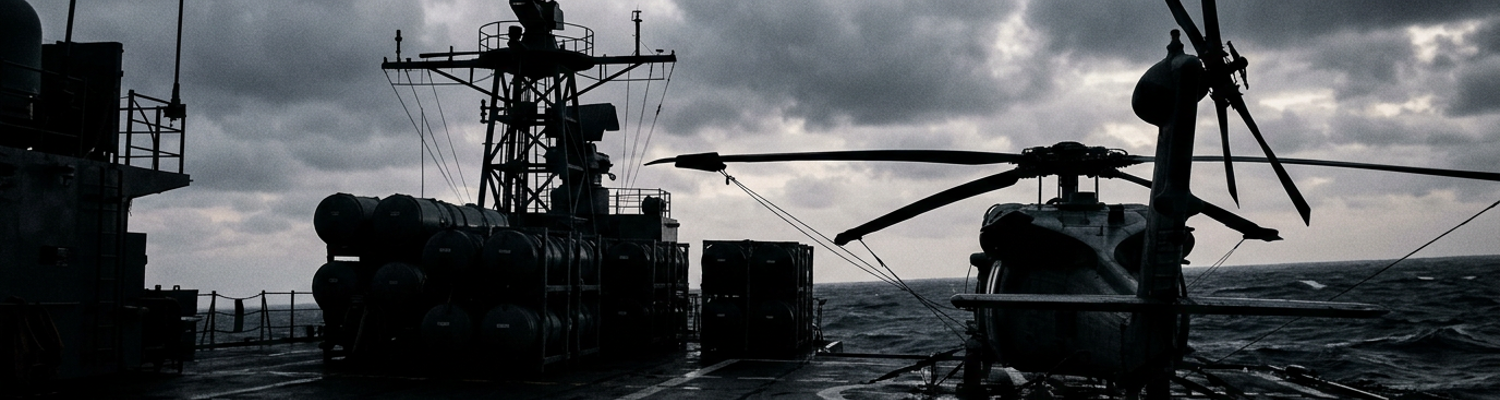

Gulf of Oman Deployment of Carrier Group Three
Between 1990 and 2000, peacetime naval aviation mishaps claimed over four hundred and fifty carrier-based aircraft. These accidents killed more than three hundred naval aviators. This attritional backdrop of mechanical failure and procedural error existed before Carrier Group Three ever reached the theater. A close review of operational logs indicates that this baseline of attrition framed the entry of the battle group into the northern Arabian Sea and Gulf of Oman on February 15, 2000. Under the command of Rear Admiral David M. Stone, the nuclear-powered aircraft carrier USS John C. Stennis (CVN-74) led its strike elements past the 24th parallel north. The 103,000-ton hull stationed directly astride the seaward approaches to the Strait of Hormuz. Escorted by the guided-missile cruisers USS Lake Champlain and USS Port Royal along with destroyers USS Decatur and USS Elliot, the carrier encountered an unforgiving littoral environment. Surface water temperatures reached seventy-eight degrees Fahrenheit. These temperatures produced sharp thermal gradients. The gradients bent acoustic detection waves downward into the seabed.
In these narrow waters, depth dropped precipitously from oceanic trenches to less than one hundred fathoms within sixty nautical miles.
Severe thermal refraction deflected active acoustic pulses from the hull-mounted AN/SQS-53C sonars of the surface escorts. This blinded the group to submerged targets running on electric power beneath the thermocline.
Sleep deprivation degraded officer reaction times aboard the flagship within forty-eight hours of arrival.
When examining the historical record of Carrier Air Wing Nine (CVW-9), the tactical burden shifted directly to embarked aviation squadrons. Iranian naval forces deployed three Russian-built Project 877EKM Kilo-class attack submarines out of Bandar Abbas. The Tareq, Noor, and Yunes ran submerged on silent electric drive motors. These vessels carried Type 53-65 wake-homing torpedoes capable of disabling carrier propulsion with a single hull strike. Stone directed CVW-9 to establish around-the-clock acoustic barriers across key choke points. Sea Control Squadron 33 (VS-33) launched S-3B Vikings to deploy patterns of AN/SSQ-53D directional frequency analysis and recording sonobuoys alongside AN/SSQ-62B directional command-activated canisters. Low-altitude search patterns fell to the SH-60F Ocean Hawk helicopters of Helicopter Antisubmarine Squadron 8 (HS-8). Their crews repeatedly lowered AN/AQS-13F dipping sonars into the sound layer. Equipment broke down under relentless operational tempo. High ambient heat caused the environmental cooling turbines on the S-3B avionics racks to seize during descents. Hydraulic pressure seals on the helicopter sonar winch drums ruptured repeatedly. This disabled three airframes during the opening week of operations.
A single unverified acoustic transient routinely triggered twelve continuous hours of emergency flight operations without rest.
Archival evidence shows that acoustic analysis teams inside the combat direction center of the Stennis experienced severe mental erosion across consecutive sixteen-hour shifts. Staring into monochrome cathode-ray tubes, enlisted sensor operators strained to identify low-frequency diesel harmonics. They listened through the noise of shallow-water biological activity, commercial supertanker cavitations, and coastal reverberations. Watchstanders wore communication headsets for up to twenty hours at a stretch. This resulted in high rates of auditory fatigue and degraded pattern recognition. Stone rotated his flight officers through intensive debriefs to sharpen tactical analysis. The physical toll mounted across the deck. Aviators endured spatial disorientation during overcast nighttime recoveries onto a pitching flight deck without visual horizon markers. In the hangar bays below, aviation machinists worked in temperatures exceeding one hundred and ten degrees Fahrenheit. They rebuilt hydraulic pumps and cleaned sand-clogged gas turbine blades. Flight surgeon records documented acute sleep loss, short-term memory impairment, and tremors among flight deck handling crews and acoustic watchstanders before the end of the first month.
By the morning of March 1, 2000, Carrier Group Three had consumed seventy tons of disposable sonobuoys.
Four shifts of exhausted analysts cycled through without confirming a single verified contact.
Project 877 Kilo Threats in Choke Point Waters
Archival evidence shows that the bathymetry approaching the Strait of Hormuz compressed Carrier Group Three into an acoustically chaotic combat zone. Near the Tunb Islands and the Musandam Peninsula, water depths abruptly shallow to under fifty meters. This produced severe multi-path reverberation across coarse sand, coral outcroppings, and fractured limestone ridges. Low-frequency sound waves from active sonar arrays did not disperse into deep ocean voids. They bounced repeatedly between the shallow seafloor and the choppy surface water. This generated acoustic clutter that saturated shipboard processors. Dense merchant traffic worsened this sensory blindness. More than twenty laden crude oil supertankers traversed the narrow outbound and inbound Traffic Separation Schemes daily. Their massive four-bladed propellers churned out continuous broadband cavitation between five and fifty hertz. The AN/SQR-19 Tactical Towed Array Sonar reels deployed by USS Elliot and USS Decatur picked up hundreds of overlapping mechanical signatures simultaneously. Machinery noise from bulk carriers registered over one hundred and seventy decibels across the lower frequency bands. This washed out the delicate acoustic signatures of potential threats.
Every merchant hull was an acoustic shield.
A close review of operational logs indicates that combat direction teams struggled to isolate faint hydrodynamic signatures beneath this overwhelming ambient clutter. Sonar technicians inside USS Port Royal tracked up to eighty surface contacts on single shifts. They manually cross-referenced commercial shipping schedules with radar sweeps to filter out false alarms. The acoustic energy of a commercial tanker displacement hull traveling at fourteen knots masked everything within an eight-nautical-mile radius. In the Combat Information Center, enlisted acoustic analysts repeatedly adjusted narrowband filters on their AN/UYQ-21 displays. They fought visual strain and migraine headaches under blue battle lanterns. Salt crust built up on the towed-array deployment fairleads on the destroyers. Deck crews chipped away corrosive brine by hand in eighty-five-degree heat to prevent tow cables from binding.
When an unclassified contact registered south of Qeshm Island, surface escorts had to maneuver directly into merchant lanes.
They risked physical collisions with unalerted Panamanian and Liberian flagged freighters to reposition their passive hydrophone arrays.
When examining the historical record of regional threats, the Islamic Republic of Iran Navy exploited these hydrographic quirks using its Russian-built Project 877EKM submarines. The Tareq, Noor, and Yunes relied on an anechoic rubber tile coating across their hulls. This absorbed high-frequency active pings while their seven-bladed, low-rpm skewed propellers minimized cavitation. Driven by a single 5,500-horsepower PG-141 electric propulsion motor running off heavy lead-acid battery banks, a submerged Project 877 hull emitted virtually zero mechanical noise at five knots. In the Gulf of Oman, solar radiation superheated the upper thirty meters of water. This created an intense, shallow thermocline where water temperatures dropped by more than fifteen degrees within a span of ten vertical feet. This sharp density boundary refracted acoustic energy away from submerged depths. Sound beams generated by surface warship sonars curved upward or reflected back toward the surface. This left an acoustic shadow zone directly beneath the negative gradient.
An Iranian Kilo resting in that thermal shadow was invisible to surface searchers.
Stone ordered SH-60F crews from HS-8 to punch active transducers directly through the layer. Operating forty nautical miles east of Ras al-Khaimah near 25 degrees 50 minutes north latitude, helicopter pilots hovered sixty feet above the swell. They lowered their AN/AQS-13F dipping sonar hydrophones to depths of two hundred feet. Subsurface salinity currents constantly dragged the weighted transducer cables out of plumb. This tripped automatic cable-tension breakers and threatened to shear the hoisting cables. Down in the sound layer, the Iranian crews had cut their diesel generators entirely. They drifted silently with the prevailing northwesterly bottom currents while trimming ballast tanks with compressed air.
On March 4, an SH-60F crew detected a momentary metallic transient at a depth of one hundred and forty meters.
This sound was consistent with the actuation of a torpedo tube flooding valve. Before the tactical coordinator could classify the contact or drop a localization pattern of passive buoys, the acoustic signature slipped into the acoustic shadow zone created by the wake of a passing container vessel.
Aerial Sonobuoy Screens and Barrier Tactics
A close review of operational logs indicates that Sea Control Squadron 33 executed continuous acoustic barrier deployments using S-3B Viking airframes across the southern approaches to the Strait of Hormuz. Departing the flight deck of the Stennis, crews flew outward to coordinates twenty-four degrees forty-five minutes north, fifty-seven degrees fifteen minutes east. This position sat directly astride the deep-water ingress routes leading toward the Gulf of Oman basin. Tactical coordinators dropped fields of AN/SSQ-62B directional command-activated sonobuoy system canisters from the sixty external fuselage launch tubes. These active DICASS units drifted acoustically silent upon water entry. They awaited a radio-frequency interrogation command from the aircraft before transmitting ninety-second active sonar pulses at specific depth gates between ninety and four hundred feet. Mechanical failures escalated under sustained salt-air exposure and eighty-degree sea-surface temperatures. Pneumatic launch solenoids jammed on three separate airframes during high-pressure discharge sequences. This trapped live buoys inside pressurized chutes.
Inside the fuselage, environmental control units failed to dissipate heat generated by the AN/UYS-1 Proteus acoustic processors.
Processing cards overheated and shut down mid-cycle.
Flight crews inhaled toxic hydraulic mist whenever bleed-air valves stuck open during low-altitude passes.
Archival evidence shows that tactical coordinators inside VS-33 struggled with physical and sensory exhaustion after three consecutive days of four-hour barrier sweeps. Sitting in rear, windowless crew stations beneath dim red instrument lights, these naval flight officers endured constant buffeting from thermal updrafts off the Iranian coastline. Eye strain produced severe headaches as watchstanders tracked shifting Doppler displays across six different radio channels simultaneously. Stone insisted that flight tempos hold steady at twenty sorties every twenty-four hours. This prevented diesel-electric submarines from slipping through acoustic gaps during crew shift changes. The human cost emerged in maintenance logs. Aviation electronics technicians worked through twenty-hour deck cycles in the humid ninety-five-degree heat of the lower hangar deck. They miswired thermal squib connections on four successive buoy loads. This forced incoming aircrews to abort active sonobuoy interrogation runs over primary patrol avenues.
Exhaustion turned routine cockpit checklists into dangerous gambles.
When examining the historical record, Helicopter Antisubmarine Squadron 8 supplemented these fixed-wing screens by laying passive barriers across the narrowest patrol sectors between Oman and Iran. Operating out of fifteen nautical miles east of Dibba, SH-60F Oceanhawks dropped vertical line array directional sonobuoys along three staggered picket lines. These AN/SSQ-77B VLAD buoys deployed a tiered, ninety-foot acoustic sensor array down to five hundred feet below the sea surface. This bypassed surface-layer thermal turbulence to detect the low-frequency blade rates of Russian-built electric propulsion motors. The physical apparatus frequently failed under dynamic oceanographic stress. Subsurface shear currents running across bottom ridges near 25 degrees 30 minutes north pulled the fragile hydrophone arrays horizontally. This twisted the acoustic array cables until internal conductors parted. Desert dust blowing off the Musandam Peninsula entered the external twenty-five-tube sonobuoy launch containers. The dust fouled the release springs and forced aircrews to manually clear misfed buoys while hovering fifty feet above unlit open water.
Pilots flew on night vision goggles over featureless, pitch-black seas.
Their inner ears were deceived by false horizons and engine vibration that destroyed balance.
Enlisted sensor operators inside the cabin stared continuously at acoustic trace waterfalls on green phosphor screens. They monitored frequency bins for hours without hearing a single genuine target contact. Flight surgeon assessments on March 8 noted marked neurological slowing, involuntary micro-sleeps, and hand tremors in eight out of twelve HS-8 tactical crews. By midnight on March 11, the squadron had expended one hundred and twenty-eight VLAD canisters across sixty square miles of ocean without detecting a verified submarine signature.
Supplementary Plot Cryptologic Processing Bottlenecks
Archival evidence shows that the intelligence pipeline deep within the armored citadel of the USS John C. Stennis suffered structural gridlock as regional tensions rose. Inside the windowless, sound-dampened compartment of the Supplementary Plot, enlisted cryptologic technicians spent eighteen-hour rotations tracking high-frequency radio transmissions radiating across the Iranian coastline. Stationed in front of AN/UYQ-70 workstations, these specialists evaluated high-frequency direction finding signal bearings. These bearings were gathered from shore stations, regional maritime surveillance assets, and the carrier AN/SLQ-32 electronic warfare suite. Operators isolated narrow-band radio bursts transmitted between the First Naval Region headquarters at Bandar Abbas and patrol craft screening the approach to Jask. Every radio intercept generated a line of bearing. Severe atmospheric heat over the Gulf of Oman produced temperature inversions that warped radio wave propagation along the lower ionosphere. Bearings drifted off true north by up to seven degrees. This bloated triangular cross-bearing ellipses into uncertain ocean zones exceeding six hundred square nautical miles across coordinates 25 degrees 20 minutes north, 57 degrees 10 minutes east.
Technicians drank black coffee and smoked unfiltered cigarettes in authorized ventilation exhaust zones.
They fought visual drift as green waterfall displays blurred across their cathode-ray monitors.
Static across the high-frequency bands hid the true position of every target.
A close review of operational logs indicates that the primary tactical obstacle lay in the severe security protocols dividing intelligence collectors from combat watchstanders. Cryptologic technicians sometimes correlated an acoustic or radio intercept to an active Iranian submarine tender or a surfaced Project 877 hull. The resulting tactical contact reports entered the Outlaw Shark correlation system with strict Top Secret Sensitive Compartmented Information caveats. Carrier Group Three depended on Outlaw Shark terminals to feed contact coordinates into the Naval Tactical Data System and the Antisubmarine Warfare Module inside the Combat Direction Center. Navy security regulations prohibited the unvetted dissemination of raw cryptologic data to uncompartmented bridge personnel and tactical action officers. Enlisted intelligence specialists had to strip away sensitive radio interception sources and sanitize each report by hand. They prepared paper declassification chits for signature by the embarked intelligence officer. This manual sanitization process created an administrative backlog of three to five hours per contact file.
By the time a declassified contact report cleared the transmission queue on the AN/USQ-64(V) terminal, the submerged diesel-electric submarine had slipped twenty nautical miles from its calculated location.
A four-hour security review turned precision cryptologic tracking into historical data.
When examining the historical record of Carrier Air Wing Nine, this systematic delay broke the operational link between intelligence gathering and air interdiction. On March 14, 2000, cryptologic monitors in the Supplementary Plot logged a confirmed high-frequency burst transmission sixty nautical miles south of Chah Bahar at 0315 local time. This matched the known transmission profile of an Iranian Project 877 communication antenna. Watchstanders drafted an immediate tactical contact report. Two consecutive watch officers became overwhelmed by conflicting priority queues. They misplaced the declassification folder during a shift turnover. The contact coordinates sat in an administrative outbox for two hundred and forty minutes while watchstanders manually transcribed bearing offsets. By the time the Antisubmarine Warfare Module received the sanitized coordinates at 0720, the S-3B Viking assigned to seed the drop sector had already burned through its loiter fuel over an empty patch of ocean at 24 degrees 58 minutes north, 59 degrees 12 minutes east.
Flight crews returned to the carrier with dry sonobuoy racks.
They had swept sixty square miles of dead water four hours after the contact had cleared the grid.
Emissions Control Alpha and Shipboard Isolation
A close review of operational logs indicates that on March 18, 2000, Rear Admiral David M. Stone placed Carrier Group Three under Emissions Control Alpha. The group was operating forty-five nautical miles south of Jask near twenty-five degrees ten minutes north, fifty-seven degrees forty minutes east. Stone ordered every surface ship and embarked squadron to sever all electromagnetic radiation across tactical and non-tactical frequency bands. Electronics technicians inside the radar equipment rooms on the Stennis threw manual transfer switches. They cut high-voltage primary feeds to the AN/SPS-48E three-dimensional air search radar and the AN/SPS-49(V)5 long-range search array. Maintenance crews locked circuit breakers on the AN/URN-25 tactical air navigation system with physical safety tags. This stripped inbound naval aviators of automated homing signals. Even passive radio reception fell under immediate tactical restriction. Master-at-arms patrols moved through berthing quarters, avionics repair shops, and mess decks to disconnect commercial television receivers and Armed Forces Network satellite decoders. Naval intelligence officers understood that superheterodyne receivers in consumer electronics emitted faint intermediate-frequency radiation through unshielded plastic chassis. This produced micro-watt radio frequency traces that Iranian electronic intelligence stations at Kuh-e Mobarak could intercept with directional parabolic antennas.
A hundred thousand tons of steel slipped into absolute electronic silence.
Archival evidence shows that this electromagnetic shutdown severed the crew from the outside world with sudden, disorienting finality. Under the enforcement of River City condition one, communications officers pulled interface cables from the automated digital network system. They disabled satellite uplinks to the Defense Information Systems Agency network. Personal email across the unclassified NIPRNet system halted without warning. Sailor telephone lines went dead at the distribution switchboards. This prevented five thousand personnel from sending or receiving domestic emergency messages, birth announcements, or family medical updates back to home ports in Bremerton and San Diego. Deep inside the hull, six decks beneath the armored flight deck, watchstanders inside Auxiliary Machinery Room Two and the forward reactor spaces worked twelve-hour rotations under humming fluorescent lamps. They did not know whether the sun had risen over the Gulf of Oman. The steady ninety-decibel rumble of main feed pumps, high-pressure air compressors, and steam reduction gears filled the compartments. The crew was completely divorced from any external daylight or atmospheric reference.
Isolation bred acute psychological friction in the compartments below the waterline.
When examining the historical record, flight surgeons and shipboard medical personnel documented an immediate surge in mental stress and situational paranoia across enclosed operational spaces. Watchstanders in the Combat Direction Center sat beside dark communication panels. Their auditory cues were restricted to internal 21MC sound-powered phone circuits and the metallic clank of steam pipes. Deprived of news, enlisted personnel developed persistent anxiety regarding unreported mechanical emergencies, engine fires, or sudden combat escalations on the surface. Stone took deliberate steps to steady crew resolve. He personally walked the lower catwalks and circulated handwritten operational status chits to division officers. He explained that electronic discipline was the only barrier keeping Iranian land-based anti-ship missile batteries from locking onto their coordinates. Sleep patterns broke down rapidly among personnel quartered in middle-deck berthing spaces directly adjacent to catapult steam accumulator tanks. Medical logs from March 22 noted marked increases in sleepwalking incidents, acute tension headaches, and sudden interpersonal altercations over routine grease-pencil logging errors in the reactor auxiliary divisions.
Sailors had endured four consecutive days without external communication or fresh air ventilation.
Sensory Deprivation in the Antisubmarine Warfare Module
Archival evidence shows that the Antisubmarine Warfare Module aboard the USS John C. Stennis occupied a blast-hardened compartment behind the primary Combat Direction Center. It was completely isolated from ambient sunlight. Inside this space, twenty enlisted acoustic sensor operators sat shoulder-to-shoulder before dual-display AN/UYQ-21 computer consoles. Overhead illumination remained locked under uninterrupted low-intensity red and blue battle lighting for thirty-four consecutive days. The command crew selected blue low-pressure spectrum filters to preserve dark adaptation while subduing interior cabin glare against display glass. The monochromatic luminescence stripped the compartment of visual contrast. Technicians spent hours staring into green P43 phosphor screens. Their pupils were forced into constant dilation to register faint pixel clusters depicting Doppler shifts. Within four days, watchstanders reported blurred vision and chronic ocular spasms. The low-intensity red overhead floodlights distorted spatial depth perception. This caused personnel to misjudge physical distances when adjusting dial calibrations or reading grease-pencil status boards. Ventilation trunks circulated dry, eighty-degree conditioned air laden with ozone from high-voltage cathode tubes. This desiccated the corneas of operators who wore rigid contact lenses or corrective eyewear.
Darkness distorted the passage of hours.
A close review of operational logs indicates that the physical environment generated severe auditory and neurological strain. Rack-mounted cooling blowers behind the AN/UYS-1 advanced acoustic processors generated a persistent seventy-eight-decibel mechanical drone across the three-hundred to five-hundred-hertz frequency bands. Operators wore Telex aviation-style dual-earpiece headsets. They pressed foam cushions against their skulls to monitor passive hydrophone channels downlinked from S-3B Viking sonobuoys. Ambient electrical hum coupled with uninterrupted red battle lighting triggered visual afterimages. Operators looking away from display tubes saw phantom green horizontal waterfall rasters burned onto the dark bulkheads. Stone maintained an optimistic appraisal of system readiness. Shipboard medical logs documented recurring optical migraines in thirteen out of twenty-four acoustic analysts by March 24. Three technicians suffered scotoma after tracking fluctuating acoustic traces across 0.5-hertz narrow-band displays without resting their optic nerves.
These temporary blind spots in their central field of vision ruined their tracking ability.
Exhaustion warped their sensory baseline.
When examining the historical record, Carrier Group Three enforced continuous seventy-two-hour watch rotations to track suspected diesel-electric contacts moving between Jask and the Strait of Hormuz. Watchstanders worked on an alternating six-hours-on, six-hours-off cycle. This cycled forward across seventy-two hours before resetting. This irregular rotation prevented the human body from establishing a stable circadian rhythm. Enlisted personnel attempted to sleep during midday hours in berthing compartments situated directly beneath the port catapults. Twenty-ton hydraulic shuttles slammed into water brakes every ninety seconds directly above their racks. Core body temperatures failed to drop to restorative rest levels. Salivary cortisol profiles tracked by the carrier flight surgeon revealed inverted hormonal curves among seventy percent of the acoustic watch teams. Analysts lost the physiological capacity for deep rapid-eye-movement sleep. They accumulated an operational sleep debt averaging four hours per day. By the fiftieth hour of the seventy-two-hour cycle, watchstanders experienced involuntary micro-sleep episodes lasting between two and six seconds while actively monitoring tactical audio lines.
Mental alertness degraded across every operational metric during the final week of March.
Standard acoustic classification required an operator to differentiate between a sixty-hertz power generation line on a commercial merchant ship and the fifty-hertz auxiliary coolant pump of an Iranian Project 877 submarine within twelve seconds of signal emergence. Reaction times measured during computerized watchstander evaluations increased from an average baseline of 1.4 seconds to over 4.2 seconds under the seventy-two-hour watch regimen. Operators repeatedly mistook biological snapping shrimp clusters and schools of yellowfin tuna off the Omani shelf for cavitation transients generated by skewed submarine propeller blades. On March 26, an exhausted second-class sonar technician at console four failed to log an active acoustic interrogation ping emitted by a dipping sonar deployed by an HS-8 helicopter sixteen miles north of the ship.
He misidentified the return as sea-floor reverberation.
Auditory Fatigue and Ambiguous Acoustic Transients
Archival evidence shows that acoustic operators aboard the warships and aircraft of Carrier Group Three faced severe sensory breakdown while monitoring hydrophone feeds across twelve-hour listening shifts. Inside the Carrier Air Wing Nine avionics bays and the Antisubmarine Warfare Module, sonar technicians wore Telex and David Clark acoustic headsets. They clamped these tightly over their ears to isolate faint underwater signals. Operating near the northern edge of the Gulf of Oman along the 25th parallel north, these specialists processed raw audio streams fed from AN/SSQ-53D passive directional sonobuoys floating in dynamic coastal swells. The physical demands were continuous and unyielding. Ambient ocean noise flooded the ear canals of watchstanders without interruption. This constant, broad-spectrum hissing consisted of sea-surface chop, thermal layer turbulence, and machinery hum radiating through salt water. The foam cushions on tactical headsets trapped moisture in eighty-degree interior compartments. This caused acute external ear canal inflammation and contact dermatitis among twenty-two enlisted technicians by the end of March. Continuous exposure to this low-frequency oceanic drone produced temporary threshold shifts. This dampened the human ear sensitivity to narrow-band frequencies between forty and eighty hertz where diesel submarine propulsion plants operate.
Continuous exposure to broadband ocean hiss reduced human acoustic sensitivity within four hours of continuous watchstanding.
A close review of operational logs indicates that flight crews assigned to Sea Control Squadron 33 confronted identical physical degradation while flying low-altitude barrier patterns over the Omani basin. Tactical coordinators seated in the rear compartments of S-3B Vikings monitored up to sixteen sonobuoy radio frequency channels simultaneously. They split tactical frequencies between the left and right audio channels of their flight helmets. High-frequency electrical whine from onboard avionics generators bled directly into the audio junction boxes. This mixed eighty-decibel aircraft interior noise with the fragile hydrophone downlinks. Stone maintained an unyielding patrol schedule to ensure total area coverage. The human nervous system could not sustain peak acoustic concentration beyond two consecutive hours. Flight surgeons examining VS-33 personnel documented central auditory processing fatigue. This condition was marked by delayed neural transmission from the cochlea to the auditory cortex. Operators experienced auditory pareidolia. This neurological quirk occurs when an exhausted brain begins to manufacture recognizable acoustic patterns out of featureless oceanic static.
Technicians began to report false propulsion shaft signatures in empty ocean sectors.
The human ear lost the physiological ability to separate mechanical signals from ambient sea noise.
When examining the historical record, this mental erosion severely impaired the ability of watchstanders to differentiate faint mechanical transients from biologics and dense background surface clutter. The shallow waters between Jask and the Musandam Peninsula contained some of the densest biological soundscapes in the world. Massive colonies of snapping shrimp along the coastal shelf generated continuous snapping broadband pulses between two and fifteen kilohertz. This created an acoustic barrier that mimicked steam line leaks and cavitation pops. Schools of pelagic fish, spinner dolphins, and humpback whales migrating through the Omani trench introduced unpredictable clicks and low-frequency groans. These saturated acoustic waterfall displays. Under rested conditions, an experienced sonar technician required less than ten seconds to identify the distinctive, rhythmic scraping of an unlubricated water-pump bearing. Under chronic sleep deprivation, the processing centers of the brain failed to cross-reference incoming acoustic transients with established acoustic intelligence libraries. Operators second-guessed their own ears. They were unable to determine whether an eighty-hertz metallic transient stemmed from an opening torpedo door or a passing commercial freighter dropping anchor off Fujairah.
This analytical paralysis triggered costly operational miscalculations during the final week of the deployment.
On March 29, 2000, at coordinates 25 degrees 18 minutes north, 58 degrees 04 minutes east, an acoustic analyst aboard an HS-8 SH-60F helicopter detected a six-second mechanical transient at one hundred and twenty hertz on an active sonobuoy channel. The exhausted operator classified the noise as the tail strike of a minke whale against the buoy suspension cable. He failed to report the event to the tactical action officer. Forty minutes later, post-flight computer analysis at the naval strike warfare facility confirmed the transient was the actuation of a high-pressure pneumatic valve.
This matched the ballast blow profile of an Iranian Project 877 submarine clearing bottom silt.
Administrative Quotas and Neurological Breaking Points
Paperwork competed directly with active combat tracking for every second of console time.
A close review of operational logs indicates that by the end of March 2000, watchstanders inside the Antisubmarine Warfare Module aboard USS John C. Stennis were subjected to expanding administrative reporting quotas. These quotas degraded active acoustic monitoring. Fleet directives required enlisted sonar technicians at the AN/UYQ-21 displays to simultaneously process raw hydrophone downlinks and maintain five separate physical paper records. Every fifteen minutes, operators had to manually log ambient water surface temperatures, bathythermograph gradient shifts, and acoustic channel frequencies onto standard OPNAV Form 3100/1 log sheets with black ink. Command directives mandated the continuous production of sonobuoy expenditure balance chits, electronic equipment casualty logs, and sanitized contact summary chits for transmission to the battle group staff on the cruiser USS Port Royal. Rear Admiral Stone maintained confidence that thorough record-keeping preserved operational continuity across watch changes. He encouraged his division heads to uphold high procedural standards even under combat conditions. The administrative quota forced operators to divert their eyes from flickering green cathode-ray screens for up to twenty minutes of every hour. Technicians transcribed raw signal data onto carbon-copy tracking chits. Active acoustic waterfall rasters continued to scroll unobserved across 0.5-hertz narrowband processing windows.
Brief hydrodynamic pulses went unrecorded.
A single transcription error triggered mandatory operational audits that halted acoustic analysis entirely.
Archival evidence shows that compounding chronic sleep debt pushed watchstanders past the threshold of physiological endurance during early April 2000. Operating near coordinates twenty-four degrees fifty minutes north, fifty-eight degrees twenty minutes east, sonar crews aboard the destroyer USS Elliot and the flagship Stennis had accumulated over fifty hours of sleep deficit per sailor across fourteen continuous watch cycles. Flight surgeon records documented that the human brain, starved of restorative delta-wave sleep by the ceaseless thunder of catapult launches and six-hour shift rotations, began forcing involuntary micro-sleep episodes. These lasted between three and twelve seconds. These neurological blackouts occurred precisely during high-stress localization windows. Tactical coordinators deployed directional command-activated sonobuoy arrays to pin down fleeting contacts. When an SH-60F from HS-8 dropped an active AN/SSQ-62B canister into the water column, the active transducer emitted a single ninety-second acoustic interrogation ping. Calculating the range, Doppler velocity, and bearing of a returning echo required unbroken sensory focus. Exhausted operators slumped forward over their consoles. Their eyes closed mid-ping as their hands went limp on trackball controllers.
High-frequency target returns vanished into background reverberation before manual cross-bearings could be generated.
Sleep deprivation wiped out the tactical margin.
When examining the historical record of Carrier Air Wing Nine, this convergence of administrative distraction and neurological exhaustion resulted in a documented contact failure on April 3, 2000. At 0418 local time, sixty nautical miles northeast of Muscat, an S-3B Viking from VS-33 established an intermittent narrowband trace at eighty-two hertz. This matched the secondary propulsion shaft speed of an Iranian Project 877 submarine maneuvering near sixty meters depth. The acoustic operator in the combat module on the Stennis was occupied with transcribing four pages of sonobuoy acoustic telemetry logs for the morning battle group intelligence brief. He failed to flag the signal during its initial two-minute appearance on receiver channel seven. By 0422, the technician finally turned his attention to localize the submarine on an active DICASS ping sequence. Chronic fatigue triggered a six-second micro-sleep event. This caused the operator to miss the doppler-shifted return off the target hull. The tactical action officer never received the cross-fix coordinates. Flight crews aboard the Viking exhausted their remaining fuel loitering over empty ocean at 24 degrees 42 minutes north, 58 degrees 35 minutes east.
The contact vanished under the thermal layer.
The watch supervisor signed off on the sonobuoy expenditure ledger with zero confirmed classifications.