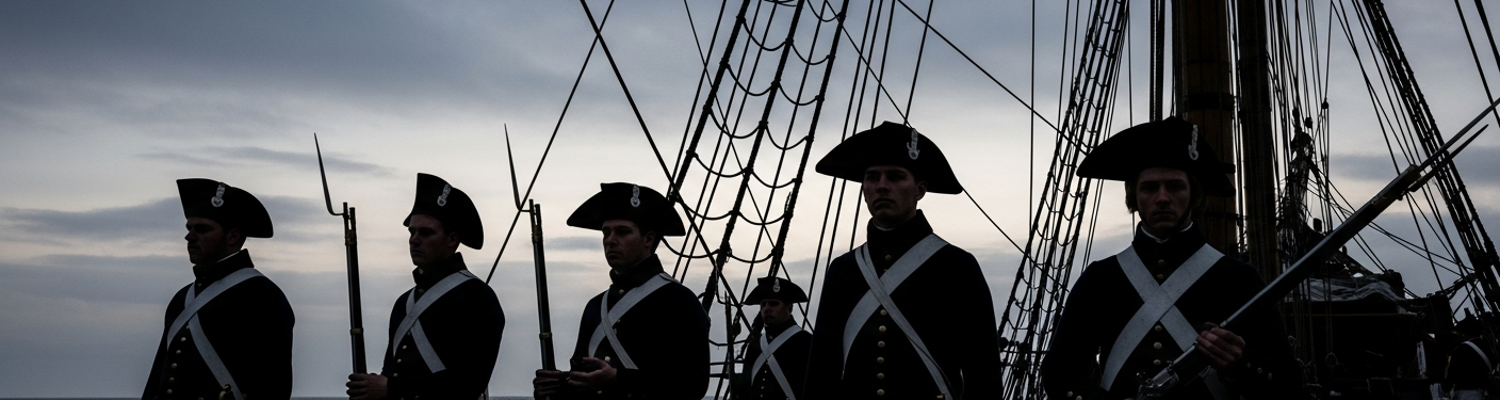

The final years of the eighteenth century tested the sovereignty of the young American republic. France, a recent revolutionary ally, had become a predator on the high seas. Its privateers and warships savaged American merchant shipping with impunity, crippling the nation's trade from the Caribbean Sea to the coastal approaches of the United States itself. The diplomatic insult of the XYZ Affair had shattered any remaining hope for a peaceful resolution, pushing the two nations into an undeclared naval conflict. This Quasi-War forced a reluctant Congress to confront a dangerous vulnerability. The nation’s security and its economic lifeblood depended entirely on sea power, a capability it had foolishly allowed to disintegrate after the American Revolution. Responding to this direct threat, Congress established the Department of the Navy in April 1798. Just weeks later, on July 11, it passed a piece of legislation that would forge a new instrument of national will, the Marine Corps Act of 1798. This law was not a theoretical exercise in governance. It was a direct, pragmatic response to operational necessity and the manifest failures of a prior, flawed system. It created a permanent, institutionally distinct military service designed from its inception to project American power from the sea. The law’s provisions and the Corps’ subsequent trial by fire during the Quasi-War would lay the doctrinal bedrock for a naval infantry force, shaping an ethos of expeditionary readiness and ship-to-shore versatility that defines the service today.
Naval Imperatives and Prior Failures
The threat that precipitated the Marine Corps' rebirth was immediate and material. French corsairs captured hundreds of American merchant vessels, challenging American sovereignty and inflicting severe economic pain. The only effective response required warships, and those warships required a specific type of soldier, one disciplined for the rigors of shipboard life and trained for combat at sea and on hostile shores. The Continental Marines of the Revolution, a capable but temporary force, had been disbanded in 1783 along with the Continental Navy. When Congress authorized the construction of six new frigates in 1794 to counter the Barbary pirates, it included provisions for Marine detachments. These new Marines, however, were raised and administered by the War Department, a decision that created a cascade of problems. This bifurcated command structure proved fundamentally unworkable in practice. The Secretary of War, James McHenry, found himself responsible for recruiting, training, and supplying troops who would serve under the exclusive command of Navy captains and be deployed by a nascent, separate Navy department. This arrangement created a fractured chain of command, constant logistical confusion, and debilitating inter-departmental friction. A ship’s captain preparing his frigate for sea had no direct control over the administrative foundation of his own Marine guard. The first Secretary of the Navy, Benjamin Stoddert, appointed in mid-1798, could not directly organize the very troops essential for his ships' security and fighting power. This system was an operational liability, a bureaucratic tangle that impeded the rapid manning and deployment of the fleet Congress desperately needed to counter French aggression. The situation demanded a unified force, a corps of soldiers who were institutionally and doctrinally part of the naval service from recruitment to deployment.
Establishing a Permanent Force Structure
Congress, driven by Federalists like Representative Samuel Sewall of Massachusetts and Robert Goodloe Harper of South Carolina who advocated for a strong central government and a powerful navy, moved to correct this structural weakness. The “Act for Establishing and Organizing a Marine Corps,” signed into law by President John Adams on July 11, 1798, was the definitive solution. The law was clear and decisive. It created a permanent Corps of Marines, ending the nation's reliance on temporary, ad-hoc arrangements that had proven so inefficient. Most critically, it placed the new Corps “under the government and orders of the Secretary of the Navy.” This single provision severed the problematic link to the War Department and fused the Marine Corps to the Navy, creating the integrated naval team that operational realities demanded. The Act was specific in the force it authorized. It established a Corps commanded by a Major, with a defined rank structure of four captains, sixteen first lieutenants, twelve second lieutenants, and an enlisted body of 720 privates. This force was supported by forty-eight sergeants, forty-eight corporals, and a drum and fife corps of thirty-two musicians. The total authorized strength was 881 personnel. The Act granted the President the authority to form the Corps into companies and detachments as needed, providing essential flexibility for assigning guards to the frigates and other armed vessels of the United States. It also empowered the Corps with the ability to conduct its own direct enlistments, a vital tool for building a service with specific recruitment needs distinct from those of the Army. The law stipulated that these Marines would serve aboard ships, but it also contained a prescient clause that would shape their future. It made the Corps liable for “any other duty on shore, as the President, at his discretion, shall direct.” This language codified the Corps’ dual function from its birth, envisioning a force capable of service not just as shipboard police, but as an expeditionary landing party, a force in readiness for missions on foreign soil.
Forging a Corps Amidst Conflict
The day after the Act became law, President Adams appointed William Ward Burrows, a Philadelphia lawyer and veteran of the Revolution, as the Major Commandant of the Marine Corps. Burrows faced a colossal task. He possessed a legislative charter but no men, no barracks, no uniforms, and no established institutional machinery. From a temporary headquarters in Philadelphia, reputedly near the Tun Tavern where the Continental Marines had first been raised, he began the hard work of building a military service from the ground up. Recruitment proved an immediate and persistent challenge. The Corps competed for manpower against the Army, the Navy’s own demand for sailors, and the lucrative appeal of serving on privateers. Burrows dispatched recruiting officers to the port cities of Boston, New York, Baltimore, and Norfolk, seeking “sober, young, active, and robust men.” The urgency of the Quasi-War meant there was no time for a lengthy stand-up period. Detachments were needed immediately for the frigates being rushed into service, including the USS Constitution, USS United States, and USS Constellation. As quickly as small units of men could be gathered, they were drilled in basic formations, marksmanship with their French Charleville pattern .69 caliber smoothbore muskets, and the duties of shipboard security before being dispatched to the fleet. Equipping this new force was another major hurdle. Burrows designed the first official uniforms, procuring the distinctive blue coats with red facings, white trousers, and the stiff leather stock worn around the neck that would give Marines their enduring nickname, “Leathernecks.” He contracted for weapons, bayonets, and leather accoutrements, establishing a logistical pipeline from scratch. Once aboard ship, the Marines’ mission was multifaceted. They served as the ship’s internal security force, enforcing discipline and protecting the officers from potential mutiny by a sometimes unruly crew. In battle, they were sharpshooters, firing from the fighting tops into the crowded decks of enemy vessels, and formed the core of any boarding party. Their most doctrinally significant role, however, was as a ready landing force. During the Quasi-War, these new Marine detachments conducted numerous landings and cutting-out expeditions in the Caribbean. The action at Puerto Plata, Santo Domingo, in May 1800, stands as a prime example. A force of about 90 sailors and Marines from the USS Constitution, the latter commanded by Captain Daniel Carmick, assaulted the harbor. The Marines landed and stormed the Spanish fort overlooking the bay, disabling its cannons, while the sailors boarded and captured the French privateer Sandwich. Though the action was later deemed a violation of Spanish neutrality, it was a textbook demonstration of the naval infantry capability envisioned by the 1798 Act. It proved the concept of a sea-based soldiery, capable of projecting power ashore with speed and precision, was fundamentally sound. The Marine detachments on ships like the USS Constellation and USS Enterprise also proved their worth in direct ship-to-ship combat, their disciplined musket fire contributing decisively to American naval victories. The Marine Corps Act of 1798 was far more than a piece of administrative legislation. It was a foundational document forged in the heat of conflict. It recognized that effective naval power required an integrated infantry component, and it created an institution purpose-built for that role. The immediate challenges of recruiting, training, and deploying during the Quasi-War forced the nascent Corps to be adaptable and pragmatic, embedding an expeditionary mindset into its institutional DNA from its very first days. The Act provided the legal skeleton, but the operational demands of war gave the Corps its muscle and its enduring purpose as America's force in readiness.