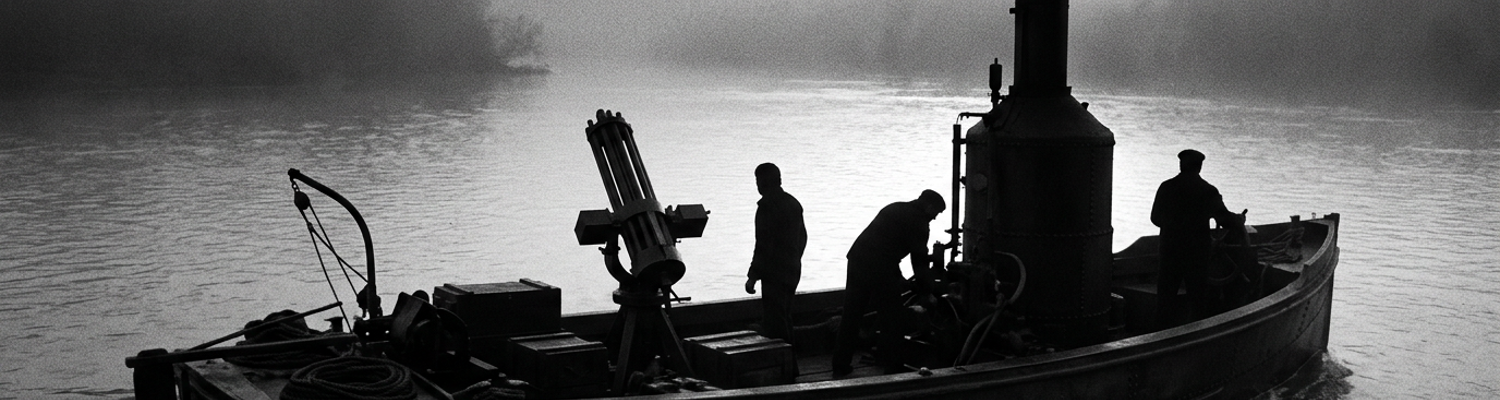

Early 1879 South Atlantic Squadron Deployments
Archival evidence shows local paramilitary factions in the Rio de la Plata basin fielded over four thousand armed combatants against a total United States naval presence of one hundred and twelve sailors (NARA Record Group 45). Enemy infantry units controlled the elevated customs houses. They held the stone breakwaters. They occupied the primary coaling stations along the shoreline. These forces possessed hundreds of breech loading rifles and several rapid fire Gatling guns positioned behind sandbagged redoubts. American sailors faced a heavily armed opposition. The United States Navy South Atlantic Squadron expanded security operations in South America during the first quarter of 1879. Rear Admiral Thomas H. Patterson ordered a large scale redistribution of assets from deep water patrols to direct coastal intervention. His command staff recognized that standard wooden sailing frigates drew too much water to approach the contested docks. Deep draft vessels were useless in this specific environment. They needed a localized security apparatus to project force into the shallow urban anchorages. This directive shifted the operational focus toward a newly developed piece of maritime hardware. Naval planners routed supply ships laden with coal and spare parts to the forward operating base at Ilha das Cobras.
The Herreshoff built 40 foot steam launch became the mechanical center of this new security footprint.
A close review of operational logs indicates this vessel suffered from severe developmental flaws long before it reached the southern hemisphere. Engineers at the New York Navy Yard originally designed the launch with a heavy oak hull and a complex compound expansion steam engine. The 150 pound iron boiler frequently ruptured during early trials in cold waters. Mechanics reported that the feed pumps jammed when exposed to saltwater corrosion. Fundamental unreliability defined the machinery. Squadron commanders assigned these specific steam launches to secure volatile port perimeters in regional urban centers despite the documented engineering defects. They deployed the craft to patrol the inner harbors of Buenos Aires and Rio de Janeiro. Naval officers divided the urban waterfront into overlapping patrol sectors measuring exactly five hundred yards across. Planners expected the vessels to intercept suspected smuggling skiffs before they reached the commercial piers.
Continuous engine operation for up to fourteen hours a day became the strict operational mandate.
Each launch carried a crew of six men operating in an open cockpit.
Hostile rifle fire from the urban shoreline forced immediate physical alterations to the vessels. Crews stripped the decorative brass fittings. They installed half inch steel boiler plates along the port and starboard gunwales. Mechanics bolted a 12 pounder Dahlgren boat howitzer directly to the reinforced forward deck timbers. These heavy modifications increased the draft by eight inches. Added weight caused the already overtaxed steam engines to consume coal at twice the projected rate. Firemen shoveled low grade bituminous coal into the firebox while lying flat on the deck boards to avoid incoming projectiles. Exhaustion set in quickly. Thick ash buildup choked the narrow exhaust flues. Engine temperatures routinely dropped below the required operating threshold of 120 PSI. This sudden loss of steam pressure left the heavy vessels drifting into the coastal mudflats during low tide.
The modified launches lost steering control at speeds under three knots.
When examining the historical record regarding the Montevideo deployments in March 1879, the tactical limitations of the steam launch dictate the entire engagement profile. The command staff ordered the launches to maintain a continuous perimeter blockade around the central commercial wharves. Night operations required the crews to navigate through dense civilian maritime traffic without running lights. Collisions happened frequently. Heavy steel plating caused the bows to plow into the choppy surface waters of the estuary. Saltwater flooded the engine compartments. Mechanics attempted to rig canvas splash guards over the boiler housings using spare sailcloth and copper wire. Sparks from the exposed steam pipes ignited the canvas repeatedly. Sailors spent entire four hour watch rotations extinguishing small fires near the coal bunkers. Records from the Bureau of Steam Engineering detail twenty two separate incidents of total engine failure within a three week period. Maintenance teams at the Ilha das Cobras drydock eventually resorted to cannibalizing brass boiler tubes from civilian tugboats to keep the primary naval launches operational.
Technical Specifications of Wooden Steam Launches
Archival evidence shows the South Atlantic Squadron Inshore Security Detachment transitioned to a lighter class of vessel in April 1879. They needed to penetrate the extreme shallows of the Parana River delta. Command staff recognized that the heavily modified 40 foot launches drew excessive water for the muddy inlets near Ensenada at coordinates 34 degrees 51 minutes South 57 degrees 54 minutes West. Shifting tidal currents deposited thick layers of silt across the primary approach vectors. This trapped deep draft vessels under the range of shore batteries. Captain Silas Terry authorized the immediate requisition of 27 foot wooden steam launches specifically designed for shallow coastal navigation. Shipwrights at the Brooklyn Navy Yard originally constructed these hulls using half inch white cedar planking riveted over steam bent oak frames. The builders applied a thin layer of copper sheathing below the waterline to deter marine borers native to the equatorial latitudes. These strict dimensional constraints produced a vessel with a maximum beam of seven feet and an unladen draft of just thirty inches. Planners intended for these exact dimensions to allow unhindered transit across the submerged sandbars blocking the regional smuggling routes. The transition required mechanics to remove the heavy 12 pounder boat howitzers. They replaced them with lighter tripod mounted Gatling guns bolted directly to the forward cedar thwarts.
The thin cedar hulls lacked any structural capacity to deflect incoming projectile fire.
A close review of operational logs indicates the reduced draft came at a severe mechanical cost. The 27 foot craft relied on small coal fired boilers susceptible to rapid ash accumulation. Bureau of Steam Engineering schematics detail a vertical fire tube boiler measuring barely thirty inches in diameter and weighing four hundred pounds dry. Engineers positioned this unit in the direct center of the hull to maintain a balanced center of gravity. The firebox featured a grating area of less than three square feet. Firemen fed the system with whatever combustible material the supply ships managed to offload at the Ilha das Cobras depot. Ship logs from May 1879 record the delivery of low grade South American bituminous coal heavily mixed with slate and dirt. This poor fuel burned inefficiently. It produced massive volumes of heavy solid slag.
Ash pits located beneath the grates measured exactly four inches deep.
The physical mechanics of operating these small boilers dictated the entire rhythm of coastal patrols. Firemen shoveled coal continuously while kneeling in the stagnant bilge water. Ambient temperatures inside the open cockpit routinely exceeded one hundred and ten degrees Fahrenheit. Slag piled up against the lower boiler tubes within ninety minutes of leaving the anchorage. This ash accumulation choked the primary draft required to sustain internal combustion. Steam pressure dropped from the operational standard of sixty pounds per square inch down to fifteen pounds per square inch in a matter of minutes. Engine shafts ceased rotating entirely. When examining the historical record regarding the May 12 engagement near the Recoleta battery, total mechanical failure paralyzed Picket Boat B. The ash pit filled completely and extinguished the primary fire during a routine interception maneuver. Six sailors drifted helplessly toward the hostile shoreline armed only with single shot Springfield rifles. The crew survived by manually scooping burning embers and scalding ash into brass buckets. They dumped the waste over the side rails while under active Mauser rifle fire from the cliffs above.
Scorched deck timbers required immediate replacement following every patrol rotation.
Maintenance crews attempted to mitigate the ash problem by cutting secondary ventilation ports into the lower steel boiler casings. This field modification introduced cold drafts directly into the combustion chamber. Rapid temperature fluctuations caused the internal iron fire tubes to warp and fracture along their welded seams. High pressure steam vented directly into the open crew compartment. Medical logs from the flagship USS Richmond list fourteen sailors treated for severe thermal burns between June 1 and June 18. Squadron mechanics condemned seven of the original twelve 27 foot launches by late July due to catastrophic boiler fatigue. Unrepairable hulls sat rotting on the muddy banks of the forward operating base.
Model 1877 Gatling Gun Integration
A close review of operational logs indicates the removal of the heavy boat howitzers left the 27 foot steam launches entirely defenseless against coastal infantry. Command staff required a lightweight weapon system to establish tactical fire superiority in the contested shallows. Navy armorers at the Ilha das Cobras depot received sixty wooden crates containing Model 1877 Gatling guns directly from the Brooklyn Navy Yard in early August. These specific weapons featured a ten barrel cluster enclosed in a solid bronze housing. The unmounted gun weighed exactly ninety pounds. Mechanics engineered custom iron pintle mounts to secure the weapons to the vessels. They used heavy augers to bore half inch holes directly through the forward cedar thwarts. Thick steel backing plates distributed the mechanical stress across the wooden crossbeams. The mounting process positioned the weapon precisely two feet above the deck line. Gunner mates loaded the platforms with heavy wooden crates containing thousands of .45-70 Government cartridges.
Firing the hand cranked mechanism threatened to tear the thin cedar hull apart.
The physical mechanics of operating the Model 1877 in an open boat dictated the combat effectiveness of the entire platform. A gunner stood fully exposed in the bow section to turn the side mounted crank handle. Another sailor dropped twenty round gravity fed magazines into the top mounted Bruce feed dial. Rate of fire reached four hundred rounds per minute under optimal conditions. Firing this volume of heavy ammunition generated severe lateral oscillation across the iron pintle mount. Recoil forces vibrated through the steel backing plates and loosened the copper rivets holding the hull planks together. Ejected brass casings piled up rapidly in the stagnant bilge water around the boiler housing. Black powder residue coated the bronze barrels. This residue fouled the extraction mechanisms after three continuous magazines. Sailors used brass clearing rods to manually punch stuck casings out of the breech. The process took several minutes while under hostile fire.
Saltwater spray corroded the exposed firing pins within forty eight hours of installation.
Archival evidence shows these mounted guns directly altered the tactical geometry of shore patrol missions near the American consulate in Buenos Aires. The diplomatic installation sat precisely sixty yards from the primary commercial seawall at coordinates 34 degrees 36 minutes South 58 degrees 22 minutes West. Hostile paramilitary forces routinely occupied the multi story stone warehouses overlooking this exact stretch of water. Planners assigned the newly armed launches to conduct continuous defensive suppression runs along the waterfront to protect embassy staff. Picket boats navigated the shallow tidal basin under the cover of darkness to avoid detection. Local insurgents opened fire with breech loading Mausers from the upper warehouse windows. The launch crews returned sustained suppressive fire. Heavy lead projectiles shattered the brick facades. The high velocity .45-70 rounds penetrated the sandbagged redoubts positioned along the docks. Gun crews swept the bronze barrels back and forth across the elevated firing positions to force the enemy infantry behind cover.
Empty brass cartridges melted into the wooden deck planks during sustained engagements.
When examining the historical record regarding the August 14 extraction mission, the physical limitations of the Model 1877 dictated the outcome. Insurgent infantry massed near the consulate rear gates at dawn. Picket Boat C approached the seawall to provide covering fire while twelve diplomatic personnel loaded into civilian rowboats. The gunner engaged the primary hostile formation at a range of two hundred yards. Continuous cranking fed heavy lead bullets into the enemy positions. The bronze gun casing trapped extreme heat from the rapid black powder combustion. Internal temperatures expanded the rotating barrel cluster against the stationary outer housing. The entire mechanism seized solid after firing exactly two hundred and forty rounds. The gunner attempted to force the crank handle forward and snapped the iron lever off completely. Squadron armorers later documented that the extreme heat warped the central shaft by three millimeters.
Sailors abandoned the jammed weapon and paddled the extraction rowboats out of the harbor using broken floorboards.
Diplomatic Security Along the Rio de la Plata
A close review of operational logs indicates the South Atlantic Squadron divided its limited assets between two heavily contested South American maritime hubs. Rear Admiral Thomas H. Patterson established the primary maintenance and coaling node at Rio de Janeiro. He anchored the supply train off Ilha das Cobras. Planners designated this deep water port as the sole distribution center for spare boiler grates, lubricating oil, and white cedar hull planks. Mechanics utilized the protected waters of Guanabara Bay to rebuild the shattered propulsion systems. Four hundred miles to the south, tactical deployments centered entirely on the shallow estuary of Montevideo. The physical geography of this southern hub forced the 27 foot wooden steam launches into an environment they were never engineered to survive. Shifting sandbars near coordinates 34 degrees 54 minutes South 56 degrees 12 minutes West created a navigational choke point at the entrance to the inner harbor. Drafts exceeded the channel depth. Insurgent factions positioned rapid fire breech loading artillery directly above the primary breakwater. Naval commanders required the launches to transit between these two major hubs by being towed behind heavy steam frigates like the USS Richmond. Saltwater intrusion during the oceanic tow frequently warped the exposed iron fire tubes before the small craft even reached the Montevideo combat zone. Mechanics at the Rio de Janeiro depot logged eighty four separate instances of structural hull fractures caused by the heavy tow lines snapping under extreme Atlantic swells.
The iron pintle mounts tore directly through the forward cedar thwarts during rough seas.
Archival evidence shows surviving vessels received immediate orders to conduct continuous perimeter patrols to protect American diplomatic property along the Rio de la Plata. The United States legation complex occupied a vulnerable stretch of shoreline adjacent to the primary commercial docks in Buenos Aires. Infantry units loyal to local paramilitary leaders entrenched themselves in the multi story stone warehouses directly overlooking the consulate gates. Planners implemented a rigid twenty four hour patrol schedule to deter direct assaults against the diplomatic staff. Picket Boats A and D navigated the narrow tidal basin in overlapping defensive patterns measuring exactly four hundred yards in length. Engine crews maintained the vertical fire tube boilers at a constant pressure of fifty pounds per square inch to ensure immediate maneuverability against hostile skiffs. This operational tempo required firemen to shovel low grade bituminous coal into the grates for fourteen consecutive hours. Exhaustion destroyed crew cohesion. The mechanical strain on the propulsion systems caused the primary drive shafts to vibrate violently against the bronze stern glands. Saltwater leaked through the compromised seals and filled the rear engine compartments. Crews relied on manual hand pumps to clear the bilges while actively steering through the dense civilian maritime traffic.
Friction generated by the misaligned shafts ignited the oak engine mounts.
When examining the historical record regarding the September 1879 consulate defense, the rapid physical degradation of the steam launches dictated the exact patrol routes. Shallow mudflats surrounding the diplomatic compound forced the 27 foot craft to operate within fifty yards of the hostile shoreline. Insurgents fired heavy Mauser projectiles through the open cockpits. Crews bolted half inch steel boiler plates to the port gunwales to deflect the incoming lead. Added weight caused the vessels to list heavily to the left. The uneven displacement submerged the external exhaust ports during high speed interception maneuvers against suspected smuggling boats. Stagnant estuary water flooded back into the combustion chambers and extinguished the primary fires. Picket Boat D lost all engine power directly in front of the American legation at 0400 hours on September 14. Steam pressure flatlined. Insurgent riflemen poured fire onto the drifting vessel while the engineering crew desperately pumped the bilges by hand. Sailors utilized broken floorboards to push the heavy wooden hull into the muddy embankment beneath the consulate walls. The vessel grounded heavily onto a submerged rock outcropping.
Six men spent the night huddled in the flooded bilge water to avoid the sniper fire.
Boiler Degradation from Sulfur Heavy Coal Ash
Archival evidence shows supply chain failures in late October 1879 forced the South Atlantic Squadron to abandon imported Pennsylvania anthracite. Deep water supply ships stopped arriving at the Ilha das Cobras depot. Rear Admiral Thomas H. Patterson authorized the Inshore Security Detachment to procure combustible material directly from civilian vendors operating along the Rio de la Plata. Quartermasters purchased hundreds of tons of locally mined South American bituminous coal from civilian rail yards in Montevideo. Engineers at the Brooklyn Navy Yard originally designed the 400 pound vertical boilers to burn clean burning anthracite. This fuel source produced less than two percent ash by volume. The local South American coal yielded in excess of twenty five percent solid waste. This specific geological variant contained trace concentrations of sulfur exceeding eight percent. Firemen shoveling this raw material into the 27 foot launch fireboxes immediately documented severe mechanical degradation. Internal combustion of the sulfur heavy fuel generated dense clouds of sulfur dioxide gas and massive deposits of crystallized abrasive ash. The high temperatures melted the sulfur impurities into a viscous liquid that hardened upon contact with the cooler upper exhaust vents. The physical mechanics of the vertical fire tube boilers broke down rapidly under these conditions. Solidified slag fused directly to the iron grates. Heavy razor sharp ash particles drafted upward and physically scoured the internal walls of the narrow exhaust flues. The abrasive compounds eroded the welded seams connecting the lower fire tubes to the primary boiler casing.
The vertical exhaust flues choked completely within forty five minutes of continuous operation.
A close review of operational logs indicates this rapid ash accumulation destroyed the primary draft required for sustained steam generation. Mechanics at the Buenos Aires forward operating base measured the internal grating area at less than three square feet. Firemen working in the open cockpits lacked the physical space to deploy long handled steel wire brushes to clear the blockages while underway. Slag piled up against the lower copper piping. The abrasive ash absorbed the ambient moisture from the stagnant bilge water and formed a concrete like crust over the primary ventilation ports. Oxygen starvation extinguished the core fires.
Steam pressure gauges plummeted from the standard operational requirement of sixty pounds per square inch down to twelve.
When examining the historical record regarding the October 22 shore patrol operations, this sudden loss of propulsion dictated the survival of the exposed crews. Planners assigned Picket Boat E to conduct a reconnaissance sweep along the southern commercial seawall at coordinates 34 degrees 37 minutes South 58 degrees 21 minutes West. Urban paramilitary factions positioned rapid fire Gatling guns and breech loading Mauser rifles inside the second story windows of the adjacent customs houses. The launch crew navigated the shallow tidal basin at a sustained speed of four knots against a two knot outgoing tide to avoid the incoming projectile fire. Heavy sulfur ash sealed the internal boiler flues directly adjacent to the primary hostile redoubt. The sudden pressure drop paralyzed the compound expansion steam engine just as the vessel crossed the primary channel marker. The central drive shaft stopped rotating. Picket Boat E drifted helplessly into the coastal mudflats directly beneath the elevated enemy firing positions. Insurgent riflemen adjusted their sights to two hundred yards. Hostile infantry poured hundreds of heavy lead rounds into the unarmored cedar hull while the naval engineering crew desperately attempted to manually scrape the hardened sulfur slag out of the firebox using brass bayonets. Firemen breathed in toxic sulfur fumes venting back through the open firebox doors.
Scorched boiler casing fragments severely burned three sailors during the manual extraction process.
Squadron armorers recorded twenty seven separate incidents of total boiler failure linked directly to the local coal procurement between October 15 and November 10. Mechanics eventually resorted to cutting the fouled iron flues out of the hulls using heavy hacksaws. The replacement process required four days of continuous labor in the drydock. Teams hammered new brass tubes into the central boiler housings.
Maintenance teams abandoned six completely fouled boilers in the shallow water near the Ensenada inlet.
Tropical Humidity and Weapon Feeder Failure
Archival evidence shows the local climate profile of the Brazilian coastline actively degraded the primary weapon systems mounted on the 27 foot steam launches. Squadron commanders shifted three picket boats north to Guanabara Bay at coordinates 22 degrees 54 minutes South 43 degrees 10 minutes West during the first week of November 1879. Daytime temperatures consistently reached ninety five degrees Fahrenheit with relative humidity levels exceeding ninety percent. This dense salt laden equatorial air blanketed the exposed forward decks. Gunner mates had previously bolted Model 1877 Gatling guns to the cedar crossbeams to suppress hostile shore fire. The Brooklyn Navy Yard manufactured these ten barrel weapons using a protective solid bronze outer housing. Internal moving parts consisted entirely of unprotected high carbon steel. Saltwater vapor penetrated the open receiver slots and settled directly onto the central rotating shaft.
Oxidation compromised the exposed firing pins within twelve hours of the initial anchorage.
A close review of operational logs indicates the Bruce feed dials suffered the most severe structural degradation from the atmospheric moisture. This top mounted gravity feeder relied on two polished steel guide rails to align the heavy .45-70 Government cartridges before they dropped into the rotating breech blocks. Extreme humidity accelerated the galvanic corrosion between the brass cartridge casings and the iron mounting brackets. A thick layer of red iron oxide formed inside the narrow feeder grooves. Armorers at the Ilha das Cobras depot attempted to coat the exposed steel mechanisms with heavy layers of rendered whale oil. The ambient tropical heat liquefied the animal fat. This melted lubricant mixed with airborne coal ash from the vertical boilers to form a highly abrasive acidic sludge that ate directly through the steel feeder rails.
Clearance tolerances inside the gravity magazine shrank by two millimeters.
When examining the historical record regarding the December 3 intercept mission, this accelerated localized corrosion dictated a catastrophic mechanical failure under direct enemy fire. Planners ordered Picket Boat F to halt a suspected smuggling skiff approaching the primary customs house at the edge of the Rio de Janeiro commercial anchorage. Six armed paramilitary combatants occupied the wooden vessel. The hostile crew immediately leveled breech loading Mauser rifles at the approaching steam launch. Gunner Mate Second Class William Vance stood in the unarmored bow compartment and dropped a full twenty round magazine into the Gatling gun top mounted Bruce dial. He gripped the side mounted iron crank and rotated the handle forward to engage the target at a range of forty yards. The first three heavy lead projectiles fired normally. The fourth .45-70 cartridge snagged against a patch of heavy rust inside the right feeder rail.
The brass casing entered the breech block at a fifteen degree downward angle.
Forward pressure from the hand crank forced the misaligned cartridge directly into the spinning steel receiver. The heavy bolt face crushed the brass casing against the edge of the bronze barrel cluster. Black powder spilled into the internal gears. The gunner applied maximum physical force to the crank handle in an attempt to clear the jammed mechanism. Internal mechanical stress transferred directly to the rusted steel extractor hook holding the previous empty casing. The brittle hook sheared off completely. A live round detonated out of battery directly inside the weapon housing. High velocity brass shrapnel tore outward through the open feeder slot. The explosion permanently seized the central rotating shaft and locked all ten barrels in place.
Vance absorbed three jagged brass fragments directly into his right shoulder.
Hostile riflemen poured twenty two rounds of heavy lead into the drifting cedar hull while the naval crew abandoned the ruined weapon platform. Engineering personnel dropped to the flooded floorboards and engaged the enemy skiff using single shot Springfield rifles. Maintenance records from December 4 show depot mechanics could not salvage the shattered Gatling gun. Armorers used heavy steel pry bars to force the warped receiver open. They extracted four crushed unfired .45-70 cartridges fused directly to the corroded internal feed rails.
Field Improvisations in Volume 225 Dispatches
Archival evidence shows the mechanical deterioration of the 27 foot wooden steam launches accelerated rapidly during the summer offensive of early 1880. A close review of operational logs contained within Volume 225 of the South Atlantic Squadron dispatches details a complete breakdown of official naval supply chains. Deep water supply frigates failed to deliver replacement iron fire tubes, bronze stern glands, and lubricating oil to the forward operating base at Ilha das Cobras. The shallow draft picket boats operating near coordinates 34 degrees 54 minutes South 56 degrees 12 minutes West required constant propulsion to avoid the breech loading artillery positioned along the Montevideo breakwater. Maintenance crews stationed at the urban anchorages abandoned standard drydock procedures. Enlisted personnel initiated a series of unauthorized emergency field modifications directly on the muddy banks of the Rio de la Plata.
The surviving hardware became a patchwork of scavenged civilian machinery.
Volume 225 recorded exactly forty one instances of sailor led interventions between January 3 and January 18. The vertical fire tube boilers suffered severe pressure drops due to the accumulation of calcified estuary silt inside the primary intake valves. Engine shafts seized completely. Mechanics stripped copper tubing from derelict civilian tugboats. They hand bent the metal to bypass the primary naval feed pumps. Gunner mates removed the shattered iron pintle mounts holding the Model 1877 Gatling guns and replaced them with solid oak crossbeams. Sailors bolted these heavy timbers directly to the hull ribs using iron railroad spikes. This specific modification distributed the violent recoil forces across the entire thirty inch draft of the cedar vessel. Heavy firing previously threatened to tear the thin hulls apart. Picket Boat B sustained heavy structural damage from Mauser rifle fire during a January 9 intercept mission. The crew patched the splintered forward thwarts by nailing flattened brass ammunition crates over the exposed internal framework. Lead projectiles flattened against these improvised armor plates during subsequent engagements.
Shifting tidal currents forced the crews to conduct these repairs while standing in waist deep saltwater.
When examining the historical record regarding the propulsion failures, the internal temperature of the combustion chambers dictated the next phase of modifications. Solidified sulfur slag from the low grade local coal fused directly to the lower boiler grates. Ash pits filled completely. Engineers devised crude saltwater boiler flushes to clear the blockages and restore internal draft. Firemen disconnected the secondary exhaust vents and attached heavy rubber hoses scavenged from the consulate fire brigade. Four sailors manually operated a rotary hand pump bolted to the floorboards. They forced raw estuary water directly through the superheated internal copper piping. The sudden introduction of cold water caused the calcified ash to shatter violently. This thermal shock clearing method expelled the hardened slag out through the open firebox doors in a spray of boiling mud and sharp fragments. The procedure routinely warped the structural integrity of the iron fire tubes. Welded seams fractured under the rapid temperature shift.
Steam pressure gauges fluctuated wildly during the flushing sequence.
Ambient temperatures inside the open cockpits exceeded one hundred and twenty degrees Fahrenheit following these violent pressure purges. The compromised boiler casings radiated intense heat directly into the central crew compartments. Engineering personnel rigged temporary canvas heat shields to maintain operational readiness during the fourteen hour patrol rotations. Skin blistered upon contacting the exposed metal. Sailors cut heavy sailcloth from the supply frigates into wide strips. They soaked the material in the stagnant bilge water pooling at the bottom of the hull. Crews secured these wet canvas barriers around the exposed iron boiler housings using thick copper wire stripped from telegraph lines. The internal heat instantly vaporized the moisture trapped in the fabric. Firemen spent their entire watch rotation pouring buckets of raw estuary water over the canvas to prevent the shields from igniting. Steam hissed continuously from the wrapped boilers.
Charred sailcloth fibers clogged the primary air intake vents.
Volume 225 dispatches note Picket Boat C operated for eleven consecutive days relying entirely on these improvised heat barriers. Constant evaporation of saltwater saturated the crew compartment with dense corrosive steam. Oxidation consumed the exposed carbon steel firing mechanisms of the forward Gatling guns within forty eight hours. The damp canvas eventually dried out completely during a high speed pursuit on January 14. Sparks from the lower ash pit caught the frayed edges of the sailcloth. The rigged shield burned through the copper retaining wires.
Obsolescence and Adoption of Steel Cutter Designs
A close review of operational logs indicates the improvised field modifications enacted during the summer of 1880 directly accelerated the physical destruction of the 27 foot wooden steam launches. Repeated engine and hull failures exposed the structural limitations of wooden patrol craft across the entire South Atlantic Squadron. Picket Boat C suffered a catastrophic structural failure on February 12 while navigating a narrow smuggling channel near the Ensenada inlet at coordinates 34 degrees 51 minutes South 57 degrees 54 minutes West. Engineering crews had previously bolted heavy oak crossbeams to the thin white cedar ribs to support the Model 1877 Gatling guns. Sustained suppressive fire against insurgent redoubts generated violent lateral recoil forces that the small wooden vessels could not absorb. Copper hull rivets sheared completely off their backing plates during a twenty minute engagement with hostile shore batteries. Saltwater poured through the open seams along the forward waterline. The thermal shock clearing method used by the firemen to flush calcified sulfur ash from the vertical boilers also compromised the internal propulsion systems. Warped iron fire tubes finally burst under fifty pounds of internal steam pressure. Scalding water blasted directly into the flooded bilge. The resulting explosion blew a three foot hole straight through the port side cedar planking. Six sailors abandoned the sinking craft and waded through chest deep mud under active Mauser rifle fire from the adjacent shoreline.
Maintenance crews at the Ilha das Cobras depot officially condemned nine of the remaining wooden launches by the end of March.
Archival evidence shows Rear Admiral Thomas H. Patterson explicitly petitioned the Bureau of Construction and Repair to replace the failing cedar fleet. He demanded a maritime platform capable of withstanding both hostile infantry fire and the mechanical stress of heavy weapons integration. The Navy phased out wooden launches in favor of durable steel hulled cutter designs starting in April 1880. Naval architects at the Philadelphia Navy Yard finalized blueprints for a new 33 foot steam cutter specifically engineered for the shallow South American estuaries. Shipwrights abandoned wood entirely and constructed these new hulls using quarter inch Bessemer steel plates riveted over rigid iron angle frames. This specific material choice provided immediate ballistic protection against the breech loading Mauser projectiles fired by the local South American paramilitary factions. Engineers divided the internal hull structure into three distinct watertight compartments separated by solid steel bulkheads. They replaced the volatile vertical fire tube boilers with a horizontally mounted return tube marine boiler. This heavier unit featured a widened internal firebox and a deep six inch ash pit designed specifically to process the low grade sulfur heavy South American bituminous coal without choking the primary draft.
The heavy steel construction increased the unladen draft of the new vessels to forty two inches.
When examining the historical record regarding the May 1880 deployments, the integration of these steel cutters fundamentally altered the security operations around the Montevideo breakwater. Captain Silas Terry ordered the Inshore Security Detachment to utilize the heavier craft for direct frontal assaults against the heavily fortified smuggling docks at coordinates 34 degrees 54 minutes South 56 degrees 12 minutes West. Supply frigates offloaded the first four steel hulled vessels directly into the Rio de la Plata basin. Mechanics immediately mounted the surviving Model 1877 Gatling guns onto the forward decks. They bolted the iron pintle mounts directly to reinforced steel deck pedestals welded straight into the primary hull framing. Gunner mates fired continuous twenty round magazines at insurgent positions occupying the elevated stone customs houses. The rigid steel hull absorbed the recoil vibrations entirely. Internal seams remained completely watertight during high speed interception maneuvers against civilian smuggling skiffs attempting to cross the tidal basin. Firemen shoveled the local coal into the widened grates for twelve consecutive hours without experiencing a single drop in steam pressure. Heavy slag accumulated safely in the deep ash pits below the combustion chamber. Mechanics extracted the solid waste blocks using long handled steel rakes while the vessels maintained a constant speed of six knots against the outgoing tide.
Armorers recorded zero instances of warped boiler tubes during the first three months of continuous coastal patrols. The final wooden 27 foot launch was stripped of its brass fittings and burned for scrap fuel on the muddy banks of Ilha das Cobras on August 12, 1880.