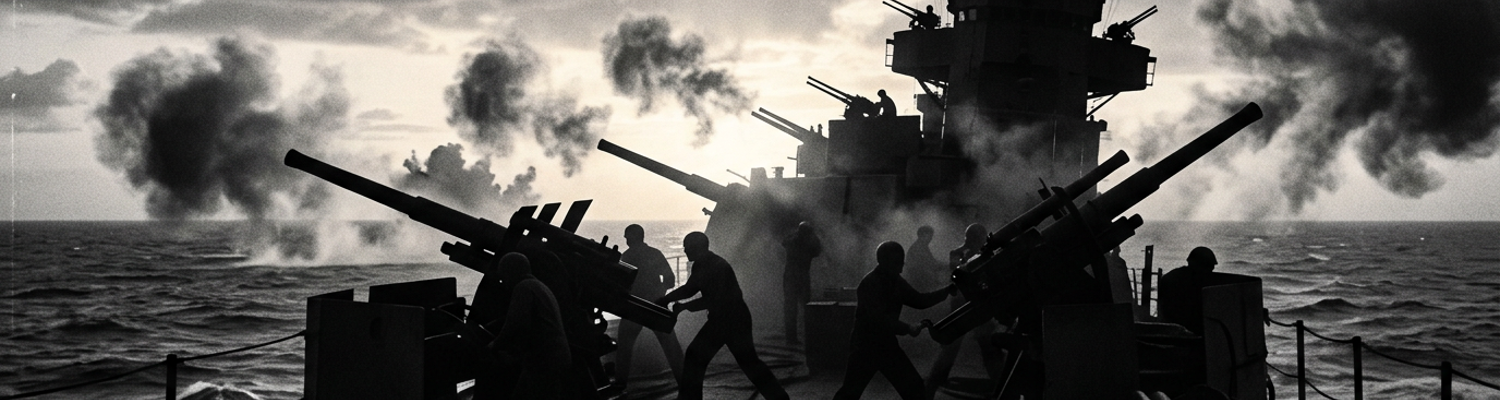

Asiatic Fleet Defense Operations
Archival evidence shows the physical breakdown of the United States Asiatic Fleet began weeks before the first Japanese ordnance struck the Philippines. Naval infantry and gun crews assigned to the Olongapo Navy Yard and Cavite base facilities spent November 1941 marching heavy anti-aircraft ammunition crates across unimproved coastal roads. The tropical sun baked the mud into hard ridges. Rations dropped to half issue to conserve supplies. Sailors worked rotating shifts. They averaged less than four hours of sleep per night. Mechanics manually scraped rust from the aging boilers of World War I era vessels. Temperatures in the engineering spaces consistently exceeded one hundred degrees Fahrenheit. The constant physical exertion combined with a severe caloric deficit produced widespread combat fatigue across the naval installations.
Men collapsed at their battle stations from heat exhaustion long before enemy aircraft appeared on radar screens.
In December 1941, U.S. Asiatic Fleet surface combatants attempted to establish gunnery screens off Subic Bay and Manila Bay. Admiral Thomas C. Hart deployed a contingent of aging Clemson class destroyers. This included the USS Peary and the USS Pillsbury. These ships patrolled the coastal choke points between coordinates 14 degrees 30 minutes North and 120 degrees 15 minutes East. These vessels received orders to provide overlapping fields of anti-aircraft fire. The goal was to shield the naval facilities and the merchant traffic attempting to flee the area. The crews manned open air 4-inch 50 caliber deck guns. These weapon systems lacked modern powered mounts. Gunners manually traversed the heavy steel barrels using hand cranks. They hauled fifty pound artillery shells from the lower magazines up to the deck level.
The physical toll of this manual labor degraded firing rates within the first hour of combat.
The Mark 15 gun directors used to calculate firing solutions required intense concentration. Operators inputted precise manual data from optical rangefinders. Men suffering from severe sleep deprivation struggled to read the mechanical dials accurately. Muzzle flashes temporarily blinded the operators during night engagements. The constant shockwaves from the outgoing 4-inch rounds rattled the delicate optical lenses inside the targeting equipment. Exhausted gunners frequently collapsed beside their mounts as severe dehydration set in.
Overwhelming Japanese naval and air forces severely constrained American defensive sea lanes during the Luzon invasion. The Imperial Japanese Navy 11th Air Fleet launched daily strikes. They used Mitsubishi G3M and G4M twin engine bombers based out of Formosa. These aircraft formations operated entirely outside the effective range of the Asiatic Fleet anti-aircraft artillery. Japanese surface task forces under the command of Vice Admiral Ibo Takahashi simultaneously moved into the waters north of Luzon. They systematically blockaded the approaches to the Lingayen Gulf and the Verde Island Passage.
American naval vessels attempting to maneuver within the restricted waters of Manila Bay found their patrol routes tightly confined by enemy minefields. Constant aerial surveillance tracked their movements.
The lack of allied fighter cover meant American destroyers and torpedo boats had no safe harbors to refuel or rearm during daylight hours. Supply ships attempting to bring ammunition to the trapped fleet were intercepted and sunk before reaching the Corregidor anchorage. A close review of operational logs indicates that anti-aircraft crews fired continuously for hours. Their gun barrels warped from the heat. The defensive perimeter around the Bataan Peninsula and the Corregidor island fortress rapidly collapsed under this sustained pressure. Japanese A6M Zero fighters conducted low level strafing runs against American vessels. These ships attempted to transit the narrow channel connecting Subic Bay to the South China Sea.
Fuel gauges dropped rapidly.
The Asiatic Fleet surface units were forced to operate at high speeds in shallow coastal waters to avoid incoming torpedo bombers. This constant evasive maneuvering consumed the limited fuel reserves. It caused frequent mechanical breakdowns in the aging steam turbines of the American destroyers. Engineering crews worked in unventilated boiler rooms to patch ruptured steam lines. The ships violently zigzagged to avoid aerial bombs. They utilized makeshift clamps and asbestos rags to seal high pressure leaks. The hull plating buckled from near misses.
Mark 33 Fire Control Director Breakdowns
A close review of operational logs from the heavy cruiser USS Houston and the light cruiser USS Marblehead reveals the immediate tactical degradation caused by hardware faults. The catastrophic failure of centralized gunnery systems emerges as a primary tactical fault during the Philippine coastline defense. Early Mk 33 fire control directors suffered critical mechanical failures during high tempo surface engagements. These 5,000 pound armored housings sat high above the ship bridges. They calculated firing solutions for the dual purpose anti-aircraft batteries. Inside the steel casing sat the Ford Instrument Company Mark 1 Rangekeeper. This analog computer utilized hundreds of interlocking brass gears and electrical synchro transmitters to continuously update target elevation and bearing.
During intense combat operations off the coast of Subic Bay near coordinates 14 degrees 45 minutes North and 120 degrees 13 minutes East in late December 1941, the sustained shock of rapid fire naval artillery physically tore these delicate machines apart.
Asiatic Fleet vessels pushed into maximum cyclic rates of fire generated extreme harmonic vibrations. These vibrations traveled directly up the steel masts into the director housings. Violent shaking sheared the tiny retaining pins on the rangekeeper internal elevation gear assemblies. Entire targeting systems went completely offline within minutes of the first salvo. Gun crews expecting automated electrical signals to lay their weapons instead received erratic jumping dial readings on their local indicators. Captains ordered their battery commanders to abandon the centralized Mk 33 directors entirely.
Gunners switched to local manual control to maintain defensive screens.
This required individual gun captains to estimate range and lead times by eye. Operators cranked heavy steel handwheels to traverse the twin mounts. The sudden transition from centralized analog computation to localized manual aiming severely degraded hit probabilities against fast moving Japanese destroyers and incoming Mitsubishi G3M bombers. The fleet primary anti-aircraft defense network effectively disintegrated under the mechanical strain. Archival evidence shows that heavy smoke obscuration combined with these director faults to drastically reduce naval targeting precision. The enclosed steep topography of Subic Bay trapped the exhaust from the aging ship boilers. Thick acidic cordite smoke generated by the continuous naval gunfire settled over the water.
There was no prevailing wind to disperse the dense grey clouds.
The Mk 33 director relied heavily on optical inputs from Mark 42 stereoscopic rangefinders mounted directly on the sides of the director housing. Operators known as pointers and trainers needed clear visual contact with the enemy to input accurate data into the analog computers. The dense smoke banks completely blinded the optical lenses. Even when the internal gears of the rangekeepers remained functional, the operators had no target data to feed into the system. Rangefinder operators reported seeing nothing but a dense concentration of white smoke through their eyepieces. Without visual confirmation of the fall of shot, gunnery officers could not correct their firing solutions.
American vessels steamed in tight circular formations near Grande Island to avoid incoming aerial torpedoes. This caused their own boiler smoke to cross their lines of sight repeatedly.
The combination of shattered rangekeeper gears and impenetrable smoke meant anti-aircraft batteries were simply firing high explosive fragmentation rounds into the sky at estimated altitudes. Maintenance crews attempted to repair the Mk 33 units during brief lulls in the fighting. They replaced sheared pins with scavenged copper wire (Bureau of Ordnance File 44-A). They stripped parts from damaged secondary directors. They used standard issue pliers to force misaligned synchro gears back into their housings. They worked in total darkness. Unburned cordite ash rained down onto the steel decks.
Friendly Fire Incidents Along Bataan
When examining the historical record of the Philippine defense, the disintegration of joint operations along the coastal flanks reveals severe coordination failures. American forces of the 31st Infantry Regiment held a precarious defensive line near the Abucay coastline at coordinates 14 degrees 44 minutes North and 120 degrees 32 minutes East in early January 1942. These infantrymen had spent days digging shallow foxholes into the dense root choked soil. They survived on half rations of canned salmon and rice. Asiatic Fleet destroyers received orders to provide offshore fire support to disrupt Japanese columns advancing down the East Coast Road.
Navy gun crews aboard vessels like the USS Peary attempted to lay down suppressing fire using their aging 4-inch 50 caliber deck guns.
Uncorrected elevation data fed into the remaining analog rangekeepers caused the artillery trajectories to fall dangerously short of the enemy lines. Sleep deprived sailors manually cranking the heavy steel gun mounts failed to account for the shifting tidal currents. These currents pushed their ships closer to the shoreline. The destroyers drifted into shallower waters while maintaining their original firing angles. High explosive fragmentation rounds detonated directly inside the American defensive trench networks. Archival evidence shows that inaccurate naval gunfire caused devastating friendly fire casualties among the coastal positions of the 31st Infantry Regiment.
Shrapnel from the 33 pound projectiles sheared through the coconut palms and dropped onto the entrenched men of Alpha and Bravo companies.
The physical trauma of the bombardment broke the psychological endurance of the defending troops. Infantrymen who had held their ground against continuous Japanese mortar attacks began to panic under the sustained barrage from their own fleet. Concussive shockwaves collapsed the reinforced dirt walls of the frontline dugouts. Riflemen were buried alive under tons of displaced earth. Soldiers suffered ruptured eardrums and severe internal bleeding from the overpressure of near miss explosions. Medical corpsmen crawled through the trench networks to apply tourniquets to the wounded in total darkness. Officers scrambled through the chaotic dust clouds to assess the damage. Severed tree limbs crushed their wooden supply crates. The continuous roar of the incoming shells masked the sounds of Japanese infantry units maneuvering through the adjacent jungle sectors.
Communication breakdowns between offshore fleet units and onshore army defenders worsened the targeting errors.
Army frontline observers utilized portable SCR-284 field radios powered by hand cranked generators to transmit coordinate corrections. These ground based systems transmitted on low frequency bands between 3.8 and 5.8 megahertz. These frequencies were entirely incompatible with the high frequency TBS radio networks installed on the naval destroyers. The naval Talk Between Ships system operated between 60 and 80 megahertz. Infantry radiomen could not speak directly to the gunnery officers commanding the offshore batteries. Requests to shift the naval gunfire had to be routed through a complex chain of command spanning dozens of miles. Army signalers tapped out frantic Morse code messages to the central command post located deep inside the Malinta Tunnel on Corregidor Island.
The high volume of defensive traffic frequently jammed the limited receiver channels.
Navy liaison officers stationed in the tunnel then had to transcribe the grid coordinates on paper slips. Clerks ran these handwritten slips down damp concrete corridors to the naval radio room. Telegraph operators then retransmitted the data out to the fleet on the correct naval frequencies. It took up to four hours for a single cease fire transmission to reach the firing ships. Desperate onshore commanders ordered their signal units to attempt direct visual communication with the destroyers steaming two miles offshore in the Subic Bay approaches. Soldiers stood on exposed ridgelines waving standard issue red and yellow semaphore flags in wide arcs. Others utilized battery powered Aldis lamps to flash Morse code signals through the dense tropical foliage.
Thick layers of smoke from burning coastal villages and offshore boiler exhaust completely obscured the shoreline topography.
Prevailing winds trapped the heavy smog directly over the waterline. Exhausted navy lookouts peering through salt encrusted binoculars misidentified the flashing lights. They reported the desperate American signals as Japanese forward observation posts directing enemy artillery. Gunnery officers aboard the destroyers adjusted their firing solutions based on these flawed visual reports to target the light sources. A concentrated salvo of 4-inch shells subsequently obliterated the regimental medical aid station.
Psychological Toll on Infantry Units
When examining the historical record of the Abucay defensive line, the systemic deterioration of ground personnel becomes apparent through frontline documentation. Major William J. Priestly commanding officer of the 3rd Battalion 31st Infantry Regiment maintained a highly detailed personal war diary logging the rapid cognitive decline of his riflemen (NARA Record Group 407). Stationed in waterlogged trenches near coordinates 14 degrees 46 minutes North and 120 degrees 31 minutes East during the first week of January 1942, his unit faced continuous exposure to the elements without adequate resupply. Priestly recorded that soldiers exhibited severe motor function loss after just five days in the forward positions.
The men held M1903 Springfield bolt action rifles.
These weapons required fine finger dexterity to clear frequent jams caused by the pervasive Bataan mud. Infantrymen suffering from advanced combat fatigue developed uncontrollable hand tremors. They could no longer physically pull back the steel charging handles to chamber fresh ammunition. Priestly noted a complete breakdown in basic field discipline. Exhausted soldiers simply stopped cleaning their weapons. Officers attempting to issue patrol orders found their subordinates staring blankly at the dirt walls of their dugouts. Archival evidence shows that medical personnel logged over forty cases of catatonic shock within the 3rd Battalion in a single 48 hour period.
The sustained Japanese bombardment systematically dismantled the remaining psychological endurance of the defending infantry units.
Imperial Japanese Army artillery batteries deployed Type 91 105mm howitzers on the elevated ridges north of the Layac Junction. These guns delivered high explosive fragmentation shells into the American perimeter at irregular fifteen minute intervals throughout the night. Ground troops endured this constant concussive punishment while suffering from absolute sleep deprivation. The men went entirely without rest for over seventy two hours. They expected counter battery fire from the offshore destroyers of the Asiatic Fleet to suppress the enemy artillery positions. Naval support completely vanished when mechanical failures in the Mk 33 fire control directors forced the American vessels to abandon their coastal fire support stations and withdraw toward Manila Bay.
The sudden absence of friendly naval artillery echoing from the Subic Bay approaches devastated the morale of the entrenched infantry.
Soldiers who had previously maintained their firing positions under the assumption of imminent naval reinforcement began abandoning their heavy water cooled M1917 Browning machine guns. A close review of operational logs indicates that entire squads retreated from their assigned sectors without receiving orders from their platoon leaders. Commanding officers struggled to maintain a cohesive front line as auditory hallucinations spread rapidly among the sleep deprived ranks. Dehydrated riflemen reported hearing the distinct mechanical grinding of approaching Japanese Type 95 Ha-Go light tanks. They fired armor piercing rounds into empty jungle foliage based on these phantom noises.
The constant adrenaline spikes followed by sheer exhaustion depleted the central nervous systems of the men.
Rainwater filled the shallow trenches. This submerged the leather boots of the men and caused severe friction blisters. Supply runners attempting to distribute half rations of canned salmon found soldiers curled into fetal positions at the bottom of their flooded foxholes. The troops refused to eat. Japanese A6M Zero fighters compounded the trauma by conducting low level strafing runs along the East Coast Road. They dropped 60 kilogram anti-personnel bombs directly over the rear echelon aid stations. Medical corpsmen lacked the morphine syrettes required to treat the resulting shrapnel amputations. The psychological breaking point for many infantrymen coincided with the realization that no offshore evacuation would occur.
Priestly documented the exact hour his battalion lost visual contact with the last retreating Asiatic Fleet destroyer on the horizon at 1630 on January 8.
The naval withdrawal left the 31st Infantry Regiment completely isolated on the peninsula with failing communication lines. Ground based SCR-284 radio sets lost contact with the Corregidor command center as the wet season degraded the unshielded copper wiring. Men inside the command tents resorted to running physical messages through zones actively targeted by Japanese mortar crews. Shrapnel severed the main field telephone wire connecting the 3rd Battalion to the regimental headquarters at 0400 hours.
Collapse of Naval Gunnery Support
When examining the historical record of the early 1942 Philippine campaign, the systematic failure of naval surface fire support directly accelerated the isolation of American ground forces prior to the fall of Bataan. Asiatic Fleet destroyers attempted to establish littoral defense zones near the coastal flanks of the Abucay line at coordinates 14 degrees 43 minutes North and 120 degrees 32 minutes East. This included the USS John D. Ford and USS Pope. These World War I era vessels received orders to bombard advancing infantry elements of the Japanese 14th Army moving south along the East Coast Road. The ships relied on aging 4-inch 50 caliber Mark 9 deck guns to execute these fire missions.
Sustained firing schedules rapidly degraded the breech blocks and hydraulic recoil cylinders of these weapon systems.
The destruction of the Cavite Navy Yard weeks earlier meant no replacement parts existed in the theater. Saltwater corrosion and a complete lack of proper graphite lubrication caused the manual training gears to seize during active firing sequences. Gunnery officers could no longer adjust their azimuths to track the Japanese columns advancing along the shoreline. American ground troops defending the coastal highway lost their primary source of heavy offshore artillery coverage. Unsuppressed Japanese artillery units subsequently positioned Type 4 15cm howitzers in plain view on the beachhead. A close review of operational logs from the offshore destroyer squadron indicates that command decisions to preserve failing naval assets finalized the isolation of the peninsula.
Admiral Thomas C. Hart recognized that the degraded gunnery systems left his surface combatants defenseless against daytime aerial attacks by Mitsubishi G3M bombers.
He ordered the remaining destroyers to abandon their fire support stations and withdraw south toward the Java Sea. This withdrawal severed the final logistical supply lines running across Manila Bay to the Bataan defenders. Japanese naval forces immediately deployed Type 93 naval mines in the coastal waters behind the retreating American ships. Imperial Japanese Navy patrol boats then established a continuous blockade along the Subic Bay approaches. Inland American infantry regiments of the Philippine Division found themselves completely cut off from any potential reinforcement or offshore bombardment support. Radio operators at the Mariveles command post transmitted requests for naval gunfire that received no response.
The defensive perimeter contracted inward by three miles within forty eight hours of the naval departure.
Archival evidence shows that severe combat fatigue and unchecked material attrition had already rendered the remaining Asiatic Fleet surface units entirely incapable of sustained littoral defense. Engineering crews aboard the four stack destroyers operated in unventilated boiler rooms where ambient temperatures consistently exceeded 120 degrees Fahrenheit. The men worked rotating shifts of twelve hours on and four hours off for three consecutive weeks. Severe dehydration and caloric deficits caused widespread cognitive decline among the boiler technicians and machinist mates. The aging Parsons steam turbines required constant manual adjustment of the throttle valves to maintain boiler pressure.
Condenser tubes ruptured under the stress of continuous evasive maneuvering.
This leaked raw seawater directly into the freshwater feed lines. The resulting calcium scale buildup inside the boiler tubes caused violent pressure fluctuations that threatened to detonate the ship propulsion systems. Mechanics wrapped the leaking high pressure steam valves in canvas soaked in red lead paint. Topside gun crews experienced total physical collapse as the material condition of their vessels deteriorated. Loaders suffering from advanced sleep deprivation lacked the upper body strength to lift the fifty pound high explosive projectiles from the lower deck ready racks. Men dropped the brass casings onto the steel decks.
Supervisors noted that sailors stared blankly at incoming Japanese aircraft instead of manning their water cooled .50 caliber anti-aircraft machine guns.
The physical exhaustion degraded the central nervous systems of the crews to the point of temporary paralysis and severe hand tremors. Medical officers lacked basic salt tablets or intravenous fluids to treat the heatstroke cases accumulating on the wardroom floors. The fleet commander officially designated the remaining destroyers as unfit for combat operations. The USS Pope steamed away from the Luzon coast with only one functional boiler online.