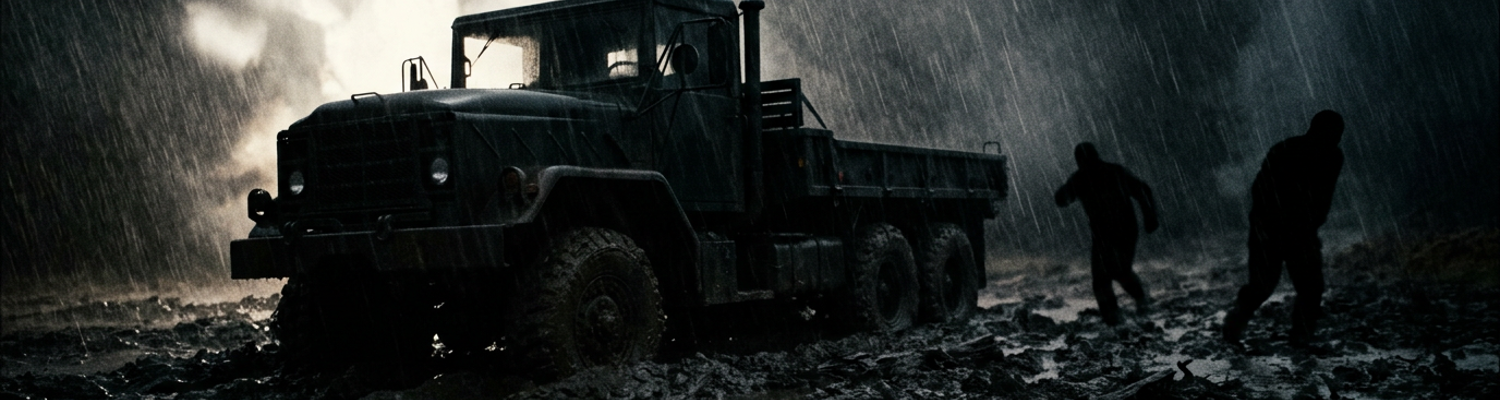

Aftermath Along the Highway 86 Corridor
Across the southern perimeter of the Salton Sink.
Absolute silence blanketed the salt flats during the final minutes before the scheduled kinetic engagement. Vehicle crews sat strapped into darkened cabs. Night-vision optics remained switched off to preserve battery reserves. Radios monitored Company Tactical Net 1 on low squelch (frequency 43.15 MHz). The speakers broadcast only faint background static. Hundreds of Marines checked safety levers on M16A2 service rifles. They secured loose cargo strapping. Everyone waited for the red star cluster pyrotechnic flare to authorize forward movement toward the simulated target objectives east of State Route 86.
The forward push disintegrated before the first live round struck a target.
Archival evidence shows that elements of the 1st Force Service Support Group encountered severe mechanical resistance within minutes of departing the asphalt shoulder at coordinate 33 degrees 12 minutes North, 115 degrees 54 minutes West. Column commanders had selected a direct southwestern bypass around local road congestion. They ordered five-ton M923A1 cargo trucks and M998 High Mobility Multipurpose Wheeled Vehicles off Highway 86 onto what appeared to be sun-baked desert crust.
The surface crust measured only three inches thick.
Beneath this thin layer lay saturated sediment fed by subterranean agricultural drainage runoffs. When the leading heavy tactical vehicles broke through this brittle salt crust, heavy drive axles immediately bottomed out against the frame rails. Drivers engaged all-wheel drive locks. They gunned 250-horsepower turbocharged Cummins 6CTA engines. The high-torque wheel spin instantly severed rear differential pinion gears and sheared universal joints.
Within ninety minutes, over thirty-five transports from 7th Motor Transport Battalion sat locked in place.
Their heavy transfer cases jammed by packed alkaline grit. Recovery vehicles attempting tow operations snapped their heavy steel winch cables. A close review of operational logs indicates that sunrise at 0548 hours exposed the full geographic scope of the wreckage across the western basin flats. Reconnaissance patrols moving south on foot from Desert Shores found empty vehicle hulls sink-trapped up to their windshield glass in grey, hyper-saline sludge.
Marine crews had executed standard defensive abandonment procedures during the night.
They isolated secondary fuel cells. They collected cryptographic code wheels from AN/VRC-12 vehicular radios. They removed the bolt assemblies from mounted M2 heavy machine guns. High concentrations of sodium sulfate in the standing mud had already begun corroding exposed aluminum transfer cases and electrical wiring harnesses. In several low-lying depressions two miles west of the shoreline, twenty-foot trailers loaded with heavy diesel generator sets had settled entirely below grade.
Only upright antennas and exhaust snorkels protruded above the grey sludge.
Marines who had stood watch through the freezing night had pulled back toward the elevated highway embankment to escape toxic hydrogen sulfide gas pockets. Emergency strobe lights flickered unread across empty desert frequencies. When examining the historical record of the recovery phase, emergency response operations suffered immediate command fractures. Staff officers at Camp Pendleton dispatched initial recovery parties from the 1st Maintenance Battalion at 0630 hours without dedicated tactical air reconnaissance or shared grid coordinates.
The resulting relief columns arrived at the Highway 86 junction in small, isolated echelons.
They possessed no operational link to the scattered units stuck in the basin. Search crews in unarmored Dodge M880 utility trucks drove alongside broken telephone poles. They discovered isolated three-man fireteams shivering beside smoldering road flares. Sections from the 1st Medical Battalion operated completely disconnected from headquarters. They set up field triage stations near Salton City without knowing where the stranded drivers were concentrated. The relief elements lacked heavy tracked M88 recovery assets capable of negotiating the alkali mud. Dispatch officers halted thirty vehicles along the pavement shoulder while small retrieval teams attempted to locate missing radio operators on foot.
Casualty Management at the Wildlife Refuge Mudflats
Rising brine obliterated the forward boundary of the aid station within twenty minutes of setup.
Archival evidence shows that 1st Medical Battalion established an emergency triage collecting point at coordinate 33 degrees 11 minutes North, 115 degrees 36 minutes West. This position sat along the salt marsh perimeter of the Salton Sea National Wildlife Refuge. Staff officers had selected the location because hard-packed access roads appeared to offer direct vehicle egress back toward Brawley. By 2200 hours, strong westerly gale winds pushed hyper-saline water over the low shoreline dikes.
Five inches of caustic foam drove across the designated casualty receiving area.
Folding aluminum litter stands sank directly into liquefied silt. Shock patients dumped onto sodden ground tarps. Navy lieutenants ordered the triage line withdrawn sixty yards up a steep drainage berm. Retreating personnel found their combat boots suctioned off by the submerged mud. Two inflatable surgical shelters collapsed when guy-line stakes pulled free from the eroding shoreline. Medical supplies packaged in standard cardboard boxes ruptured on contact with the salt tide.
Thousands of sterile abdominal dressings, gauze rolls, and disposable airway tubes soaked in black silt.
Electrical generators choked on corrosive sea foam and failed across the entire refuge sector. A close review of operational logs indicates that Navy hospital corpsmen managed incoming trauma cases under complete blackout restrictions. They used only cracked Cyalume chemical light sticks. Twelve-hour green and red chemical tubes, looped around necks or gripped between teeth, cast a faint, six-foot pool of illumination over compound fractures and compressed rib cages.
Most casualties arriving from the stranded 7th Motor Transport Battalion convoy suffered blunt-force crushing injuries.
These injuries were sustained when five-ton tactical trucks rolled into soft mud shoulders or when heavy pintle hitches snapped under tow tension. Hospital Corpsman Second Class personnel worked in flooded mud pits. They applied wire-ladder Thomas splints to shattered femurs while thick silt poured into splint padding. White-light flashlights were strictly forbidden under the nighttime operational security order. Medical teams evaluated pupillary responses and arterial bleeding rates by holding green chemical wands two inches from patient faces.
Corpsmen wedged broken wooden transport crates beneath litter stretchers to keep wounded Marines above the rising brine pool.
Surface mud throughout the refuge basin carried a pH level exceeding 9.5. When examining the historical record, medical officers recorded that contact with the high-alkaline lake bed rapidly produced severe chemical skin burns. These burns disrupted standard trauma stabilization protocols. Saturated utility uniforms held concentrated sodium carbonate and sulfate salts against torn flesh. This stripped the epidermis from open wounds and turned simple abrasions into full-thickness chemical lesions.
This alkaline slurry destroyed skin integrity.
Rapid subcutaneous edema completely masked peripheral blood vessels. Corpsmen attempting to initiate fluid resuscitation for hypovolemic shock lost catheter access repeatedly. Standard 18-gauge intravenous needles blew through macerated, friable vein walls. Adhesive medical tape failed to bond against brine-slicked arms. Intravenous lines pulled free whenever litter bearers shifted position in the suction mud.
Facing systemic vascular collapse among multiple crush victims, corpsmen bypassed forearm cannulation entirely.
They cut open trouser legs with trauma shears to perform deep saphenous vein cutdowns. They executed blind femoral punctures by the faint yellow glow of expiring chemical lights.
M923 Five-Ton Truck Hydraulic System Failures
Steering assemblies across thirty-eight tactical transports locked up simultaneously before midnight.
Archival evidence shows that elements of Company C, 7th Motor Transport Battalion encountered severe aerodynamic resistance along the shoreline track at coordinate 33 degrees 13 minutes North, 115 degrees 49 minutes West. Sixty-knot gale winds blasting eastward across the open playa exerted unrelenting lateral pressure against twelve-foot-high canvas troop-bed enclosures. Drivers corrected against this continuous side-load by holding steering wheels at full thirty-degree lock while fighting washboard tracks.
This relentless physical strain pushed the hydraulic power steering assist pumps beyond design tolerances.
Inside the Vickers power-steering pump bodies, continuous high-pressure fluid bypass caused reservoir oil temperatures to exceed 290 degrees Fahrenheit within forty minutes. Hydraulic fluid thinned drastically. It lost viscosity and foamed inside the supply lines. Steering gear boxes suffered catastrophic internal pressure loss as rubber seals degraded and fluid escaped past relief valves. Operators reported sudden resistance spikes that jerked steering wheels violently out of their hands.
Multi-ton vehicles veered sharply off the hard-packed trail into roadside silt banks.
Engines starved of oxygen began shutting down across the rear echelon. A close review of operational logs indicates that gale force winds lifted thousands of tons of desiccated salt and fine silt off the exposed seabed. This generated an airborne particulate cloud that blinded tactical convoys south of Desert Shores. M923 trucks drew intake air through passenger-side cowl openings mounted five feet above the ground. Airborne hypersaline silt entered the Donaldson dry-element filter canisters in massive volumes.
Ambient moisture rolling off the brine sea reacted instantly with the calcium sulfate and sodium chloride crystals.
A dense, cement-like crust formed across the pleated paper filter media. Manifold absolute pressure sensors registered immediate vacuum spikes. Primary air intakes completely choked by alkaline paste. Cummins 6CTA 8.3-liter turbocharged engines suffered severe air starvation. Exhaust gas temperatures surged beyond 1,400 degrees Fahrenheit as fuel injection pumps attempted to compensate for air loss.
Marine drivers who pulled emergency manual filter-bypass switches only worsened the failure.
They allowed abrasive salt grains directly into the intake manifolds. Scoring damaged cylinder walls and caused mass thermal seizures. Every attempt to alter tire footprint accelerated the mechanical collapse. When examining the historical record, maintenance logs reveal that operators attempted to escape the softening mudflats by using the central tire inflation system to drop wheel pressures to cross-country settings.
This command decision triggered a cascade of failures along the axles.
External air distribution lines running to the wheel hubs accumulated thick layers of wet, abrasive salt slurry thrown up by spinning Michelin 14.00R20 radial tires. Salt crystals packed into the clearance gaps between the wheel-hub rotary union assemblies and the brake backing plates. This concentrated sediment acted as a grinding compound against the exposed nylon and stainless-steel braided air lines. Particulate accumulation severed the pressurized inflation tubes at the wheel spindle fittings on twenty-two vehicles within two hours.
Rather than maintaining fifteen pounds per square inch of ground pressure, the severed lines vented onboard reservoirs to zero.
Internal safety check valves jammed open with grit. They exhausted the main air tanks and triggered automatic mechanical spring brakes. Drive wheels locked instantly while convoys were still moving at fifteen knots.
LVTR-7 Recovery Vehicle Mechanical Attrition
Steel track pins shattered under thirty tons of deadweight before midnight.
Archival evidence shows that three LVTR-7 recovery vehicles from Company A, 3rd Assault Amphibian Battalion entered the saturated marshlands near coordinate 33 degrees 14 minutes North, 115 degrees 51 minutes West. They moved to assist stranded logistics echelons. Surface sediment along this sector consisted of deep clay saturated by agricultural runoff and hypersaline brine. The 52,000-pound armored vehicles churned through four feet of liquid mud.
High-density silt packed into the track return rollers and drive sprockets.
This continuous mud accumulation forced track shoe assemblies outward. Track tension increased beyond mechanical limits. Center-guide horns repeatedly jumped off the dual road wheels. Full track bands shed into the mire. Inside the drive compartments, Detroit Diesel 8V53T engines generated relentless rotational force against the locked suspension. Left and right planetary final drive assemblies experienced severe thermal expansion.
Internal bronze thrust washers melted and gear teeth fused solid.
Drivers attempting to clear the track slack by applying differential steering levers sheared the splined input shafts directly at the steering cross-drive transmission housings. Recovery operators pushed their winches straight into thermal ruin. A close review of operational logs indicates that remaining LVTR-7 crews attempted direct recovery of mired M923 five-ton tactical transports using thirty-thousand-pound capacity hydraulic winches. Saturated salt mud created vacuum suction around each trapped truck chassis.
Extraction forces exceeding eighty thousand pounds were required.
Section leaders ordered recovery lines rigged without mechanical advantage to accelerate operations. They bypassed double-reeve snatch block procedures. Hydraulic fluid inside the Gar Wood winch pump circuits rapidly surpassed three hundred degrees Fahrenheit under this severe resistance load. High-pressure hydraulic hoses burst at their swaged coupling joints. Hot petroleum-based fluid sprayed across hot engine exhaust blankets.
Internal directional control valves warped from localized heat buildup.
All pump pressure vented back to the supply reservoirs. Winch friction brake linings glazed over completely. Drum shafts slipped and stripped bronze worm gears under full cable tension. In two instances, winch drive hydraulic motors suffered total rotor seizure. The recovery drums welded stationary. Three-quarter-inch steel extraction cables locked under tension across the mudflats.
Armored support collapsed across the entire western shoreline.
When examining the historical record, maintenance logs document the complete loss of heavy armored recovery capability across the operational area between 0230 and 0500 hours. This sudden breakdown coincided directly with peak evacuation requirements for hypothermic and chemically burned Marines from 7th Motor Transport Battalion. All four deployment-authorized LVTR-7 chassis deadlined in the alkali flats. Forward unit commanders had no assets capable of traversing the liquefying terrain to reach trapped vehicle cabs.
Wheeled M984 wreckers sent forward from 1st Maintenance Battalion lacked flotation tracks.
They bogged down fifty yards past the hard asphalt boundary of State Route 86. Light tactical vehicles dispatched to replace the heavy amphibians slid off drainage levees or suffered submerged electrical failures within minutes. Tracked extraction platforms were required to anchor tow lines or cut physical evacuation channels through the brine. Without them, emergency vehicle movement stopped entirely across five square miles of coastal marshland. Logistics officers suspended all further mechanical retrieval missions. Medical personnel were forced to carry litter patients three miles on foot through deep alkaline mud to reach the highway.
Closed-Basin Microburst Dynamics in the Imperial Valley
Atmospheric pressure over the Salton Sink plunged eight millibars in eleven minutes.
Archival evidence shows that elements of Company B, 7th Motor Transport Battalion were transiting the southern playa at coordinate 33 degrees 10 minutes North, 115 degrees 45 minutes West. An isolated convective cell collapsed over the Santa Rosa Mountains. At two hundred and twenty feet below sea level, superheated ground air collided with a cold descending downdraft channeling directly off the western escarpment. Wind sensors at the Desert Test Center recorded radial outflow gusts accelerating from twelve knots to sixty-one knots within ninety seconds.
These sixty-knot microbursts struck the column broadside across the exposed salt flats.
Vinyl cargo tarpaulins tore instantly from twenty-four M923 cargo beds. Unsecured equipment crates scattered across a three-mile debris fan. Convoy commanders ordered vehicle operators to form a defensive herringbone formation to point truck noses into the gale. High-velocity winds carrying coarse mineral sand stripped automotive paint down to bare steel. Side-mirror assemblies blew out before drivers could reposition their chassis.
Flying gravel cracked laminated safety windshields across eleven leading transports.
Marine crews ducked beneath their dashboards while sixty-mile-per-hour gusts shook twelve-ton chassis violently on their leaf springs. Torrential rain hit the dry lakebed four minutes later. A close review of operational logs indicates that the collapsing storm core dropped 1.6 inches of precipitation across the western flats in under twenty-five minutes. Before the storm, the basin floor consisted of an eight-inch dehydrated crust composed of calcium sulfate, sodium chloride, and dense agricultural silt. Heavy water volume rapidly dissolved this soluble mineral binding layer.
Flash saturation converted the dry alkaline soil into an unnavigable liquid slurry.
This slurry measured two feet deep across an area of twelve square miles. Soil bearing capacity dropped from forty pounds per square inch to under four pounds per square inch almost instantly. Five-ton tactical transports attempted to maintain forward momentum. Fifty-three-inch Goodyear radial tires sliced through the weakened surface mud. Heavy cast-iron Rockwell drive axles dropped directly onto the underlying clay stratum.
Drivers gunning their diesel engines only dug the vehicle frames deeper into the caustic slime.
Thirty-one tactical vehicles were trapped up to their wheel hubs before Company B could establish recovery anchor points. Sinking frame rails displaced fluid mud into open brake drums. Fine alkaline silt packed around the brake shoes and seized the mechanical linkages within minutes. Total visual darkness closed over the dispersed convoy simultaneously. When examining the historical record, maintenance reports confirm that airborne moisture and suspended salt dust eliminated all tactical visibility within seconds of the initial outflow.
Drivers and vehicle commanders attempting to orient themselves through AN/PVS-5 and AN/PVS-7 night-vision goggles experienced complete photopic washout.
Suspended water droplets and hyper-saline crystals refracted ambient starlight. This created an impenetrable luminescence that overwhelmed the second-generation microchannel image intensifier tubes with severe visual blooming. Standard 24-volt vehicle sealed-beam headlamps proved equally useless. Light beams projected straight into dense, churning spray. Glaring white illumination reflected directly back into the cabs and blinded operators to terrain features beyond their front bumpers.
Unable to distinguish between firm soil and water-filled drainage channels, seven drivers steered off the main transit track.
They rolled their five-ton trucks into five-foot-deep agricultural discharge canals at coordinate 33 degrees 09 minutes North, 115 degrees 46 minutes West. Marine drivers who switched off their running lights to rely on infrared blackout markers discovered the particulate cloud completely absorbed the low-intensity beams. Thirty-five transport trucks halted in place three miles from the highway.
Fleet Marine Force Pacific Movement Timetables
Staff planners in Honolulu locked the Pacific march tables to an unyielding timetable eighteen hours before zero hour.
Archival evidence shows that Fleet Marine Force Pacific command directives bound the 7th Motor Transport Battalion to an inflexible march matrix. This matrix was established to coordinate with offshore naval exercises near San Clemente Island. Headquarters watch officers at Camp H.M. Smith enforced arrival windows along the State Route 86 axis between coordinates 33 degrees 19 minutes North, 115 degrees 59 minutes West and 33 degrees 08 minutes North, 115 degrees 42 minutes West down to five-minute intervals. Field barometers operated by forward mobile observation posts registered rapid atmospheric decay by 1800 hours.
Aneroid dial indicators plummeted past 998 millibars.
A dense low-pressure trough settled over the basin floor. Captains leading the transport serials requested an immediate operational delay. They wanted to hold vehicles on high ground near Thermal until barometric pressure stabilized. Logistics controllers flatly rejected these requests. Operational directors mandated that all sixty-four M923 cargo transports clear Checkpoint Alpha by 2030 hours at a sustained transit speed of twenty-eight miles per hour.
Drivers trying to maintain these aggressive speeds fought crosswinds that forced tires against saturated roadside berms.
Eaton transfer case linkages overloaded. Transmission torque converters scorched across seven lead vehicles. Tactical radio traffic dissolved into static twenty minutes past the basin rim. A close review of operational logs indicates that the geographic basin created an absolute radio dead-zone. This severed forward units from the 1st Force Service Support Group control center. Operating at negative two hundred and twenty feet below sea level, vehicular AN/VRC-12 transceiver systems lost direct line-of-sight propagation to the tactical repeater station situated atop Toro Peak.
Cryptographic encryption assemblies on KY-57 NESTOR voice-security units lost digital synchronization.
Ground-wave signals scattered across the ionized alkaline dust layer. Radio operators in the lead serial switched MX-6707 antenna base matching units from low to high power in frantic attempts to bridge the twenty-mile communications void. This excessive load drained vehicle alternator circuits and burned out transistor modules in receiver-transmitter racks. Marine logistics monitors situated at the rear operating base in El Centro received no status updates. Staff officers interpreted the prolonged silence as proof of uninterrupted progress along the asphalt boundary.
When examining the historical record, Naval Air Facility El Centro aerological officers issued flash weather advisory Delta-Nine at 1910 hours.
This advisory warned of severe localized squalls with sustained winds surpassing fifty-five knots. The warning specifically predicted zero-visibility conditions and rapid soil liquefaction across the southwestern salt flats. Communications clerks at the regional switching station routed the dispatch through routine administrative channels rather than the high-precedence operational queue. Shift supervisors at the headquarters dispatch terminal failed to scan incoming priority teleprinter rolls before clearing their desks for evening watch turnover.
Convoy commanders transiting coordinate 33 degrees 11 minutes North, 115 degrees 48 minutes West received no word of the approaching squall line.
Without alert notices, unit leaders ordered vehicle operators to douse headlamps. They proceeded forward under passive night vision into the collapsing convective storm cell. The teleprinter dispatch slip was retrieved from an unread message bin at 0640 hours the following morning.
Fleet Marine Force Pacific Post-Incident Logistical Audit
The formal board of inquiry convened at Marine Corps Base Camp Pendleton sixty-eight hours after the last hull was abandoned.
Archival evidence shows that investigating officers, led by Colonel Arthur Vance, focused immediately on the G-3 operational plans division at Fleet Marine Force Pacific headquarters in Honolulu. G-3 planners had evaluated weather probabilities using ten-year oceanic averages recorded at Naval Air Station North Island. This station was situated over one hundred miles west across the Peninsular Ranges. This methodology completely ignored localized microclimate data compiled by the Desert Test Center and the Imperial County agricultural extension station in Brawley.
Lower elevation topography sitting two hundred and twenty feet below sea level trapped thermal updrafts against cold maritime air spilling through San Gorgonio Pass.
Severe pressure drops generated by this collision were recorded by regional forecasters dozens of times each autumn. Marine staff officers received three separate warnings from regional water district hydrologists regarding subterranean soil saturation along the State Route 86 corridor. Dispatch clerks marked these warnings as low-priority administrative traffic. Inquiry depositions revealed that headquarters watch personnel viewed the Salton Sink as uniform, hard-baked caliche identical to open Mojave training sectors at Twentynine Palms.
They treated a closed hydrological drainage basin filled with agricultural runoff as standard dry wash terrain.
Planners committed sixty-four multi-ton tactical vehicles to a coastal marsh disguised by a paper-thin salt crust. Headquarters prioritized peacetime transit quotas over physical ground reconnaissance. A close review of operational logs indicates that the transit schedule had been calculated using peacetime highway movement tables created for paved Interstate corridors. Logistics controllers at Camp H.M. Smith established mandatory passage quotas requiring sixty-four vehicles to clear five designated checkpoints within four hours.
This plan demanded a sustained twenty-eight mile per hour average speed along unsurfaced desert tracks.
Field commanders on the ground at coordinate 33 degrees 11 minutes North, 115 degrees 48 minutes West observed soil bearing strength dropping below five pounds per square inch. Standing surface brine dissolved the lakebed crust. Captains who requested permission to hold vehicles on high ground near Thermal or divert columns onto paved highway lanes were threatened with administrative relief by rear-echelon watch officers monitoring computer-generated convoy tracking boards. Staff officers operating thousands of miles away in Hawaii insisted on absolute adherence to the movement matrix to synchronize with amphibious exercises off San Clemente Island.
Marine truck drivers, bound by these rigid movement directives, gunned their engines into saturated mud channels rather than miss administrative transit windows.
The Donaldson intake air cleaners had turned to stone. When examining the historical record, Marine Corps Systems Command issued immediate fleet-wide directives altering both mechanical assemblies and tactical command authority across all motorized transport units. Technical teardowns of recovered Cummins 6CTA engines conducted at Marine Corps Logistics Base Barstow revealed that airborne alkaline dust combined with sixty-knot humidity inside standard paper filter housings to create an impermeable calcium-sodium paste.
This paste choked manifold airflow within forty minutes of initial dust contact.
Marine engineers developed a dual-stage cyclonic pre-cleaner system mounted outside the passenger cab cowl. This system utilized centrifugal deflection vanes to eject coarse mineral particulates before intake air reached internal dry paper filter media. The inquiry panel also forced a comprehensive revision of convoy abort procedures in Fleet Marine Force Reference Manual 4-11. Under the updated regulations, the authority to halt, divert, or abort a motorized column was stripped entirely from rear-echelon headquarters staffs.
It was granted unconditionally to the forward convoy commander.
Any motorized unit encountering an unforecast barometric pressure drop exceeding four millibars per hour, or sustained surface winds surpassing thirty-five knots across closed-basin terrain, was mandated to halt and occupy defensive herringbone dispersed formations on hard ground. The directive formally took effect on March 14, 1990.