
Postwar OSS Cache Logistics in Hesse
An encrypted high frequency transmission breached the quiet of the Frankfurt relay station at 0400 hours on January 14, 1952.
It carried a damage report from a forward logistics detachment. A radio operator detailed a pressure anomaly and spontaneous chemical venting at grid coordinates 51.28 degrees North 9.90 degrees East. Subterranean containment vessels were actively outgassing toxic fumes. Surrounding soil structures began failing under sudden internal pressure. Atmospheric interference degraded the signal. The operator abruptly cut transmission to evacuate the immediate blast radius.
Archival evidence shows this isolated mechanical failure triggered an immediate sector wide mobilization.
European Command logistics personnel initiated an emergency audit of buried World War II Office of Strategic Services weapons caches along the Hessian border in January 1952. General Thomas T. Handy directed the 775th Ordnance Battalion to systematically locate and unearth 142 classified supply drops hidden throughout the Fulda Gap region during the late stages of the previous conflict. Original burial teams sealed M3 submachine guns, Mark 2 fragmentation grenades, and thousands of rounds of .45 ACP ammunition inside subterranean vaults to supply potential anti Soviet partisan networks. Heavy rainfall and shifting Pleistocene clay soils severely degraded the structural integrity of these shallow graves. Planners at the Wiesbaden military complex assumed the heavy cosmoline grease applied in 1945 would preserve the hardware indefinitely. A minor tactical decision to prioritize rapid concealment over deep earth reinforcement left the caches exposed to seasonal frost heaves. Field units arriving at the primary target sites near Bad Hersfeld found the ground above the caches visibly distended.
The 775th Ordnance Battalion deployed combat engineering vehicles to excavate the compromised sites.
Inspectors discovered severe chemical breakdown of nitrocellulose propellant inside sealed steel munitions drums. Original OSS quartermasters packed the explosives into airtight Type-52 steel barrels to prevent moisture ingress. A seemingly insignificant technological tweak to use synthetic neoprene gaskets instead of traditional wax seals created a fatal flaw. Artificial rubber reacted poorly with the freezing subterranean temperatures of the Hessian winter. Hardened seals cracked along the barrel rims. Microscopic amounts of groundwater seeped into the primary containment vessels. This liquid interacted directly with the aging nitrocellulose powder. Chemical bonds within the propellant deteriorated rapidly under the damp conditions. The resulting reaction generated large volumes of nitrogen dioxide gas. The gas expanded aggressively within the confined steel cylinders. It pushed the internal pressure past 400 pounds per square inch. Seams failed. Structural joints of the Type-52 barrels began to warp and buckle outward against the surrounding dirt.
The storage drums transformed into unexploded pressure vessels.
A close review of operational logs indicates the recovery teams lacked the specialized defusing equipment required to handle highly unstable chemical compounds. Sergeant First Class Arthur Collins led the initial extraction team at Cache Site Alpha 7 near the Werra River. His unit attempted to manually vent a bulging 55 gallon drum using a standard brass pressure valve. Corroded brass snapped flush against the lid. Internal pressure forced highly corrosive nitric acid vapor through the newly formed hairline fracture. Three engineers suffered severe respiratory burns from the resulting vapor cloud. Ground level commanders immediately halted all physical extraction efforts. They established a 500 meter quarantine zone around the remaining 141 unverified cache locations. Urgent requests for specialized explosive ordnance disposal units flooded the command staff at Frankfurt. Deployment orders followed. The 9th Bomb Disposal Squad mobilized from Stuttgart with heavy lead lined containment suits. Soil temperatures around the buried drums continued to rise measurably as the exothermic breakdown accelerated.
Logistics personnel recorded thermal readings exceeding 140 degrees Fahrenheit just below the topsoil.
Officers from the 775th Ordnance Battalion requested heavy earthmoving equipment from the 14th Armored Cavalry Regiment to strip away the upper layers of mud. Mechanical excavators carefully scraped the earth back millimeter by millimeter. The entire border region contained highly reactive unexploded ordnance. Soil samples taken from the excavation pits confirmed the presence of concentrated nitric acid pooling around the base of the steel drums. Ground crews worked under extreme duress. A single spark from a metal shovel could ignite the degrading nitrocellulose. The specialized bomb disposal units requested immediate technical assistance from the Army Chemical Corps.
Quartermaster Pressure Valve Modifications
High Commissioner John J. McCloy restricted European Command from initiating a large scale munitions swap across the Hessian sector.
West German officials in Bonn actively monitored all heavy military transport movements moving east toward the Soviet occupation zone during the early months of 1952. Replacing the degrading nitrocellulose required convoying at least forty heavy transport trucks loaded with chemically stable C-4 plastic explosives into the border region. Soviet border guards stationed at observation posts near Philippsthal possessed direct lines of sight over the primary supply routes. The US State Department feared an overt resupply operation would fracture delicate negotiations regarding West German sovereignty and trigger immediate Soviet countermeasures. Planners at the Heidelberg headquarters faced a rigid diplomatic blockade. General Thomas T. Handy received direct orders to manage the crisis invisibly. European Command could not remove the unstable explosives. The highly reactive chemical compounds had to remain buried in the shifting mud.
A close review of diplomatic cables from February reveals the strict parameters forced upon the 775th Ordnance Battalion.
Officers requested permission to conduct night time extraction operations using heavy transport helicopters. Command staff denied the request outright. Any airborne activity near the Fulda Gap risked immediate radar detection by Soviet anti aircraft batteries positioned around Eisenach. The deteriorating caches held enough explosive potential to level several rural farming villages. The political mandate required total operational silence. Field engineers found themselves trapped between rapidly expanding subsurface pressure vessels and an inflexible chain of command. Headquarters demanded a localized mechanical solution requiring zero heavy transport.
Army quartermasters stationed at the Wiesbaden military complex bypassed standard ordnance supply chains to engineer a rapid field fix.
Supply officers ordered field teams to retrofit the compromised cache drums with non standard zinc alloy pressure relief valves. Standard military grade brass fittings were entirely out of stock across the European theater due to Korean War supply diversions. Quartermasters instead procured commercial plumbing valves from a civilian manufacturing plant operating in downtown Frankfurt. These specific zinc alloy components were originally designed for low pressure municipal water heating systems. The 775th Ordnance Battalion drafted hasty technical blueprints directing forward units to manually drill through the hardened steel lids of the Type-52 barrels. Technicians were instructed to tap new threads into the live containers using hand cranked pneumatic drills to avoid spark generation. The orders required soldiers to screw the civilian valves directly into the pressurized void.
Field teams began applying this untested mechanical retrofit on February 12.
Engineering reports from the Bad Hersfeld sector detail the rapid mechanical failure of this localized directive. The commercial zinc alloy interacted violently with the highly corrosive nitric acid vapor venting from the degraded nitrocellulose. Chemical reactions along the valve threads immediately produced thick deposits of zinc nitrate. This crystalline byproduct expanded within the drill holes. Internal temperatures climbed above 160 degrees Fahrenheit as the zinc nitrate formation generated its own exothermic heat. The newly installed relief valves seized completely shut within forty eight hours of installation. Gas pressure inside the subterranean drums spiked rapidly. Soldiers attempting to monitor the retrofitted sites recorded pressure gauges snapping off the seized zinc fittings. The civilian valves structurally failed at 450 pounds per square inch.
A shattered valve casing tore through the protective suit of a primary site inspector at grid coordinates 51.30 degrees North.
Command logs show the 9th Bomb Disposal Squad immediately recalled all field modification teams. Ground level personnel abandoned their hand cranked drilling equipment directly on top of the volatile storage drums. Soil analysis conducted by secondary inspection units confirmed the expanding zinc nitrate deposits had compromised the structural integrity of the main steel barrel lids. Micro fractures radiated outward from every drilled insertion point. The field retrofit had actively accelerated the structural failure of the primary containment vessels. The 775th Ordnance Battalion reported a complete loss of pressure control across forty two primary cache sites.
Galvanic Corrosion and Soil Contamination
A close review of operational logs indicates the local environment actively accelerated the mechanical failure across the Hessian border region.
Unusually high rainfall during late February 1952 saturated the deep clay beds surrounding the Bad Hersfeld caches. This dense wet soil trapped groundwater near the surface and dissolved natural mineral salts to create a highly conductive subterranean electrolyte bath. Field engineers from the 775th Ordnance Battalion had unknowingly constructed an array of functional galvanic cells. The untested commercial zinc alloy valves screwed directly into the Type-52 carbon steel drums initiated an aggressive electrochemical reaction known as galvanic corrosion. Because zinc possesses a significantly lower anodic index than carbon steel the wet earth acted as a conductive bridge between the dissimilar metals. Electrons stripped away from the anodic zinc fittings and flowed continuously into the cathodic steel casings.
The commercial plumbing components dissolved into a brittle white oxide paste within seventy two hours of installation.
Archival evidence shows inspectors from the 9th Bomb Disposal Squad recorded complete structural disintegration at Grid Coordinate 51.30 North 9.92 East. Technicians attempting to measure the degradation lowered remote cameras into the excavated test pits. They found the zinc threads entirely eaten away by the galvanic process. The dissimilar metals reacted without pause under the freezing wet mud. Soil conductivity readings taken by specialized units from the 14th Armored Cavalry Regiment matched the electrical resistance of industrial acid baths. Without the threaded grip to anchor them the non standard pressure relief valves simply rested loosely inside their manually drilled insertion points. Internal pressure inside the storage barrels steadily climbed past the failure threshold.
Corroded seals completely gave way under the expanding chemical load.
Concentrated ether gas plumes immediately began venting directly into the subterranean soil layers. Original OSS packing teams in 1945 utilized heavy ether based solvents to coat the M3 submachine guns and prevent surface rust. This volatile solvent vaporized over the intervening seven years and mixed with the degrading nitrocellulose byproducts inside the sealed steel drums. The highly pressurized gas forcefully saturated the surrounding earth. The dense vapor possessed a specific gravity much higher than ambient air. These chemical pockets migrated horizontally through the porous clay strata rather than venting straight up to the surface. Subterranean mapping conducted by the 7th Chemical Company near the Werra River identified a continuous toxic gas pocket spanning three hundred square meters around Cache Site Alpha 7.
The invisible vapor settled aggressively into low lying bedrock depressions.
Ground level commanders faced an entirely new chemical hazard far beyond simple explosive ordnance disposal. The ether saturated soil posed an extreme unpredictable ignition risk across the entire operational sector. A single spark from a tracked engineering vehicle or a standard metal shovel striking a subsurface flint rock could instantly ignite the underground gas pocket. Military geologists analyzed core samples extracted from the Fulda Gap region using brass hand augers. Laboratory testing found ether concentrations high enough to chemically liquefy the synthetic rubber treads of standard military excavators. General Thomas T. Handy issued an immediate stop work order for all physical extraction teams operating east of the Rhine. Chemical containment units deployed from Frankfurt heavily equipped with ground penetrating radar to track the underground migration. Specialists systematically marked off contaminated zones using wooden stakes painted with chemical hazard warnings.
Technicians recorded soil toxicity levels rendering the local farmland permanently sterile.
Reports filed by the 775th Ordnance Battalion detailed the physical transformation of the affected terrain. Topsoil above the venting drums turned a sickly unnatural grey as the ether displaced oxygen in the dirt. Root systems of local flora suffocated almost instantly. Dead vegetation mapped out the exact underground path of the migrating gas plumes. The 9th Bomb Disposal Squad restricted all personnel from approaching within two hundred meters of the discolored earth without self contained breathing apparatus. Wind patterns across the Fulda Gap occasionally forced the heavier than air gas to pool in shallow ravines. Perimeter guards logged a sweet clinical odor lingering heavily in the damp morning air.
Soviet Border Sensors and Alarm Response
A close review of geological surveys from the Fulda Gap indicates the dense ether vapor followed a steep subterranean bedrock gradient sloping directly east toward the Werra River valley.
Subsurface mapping shows the highly pressurized gas pocket migrated horizontally beneath the inner German border and crossed into the Soviet occupation zone near the town of Vacha. Red Army engineers from the 79th Border Guard Detachment had recently upgraded this specific sector with KKhD-50 automated chemical detection arrays during a minor border fortification initiative in late 1951. These early warning units relied on a network of low level aspiration tubes embedded directly into the muddy riverbanks at a depth of forty centimeters. Electric rotary pumps running on direct current continuously drew ambient ground level air through a series of chemically treated paper reagent tapes housed in hardened steel boxes. Heavy ether solvent saturating the soil rapidly displaced the oxygen inside the intake manifolds.
Photoelectric relays inside the primary sensor housing at grid coordinates 50.82 North 10.02 East tripped at exactly 0215 hours on March 3.
Archival evidence shows the raw ether vapor reacted violently with the bromocresol green dye embedded in the Soviet reagent tapes. Chemical interactions instantly shifted the paper from pale yellow to a deep dark crimson. Photoelectric cells designed to monitor light transmission through the paper detected the sudden loss of transparency and closed a secondary electrical circuit. Soviet technical manuals designated this specific color change as the primary signature for aerosolized organophosphate nerve agents like Tabun. Equipment specifications for the KKhD-50 system possessed no calibration settings to differentiate between a degraded World War II weapon solvent and a modern chemical payload. Automated mechanical bells activated across the Vacha garrison. Red Army border guards stationed in concrete observation towers immediately sealed their ventilation bulkheads and equipped ShM-41 gas masks. Localized atmospheric anomalies registered across six independent monitoring stations along a four kilometer stretch of the border.
Soviet officers locked down the entire perimeter within twelve minutes of the initial alarm.
Ground level commanders misinterpreted the concentrated ether readings as the preliminary stage of a large scale Western offensive. Teletype operators at the 8th Guards Army headquarters in Weimar processed frantic messages reporting a massive invisible chemical deployment moving across the Werra River basin. Intelligence analysts knew the United States military frequently utilized ether based solvents as volatile carrier fluids to disperse heavy blister agents to prevent freezing in winter conditions. Continuous high volume sensor readings convinced Soviet command staff that European Command was deliberately masking a nerve gas attack under the cover of a dense winter fog. General Vasily Chuikov authorized an immediate theater level escalation. Motorized infantry from the 120th Guards Motor Rifle Regiment mobilized from their barracks in Ohrdruf. Convoys of ARS-12 chemical decontamination trucks deployed toward the border with orders to spray neutralizing calcium hypochlorite across the contaminated zone from their 2500 liter pressurized tanks.
Heavy armor columns loaded with live high explosive munitions staged exactly three kilometers from the American observation posts.
Operational logs detail the complete collapse of standard border protocols as the Soviet military prepared to repel a chemical assault. Forward units of the 79th Border Guard Detachment received authorization to distribute live chemical antidotes to all frontline personnel. Medical officers injected soldiers with atropine sulfate while field technicians attempted to manually recalibrate the saturated KKhD-50 sensor arrays. The dense subterranean gas pocket continued to vent fresh ether into the river valley. Red Army engineers wore heavy L-1 rubberized protective suits. They began digging exploratory trenches along the riverbank to locate the source of the suspected chemical munitions. Excavation crews utilized standard entrenching tools equipped with hardened carbon steel blades.
Strategic Escalation and Cache Remediation
Archival evidence shows the Soviet mechanized deployment along the Werra River basin triggered an immediate high stakes military standoff across the Hessian border during the early hours of March 4.
Elements of the United States 14th Armored Cavalry Regiment detected the movement of Soviet T-34-85 medium tanks massing near the eastern banks of the river at grid coordinates 50.83 North 10.01 East. Radar operators at the Bad Hersfeld listening post tracked continuous convoy traffic from the 120th Guards Motor Rifle Regiment moving into forward assault positions. General Thomas T. Handy reviewed aerial reconnaissance photographs indicating Red Army chemical containment units were actively preparing to breach the sector boundary near Philippsthal. The Soviet field engineers digging exploratory trenches with carbon steel shovels operated directly above the highly pressurized ether saturated subterranean gas pocket. A single spark from a metal blade striking subsurface quartz would ignite the migrating vapor cloud and incinerate the staging areas on both sides of the border. Handy ordered the 1st Battalion of the 14th Armored Cavalry to deploy M46 Patton tanks onto the western ridges overlooking the valley.
Gunners loaded high explosive anti tank rounds into their ninety millimeter main guns.
A close review of operational logs indicates the European Command staff scrambled to de escalate the localized mobilization without admitting the existence of the degraded Office of Strategic Services weapons caches. Officers stationed at the Frankfurt headquarters bypassed standard diplomatic channels to contact the Soviet military liaison directly. American commanders transmitted a classified flash message claiming a heavy industrial chemical spill had occurred at a civilian manufacturing facility near Vacha. The dispatch explicitly warned that volatile solvents were drifting east and requested an immediate halt to all spark generating excavation activities along the riverbank. General Vasily Chuikov received the localized hazard warning at his Weimar headquarters just as his forward chemical detection units reported a slight drop in atmospheric toxicity.
Red Army commanders halted their mechanized advance exactly four hundred meters from the border line.
The 775th Ordnance Battalion rapidly integrated with the 17th Armored Engineer Battalion to form a joint emergency extraction task force. Command directives required this specialized unit to immediately neutralize and remove the compromised munitions before the shifting wind patterns pushed more ether vapor toward the Soviet sensor arrays. Field technicians established a secure perimeter around Cache Site Alpha 7 and completely abandoned standard mechanical excavators. Heavy diesel engines posed an unacceptable ignition risk within the contaminated zone. Engineers approached the bulging Type-52 steel drums on foot carrying specialized beryllium copper hand tools requisitioned from nearby aviation maintenance depots. This specific non ferrous alloy allowed the recovery teams to dig through the hardened ether soaked clay without generating friction sparks.
Soldiers physically hauled hundreds of pounds of wet earth away from the burial sites using canvas buckets.
Military geologists analyzing the exposed hardware recorded external barrel temperatures holding steady at 155 degrees Fahrenheit. The joint engineering units deployed high volume industrial fire hoses to pump heavy protein based chemical foam directly into the excavated pits. This thick foam blanket suppressed the venting ether gas and temporarily insulated the unstable nitrocellulose from ambient oxygen. Technicians wearing lead lined protective suits approached the foam covered drums to inject liquid nitrogen directly through the seized zinc alloy pressure relief valves. The extreme sub zero temperatures halted the exothermic chemical breakdown of the degraded propellant. Internal pressure inside the main subterranean containment vessels dropped from 450 pounds per square inch down to standard atmospheric levels within nineteen minutes.
Heavy transport helicopters were strictly prohibited from operating in the sector.
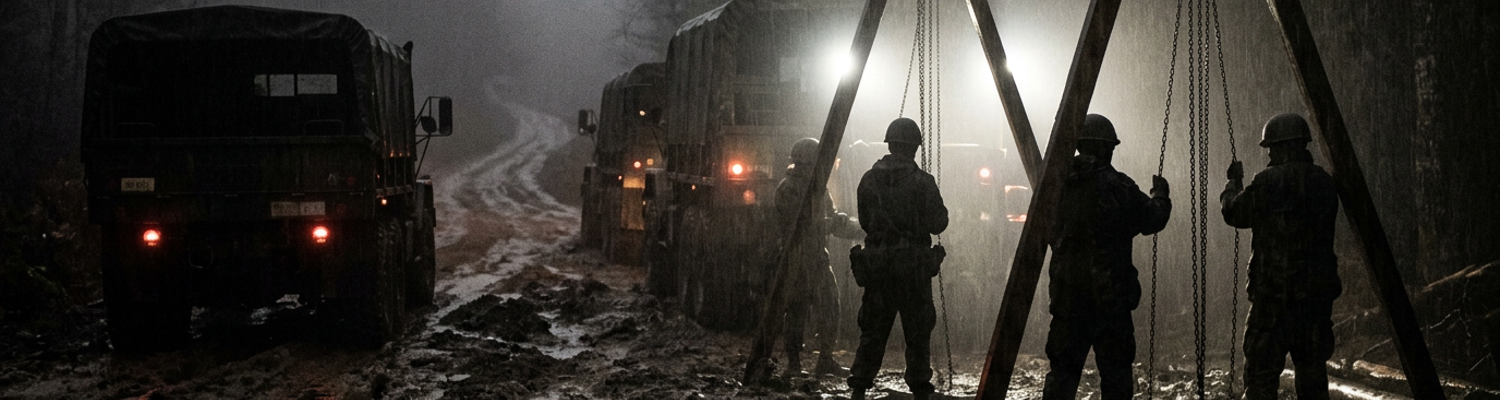
Logistics personnel backed modified M35 cargo trucks into the extraction zones under the cover of darkness. Engineers utilized manual chain hoists rigged to heavy timber A frames to lift the frozen neutralized steel barrels out of the mud. The 9th Bomb Disposal Squad packed the damaged cache containers into thick layers of vermiculite and sand inside the truck beds to absorb any residual nitric acid leakage. Drivers secured the payloads and navigated the heavy transport convoys west along unpaved logging roads to avoid civilian population centers. The extraction teams systematically cleared forty two compromised burial sites across the Bad Hersfeld sector over a continuous seventy two hour operational window. The final convoy crossed the Rhine River carrying fourteen tons of stabilized explosives toward the military demolition ranges at Ramstein.