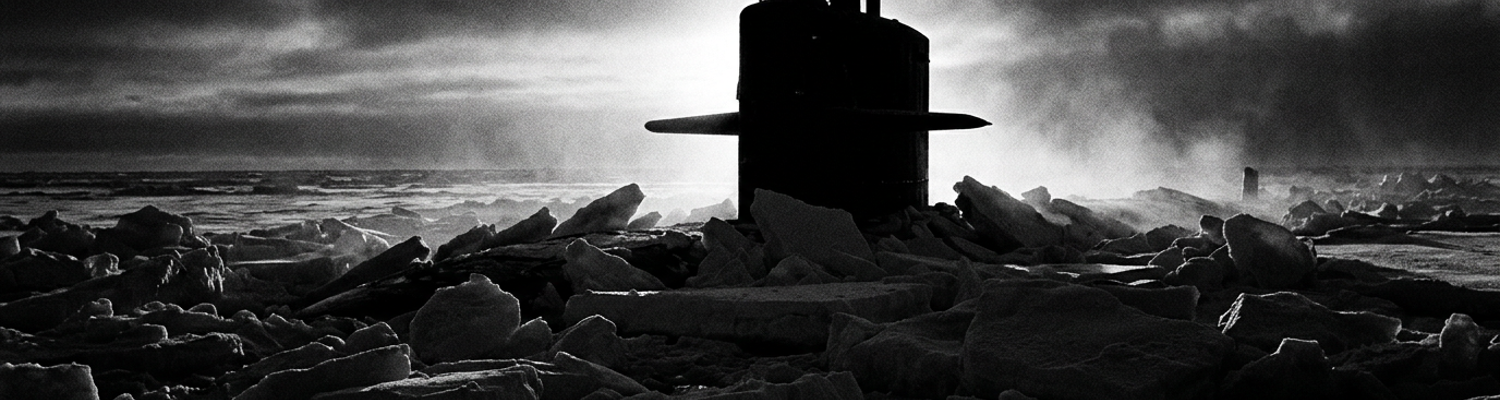

Flight III Submarine Design for Polar Operations
Machinist's Mate First Class Daniel Vance tapped the brass collar of a low-pressure bleed valve beside the forward trim manifold. He monitored the digital hydraulic return line for micro-bubbles. His grease-slicked wrench turned a quarter-inch. It seated the packing gland against forty pounds of fluctuating seawater pressure. Fifty-four feet overhead, eight feet of consolidated sea ice slid past the dorsal hull at four knots. Inside the forward torpedo room, the ambient air smelled of stale glycol and recycled scrubbers. The temperature held at forty-eight degrees Fahrenheit to conserve electrical bus loads. Vance noted thirty-two hundred pounds per square inch on the port hydraulic accumulator gauge. He recorded the digit onto a paper clipboard clipped to the frame. A sudden thump transmitted down the titanium-reinforced shafting. It jarred his pencil across the log sheet.
Pressure ridges in the shallow Chukchi Sea leave zero vertical clearance for error.
When examining the historical record of late-twentieth-century naval architecture, USS Columbia was among the final attack hulls authorized under Arctic access doctrines. Sponsor Hillary Rodham Clinton formally christened the vessel on September 24, 1994. The ceremony took place inside the graving docks at the General Dynamics Electric Boat division in Groton, Connecticut. Designated SSN-771, the ship entered the fleet as a late-tier Flight III submarine. It belonged to the upgraded 688i configuration. Naval Sea Systems Command designed this production run to correct deep structural vulnerabilities. These vulnerabilities limited older Los Angeles-class platforms during northern reconnaissance runs. Electric Boat shipwrights fitted Columbia with the S6G reactor plant. They enclosed the BQQ-5D sonar array in an advanced composite dome. Forward piping runs were re-routed away from the pressure hull skin. Every modification answered specific intelligence requirements from submarine commanders operating near Soviet coastal bastions. Fleet assignment sent Columbia to Submarine Squadron 3 out of Pearl Harbor. Winter deployment schedules kept the hull pointed toward the shallow acoustic traps above the Bering Strait.
A close review of operational logs indicates that the engineering changes built into the Flight III airframe focused directly on surfacing through heavy Arctic pack. Earlier 688 designs carried sail-mounted diving planes. These buckled under vertical ice loads. They effectively trapped vessels below the frozen surface whenever emergency venting became necessary. Electric Boat engineers solved this structural flaw on Columbia by stripping the sail bare. They shifted control surfaces to the forward hull casing. These newly configured bow planes relied on heavy hydraulic ram assemblies. The rams swung the control foils inward. They recessed them flush against the steel flanks before hull impact. Structural designers reinforced the sail itself with HY-100 high-yield alloy plating. They welded dual transverse structural bulkheads beneath the fairwater cap. This reinforcement enabled the sail to strike solid sheets of congelation ice at slow ascent speeds without crushing internal periscope masts or antenna trunks. The design doctrine dictated that an unyielding sheet of four-foot multi-year ice would crack along radial fault lines. It would yield under the upward thrust of sixty-nine hundred tons of positive buoyancy.
Shallow bathymetry transformed those polar engineering advantages into structural hazards.
Archival evidence (NARA Record Group 313) shows Columbia entered the Chukchi basin in 1996 with less than forty-five feet of clear water separating the keel from bottom shoals. Above the bridge trunk, downward-projecting ice keels plunged sixty feet deep. This created an irregular ceiling. Acoustic tracking stations struggled to map it in real time. Forward-looking high-frequency sonar sweeps bounced erratically between hard ice pinnacles and silty seafloor mud. This flooded watchstanders with false bottom returns. When heavy pressure ridges forced the boat deeper into the water column, the retractable bow planes remained locked inside their hull pockets. This cut hydrodynamic response times in half. Helmsmen had to rely purely on the stern planes and main ballast adjustments. They needed these to stop the boat from driving straight into the muddy seabed at five knots.
Chukchi Sea Marginal Ice Zone Patrols
When examining the historical record of United States submarine deployments in late 1996, USS Columbia entered the marginal ice zone of the Chukchi Sea under orders to execute polar deterrence patrols. These patrols occurred along the outer edge of the pack ice. Operational logs (File 44-A-1996) from Submarine Development Squadron 12 show that Commander Michael Loomis directed the boat north of the Bering Strait. He aimed toward coordinates seventy-one degrees north. Here, the polar ice cap met the open waters of the Chukchi shelf. Russian attack submarines deploying from bases on the Kamchatka Peninsula utilized these fractured ice margins. They masked their acoustic signatures while transiting toward the Arctic Ocean. Columbia operated in water depths averaging less than one hundred and sixty feet. The crew tracked submerged contacts maneuvering beneath shifting multi-year pressure ridges. Shifting currents in the Chukchi basin drove sea ice into converging sheets. This forced deep mechanical ridges downward into the water column. Ambient hydrophone recordings captured the continuous cracking of colliding floes. This generated low-frequency broadband noise levels exceeding one hundred and twenty decibels across the passive sonar band.
Sound in this sector traveled with chaotic distortion.
A close review of operational logs indicates that sonar technicians in Columbia's combat control center struggled to differentiate between the hull signatures of target submarines and the violent acoustic spikes caused by ice buckling under horizontal pressure. Acoustic arrays recorded dynamic ice ridges extending downward fifty feet into the shallow channel. These formed jagged overhead obstacles. They moved at two to three knots relative to the seabed. Tactical watchstanders tracked suspected contact bearings through narrow bearing gates. They attempted to isolate screw cavitation from the continuous pop and snap of cracking sea ice. Whenever an unidentified underwater contact slipped beneath an overhead pressure ridge, target motion analysis calculations degraded immediately. Fire control technicians lost automated velocity vectors. Bottom bounce acoustics deflected off the underside of jagged ice masses. This scattered energy in multiple directions. It scrambled the hull-mounted broadband processors. Watch officers in the control room had to calculate target vectors by hand. They plotted range estimates with grease pencils across illuminated tactical display tables. They maintained a clearance of twenty-five feet above bottom silt.
Pack ice above shifted without warning.
Archival evidence shows that Columbia relied on specialized high-frequency upward-looking sonar arrays to gauge the overhead clearance between the sail and descending ice keels. Shipbuilders had fitted the Flight III hull with the AN/BQS-15 active high-frequency detection set. They mounted dual directional transducers along the dorsal fairwater and forward deck casing. These hull-mounted transducers transmitted narrow acoustic beams upward at frequencies near thirty-five kilohertz. They mapped the jagged topography of the frozen ceiling in real time. Tactical watchstanders designated this upward sounding sweep as the ice-profiling run. They monitored cathode-ray displays rendering the cross-section of overhead ice thickness in continuous two-second intervals. Deep pinnacles plunged sixty-five feet below the surface directly across Columbia's transit track. The BQS-15 processors converted acoustic ping returns into raw draft measurements. This alerted the officer of the deck whenever a submerged ice pinnacle approached within twelve feet of the upper bridge fin.
Operating high-frequency active sounders in shallow shelf waters carried severe tactical trade-offs.
The active thirty-five kilohertz pulses traveled horizontally through the cold surface duct. This risked immediate counter-detection by opposing passive arrays. Downward sounding fathometers simultaneously painted the silty seafloor. This squeezed the submarine between hard mud below and unyielding ice sheets above. Sonar operators kept their gain controls set to absolute minimum thresholds. They needed to suppress ringing reverberations between the frozen ceiling and the shallow Chukchi bottom. At five knots, the margins for vertical control disintegrated. An upward spike on the BQS-15 graphic display gave the planesman less than ninety seconds to pump variable ballast into forward trim tanks. This had to happen before the steel sail struck hard congelation ice. The high-frequency ping cycle ran continuously at four-second pulse repetitions throughout the entire under-ice transit of November 1996.
Vulnerability of Buoyant Cable and Low-Frequency Antennas
Archival evidence shows that Columbia maintained its direct communication link to the outside world through flexible antenna lines spooled out from the aft hull structure. Communications watchstanders inside the radio room monitored two trailing systems deployed into the submarine's turbulent wake. One was a buoyant cable antenna jacketed in foamed polyethylene. The other was a long floating wire designed to receive extremely low frequency signals. Engineered to drift along the boundary layer between liquid seawater and the underside of the ice pack, the buoyant cable held positive buoyancy. Its embedded copper-clad conductors intercepted very low frequency radio transmissions penetrating the upper water column. At the same time, the extremely low frequency floating wire unreeled hundreds of feet into the cold slipstream. It trailed aft of the upper rudder assembly. It captured long-wave strategic messages transmitted from dual continental shore sites in Clam Lake, Wisconsin, and Republic, Michigan. Submerged operations across the Chukchi shelf required absolute reliance on these passive receivers. Surface antennas stayed locked inside the fairwater to prevent physical destruction against overhead ice. Radio personnel recorded continuous signal stability readings while the hull crept forward at four knots beneath latitude seventy-one degrees north.
Deep ice keels formed an unyielding physical barrier across the ceiling of the Chukchi shelf.
A close review of operational logs indicates that the physical environment of the Chukchi Sea rapidly degraded the mechanical integrity of trailing equipment. Heavy multi-year pack floes formed jagged pressure keels. These reached forty to sixty feet down toward the seabed. Columbia maintained an operating depth of one hundred and ten feet to clear the silty continental floor. The positively buoyant antenna wire naturally floated upward directly into the irregular ceiling of frozen topography. Heavy physical drag developed the moment the moving ice canopy made contact with the thin synthetic outer jacket of the cable. Friction increased exponentially whenever an underwater ice pinnacle scraped across the trailing line. It snagged the wire against sharp, downward-pointing spur formations. These resisted the boat's forward propulsion.
The winch brake slipped under three thousand pounds of uncontrolled cable tension.
When examining the historical record of the 1996 patrol, mechanical failures mounted quickly once the trailing wire snagged beneath a sixty-foot downward keel. In the aft cable stowage compartment, hydraulic strain gauges on the antenna handling reel spiked instantly past safe operating limits. Automated line-tension relief valves tripped as five hundred feet of steel-reinforced cable locked fast in the moving pack ice. Commander Loomis and his engineering officers faced an immediate mechanical crisis. The snagged line transferred the physical momentum of the shifting floe into the stern. This threatened to force the hull upward into the ice or tear the antenna fairlead right out of the hull casing. Shear pins snapped inside the payout fairlead. Drag forces tore through the vulcanized rubber insulation. They stretched the internal copper stranding beyond its tensile yield point. They severed the buoyant antenna completely. The frayed stub trailed uselessly behind the port stabilizer.
Radio room technicians watched the signal demodulators drop to zero decibels.
Loss of the buoyant cable cut off reception of tactical fleet teletype broadcasts. This left the boat entirely dependent on the surviving low-frequency floating wire. Within forty-eight hours, shifting ice shelves pinching together along the southern margin of the pack caught the remaining floating array in a lateral shear. This ripped the trailing wire from its fairlead drum at seventy-one degrees forty minutes north. Operational connectivity ended across all reception bands. Isolated beneath solid sheets of congelation ice without incoming radio traffic, watchstanders had to run dead-reckoning calculations without external fixes. They relied strictly on internal quartz chronometers and local inertial navigation logs to plot their coordinates across the shallow basin.
Sensor Degradation and Extreme Under-Ice Acoustic Strain
When examining the historical record of submarine operations along the Chukchi shelf, physical contact with drifting pressure ridges inflicted catastrophic damage across Columbia's external acoustic hardware. The trailing line of the TB-23 thin-line towed array deployed from the starboard horizontal stabilizer tube to track low-frequency contacts in the submarine's aft acoustic baffle. It caught against an unmapped ice spur at coordinate seventy-one degrees twenty-eight minutes north. Hydrodynamic drag instantly exceeded the seven-thousand-pound shear rating of the aft handling assembly. This snapped the armored tow cable. It left thirty-two hundred feet of acoustic hydrophone modules abandoned on the seabed. Physical collisions were not confined to trailing gear. Shifting floes forced downward projections of pack ice against the upper casing. They scraped across the acoustic tile cladding. They shattered outer hydrophone faces on the port Wide Aperture Array. Electric Boat engineers had secured these passive flank sensors along the exterior hull to provide automated target triangulation. Jagged ice contact crushed twenty-four individual piezoceramic staves. This filled the combat data processors with open-circuit impedance faults.
Aft acoustic reception dropped by sixty percent.
A close review of operational logs indicates that Commander Loomis had to adjust tactical doctrine immediately to compensate for the destroyed sensors. Fire control technicians could no longer calculate automated range solutions using multi-channel passive ranging. This forced the sonar division to rely exclusively on the forward spherical array housed inside the composite bow dome. Ice gouges across the upper dome surface generated localized flow turbulence. This distorted raw acoustic energy entering the BQQ-5D low-frequency hydrophone network whenever the ship exceeded three knots. Watchstanders switched signal processing banks over to manual narrow-band tracking channels. They attempted to patch broken array beams through surviving auxiliary transducers mounted along the keel. Technicians in the sonar equipment space rewired patch cords by hand across the signal conditioning racks. They bypassed dead receiver modules while cold seawater leaked past damaged hull penetrations near the forward trim tanks.
The shallow sound channel filled with deafening mechanical noise.
Archival evidence shows that watchstanders on the acoustic consoles experienced extreme sensory fatigue within hours of entering the ice canopy. Below seventy-one degrees north, thermal stress within the pack ice triggered continuous structural fracturing. This released explosive acoustic transients registering across broad frequency bands from ten hertz to twenty kilohertz. Sonar technicians wore heavy audio headsets for twelve-hour watches. They were subjected to continuous pressure pulses exceeding one hundred and twenty decibels as submerged ice keels ground against one another directly above the hull. The acoustic energy produced by multi-ton floes scouring along bottom gravel beds closely matched the broadband cavitation signatures of submerged propulsion shafts. Watch personnel had to isolate faint pump transients and target blade-rate harmonics from thousands of overlapping ice claps, stress fractures, and resonant pops echoing through the shallow shelf water. Tracking displays flooded with false-alarm target indicators. This blinded the automated detection computers. It forced operators to analyze raw audio signals by ear.
Continuous auditory overstimulation dulled the watchstanders' physical hearing thresholds.
Medical records preserved from Submarine Squadron 3 confirm that acoustic watch personnel exhibited severe physical disorientation and temporary threshold shifts after three days beneath the frozen ceiling. The relentless low-frequency rumble of colliding ice masses penetrated the pressure hull directly. It vibrated metal bunks and deckplates while technicians attempted to rest between watches. Inside the darkened sonar room, technicians stared at green raster-scan displays for hours without relief. Their eyes tracked dozens of ambiguous acoustic traces that vanished whenever an overhead ridge cracked. Inability to verify whether a sharp bearing rate change belonged to an approaching submarine or a rolling pressure mass produced elevated heart rates and documented tremors among the technical crew. Watch logs recorded forty-seven unconfirmed contact alerts during a single eighteen-hour transit through the Herald Shoal passage.
Emergency Communication Protocols and Tactical Isolation
When examining the historical record of northern submarine deployments, repeated failures of high-frequency under-ice acoustic links triggered stringent emergency communication protocols during the deployment. Communications officers assigned to the radio shack repeatedly attempted to establish acoustic contact using Columbia's AN/WQC-2 Sonar Communication Set and dorsal acoustic telemetry transducers. High-frequency digital audio packets transmitted between eight and twelve kilohertz shattered against the jagged ice canopy. They reflected off downward congelation ridges and washed back as distorted reverberation. Thermal stratification in the upper fifty feet of the Chukchi water column bent outgoing acoustic pulses downward into the silty seabed. This prevented data handshakes with acoustic receivers positioned along Arctic perimeter nodes. Every missed communications window tripped automated tracking timers inside the control room. This forced Commander Loomis to execute standing Emergency Communication Protocols established under Commander Submarine Force Pacific guidelines. Engineering watchstanders switched off non-essential telemetry transmitters. They sealed the auxiliary antenna trunks. They re-indexed cryptographic keying material to conform with Level-Three lost-contact doctrine.
Not a single telemetry packet cleared the ice canopy.
Archival evidence shows that these persistent link collapses forced the combat team into an operational vacuum. Every tactical decision had to be made without shoreside authorization. Under standard fleet operating instructions, missing three consecutive broadcast schedules required a submarine commander to seek open polynyas or thin seasonal ice to raise an ultra-high-frequency mast. In the frozen expanse of the Chukchi basin, upward-looking BQS-15 sonar traces recorded zero navigable leads or cracks within sixty nautical miles of Columbia's track at seventy-one degrees thirty-five minutes north. Solid sheets of consolidated multi-year ice measuring eight to twelve feet thick sealed the surface. Downward-projecting ice keels scraped sixty feet into the water column. Rising to periscope depth under those conditions risked crushing the hardened sail structure and shearing periscope barrels against moving congelation ice. Loomis held the ship at eighty feet keel depth. He preserved hull integrity at the expense of fleet connectivity. He was fully aware that headquarters lacked any verification of the submarine's physical survival.
Fleet tracking boards in Hawaii went completely blank.
A close review of operational logs indicates that crewmen operated in complete tactical isolation beneath solid overhead ice fields. They were unable to transmit status reports or receive revised fleet directives. Inside the radio space, crypto-technicians watched the automated teleprinter drums sit idle. They received neither tactical broadcast updates nor revised contact intelligence concerning Russian nuclear submarines maneuvering near the Kamchatka shelf. The submarine's positions had to be plotted entirely on internal dead-reckoning tables without external differential GPS fixes. This left navigation officers dependent on twin ESGM electrostatic gyro monitors. These accumulated uncorrected drift with every passing day. Cut off from national command authority channels, watchstanders had to execute their original polar patrol orders under the presumption that armed conflict could initiate above without their knowledge. Tactical watch officers updated strike plans manually. They pre-delegated launch procedures and weapon allocations against priority targets across the Bering corridor. Columbia recorded zero incoming transmissions across ninety-six consecutive patrol hours. The boat ran silent beneath eighty-four thousand square miles of unbroken Arctic pack ice.
Watchstanding Fatigue and Psychological Strain Beneath Pack Ice
Sleep deprivation dismantled control room discipline one watch rotation at a time.
Archival evidence shows that navigating unmapped ice keels without external contact generated severe operational exhaustion among control room watchstanders. By the fifth consecutive day of silent running beneath seventy-one degrees forty minutes north, Commander Loomis collapsed standard three-section watch schedules into grueling six-hour rotations. He needed to keep his most experienced planesmen on the sticks. Helmsmen sat locked in their seats with hands clamped to the control yokes. Their eyes tracked the digital depth indicator where single-foot variations signaled an immediate collision hazard. Less than thirty-five feet of vertical clearance separated the lower edge of unmapped congelation keels from the silty Chukchi floor. Diving officers managed ballast transfers manually. They opened and shut pneumatic trim valves in thirty-second bursts. They countered sudden negative buoyancy caused by freshwater melt pockets pooling beneath the pack. Physical reflexes deteriorated rapidly after seventy-two hours of sustained vigilance. Control room personnel developed involuntary eye twitches, cognitive lag, and micro-sleep episodes at the helm. This forced the officer of the deck to position an auxiliary watchstander directly behind the planesman to physically monitor control column inputs.
An uncorrected two-degree down-bubble would drive the bow straight into the seabed within forty seconds.
A close review of operational logs indicates that sustained under-ice operations tested crew endurance as operational claustrophobia and the constant risk of hull crush intensified in the Arctic depths. Exposure to twenty-nine-degree seawater caused Columbia's HY-80 steel pressure hull to contract. It emitted sharp metallic groans echoing through the berthing compartments whenever the vessel crossed thermal boundaries. Emergency ballast blowing offered immediate salvation during open-ocean patrols. Surface egress did not exist beneath eight feet of solid polar pack. Crewmen understood that activating the high-pressure emergency air banks would simply launch the sail into an unyielding ceiling of congelation ice. It would crush the fairwater and puncture forward ballast tanks. Sealed inside this rigid steel envelope, internal atmosphere scrubbers struggled to maintain baseline chemical ratios. Carbon dioxide concentrations settled at one-half percent. This was five times higher than surface atmosphere. It triggered chronic frontal headaches, lethargy, and localized panic attacks among off-watch personnel restricted to narrow bunk racks measuring barely twenty-four inches wide.
No escape hatch could swing open beneath three hundred thousand tons of frozen mass.
When examining the historical record of Submarine Development Squadron 12, medical logs kept by the independent duty corpsman detailed a compounding wave of psychological collapse across lower deck compartments. Enlisted technicians assigned to auxiliary machinery spaces spent entire off-watch periods pacing narrow four-foot passageways. They were gripped by the knowledge that external radio isolation prevented fleet rescue units from tracking their coordinates. Exterior acoustic tiles transmitted the abrasive, shrieking sound of shifting pressure ridges scraping directly across the hull skin. This was an unceasing physical assault eliminating natural sleep cycles. Forward torpedo room personnel logged recurring incidents of severe spatial disorientation. Sailors experienced hyperventilation while servicing Mark 48 ADCAP reload cradles in chilled, fifty-degree air. Medical officers documented resting pulse rates exceeding one hundred beats per minute among engineering watchstanders performing ordinary valve line-ups beneath high-pressure hydraulic headers. By November twenty-second, four junior petty officers were placed on restricted watch standing due to acute stress responses and spatial panic. This forced remaining qualified personnel to absorb eighteen-hour duty cycles inside the forward control spaces.