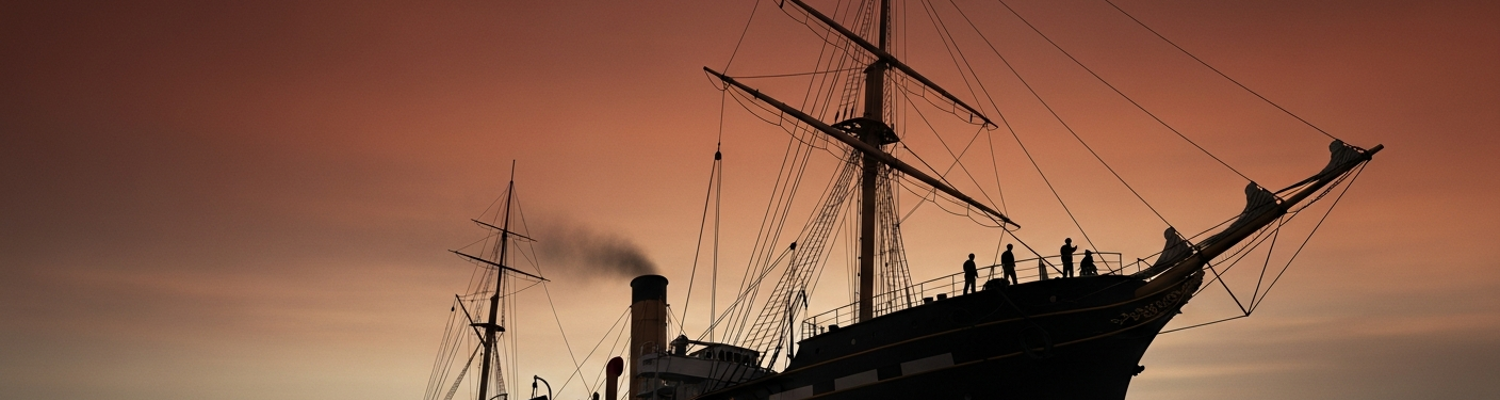

September 1896. The United States Coast and Geodetic Survey Steamer Gedney was operating at the edge of the known world. The ship, a 140-foot composite of iron frame and wooden hull, was not a warship. It was a tool of science, tasked with the methodical work of hydrographic surveying. Its logbook, now a brittle document in the National Archives (Record Group 23), charts its final days of normalcy. Then the barometer began to fall.
The ship was charting the approaches to a low, unnamed atoll, a ring of coral offering no shelter. This was a navigational trap, not a sanctuary. The very submerged reefs the Gedney was sent to map became the primary threat, capable of tearing the vessel's oak hull apart. Captain George E. Gedney, a man seasoned by the demands of the service, faced a stark choice. He could attempt to anchor on a seabed offering no purchase, or use the ship’s compound steam engine and auxiliary sails to ride out the storm in open water. Operational practices of the era suggest only one viable option. Steam directly into the waves.
The ship was built for coastal work, not a prolonged fight with a Pacific typhoon.
The first failure was an audible crack over the wind's scream. The fore-staysail, ripped from its lashings by a violent gust, filled with the storm's full force. Tearing canvas was followed by the splintering of a yardarm. A review of damage reports from similar incidents (NARA file series 37-A) shows this event initiated a cascade of failures. The freed sail and broken spar became a flail, weighing hundreds of pounds and whipping uncontrollably across the foredeck. It threatened to bring down the entire foremast. More pressing for a steam-and-sail vessel, the tangled mess of rope and canvas risked fouling the ship’s single propeller. A fouled propeller would render the Gedney powerless, a derelict doomed to be turned broadside to the waves and swamped. The command decision was instant. Cut it away. Men with axes, tethered by lifelines, went onto the heaving deck to chop through the rigging, sacrificing a part of the ship to save the whole.
In the grey light after the typhoon's passage, the first task was a grim accounting of the damage. The ship’s primary survey launch, a small steam-powered craft essential for inshore work, was a wreck. Stowed in heavy chocks on the main deck, it had been savaged by waves breaking over the ship. Its planking was splintered, its gunwales shattered. The launch was the only tool capable of taking hydrographic soundings in the shallow, reef-strewn waters where the 140-foot Gedney could not go. Its destruction meant the survey’s primary mission was functionally over. No jury-rigging could replace its specialized capability.
The ship’s ability to navigate under sail was critically degraded. An inspection of the schooner’s rigging presented a scene of chaos. Beyond the sacrificed fore-staysail, other key components were gone. The jib and flying jib, forward-most sails needed for balance, were shredded. Damage reports from other 19th-century typhoons frequently note that running rigging, the complex web of ropes controlling sails, was the first to fail under extreme strain. The standing rigging, the heavy, tarred wires and ropes supporting the masts, was stretched and suspect. While the masts themselves remained standing, their supporting shrouds were compromised. Captain Gedney transformed from a versatile steam-and-sail vessel into a low-powered steamer with poor stability, entirely dependent on its coal-hungry engine.
The most urgent assessment was of the hull itself. The ship’s carpenter began his inspection immediately. The process was methodical, starting with manning the bilge pumps to gauge the rate of incoming water. He moved through the lower decks, sounding the inner hull with a mallet, listening for the dull thud that indicated waterlogged planking. The Gedney was a composite-built vessel, with wooden planks over an iron frame. This construction created points of potential failure where wood met metal. The inspection involved checking for weeping at the seams between oak planks and looking for sheared rivets in the iron skeleton. Any damage to the sacrificial copper sheathing on the outer hull, while not an immediate buoyancy threat, would expose the timber to marine borers, a long-term danger that could cripple the vessel.
The hull was sound.
A review of the technological standards for a vessel of the Gedney’s class reveals a dependency on a single point of failure. The ship possessed one piece of instantaneous internal communication: the engine order telegraph. This was not a wireless system. Ship-to-shore radio was years away. The telegraph was the ship’s nervous system, a mechanical linkage connecting the bridge to the engineering crew deep within the hull. Its polished brass dial on the bridge was physically connected by a series of chains and pulleys to a corresponding dial in the engine room. For all external communication, the ship relied on signal flags and lamps, useless in a storm. The ship had a modern steam heart, but its voice was primitive.
The system failed at the height of the typhoon. As the Gedney was subjected to violent hogging and sagging stresses in mountainous waves, its 140-foot frame flexed continuously. A wave lifting the bow and stern caused the keel to sag; a wave passing underneath hogged the keel upwards. This structural distortion severed the telegraph’s connection. The brass chain running through conduits welded to the iron frame snapped. The bell in the engine room fell silent. The pointer on the engineer’s dial froze. In a fight for survival that demanded constant adjustments to engine power, the bridge was rendered mute. The backup, a brass speaking tube, was useless against the deafening roar.
This single mechanical break finalized the ship’s complete isolation. The storm had already made a mockery of signaling the outside world. The failure of the internal telegraph confirmed their solitude. It severed the ship from itself. Captain Gedney’s orders were now meaningless. A runner, stumbling through darkened, pitching passageways, was the only link to the engine room, a method of communication impossibly slow. The Gedney was adrift in a technological sense, its command structure shattered. The lesson being seared into the minds of the survivors was that their vessel, a product of an industrial age, was designed with a single, fragile spine.
An analysis of U.S. Coast and Geodetic Survey operational protocols in the late 19th century confirms the severity of the Gedney’s predicament. Once a vessel was beyond the horizon, it was erased from the world until it reappeared in port. Headquarters in San Francisco would have a last known position from the ship’s sailing orders. For weeks, nothing would seem amiss. Then, as the date for its expected return passed, a quiet concern would build. The ship would be listed as overdue. Weeks later, that designation would change to missing. With no knowledge of the typhoon, command authorities would have no specific search area. The Gedney had sailed off the edge of the Earth.
This external isolation was compounded by a crisis of internal command for Captain Gedney. His authority was absolute, yet the instruments of that authority were broken. The failure of the engine order telegraph meant he could no longer instantly control the ship’s propulsion. The destruction of the rigging left him with a vessel that handled poorly. His command was confined to the battered bridge, his orders relayed by runners. A captain’s authority was rooted in his immediate control of the vessel. With that control compromised, Gedney was left with the pure weight of responsibility.
His authority was now total. The primary mission was no longer hydrographic research; it was survival. Gedney’s operational calculus was rebuilt from nothing. The survey charts were secondary to fundamental questions: Where is the nearest land? What is the safest course? Does this damaged ship have the coal and integrity to make it? Every decision carried the risk of total failure. A course for a distant port like Honolulu would consume vast quantities of coal. A shorter course to a closer island might lead to a safe harbor or a treacherous reef. This was the arithmetic of command in isolation. Captain Gedney was forced to gamble with the lives of his crew based on imperfect information, the state of his battered ship, and his own will.
Operational tenets of the U.S. Coast and Geodetic Survey dictated that the immediate resumption of work was an institutional imperative. With the hull sound and the engine functional, Gedney’s duty was clear. To run for port without exhausting every remaining capability was not an option. The decision was made to resume survey operations. This served a dual purpose. It acted as a psychological restorative for a battered crew, imposing the familiar structure of duty over chaos. It also represented a reclamation of the mission. The ship, though maimed, was still a survey platform. The men, though exhausted, were still surveyors.
Their focus narrowed on the very waters that had nearly been their undoing. The unnamed atoll, previously a routine objective, was now a high-priority target. The destruction of the steam launch made the planned inshore survey of the lagoon impossible. This forced a shift in strategy. All efforts were redirected to charting the deeper approaches to the atoll, the zone where the Gedney itself could still operate. Atolls often rise with terrifying abruptness from the abyssal plain. The lead lines, now deployed directly from the sides of the 140-foot ship, became the primary instruments. The ship maintained a slow, steady course while leadsmen in the chains rhythmically cast their weighted lines, calling out the depths. Each data point was a small victory against the unknown.
Every survey task was re-evaluated in the context of the ship’s damage. Prioritization became an exercise in pragmatism. With the foremast rigging compromised, the Gedney relied almost entirely on its steam engine. This placed a severe constraint on the operation: coal consumption. Every survey transect was weighed against the finite fuel in the bunkers. The original survey grid was discarded. In its place, a new plan was devised. Hydrographic methods of the period suggest they resorted to running widely spaced sounding lines, perpendicular to the general trend of the atoll’s reef. This would not produce a detailed chart, but it would establish the general bathymetry and identify immediate offshore dangers. The ship’s position for each sounding was fixed with sextants and chronometers, a task complicated by the ship’s compromised stability. The work was a shadow of what had been intended, a salvage operation for data.
Pacific maritime expedition logs from the late 19th century reveal a persistent friction between survey crews and island populations. The scientific mission of a vessel like the Gedney was indistinguishable to inhabitants who had endured decades of predatory contact, including the brutalities of the blackbirding trade. For the exhausted men on the ship, the first sign of this new danger was a flicker of movement at the edge of the atoll’s tree line. Then, the appearance of several outrigger canoes, paddling just beyond the effective range of small arms. They watched in silence. Archival accounts of similar encounters describe canoes filled with warriors, their intentions masked by distance. For the men of the Gedney, performing the slow work of taking soundings under this gaze, every shadow on the shore became a potential ambush.
This was a state of siege.
The crew’s vulnerability was a direct consequence of the typhoon. The ship, designed for charting and not combat, was a crippled platform. An inventory of standard armaments for a USC&GS vessel of this era included a single, small-caliber deck gun, perhaps a 1-pounder Hotchkiss cannon, and a ship’s armory containing a limited number of service rifles. This was a force intended to deter casual piracy, not to fight a sustained engagement. The destruction of the primary steam launch was a tactical disaster, removing their only means of projecting a party ashore. The Gedney itself, with its damaged rigging and dependence on a coal-fired engine, was forced to operate in a slow, predictable pattern as it ran its sounding lines. This made the 140-foot vessel a stationary target. Every crew member on deck was exposed.
This precarious position was made worse by the absence of external support. Every bullet in the ship’s magazine, every bandage in the medical locker, and every lump of coal was a finite resource. A hostile encounter resulting in wounded men would precipitate a medical crisis. A well-aimed shot from shore that damaged a piece of the engine’s steam piping could disable the ship as surely as the typhoon had. The operational risk of continuing the survey had shifted. The primary danger was no longer the uncharted reef, but a confrontation the Gedney was structurally and logistically incapable of winning. Armed lookouts were posted at all times, their eyes scanning the shoreline while surveyors scanned the seabed.
The near-destruction of the USC&GSS Gedney became a seminal event for the U.S. Coast and Geodetic Survey. An analysis of the vessel’s cascading failures provided a hard education in open-ocean surveying. The failure of the engine order telegraph spurred a re-evaluation of shipboard systems. Redundancy became doctrine. A review of subsequent shipbuilding contracts and refit orders for the Survey shows a clear shift toward installing multiple, independent methods for bridge-to-engine-room communication. The destruction of the primary survey launch highlighted a critical vulnerability. Future survey vessels were designed with heavier, more protected launch cradles and provisions for a secondary launch. The ordeal also accelerated the Survey’s transition away from composite steam-and-sail vessels for its most demanding Pacific assignments, favoring full-steam propulsion that offered greater power and reliability.
From the challenges faced by Gedney and his crew, the Survey distilled lessons in command and resilience. The incident became a case study in autonomous decision-making under absolute isolation. Gedney's shift from hydrographer to survivalist, calculating coal consumption against the integrity of a battered hull, was entered into the institutional memory of the service. His order to cut away the fouled fore-rigging to save the propeller was held up as a model of clear-eyed command. The subsequent imposition of rigid daily routine was recognized as a vital psychological tool for restoring order. These lessons, born from the brink of disaster, were absorbed into the training for future commanding officers.
The most significant contribution from the Gedney’s ordeal was the hydrographic data it acquired after the typhoon. The decision to resume survey work was a reclamation of the mission. This was a targeted investigation of a feature that had just proven its lethality. The soundings taken in the days following the storm, though limited, were uniquely valuable. They represented the first-ever detailed bathymetric measurements of the atoll’s treacherous approaches. The resulting chart would reveal the steep, wall-like slope rising from the depths, a feature that gave no warning on older maps. Each sounding, taken from the heaving deck of the damaged ship, was a point of light in a vast unknown, information that would directly prevent other ships from falling into the same trap. This act established a new, unwritten protocol within the Coast and Geodetic Survey: when a natural hazard reveals itself with such violence, the immediate documentation of that danger becomes the most urgent mission of all.