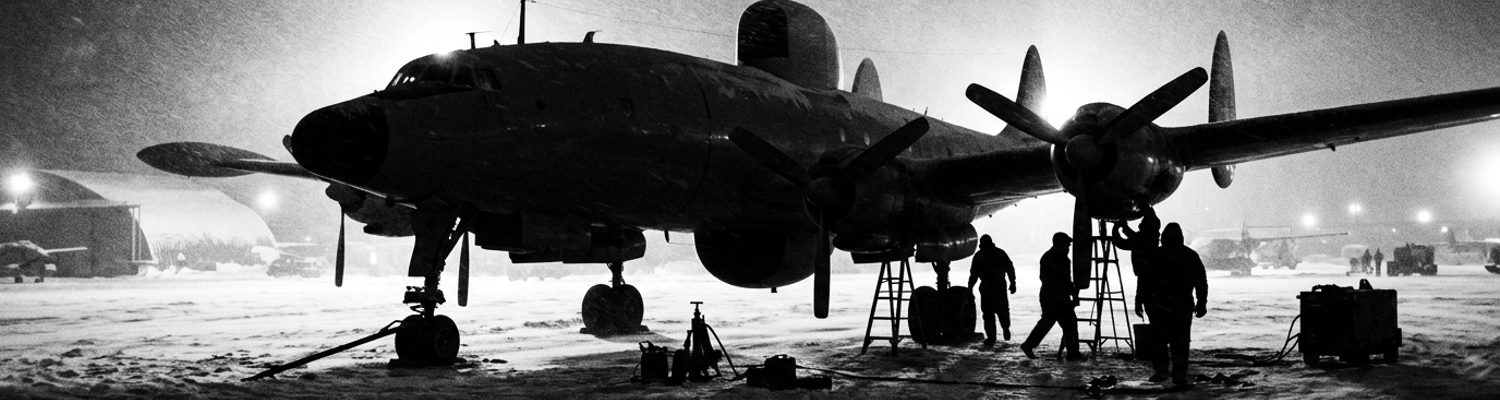

Soviet Bomber Threat and Bristol Bay Patrols
Archival evidence shows the Soviet Long Range Aviation command possessed over 1500 strategic bombers by late 1956. Masses of Tupolev Tu-4s and newly deployed turboprop Tu-95 bombers sat on continuous alert across Chukotka and Kamchatka airbases. This armada heavily outnumbered the sparse defensive perimeter of interceptor aircraft stationed along the North American coastline. A massed strike flying over the polar route would saturate existing ground based radar lines within minutes. Soviet planners calculated they could overwhelm the continental United States by sheer volume. Hundreds of aircraft crossing the Bering Strait simultaneously presented a mathematical problem the Pentagon could not solve with ground stations alone.
To counter this numerical disadvantage the Alaskan Air Command established airborne early warning patrols over Bristol Bay in 1957.
Radar technicians calculated that the sheer density of enemy airframes guaranteed physical penetration of the defense grid. The threat of nuclear annihilation was tracked on poorly illuminated cathode ray tubes. Bureaucratic friction between the Alaskan Air Command and the newly formed North American Aerospace Defense Command delayed this localized deployment for months. General officers in Colorado Springs prioritized the Distant Early Warning Line across northern Canada. They dismissed the requirement for separate airborne patrols in the Aleutian sector as a waste of aviation fuel. AAC commanders in Anchorage pushed back through official channels. They submitted hundreds of pages of terrain analysis to prove ground based installations at Cape Newenham could not see targets flying below ten thousand feet.
Inter service jurisdictional disputes cost the western defense grid six months of preparation time.
Air Force officials eventually forced the authorization of continuous flight tracks over the freezing waters near 58 degrees North and 160 degrees West. Planners designated a racetrack flight pattern covering three hundred miles of open ocean. Flight crews operated radar surveillance aircraft to detect potential Soviet strategic bombers attempting to navigate through the Bristol Bay corridor. A close review of operational logs indicates the primary deployment of Lockheed RC-121D Warning Star aircraft. These were modified C-121 Constellations packed with electronic detection gear. They carried the heavy AN/APS-20 search radar housed in a protruding ventral radome. An AN/APS-45 height finding radar sat above the fuselage in a dorsal radome. Mechanics at Elmendorf Air Force Base struggled daily to keep these complex radar systems functional in sub zero temperatures. The vacuum tubes powering the AN/APS-20 failed constantly.
Extreme cold penetrated the uninsulated lower fuselage during twelve hour patrols.
Radar operators stared at green phosphor screens in a darkened unheated cabin. They searched for the specific radar cross sections of Myasishchev M-4 bombers. A single shattered magnetron tube rendered the entire patrol useless. Technicians wore heavy arctic parkas at their consoles to prevent frostbite. Flight engineers manually monitored engine oil temperatures to prevent the four Wright R-3350 Duplex Cyclone radial engines from freezing mid flight. The AAC mission planners required two RC-121D aircraft airborne at all times to maintain overlapping radar coverage across the Aleutian chain. Navy commanders in the region refused to share their proprietary meteorological data gathered from Pacific fleet vessels. This inter agency hostility forced Air Force weather officers to rely on incomplete atmospheric readings from isolated civilian stations on Kodiak Island.
Aircraft flew blindly into stratospheric ice storms without warning.
Stratospheric Icing and Radome Failure
Meteorological logs from October 1957 detail a severe low pressure system colliding with a stationary arctic front directly over Bristol Bay. At the primary patrol altitude of twenty thousand feet temperatures dropped to minus forty five degrees Celsius. Evaporating from the relatively warmer surface of the Bering Sea high moisture content became trapped beneath the descending freezing air mass. This specific thermal inversion generated a continuous layer of supercooled water droplets suspended throughout the lower stratosphere. Elmendorf Air Force Base weather officers possessed absolutely no data regarding this localized atmospheric anomaly. Aboard destroyers in the Aleutian trench Navy meteorologists had tracked the rapidly organizing storm cell for three consecutive days. Fleet commanders strictly adhered to internal security directives. They refused to transmit their atmospheric soundings over unsecured inter service radio frequencies to the Alaskan Air Command.
Bureaucratic protocols demanded that Navy personnel send encoded teletype messages to Pacific Fleet headquarters in Hawaii before routing the data back to Air Force desks in Anchorage.
Seventy two hours late the delayed weather intelligence arrived on the desks of mission planners. Flight crews of the 531st Airborne Early Warning and Control Squadron launched directly into the freezing precipitation. Upon reaching their designated racetrack patrol coordinates near 58 degrees North and 160 degrees West the RC-121D Warning Star aircraft encountered the severe sub zero atmospheric icing. Supercooled droplets struck the aluminum skin of the airframes and instantly crystallized into dense heavy rime ice. On the wings standard pneumatic rubber boots struggled to break the rapid accumulation. They constantly inflated and deflated against the hardening shell. The primary structural vulnerability existed directly beneath the main fuselage. Inside an eight foot unheated fiberglass radome protruding from the belly of the aircraft the massive AN/APS-20 search radar operated.
Air Materiel Command engineers in Ohio had deliberately rejected urgent field requests from Alaska to install electro thermal de icing elements on these specific radomes.
Arguing that internal heating coils would add three hundred pounds to the maximum takeoff weight procurement officers blocked the modification to preserve fuel efficiency. This budget driven administrative decision left the primary electronic detection component completely unprotected from the brutal October storms. A post flight engineering review confirmed that ice built up on the forward curve of the ventral radome at a rate of one and a half inches every five minutes. The sheer weight of the frozen mass altered the center of gravity on the aircraft. Pilots had to maintain constant back pressure on the flight controls. The rapidly expanding frozen barrier completely absorbed and scattered the ultra high frequency radio waves. Supercooled droplets effectively blinded the AN/APS-20 radar radomes on every single airborne early warning aircraft operating in the Bristol Bay sector.
Thick layers of solid rime ice blocked transmission.
Fundamentally altering the dielectric properties of the protective fiberglass shell the ice caused complete system failure. Radar operators sitting at their consoles in the darkened aft cabins watched their cathode ray tubes fill with entirely disorganized green static. Megawatt transmitted pulses bounced directly off the dense ice casing and reflected back into the receiver array. This localized signal deflection created a massive permanent false echo that masked all incoming contacts from Soviet airspace. Desperate technicians attempted to force transmission through the physical interference. They manually overrode the factory safety limiters on the transmitter unit. Pushing the equipment far beyond its designed operating voltage caused the primary magnetrons to overload. While the outside atmospheric air remained far below zero the internal temperature of the radar transmitter cabinet spiked past two hundred degrees Fahrenheit.
The intense thermal shock shattered the delicate glass envelopes of the high voltage rectifier tubes.
Raw electrical current discharged into the ungrounded aluminum deck plates.
Antenna Destruction and Radio Blackout
A review of maintenance reports from Elmendorf Air Force Base details the rapid degradation of external communication arrays on the RC-121D Warning Star. Airborne crews relied on the AN/ARC-27 ultra high frequency radio for line of sight contact and the AN/ART-13 high frequency transmitter for over the horizon liaison. Both systems utilized exposed external antennas highly susceptible to the supercooled water droplets saturating the Bristol Bay corridor. Rime ice built up rapidly on the fixed copper weld wire antennas stretching from the upper fuselage to the vertical stabilizers. Accumulating mass altered the aerodynamic drag profile of the wires. This added hundreds of pounds of downward force. Extreme tension stressed the ceramic standoff insulators mounted on the aluminum skin. As the aircraft battered through heavy turbulence at twenty thousand feet the accumulating ice caused the primary high frequency antenna wires to snap entirely.
Broken copper cables trailed violently in the slipstream behind the aircraft.
The destruction of the external wires physically severed over the horizon radio communications between the airborne radar crews and the 71st Aircraft Control and Warning Squadron stationed at Cape Romanzof. Inside the unheated aircraft cabins technicians attempted to reroute transmissions through the shorter ultra high frequency blade antennas mounted on the ventral fuselage. A thick casing of solid ice had already encapsulated these components. Freezing water fundamentally changed the physical length and electrical capacitance of the metal blades. This structural alteration detuned the resonant frequency of the AN/ARC-27 radios. Keying their microphones to transmit contact reports radio operators sent high frequency energy down the coaxial cables. The signal reflected directly back into the transmitter unit. Ground controllers sitting in the concrete radar blockhouse at Cape Romanzof broadcasted repeated requests for position updates across all assigned military frequencies.
The AN/FPS-3 search radar at the ground station lacked the range to see past the curvature of the earth into the patrol zone.
Operators stared at empty scopes while calling the aircraft in the blind. They heard only static. Airborne commanders were completely isolated in the lower stratosphere. Archival transcripts from the Alaskan Air Command headquarters in Anchorage illustrate the immediate operational collapse caused by this radio blackout. Without functional voice or secure teletype data links from the AN/TRC-24 radio sets aboard the patrol planes the regional command lost all real time radar tracking across the northern Pacific perimeter. Manual plotting boards inside the Combat Alert Center at Elmendorf sat entirely blank for the duration of the twelve hour patrol shifts. Airmen holding grease pencils stood idle beside the massive plexiglass maps. Staff officers lacked any tactical awareness of Soviet bomber movements originating from the Chukotka peninsula airfields.
Generals in Anchorage demanded immediate status reports from the 531st Airborne Early Warning and Control Squadron.
Squadron commanders could only state that their aircraft had departed the runway and disappeared into the storm system. Bureaucratic infighting escalated rapidly inside the command center. Air Force colonels drafted urgent memorandums blaming the Pacific Fleet for intentionally withholding localized atmospheric soundings. Navy liaison officers refused to accept responsibility for the frozen Air Force antennas. Jurisdictional disputes paralyzed the regional command structure while the radar perimeter collapsed. Officers at the North American Aerospace Defense Command headquarters in Colorado Springs initiated a formal inquiry into the Anchorage blackout. Demanding answers they ordered a full investigation into why a three hundred mile stretch of the Bering Sea approach was completely unmonitored. Anchorage commanders responded by ordering ground crews to install thicker heavily insulated antenna wires on the surviving C-121 Constellations. Mechanics requisitioned parts from civilian depots in Seattle because the military supply chain could not deliver the modified wire rope fast enough.
Returning from the Bristol Bay racetrack flight crews manually handed their paper radar logs to intelligence officers on the tarmac.
These handwritten notes provided the only tracking data available to the defense grid. The paper reports arrived fourteen hours after the Soviet radar contacts were initially detected on the airborne screens.
Naval Air Station Kodiak Supply Chain Delays
A close review of operational logs from mid October 1957 reveals a complete breakdown in supply chain coordination across the Alaskan theater. Flight engineers aboard the 531st Airborne Early Warning and Control Squadron RC-121D aircraft recorded catastrophic drops in engine oil pressure while patrolling the 58 degrees North 160 degrees West grid. The standard MIL-L-6082 aviation oil was rated for a minimum operating temperature of zero degrees Celsius. Standard military grade petroleum lubricants thickened into a dense sludge when exposed to the minus forty five degree Celsius temperatures of the lower stratosphere. Wright R-3350 Duplex Cyclone radial engines began experiencing severe internal friction. Scavenge pumps failed to return the freezing fluid to the holding tanks. Master rod bearings rapidly overheated. Multi engine failure over the freezing waters of Bristol Bay became a statistical certainty.
Air Force maintenance crews at Elmendorf Air Base completely exhausted their limited regional stockpile of cold weather fluids within the first week of the radar deployment.
Base commanders initiated emergency requisition protocols over the regional AN/FGC-1 teletype network. Elmendorf supply officers specifically targeted naval facilities holding winterized aviation assets to keep the radar planes flying. Navy personnel operating the coastal supply depots ignored the incoming transmissions for forty eight hours. Archival supply manifests detail how inter service friction stalled these emergency supply requests between Air Force controllers and Navy officers. When Elmendorf logistics staff finally established direct telephone contact with the Alaskan Sea Frontier command in Kodiak naval captains refused to authorize immediate cross branch transfers. Air Force controllers requested temporary access to Navy stockpiles to keep the early warning radar patrols airborne over the Bering Sea approach. Fleet quartermasters cited outdated Department of Defense directives from 1953. These directives prohibited the release of aviation assets without pre approved budgetary transfer codes.
The 11th Air Division commander bypassed regional channels entirely.
He ordered his staff to transmit unencrypted demands directly to the naval communications annex on Kodiak Island. Teletype machines punched holes in paper tape. They routed the desperate pleas through civilian relay stations before reaching the naval base. Radio operators at the Navy facility received the emergency requests but intentionally logged them as low priority administrative traffic. Bureaucratic ego dictated the naval response. Fleet officers expressed resentment that Air Force generals were attempting to commandeer their proprietary winter stockpiles. Naval commanders insisted that Air Force procurement officers submit formal DD Form 1348 requisition paperwork through the Pentagon before a single crate would be moved to the flight line. Typewriters at Elmendorf clattered through the night to satisfy the naval administrative demands.
Naval Air Station Kodiak logistics officers delayed releasing thermal de icing kits and specialized Arctic lubricants for an additional six days.
Warehouses along the Kodiak Island coastline held thousands of gallons of MIL-L-23699 synthetic Arctic lubricants. These fluids were specifically engineered to maintain viscosity in sub zero maritime environments. Navy supply clerks also possessed pallets of Type II electro thermal de icing kits designed for their P2V Neptune maritime patrol aircraft. These neoprene encased wire grids were designed to melt rime ice upon contact. This modification would have saved the Air Force radomes from signal deflection. Maintenance engineers confirmed these exact resistance heating elements could be field modified to fit the vulnerable fiberglass radomes on the Air Force RC-121Ds. Kodiak logistics officers locked the doors to Warehouse 4 and demanded a physical signature from an Air Materiel Command auditor before authorizing the release. Navy regulations strictly categorized the synthetic lubricants and thermal kits as priority assets reserved exclusively for Pacific Fleet anti submarine operations.
The paperwork slowly navigated the chain of command in Washington.
Air Force mechanics in Anchorage watched their grounded radar aircraft accumulate frost on the tarmac. A sudden drop in barometric pressure over the Aleutian trench forced the 531st Squadron to launch their remaining functional aircraft using standard summer weight engine oil. The right outboard engine on aircraft tail number 53-3401 seized violently at twenty thousand feet due to main bearing starvation. Shattered metal fragments tore through the aluminum engine cowling and struck the fuselage.
Nushagak River Fish and Wildlife Interventions
Operational flight logs from late October 1957 reveal the complete isolation of the 531st Airborne Early Warning and Control Squadron. Ice accumulations had snapped the primary copper weld high frequency antennas on the RC-121D Warning Star aircraft operating near 58 degrees North and 160 degrees West. Airborne radio operators sat in unheated aft cabins staring at dead AN/ARC-27 transceivers. Atmospheric blackouts generated by severe auroral activity across the upper latitudes completely scrambled any surviving line of sight military frequencies. Flight crews flew blind through dense advection fog. This fog formed when supercooled stratospheric air collided with the relatively warmer Bering Sea currents. This pitch black fog reduced external visibility to zero inches. Navigators could not secure celestial fixes through the astrodome. Radar screens showed only the permanent green static of deflected radio waves bouncing off the frozen radomes. Standard operational procedure required pilots to ditch the sixty five ton aircraft in the freezing ocean if they could not establish contact with Alaskan Air Command controllers within four hours.
Desperate technicians began manually cranking their receiver dials through unauthorized civilian wavelengths.
Archival transcripts from October 22 show that an isolated RC-121D crew successfully established emergency two way contact with a civilian Fish and Wildlife Service radio shack. Federal game wardens stationed in remote timber cabins along the Nushagak River monitored the 2.4 megahertz frequency. They used this channel to track commercial salmon fishing fleets and coordinate anti poaching patrols. Military aircrews utilized the surviving base stubs of their trailing wire antennas to broadcast blind distress signals on this low frequency band. Ground based civilian operators at the Dillingham outpost detected the heavily distorted transmissions. This station was located exactly at 59 degrees 2 minutes North and 158 degrees 27 minutes West. These wardens operated simple Collins 32V-3 amateur radio transmitters powered by portable diesel generators. Upon hearing the Air Force distress calls the civilians abandoned their wildlife monitoring duties to establish a continuous communication loop with the freezing aircraft.
Military protocol strictly prohibited unencrypted transmission of flight telemetry to non cleared personnel.
The airborne commanders ignored these directives to save their airframes. They transmitted their estimated fuel states engine oil pressure drops and heading data directly to the game wardens. Bureaucratic security protocols dissolved instantly under the threat of a mid air engine stall. Civilian radio operators actively assisted the military flights during the ongoing pitch black fog and atmospheric blackouts. Lacking any radar tracking equipment the Fish and Wildlife Service wardens stepped outside their wooden shacks into the freezing temperatures to listen for the drone of the Wright R-3350 Duplex Cyclone radial engines. They used handheld magnetic compasses to estimate the directional bearing of the engine noise penetrating the dense fog layer. Running back inside the wardens keyed their Collins microphones to transmit these crude directional fixes back to the blind RC-121D navigators.
The civilians also relayed real time surface barometric pressure readings and wind velocity measurements from their analog weather stations.
This raw telemetry allowed the military flight engineers to manually calculate their true altitude above the unseen terrain. To connect the isolated aircraft back to the defense grid the Dillingham wardens utilized the civilian Alaska Communication System telephone network. They placed long distance toll calls directly to the Combat Alert Center at Elmendorf Air Force Base to relay the coordinates. Air Force intelligence officers initially threatened the civilian operators with federal espionage charges for discussing classified aircraft movements over an open public telephone line. Regional command center logs detail the resulting administrative standoff between the Department of the Interior and the Department of Defense. General officers in Anchorage demanded that the Fish and Wildlife Service immediately surrender control of the radio frequencies to military personnel.
Anchorage controllers refused to accept tactical tracking data relayed by federal game wardens without proper cryptographic authentication.
The civilian operators ignored the Air Force demands and kept the telephone lines open to guide the planes. For eleven hours a wildlife management outpost served as the sole air traffic control center for the western Alaskan defense perimeter. The wardens guided aircraft tail number 53-3401 away from the jagged peaks of the Ahklun Mountains using only acoustic engine tracking and handheld compass bearings. The Department of Defense later refused to reimburse the Fish and Wildlife Service for seventy four dollars in long distance telephone charges.
Manual Plotting and Telephone Relay Gridlock
Post flight navigational charts from late October 1957 record the immediate procedural collapse aboard the RC-121D Warning Star aircraft. Ice encapsulation disabled the AN/APS-20 search radar entirely. It severed the high frequency external antennas. Operators in the unheated aft cabin stared at blackened cathode ray tubes. Deprived of electronic telemetry the flight crews reverted to manual target plotting over the Bering Sea. Navigators unclipped heavy paper dead reckoning charts from their aluminum bulkheads. Working by the dim red glow of emergency cabin lights they calculated intercept vectors using metal E-6B flight computers and standard graphite pencils. Technicians wearing thick arctic gloves struggled to manipulate delicate brass dividers across the paper grid. The minus forty five degree temperatures penetrating the fuselage caused the graphite pencil leads to snap against the frozen paper. Radar officers factored in the raw acoustic engine bearings previously transmitted by the civilian ground stations to estimate the position of unidentified Soviet bomber formations.
Technical sergeants physically drew intersecting lines across the map to predict enemy flight paths based on estimated airspeed and wind drift.
Without continuous radar updates from the ventral radome these manual plots degraded in accuracy by three nautical miles every sixty seconds. Airborne commanders demanded that these hand drawn coordinates be transmitted immediately to the Alaskan Air Command to trigger the launch of F-89 Scorpion interceptors. Advanced early warning crews calculated intercept vectors using analog slide rules. To move these handwritten coordinates from the isolated aircraft to the Combat Alert Center at Elmendorf Air Force Base the crews relied exclusively on the civilian game wardens. Airborne radio operators broadcasted their manual mathematical calculations over the low frequency 2.4 megahertz civilian band. Down below federal wildlife officers sitting in their Nushagak River radio shacks transcribed the incoming numbers onto scrap paper. These remote timber outposts lacked teletype equipment. The civilians dialed the Alaska Communication System operator to establish a toll connection with military intelligence desks in Anchorage.
Administrative hostility disrupted the relay process immediately upon connection.
Air Force duty officers sitting in the secure Elmendorf blockhouse refused to log the incoming coordinates. Bureaucratic formatting rules stalled the deployment of defensive fighter squadrons. Transcripts of the telephone exchanges document the severe administrative gridlock between the Nushagak River shacks and the regional Air Force command nodes. The wardens read the intercept vectors using standard latitude and longitude degrees. Military protocol strictly required all early warning data to be formatted in the standardized Military Grid Reference System. Anchorage controllers demanded that the civilians mathematically convert the data on the spot before the Air Force would dispatch interceptor aircraft. Civilians operating the Collins 32V-3 transmitters lacked the classified conversion tables required to translate the raw coordinates into the military grid format. A shift supervisor at the Air Defense Direction Center ordered his communications technicians to terminate the phone call to clear the line for official military traffic.
The Dillingham wardens immediately redialed the base.
They read the manual target plots directly to the civilian telephone switchboard operator in Anchorage. This forced her to physically walk the transcribed notes to the military guard shack outside the base perimeter. Military police officers confiscated the civilian scrap paper at the gate. Base security protocols required a secondary threat assessment before allowing unverified civilian documents into the combat center. By the time the handwritten coordinates reached the situation room plexiglass plotting boards seventy five minutes had elapsed. Soviet Tu-95 bombers operating near the Aleutian chain had already transited through the unmonitored sector.
Directive 4140.1 and Radome Thermal Retrofits
When examining the historical record of the October 1957 Bering Sea deployment post flight administrative reviews document severe fractures in material handling between military branches. The near loss of aircraft tail number 53-3401 over Bristol Bay exposed deep vulnerabilities in joint service Cold War supply chain protocols across the northern Pacific theater. Air Force mechanics at Elmendorf Air Base had completely depleted their local inventory of cold weather aviation fluids within seven days of initiating the continuous early warning patrols. Less than two hundred and fifty miles south Naval Air Station Kodiak maintained fully stocked climate controlled warehouses containing thousands of gallons of MIL-L-23699 synthetic Arctic lubricants. Cross branch material transfers required formal authorization from Pentagon controllers using triplicate DD Form 1348 requisition paperwork. Naval logistics officers strictly adhered to these rigid peacetime administrative parameters during the active radar blackout. They blocked the release of their designated anti submarine warfare stockpiles to the 11th Air Division.
Air Force supply sergeants standing at the Kodiak facility gates were physically turned away by armed Marine guards.
Typewriters in Anchorage generated redundant supply request forms while the RC-121D engines suffered oil starvation in the lower stratosphere. Archival supply manifests reveal the structural changes forced upon the regional command following the communication collapse. Department of Defense auditors arrived at Elmendorf in early November 1957 to investigate the grounding of the 531st Airborne Early Warning and Control Squadron. Investigators discovered that Navy quartermasters at 57 degrees 45 minutes North held exactly 4200 specialized winterization kits behind locked chain link fences. Air Force procurement officers fifty miles away had been manually calling civilian supply depots in Seattle to source identical hardware. To eliminate this inter branch hoarding the Pentagon drafted Directive 4140.1. This mandate stripped regional base commanders of their unilateral authority to deny cross branch material transfers during active airspace defense conditions. Supply clerks integrated the Elmendorf and Kodiak inventory ledgers into a single regional tracking system accessible via the AN/FGC-1 teletype network.
Navy base commanders lost the ability to classify basic aviation lubricants as proprietary fleet assets.
Air Force mechanics gained unrestricted physical access to Navy warehouses holding Type II electro thermal de icing kits. A close review of engineering schematics from the Air Materiel Command details the rapid mechanical overhaul of the Alaskan surveillance fleet. The budget driven administrative decision to fly with unheated ventral radomes was entirely reversed by mid November. Technicians stripped the ice battered eight foot fiberglass domes from the bellies of the C-121 Constellations on the tarmac at Elmendorf. They bonded the newly acquired Navy Type II electro thermal resistance heating grids directly into the forward curve of the replacement radomes. These neoprene encased wire matrices were explicitly designed to prevent the accumulation of supercooled water droplets by melting rime ice upon initial contact. Modified thermal de icing systems were implemented across Arctic surveillance aircraft fleets operating near 58 degrees North and 160 degrees West. Crews applied a specialized dielectric epoxy over the heating grids to ensure the megawatt radio pulses could transmit through the synthetic rubber casing without distortion.
The internal heating coils completely stopped the physical signal deflection that had blinded the AN/APS-20 search radars.
Powering these continuous electrical grids required substantial internal modifications to the heavily laden airframes. Flight engineers removed the factory standard secondary auxiliary power units from the aft compartments. They installed heavier 400 hertz alternators driven directly by the inboard Wright R-3350 Duplex Cyclone radial engines. The new heating elements drew sixty kilowatts of continuous electrical power to maintain a steady surface temperature of five degrees Celsius while the aircraft battered through high altitude precipitation. Routing the heavy gauge copper wiring from the engine nacelles to the ventral radome required mechanics to drill directly through the primary titanium floor bulkheads. This specific structural retrofit added three hundred and forty pounds to the baseline weight of the radar planes. Pilots manually adjusted their standard takeoff calculations to account for the increased drag and reduced climb rate out of the Anchorage runways. Aircraft tail number 53-3401 required an additional twelve hundred feet of runway to achieve rotational velocity.