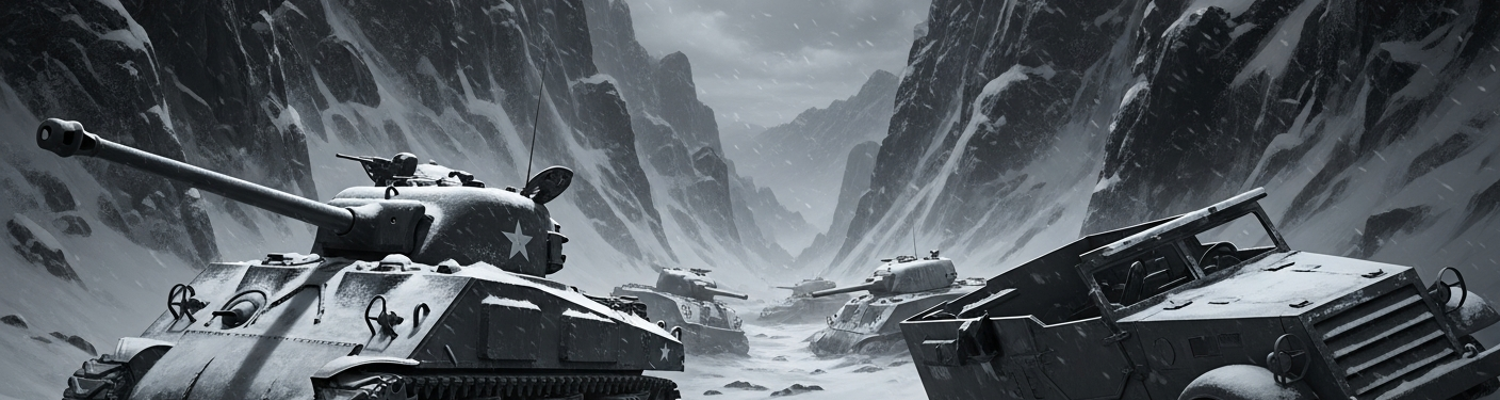

A Republic of Korea Army corporal felt the vibration first. It came through the soles of his worn boots, a low, rhythmic shuffling in the desolate hills near Onjong in late October 1950. The sound did not belong. He reported it. The report, one of dozens like it, became a ghost moving up a chain of command that had already declared victory. Beginning on October 19, elements of the Chinese People’s Volunteer Army, specifically the 38th, 39th, 40th, and 42nd Corps, began slipping across the Yalu River. They moved with disciplined silence, thousands of soldiers wading through frigid water under the cover of darkness, avoiding the main bridges watched by UN reconnaissance flights. A close review of operational logs (NARA Record Group 338) shows these crossings went almost entirely undetected by Far East Command’s intelligence assets. The first physical proof of a new enemy came on October 25. A patrol from a Republic of Korea (ROK) division near Unsan captured a soldier whose language they did not understand. He was Chinese. That same day, ROK forces near Chosan were hit by a large, unidentified enemy force and a battalion was effectively destroyed. The war had fundamentally changed. The men who needed to understand that fact were hundreds of miles away, insulated by optimism and layers of staff.
The initial field reports were met with institutional disbelief. At General Douglas MacArthur’s Far East Command (FEC) headquarters in Tokyo, the prevailing atmosphere was one of impending triumph. The Home-by-Christmas offensive was being planned. The war was considered all but over. Major General Charles A. Willoughby, MacArthur's chief of intelligence (G-2), was the primary filter for all incoming information. His office systematically downplayed the significance of the new contacts. Captured Chinese soldiers, who identified themselves as being from regular units of the People’s Liberation Army, were officially categorized as a handful of individual volunteers or ethnic-Korean deserters from the Chinese Civil War. Archival evidence shows that even as ROK units like the 6th Division were being broken at the Battle of Onjong, Willoughby’s daily intelligence summaries refused to acknowledge a coordinated, national intervention. The G-2 section estimated a maximum of 34,500 Chinese troops in Korea by early November. In reality, over 300,000 had already crossed the Yalu. This was not a failure to obtain information; it was a failure to believe it. Warnings relayed through Indian diplomats from Beijing were dismissed as political bluffs. The possibility that a poorly equipped, non-industrialized army would dare to challenge the full might of United Nations air and ground power was deemed illogical.
This dismissal was compounded by a fractured and dysfunctional command structure. The Eighth Army, under General Walton Walker, and the X Corps, under General Edward Almond, were operating as two entirely separate forces on the peninsula. Both reported directly to MacArthur in Tokyo, not to each other, with a wide, mountainous gap separating their zones of operation. This arrangement prevented any unified interpretation of intelligence at the theater level. The CIA, which held a more sober view of Chinese capabilities and intentions, was effectively shut out of the region by MacArthur, who preferred the analyses of Willoughby’s staff. Willoughby, in turn, ensured that any intelligence that contradicted MacArthur’s planned offensive was suppressed or explained away. When X Corps captured Chinese prisoners in the east, and Eighth Army was being hit by massive formations in the west, there was no single, objective body below MacArthur’s headquarters to connect the dots. Each command saw only its piece of the front. The G-2 in Tokyo, which saw everything, filtered the information to confirm its own biases. The system was designed to validate a predetermined strategy of victory, not to challenge it with inconvenient facts from the battlefield. This created a dangerous information vacuum, leaving the frontline divisions of the Eighth Army completely unaware of the scale of the force gathering in the mountains before them.
Following the violent, short-lived battles around Unsan in early November, a strange quiet descended over the Eighth Army’s front. The Chinese People’s Volunteer Army (PVA) units that had struck with such ferocity during their First Phase Offensive seemed to simply melt away. A close review of operational logs from US I and IX Corps for the period between November 6 and November 24 reveals a perplexing and near-total loss of contact. The PVA 13th Army Group, under Peng Dehuai, had deliberately disengaged. They withdrew into the rugged, trackless mountains that dominated the spine of North Korea. This was a calculated deception. For the frontline soldiers of the US 2nd, 24th, and 25th Infantry Divisions, the silence was unsettling.
The enemy was gone.
The response from Eighth Army headquarters was to initiate reconnaissance-in-force. Patrols, typically company or battalion-sized armored and infantry task forces, pushed deep into the territory previously held by the PVA. The results were consistently misleading. A typical patrol, such as those conducted by elements of the 24th Infantry Division north of the Chongchon River, would advance for miles without firing a shot. They discovered abandoned defensive positions, fields of fire that had been meticulously prepared, and the cold ashes of thousands of small campfires. They found stragglers and released prisoners of war who, under instruction from their captors, repeated stories of low morale and a general retreat back toward China due to supply shortages. Air reconnaissance was equally ineffective. PVA formations had perfected the art of daytime concealment, moving only at night and remaining motionless at the sight of an aircraft. The inability of aerial observation to detect the movement of what was, in reality, over 230,000 soldiers was a catastrophic failure of intelligence collection. The patrols returned with the same conclusion: the enemy was gone, seemingly in full retreat.
This flood of incomplete and actively deceptive information was processed through an intelligence apparatus predisposed to see exactly what it was being shown. At General Walker’s Eighth Army headquarters, and especially at MacArthur’s Far East Command, the narrative of a beaten, withdrawing Chinese force was eagerly accepted. It confirmed the high command's deeply ingrained belief that the agrarian Chinese army could not sustain a modern campaign against American firepower. Field reports noting the absence of contact were not interpreted as a sign of a skillful enemy regrouping, but as proof of their defeat. Intelligence summaries transformed the eerie quiet at the front into a concrete assessment that the Chinese intervention had been a limited, face-saving gesture that had now concluded. This misinterpretation formed the entire basis for the renewed UN offensive ordered by MacArthur to begin on November 24, 1950. Eighth Army was ordered to push forward to the Yalu River, directly into the mountain ranges where hundreds of thousands of PVA soldiers were waiting in carefully prepared ambush positions.
The foundational element of the PVA strategy was its ability to render hundreds of thousands of soldiers functionally invisible to a technologically superior enemy. This was not achieved through advanced technology, but through a rigid and unforgiving system of individual camouflage and movement discipline. A close review of PVA operational doctrine and post-war interviews with soldiers reveals a simple, brutal rule: during daylight hours, if an aircraft was seen or heard, every soldier was to freeze in place. This was an absolute order. Entire columns of men, sometimes thousands strong, would halt instantly, using available terrain, foliage, or simple earth-colored quilts to blend with the Korean landscape. They would remain motionless until the aircraft had passed entirely from sight and sound. This simple tactic, ruthlessly enforced by unit commanders, effectively negated the total air supremacy held by the United Nations forces.
Pilots saw nothing.
With daylight neutralized, the night belonged to the PVA. Archival evidence from captured documents shows that the PVA’s main formations, like the 38th, 39th, and 40th Corps, conducted all major movements and resupply efforts under the cover of darkness. This was a feat of exceptional human endurance. The standard pace for these night marches was approximately 18 miles, conducted over successive nights through punishing mountain terrain. Individual soldiers carried their own weapons, grenades, and a personal food supply, often consisting of roasted grain carried in a long tube-like bag. Lacking a significant vehicle park, they had no motorized signature for UN intelligence to track. Heavy equipment like artillery pieces and heavy mortars were disassembled and hauled by pack animals or teams of men. When existing roads were insufficient, PVA engineering units, using only hand tools, carved new tracks through the mountainsides, allowing their forces to emerge on the UN flank from entirely unexpected directions.
A close review of Far East Air Forces (FEAF) operational directives from late 1950 reveals a near-total reliance on high-altitude photographic reconnaissance. The primary asset for this mission was the RF-80A Shooting Star, a modified version of America’s first operational jet fighter. Stripped of guns and fitted with a suite of cameras in a redesigned nose, the RF-80A was tasked with flying fast, high passes over enemy territory. The jet’s speed was its protection, but its operational ceiling and the technical limitations of its K-17 and K-22 cameras made it fundamentally unsuited for the task. Flying at altitudes necessary to avoid anti-aircraft fire, the resolution of the resulting photographs was simply too low to detect individual soldiers or small, well-camouflaged positions. The photographs that came back to intelligence analysts in Japan showed exactly what the PVA wanted them to see: empty mountain ridges and deserted roads.
Carrier-based air power, the second pillar of UN air supremacy, proved just as ineffective. Task Force 77, operating in the Sea of Japan, launched hundreds of sorties with its F4U Corsairs and AD Skyraiders, tasked with interdicting the flow of men and material to the front. The primary targets were the bridges spanning the Yalu River. An analysis of these strikes shows some success in damaging the permanent structures, but this success was strategically irrelevant. Political restrictions forbade pilots from crossing into Manchurian airspace, forcing them into predictable attack runs. More importantly, the PVA was not a mechanized army reliant on bridges. They moved almost exclusively at night, on foot, through the mountains. Lacking a significant vehicle park, they presented no concentrated targets for night-flying intruders like the B-26 or the Navy’s F4U-5N Corsairs. Pilots were hunting phantoms in the dark, bombing empty roads and abandoned campfires, while tens of thousands of soldiers slipped past them undetected.
This chasm between what air reconnaissance perceived and what existed on the ground created a dangerous intelligence feedback loop. The evidence gathered by RF-80s and the lack of targets reported by interdiction pilots were not seen as indications of a clever, concealed enemy. Instead, they were interpreted by General Willoughby’s G-2 section as confirmation of their own preconceived bias. Prisoner interrogations that provided clear evidence of entire Chinese armies operating in Korea were dismissed. A CIA estimate from early November 1950, which correctly identified a massive buildup of forces in Manchuria, was ignored in favor of lower official FEC estimates. By November 24, on the eve of the renewed offensive, MacArthur’s headquarters officially listed a maximum of 70,000 Chinese troops in Korea. The actual number was over 300,000, already hidden in prepared ambush positions directly in the Eighth Army’s path.
The systematic misidentification of Chinese tactical formations was another failure, born from an inability to understand the enemy’s methods. The PVA did not fight like a Western army. Lacking radios below the regimental level, they coordinated complex night attacks using a combination of bugles, whistles, and signal flares. To the UN soldier in a frozen foxhole, the sudden eruption of unfamiliar sounds from all directions, followed by waves of infantry appearing out of the darkness, felt like a chaotic, suicidal assault. This interpretation was tactically incorrect. Archival analysis of PVA operational doctrine reveals these were not disorganized swarms but highly coordinated multi-directional attacks designed to infiltrate, bypass, and encircle fixed defensive positions.
The bugles were not a sign of chaos.
Chinese commanders used bugle calls to signal specific movements: advance, flank, assault, withdraw. This allowed them to maneuver entire battalions in the dark. What was perceived by Eighth Army intelligence as the desperate charge of a small, retreating unit was often a PVA company executing a planned flanking maneuver as part of a much larger encirclement. The swarm was a disciplined formation, but its logic was alien to UN commanders, who repeatedly classified major regimental attacks as small-scale probes, fatally underestimating the strength and sophistication of the force arrayed against them.
On the frigid night of November 25, 1950, the UN offensive had been underway for just over a day. The mood at General Walker’s Eighth Army headquarters was one of supreme confidence. This belief was built upon the intelligence assessment that a maximum of 70,000 Chinese troops were in Korea. Advancing north toward the Yalu, the American and ROK divisions were marching directly into a trap laid by the PVA 13th Army Group. The attack, when it came, was a coordinated, front-wide offensive designed for annihilation. It began with a sudden storm of mortar and artillery fire, followed by the sound of bugles and whistles from the dark, frozen hills.
The scale of the Chinese Second Phase Offensive was immense. The PVA commander, Peng Dehuai, had allowed the Eighth Army to advance into the narrow valleys and broken terrain north of the Chongchon River, deliberately creating the conditions for a mass ambush. His primary blow was aimed not at the heavily armed American divisions but at the vulnerable right flank of the Eighth Army, held by the ROK II Corps. Chinese forces, who had infiltrated the mountains on foot and at night, struck the ROK 6th, 7th, and 8th Divisions with crushing force. These units, already battered from earlier engagements, disintegrated. The collapse of the ROK II Corps was absolute; it ceased to exist as a coherent fighting force, opening a massive gap in the UN line. This exposed the entire right flank of the US IX Corps, specifically the US 2nd Infantry Division and the attached Turkish Brigade, to encirclement.
The offensive was a tactical masterpiece of infiltration. The UN command, blinded by its own assumptions, had no concept of the enemy’s true strength. As the ROK flank evaporated, PVA divisions poured through the gap, racing south to establish roadblocks and cut the main supply routes behind the American divisions. The US 2nd Infantry Division, having advanced the furthest north, suddenly found itself fighting in all directions. The division’s attempt to withdraw south through the town of Kunu-ri turned into a nightmare. A PVA division, the 113th, had force-marched undetected to block the main road south of Kunu-ri, creating a lethal kill zone in a narrow valley that became known as The Gauntlet. Trapped and savaged by machine gun and mortar fire from the overlooking hills, the division was shattered. A review of operational records shows the 2nd Infantry Division suffered over 4,000 casualties in the fighting around the Chongchon River and Kunu-ri. Its supporting artillery battalions were overrun. In a final act, the 2nd Engineer Battalion burned its regimental colors to prevent their capture. The Turkish Brigade, fighting fiercely at Wawon to cover the initial withdrawal, was also encircled and effectively destroyed as a fighting unit. The surprise was so complete and the collapse so rapid that what began as an offensive transformed into a desperate flight. The Eighth Army was no longer attacking; it was fighting for its very survival in the longest retreat in American military history.