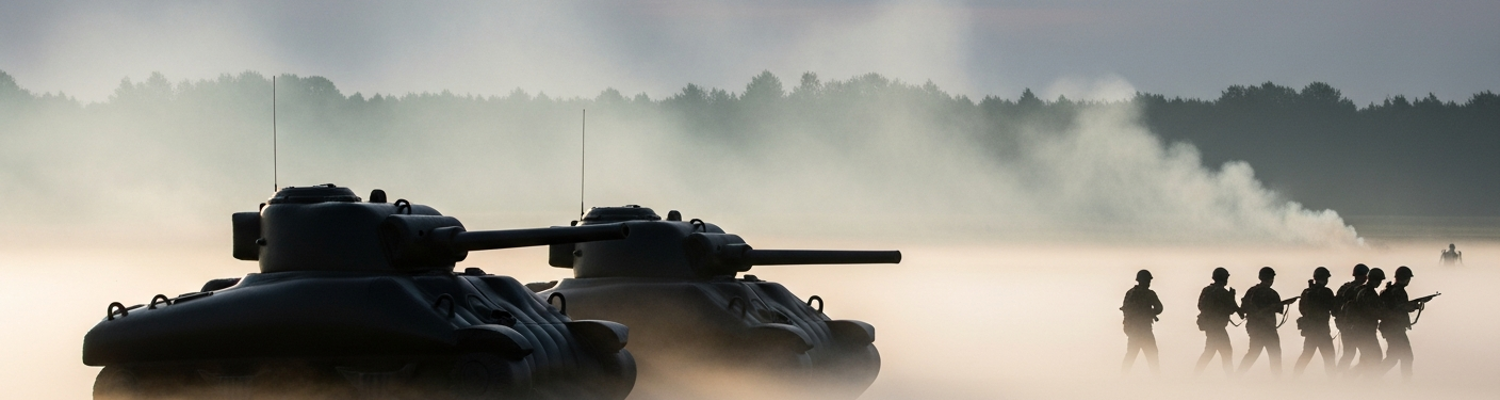

In the highest echelons of the Allied command during 1943, a radical concept gained traction. It was a strategy born not of metallurgy and ballistics, but of perception and psychology. The leadership decision, championed by visionaries like Major Ralph Ingersoll and Colonel Billy Harris, was to weaponize creativity on an industrial scale. This led to the activation of the 23rd Headquarters Special Troops on January 20, 1944, at Camp Forrest, Tennessee. This was not a unit forged in the traditional military mold. Its 1,100 men were deliberately selected for their civilian skills. Recruiters scoured the art schools of New York and Philadelphia, pulling in painters, illustrators, and architects. They poached talent from advertising agencies, sound studios, and theater design workshops. Men who might otherwise have been designing posters or building stage sets were now tasked with building a phantom army. Under the command of Colonel Harry L. Reeder, this eclectic group of creatives became a self-contained tactical deception unit. Their mission was to impersonate other, much larger U.S. Army formations, manipulating German intelligence to divert enemy troops and resources away from real Allied objectives. The decision to field such a unit was a profound gamble, a bet that battlefield artistry could save thousands of lives by turning the enemy's own intelligence apparatus against them. The unit's existence was a direct result of observing successful British deception tactics, particularly Operation Bertram at El Alamein, where dummy equipment played a key part in the victory. The American military leadership, facing the prospect of a costly invasion of Europe, saw the immense value in an asset that could win engagements before they were even fought.
Forging the Phantoms
The training at Camp Forrest and later Fort Meade was as unconventional as the unit itself. Soldiers learned to inflate a 93-pound rubber M4 Sherman tank in minutes. They studied the organizational charts of every major American division in the European Theater, memorizing their insignia, vehicle markings, and command structures. This was essential for the visual deception component of their mission. The 603rd Camouflage Engineer Battalion, the artistic heart of the unit, was filled with men like fashion designer Bill Blass and painter Ellsworth Kelly. They spent their days not just deploying the inflatable decoys manufactured by companies like Goodyear and U.S. Rubber, but also perfecting the illusion. They learned to use bulldozers to carve fake tank tracks into the soil. They would stage single trucks to drive in loops with different canvas covers, creating the appearance of a long convoy. They created elaborate, fake command posts and motor pools, knowing that a single misplaced detail could give the entire game away to a German reconnaissance pilot. The level of detail was staggering. Soldiers were even instructed to create fake laundry lines with the appropriate divisional insignia on display, a small but convincing touch of authenticity. This was theater on a grand scale, with the front lines as its stage and the German army as its unwilling audience.
The Arsenal of Illusion
The Ghost Army’s power lay in its multi-sensory approach to deception. Visuals alone were not enough. The 3132nd Signal Service Company Special provided the soundtrack for their war. In a groundbreaking collaboration with engineers from Bell Laboratories, the unit recorded a vast library of sounds at Fort Knox. They captured the specific acoustic signatures of different armored and infantry divisions on the move. The recordings included the clatter of M4 Sherman tank treads versus the lighter M5 Stuart, the rumble of engineering battalions constructing pontoon bridges, and even the casual chatter and shouted orders of soldiers in an assembly area. These sounds were recorded onto state-of-the-art wire recorders and then blasted across the battlefield using powerful speakers mounted on M3 halftracks. The sound could travel up to 15 miles, creating a believable audio landscape of a massive military force where none existed. These sonic performances were carefully scripted. A typical script might begin with the faint sounds of an approaching column, grow in volume as the 'unit' arrived, and then transition to the sounds of digging in and setting up camp. This sonic deception was a potent tool, preying on the ears of enemy listening posts. To complete the ruse, a special Signal Company detachment handled radio deception. They knew German intelligence closely monitored radio traffic, even analyzing the unique sending style, or 'fist', of individual Morse code operators. Ghost Army operators painstakingly learned to mimic the fists of operators from the divisions they were impersonating. They would then transmit streams of false traffic, discussing troop movements, supply requisitions, and patrol reports, all designed to paint a convincing but utterly false picture of the Allied order of battle. This three-pronged attack on the enemy's senses, visual, sonic, and electronic, made the Ghost Army a uniquely effective force.
Deception on the Front Lines
Across France, Belgium, Luxembourg, and Germany, the Ghost Army conducted over 20 major deceptions, operating perilously close to the front lines. Their job required them to draw attention, which often meant drawing enemy artillery fire onto their dummy positions. In September 1944, during the push toward the heavily fortified city of Metz, a critical 75-mile gap opened in General George S. Patton's Third Army line. The 23rd was rushed in to fill it. For nearly ten days, a period far longer than considered safe for a deception to remain plausible, the 1,100 men of the Ghost Army masqueraded as a full armored division. They used every tool in their arsenal, running sonic convoys at night and creating a flurry of fake radio traffic. Their performance was convincing enough to hold the line, preventing a potential German counterattack through the vulnerable sector until actual reinforcements could arrive. It was a high-wire act that demonstrated the unit's capability under extreme pressure. Patton, a commander known for his aggressive and direct nature, had to rely on a unit armed with air compressors and speakers to secure his flank, a testament to the desperate realities of the campaign and the pragmatic acceptance of this new form of warfare.
Operation Viersen's Grand Feint
The unit's capstone performance, Operation Viersen, occurred in March 1945. As the U.S. Ninth Army prepared for Operation Plunder, the monumental task of crossing the Rhine River, the Ghost Army was given its most critical mission. They were to simulate two entire infantry divisions, the 30th and 79th, preparing a fake river crossing ten miles south of the actual assault point near a town called Viersen. The goal was to draw German reserves away from the real target. This deception required projecting the presence of nearly 40,000 men. For several days, the 603rd deployed over 600 inflatable tanks, cannons, and trucks in convincing assembly areas. The 3132nd blasted the sounds of pontoon bridge construction toward the German lines all night. Soldiers from other units were brought in, given the patches of the 30th and 79th divisions, and sent into local towns to spread rumors. The deception worked perfectly. German intelligence took the bait. Luftwaffe reconnaissance planes photographed the phantom buildup, and German artillery rained down for days on the empty fields and rubber decoys. The German High Command, convinced a major assault was imminent at the Viersen location, diverted significant forces, including at least one panzer division, to meet the non-existent threat. When the actual Ninth Army crossed the Rhine on March 24, they encountered surprisingly light resistance. The crossing, expected to be a bloodbath, was achieved with minimal casualties. Ninth Army commander General William Simpson later sent a formal commendation directly to the 23rd, a rare and explicit acknowledgment of how their elaborate stage play had directly saved the lives of his men.
The Long Silence and Final Recognition
Immediately after V-E Day, the Ghost Army vanished again, this time into secrecy. The War Department classified the entire program as top secret, recognizing the immense value of such psychological warfare tactics for future conflicts. The men were ordered to remain silent. Their equipment was packed away, their records sealed. Veterans, who had fought a unique and hazardous war, could not speak of their true roles, even to their families. For fifty years, the story of the 1,100 artists and engineers who fought with illusion was officially erased from the public history of the war. This secrecy had a profound effect. The innovative, low-cost, and life-saving doctrine developed by the 23rd was not integrated into public military thought or training for two generations. The full declassification of the unit's history did not occur until 1996. Only then did historians and military analysts begin to understand the scope of their impact. It is now estimated that the Ghost Army's deceptions saved between 15,000 and 30,000 Allied lives. The strategic foresight of the leadership that created the unit paid dividends measured in soldiers who returned home. The final validation came decades later. After a long campaign by veterans and historians, the surviving members of the 23rd Headquarters Special Troops and its sister unit, the 3133rd Signal Company Special, were awarded the Congressional Gold Medal in March 2024. It was the nation's highest honor, a long-overdue recognition for the artists who went to war and proved that, in the right hands, a loudspeaker could be as mighty as a cannon.