
Infiltration Objectives and a Doctrinal Contradiction
The amphibious reconnaissance manuals of the era, conceived for a conventional European war, depicted clandestine insertions as clockwork operations. The reality confronting the 3rd Reconnaissance Battalion in July 1965 off the I Corps Tactical Zone coast was a violent refutation of that theory. The coastline near Da Nang was not a sterile, empty battlespace. It was a dense network of fishing villages and Viet Cong sympathizers, a living early warning system. Treacherous currents and shifting sandbars made the simple act of reaching shore a monumental effort against nature itself.
The mission was interdiction.
This directive represented a profound shift from traditional reconnaissance. The objective for the 3rd Reconnaissance Battalion was not to observe, but to disrupt and destroy. Operational logs (3rd Recon Bn S-3 Journal, July 1965) show teams deploying from Chu Lai and Da Nang were tasked to halt Viet Cong supply flow along coastal routes. This meant small, six-to-eight-man patrols carried heavy mission loads. Their packs were filled with Claymore mines, extra ammunition, and grenades, a loadout fundamentally at odds with the reconnaissance tenet of avoiding decisive engagement. After-action reports indicate teams were expected to set ambushes and direct naval gunfire, transforming them from observers into bait for a larger conventional response. This aggressive posture placed isolated teams in constant jeopardy.
The mechanics of insertion were fraught with peril. A review of company logs from May through July 1965 reveals constant deployments by Companies A, B, C, and D, often by ship from Da Nang to Phu Bai. The infiltration itself relied on the LCR-S, an inflatable rubber raiding craft. These boats, pushed by temperamental outboard motors, were exceptionally vulnerable. The sound of a struggling engine could carry for miles over water on a still night. Even with disciplined paddling, the phosphorescent glow of disturbed plankton could paint a glowing trail directly to the team. The physical exertion of fighting powerful currents left men exhausted before their patrol even began. Beyond the beach, a landscape of dense foliage and rice paddies could hide an enemy observer, turning the entire coast into a monitored zone where anonymity was impossible.
The Onslaught of a Category Three Typhoon
Weather reports filtering into the 3rd Reconnaissance Battalion’s command post at Da Nang Air Base were initially routine. The summer of 1965 was well into typhoon season, and tropical disturbances were common. This system, however, intensified with a speed that defied the forecasting technology of the day. A tropical storm far out in the South China Sea exploded in strength, its trajectory aimed squarely at the I Corps Tactical Zone. Within 48 hours, it was a Category 3 typhoon, a storm with sustained winds between 111 and 129 miles per hour. For reconnaissance teams already deployed or preparing for insertion, the storm's rapid onset was an unforeseen disaster.
All planned operations ceased.
The doctrinal manual, with its precise instructions for stealth and ambush, became irrelevant against the raw power of the atmosphere. Operational procedure shifted from fighting the enemy to surviving the environment. Teams near the coast had to make immediate decisions that violated their specialized training. Instead of maintaining radio silence, patrols began continuous transmissions, reporting their desperate positions as the storm surge inundated low-lying areas. The LCR-S inflatable boats, essential for infiltration, became liabilities. Any craft not hauled far inland were torn from moorings and destroyed by the surf. Teams in the field abandoned their concealed observation posts, stripped of foliage by the wind, and sought sturdier shelter. This was not a choice but a necessity.
The typhoon brought the battalion's mission to a complete halt. The operational tempo, which had seen companies constantly rotating on patrols, was reset to zero. Missions were scrubbed indefinitely. Teams already in the field were ordered to attempt emergency extractions under perilous conditions or dig in. The physical damage to the coastal infrastructure was severe. Infiltration trails were washed away or buried under mud. The vegetation that teams relied on for concealment was shredded, dramatically altering the terrain. Back at the main bases, the storm damaged equipment and flooded encampments, bringing all air and naval support to a standstill. For several days, the battalion’s focus was not reconnaissance but recovery and personnel accountability.
Typhoon-Induced Operational Isolation
The moment the typhoon made landfall, the reconnaissance teams in the field were no longer hunters. They were prey. Archival evidence from 3rd Reconnaissance Battalion operational logs shows multiple six and eight-man patrols were immediately cut off. For more than 72 hours, these teams were completely alone. The violent sea state made extraction by inflatable craft suicidal. Hurricane-force winds grounded all helicopters at Da Nang and Phu Bai, severing the lifeline of air support. A patrol’s world shrank to the few square meters of ground they occupied. Pinned down, they were unable to move without risking exposure in a landscape stripped of its cover. Their isolation was absolute.
The physical toll was severe. Constant, driving rain and sea spray saturated their jungle fatigues within minutes. A review of medical after-action reports from the period details a rapid onset of debilitating, non-combat casualties. Near-hypothermia became a primary concern. As a man’s core body temperature dropped, shivering gave way to a loss of fine motor skills. For a reconnaissance Marine, the inability to manipulate a rifle safety or tune a radio was a death sentence. The oppressive humidity prevented evaporation, turning clothing into a heavy, waterlogged second skin that accelerated heat loss and chafed skin raw. Immersion foot, normally a chronic issue, became an acute threat in hours as infections developed in the filth and moisture.
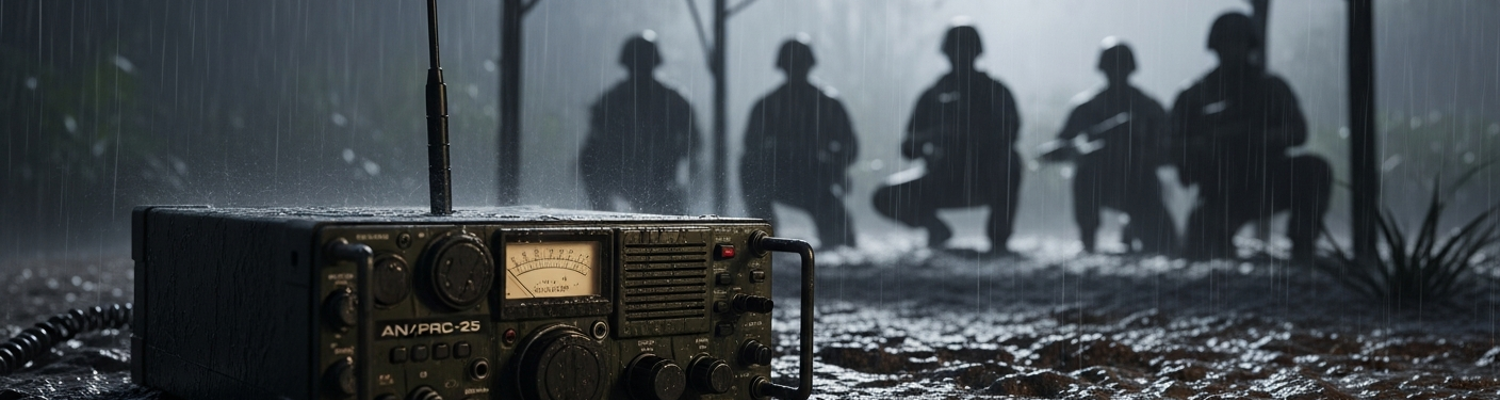
This environmental assault triggered a systemic failure of essential gear. The AN/PRC-25 radio, the primary link to salvation, proved vulnerable to water. While the transceiver was water-resistant, the handset was not. Historical analysis of radio performance in Vietnam shows moisture penetrating the handset could render it inoperable. Marines resorted to wrapping handsets in plastic bags from battery packages, a flimsy defense. The saturation destroyed everything else. Paper maps dissolved. The firing mechanisms for M18A1 Claymore mines shorted out. The steel of M14 rifles began to show rust in hours, threatening to jam the actions. Every piece of equipment was systematically defeated by water, leaving the teams deaf and disarmed.
Combat Stress and Morale Fragmentation
The typhoon-induced radio silence imposed a level of psychological stress that no manual could anticipate. For a unit whose survival depended on information, the loss of communication was a catastrophic failure. The AN/PRC-25 radio's vulnerability to moisture plunged every patrol into an information black hole for over 72 hours. They could not report their status, call for aid, or receive intelligence. Operationally, they were erased from the map.
This absolute isolation created an environment of acute sensory pressure. The constant, deafening roar of the wind and rain was a form of auditory assault, masking the subtle sounds of an approaching enemy. Each man was left alone with his own thoughts, trapped in a cycle of hypervigilance. The inability to communicate with the outside world fostered a profound sense of abandonment. Studies on the effects of such isolation on military personnel indicate a rapid increase in anxiety and paranoia. In a small team, this individual psychological degradation became a collective crisis.
The foundation of their unit, built on mutual trust and the certainty of support, had been washed away.
The collapse of external communication triggered a subtle fragmentation of internal morale. A reconnaissance team is a finely tuned instrument, each member functioning with a single purpose. When the mission became mere survival, this unity began to splinter. With no orders from battalion and no way to send reports, the formal authority of the patrol leader was implicitly undermined. He had no more information than any other Marine. Tactical decisions were replaced by primal arguments over survival: where to find shelter or how to ration supplies. After-action reports from long-range patrols frequently highlight the importance of leadership in maintaining morale, but leadership is predicated on the ability to act decisively based on information and a clear objective. Deprived of both, the team structure began to fray from the corrosive effect of individuals realizing they were entirely on their own.
Ad-Hoc Survival and Unconventional Extraction
The typhoon's aftermath forced a complete inversion of reconnaissance doctrine. Standard infiltration and exfiltration procedures were abandoned. A review of operational logs shows that the primary concern for isolated patrols shifted from stealth to broadcast. Teams broke radio silence, transmitting continuously to signal their existence. This desperate need to communicate was a direct violation of the core tenet of avoiding detection, but it was the only way to coordinate a rescue. Movement ceased. Teams hunkered down in sodden, exposed positions, reversing the doctrinal emphasis on constantly shifting locations.
Survival became an exercise in environmental observation.
Forced into static positions, the Marines had to learn from a landscape that was both enemy and provider. They observed how local structures were often built on high ground or with features designed to shed wind and water. They learned to identify terrain features that offered natural protection from the elements, not just from enemy observation. This employment of local knowledge was not about cultural exchange; it was a series of rapid-fire lessons in how to exist in an environment that generations of Vietnamese had already learned to endure. Patches of intact bamboo became sources for constructing shelters, and the natural contours of the land indicated where flash floods would be most dangerous.
Securing a partial extraction required unconventional methods. With standard landing zones destroyed and high winds precluding a stable hover, traditional helicopter pickups were impossible. This forced a reliance on high-risk emergency extraction techniques. The most common was the STABO (Stabilized Body) rig, a harness worn by the Marine that could be clipped onto a rope dropped from a helicopter. Developed for jungle extractions where a landing was impossible, it became the primary method for pulling men out of the devastated coastal areas. Another method was the jungle penetrator, a weighted device lowered by cable that could carry up to three people. These extraction procedures reveal a grim calculus: a helicopter would hover as low as possible in treacherous crosswinds while exhausted Marines were hooked up and lifted out, dangling hundreds of feet in the air.
The Doctrine Disconnect and Its Legacy
The standard amphibious reconnaissance field manuals available in 1965 were dangerously inadequate. These documents were written for a linear European battlefield against a conventional Soviet opponent. They detailed procedures for stealth and radio silence to perform surveillance on high-value targets. A review of this doctrine reveals its complete failure to account for an operational environment where weather was the most destructive force. There were no annexes for surviving a Category 3 hurricane. No chapters detailed how a six-man team should function when its primary battle was against hypothermia and equipment failure. The manual’s instructions to maintain concealment became nonsensical when 120-mile-per-hour winds stripped every leaf from the jungle.
Survival hinged on systematically violating the rules.
The methods that kept the reconnaissance teams alive were a direct inversion of their training. Standard operating procedure demanded strict radio silence. Instead, teams transmitted continuously. Doctrinal emphasis on constant movement was replaced by a static existence for more than 72 hours. Concealment was abandoned in favor of a desperate search for hard shelter from the elements. These were not tactical decisions; they were primal responses to an environmental assault for which their training offered no solutions.
The lessons learned from the typhoon’s devastation had lasting implications for the Marine Corps. The event was a brutal confirmation that the environment itself could neutralize elite units. A historical review of Marine Corps training evolution shows that experiences in Vietnam, including extreme weather events, directly influenced the development of new programs focused on environmental survival. The near-hypothermic conditions suffered by Marines in tropical rains highlighted a vulnerability functionally identical to cold-weather injuries. This realization helped spur a more holistic approach to environmental warfare training and was a contributing justification for the 1976 reactivation of the Marine Corps Mountain Warfare Training Center, which had been in a caretaker status, to systematically expose Marines to extreme conditions and harden them against the very attrition that had crippled the 3rd Reconnaissance Battalion in 1965.