
Strategic Isolation of the Stony Point Garrison
The cast-iron pinion gear inside the British hauling winch sheared three teeth under the deadweight of a naval twenty-four-pounder barrel. Metal shavings jammed the drum axle. Mechanical advantage on this slope required hand-cranked timber jacks and hemp hawser ropes. These ropes ground through ungreased iron blocks. The gear teeth fractured. The barrel slipped four inches into the mud. It pinned an artilleryman against the granite outcropping. British pioneers drove iron wedges directly into the casing. They locked the spool before the entire carriage rolled down the ravine.
The gun belonged to Captain Alexander Mercer and his engineering detachment.
They brought it up from the riverbank to command the King Ferry water route. Control of the Hudson River corridor turned on raw mechanical leverage. Archival evidence shows that by early June 1779 British troops under General Sir Henry Clinton transformed the peninsula of Stony Point into a fortified position. This installation choked American north-south movements. Situated forty miles north of New York City the rugged granite promontory rose 150 feet above the water. It jutted half a mile into the Hudson. King Ferry linked this western headland to Verplanck Point on the eastern shore. This formed the primary transit route connecting New England to the middle and southern states.
Clinton recognized that seizing both points severed Continental supply lines across the Hudson.
Royal Engineers constructed two concentric lines of abatis. They felled entire groves of oak trees. They pointed the sharpened branches outward toward the inland approach. Seven earthwork redoubts went up across the crest. These mounted fifteen artillery pieces ranging from light brass three-pounders to twelve-pounder garrison cannon and eight-inch mortars. Gunboats and the armed sloop HMS Vulture anchored in the deep channel off the south shore. They swept the shoreline with grape and round shot. The spit of land was functionally an island during high tide.
A close review of operational logs indicates that Lieutenant Colonel Henry Johnson held the fortification with a force numbering just over six hundred officers and men.
Johnson commanded the 17th Regiment of Foot. He maintained his headquarters in a small stone farmhouse behind the inner defense works. His main force consisted of the 17th Foot supported by two flank companies of the 71st Regiment of Foot and a specialized detachment from the Royal Regiment of Artillery. A forty-man contingent of the Loyal American Regiment manned the northern pickets. They also managed local intelligence networks. Daily orders recovered from the field desk of Johnson show that the garrison dug additional ditching every morning before dawn. They cleared brush to eliminate blind spots across the salt marsh. British sentries occupied five outward-facing redoubts. These covered the mud causeway with overlapping fields of fire.
Reconnaissance maps drawn in early July registered zero blind paths through the outer works.
George Washington spent three full days studying these positions from the heights of Buckberg Mountain. This vantage point sat two miles northwest of the post. Washington used a long brass monocular telescope to chart the ebb and flow of tidal water across the marsh. His tactical assessment confirmed that an open artillery siege would trigger naval reinforcements from British ships downriver. A fast silent infantry assault under total darkness offered the only viable alternative. Washington issued detailed operational directives on July 10. He instructed Brigadier General Anthony Wayne to deploy the newly organized Corps of Light Infantry in a synchronized night counterstroke.
Muskets were ordered to be unloaded.
Flintlocks required unpriming to prevent any accidental discharge from alerting the British pickets. Wayne forced his men to rely on fixed socket bayonets. They waded through waist-deep water across the flooded flats to bypass the main causeway at low water. The plan designated two assault columns of light infantry to hit both flanks of the hill simultaneously. A small central diversion engaged the outer abatis with controlled musket fire at midnight on July 15.
Continental Light Infantry Marsh Crossing Preparations
David Springsteel farmstead became an armed staging ground at eight in the evening.
Brigadier General Anthony Wayne brought his 1300-man Corps of Continental Light Infantry to a halt. They assembled across the pastures of a small farm. This property sat one and a half miles west of Stony Point along the southern base of Buckberg Mountain. The men had just completed a punishing thirteen-mile forced march from Sandy Beach near Fort Montgomery. Moving across narrow defiles and boulder-strewn paths in single file under heavy summer humidity took a physical toll. The light infantry companies kept strict march spacing without baggage wagons or pack animals. The force brought together handpicked veterans organized into four provisional regiments. Colonels Christian Febiger and Richard Butler commanded the primary elements alongside Return Jonathan Meigs. Major William Hull led a fourth battalion.
Wayne withheld the tactical destination from company officers until the units formed lines in the clearing.
Sentries immediately cordoned off the farm perimeter. Every civilian on the property was detained inside the house. This stopped any local informant from slipping away to British lines. Accidental ignition meant tactical ruin. A close review of operational logs indicates that Wayne enforced total silence by dismantling the firing mechanisms of his infantry weapons. Officers ordered soldiers to unscrew the jaws of their gun cocks. They pried out the English and French flint pieces wrapped in lead or leather sheaths. The men secured the stones inside their cartridge pouches. Every musket remained completely unloaded. Powder horns stayed closed and pan covers down.
The command stripped the main columns of any capacity to return fire.
This compelled all thirteen hundred men to depend entirely on their eighteen-inch steel socket bayonets. Major Hardy Murfree and his two North Carolina companies formed the sole exception. They kept their flints and paper cartridges to deliver rolling diversionary volleys against the center works. Subalterns conducted tactile weapon checks in the dark. They slid hands down barrel tangs to ensure bayonets were locked over the front sight studs. Wayne issued direct instructions authorizing officers to run through any soldier who attempted to prime a musket. Breaking company ranks or uttering a sound during the advance carried an immediate death sentence.
Complete darkness wiped out standard battlefield recognition.
Fratricide posed the greatest physical hazard once the columns of Wayne breached the inner works at the point of the bayonet. British infantrymen of the 17th Foot and the 71st Highlanders wore uniforms and cocked hats that appeared identical to Continental coats in zero-visibility conditions across the marsh and rocky cuts. Wayne solved this identification issue with an improvised mechanical marker. Officers distributed scraps of white paper and torn parchment across every platoon. They ordered the men to pin or wedge these light squares directly into the front cockades or brim folds of their hats. The pale paper caught ambient starlight against the black profile of the granite hill. This gave Continental light infantrymen an immediate visual cue when engaging in hand-to-hand combat inside the trenches.
Soldiers without paper markers pinned white fabric patches torn from extra linen shirts directly above their brows.
Assault detachments under Lieutenant Colonel Francois de Fleury and Major John Stewart carried extra paper slips in their coat pockets. They used these to replace markers torn away while crawling through thick brambles. Wayne drew his short infantry saber. He deployed the vanguard into the southern marsh channel at twenty minutes before midnight.
Pioneer Engineering Across the Flooded Tidal Morass
Midnight brought twenty-four inches of standing river water over the sandbar.
Wayne and his strike force reached the western edge of the morass at precisely twelve o clock on July 16. They discovered that an unusually strong high tide had swallowed the low-lying dirt causeway. Mud and brackish water spread across a three-hundred-yard expanse. This separated the mainland marsh banks from the granite foot of the Stony Point promontory. Two main attacking formations split into separate approaches. Colonel Richard Butler led the northern column toward the secondary works. Wayne took personal command of the right column alongside Colonel Christian Febiger to swing around the southern marsh flats. Each soldier stepped directly off solid ground into black marsh silt. The mud sucked grease-treated leather shoes off bare feet. Water rose quickly past knees to hips. This soaked the wool trousers of the light infantrymen and put their dry cartridge pouches at risk of submersion.
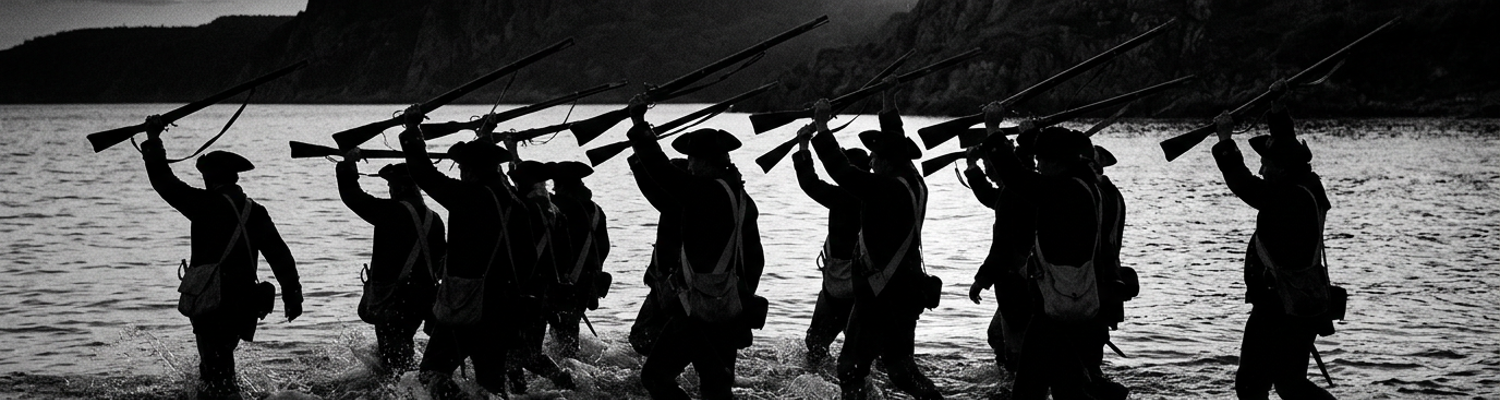
Every man slung his loaded weapon diagonally across his chest.
Others held their firelocks high above their shoulders with both hands. They kept powder horns out of the brine. They maintained absolute footing in zero visibility. Footing had to be located through physical touch alone. Pioneer detachments and axemen moved ahead of the advance infantries to sound depth across saturated mud flats. Two specialized twenty-man forlorn hope detachments spearheaded the advance. Lieutenant George Knox took the right flank. Lieutenant James Gibbons took the left. They deployed teams carrying heavy felling axes and broad-bladed hatchets. Axemen gripped smooth hickory tool handles upside down. They drove the ash shafts straight down into the silt every three steps to gauge the firmness of the submerged river bed.
When a sounding handle plunged four feet into bottomless river muck without hitting rock or firm clay the pioneer signaled the trailing files.
He used two muffled clicks of his fingernails against the axe eye. The pioneers improvised tracks across the quicksand pockets. They threw down bundles of harvested marsh reeds and cut alder stakes. They pulled fallen drift logs directly from the tidal wash. Men slipped under the water without making a sound. They dragged themselves up by grabbing the coattails of the file leaders. They kept their tool blades turned away from adjacent soldiers. Silence kept six hundred British defenders looking elsewhere. The stealth movement of the vanguard columns past exterior British water pickets succeeded because Wayne exploited the environmental noise of the estuary.
British naval row-barges and armed water pickets from HMS Vulture were stationed three hundred yards offshore in the deep river channel.
They sat there to prevent amphibious surprises. Fixed ground outposts guarded the exposed causeway. Wayne instructed the wading files to match their step cadences directly to the rhythmic break of the river chop against the mud berms. Soldiers dragged their boots through the silt rather than lifting their feet completely out of the water. This prevented the distinctive suction slap of breaking surface tension from echoing across the cove. Major Hardy Murfree and his North Carolina detachment simultaneously opened a steady rhythmic diversionary fire straight down the center road. This drew the attention of the British pickets directly forward into the blackness. The axemen of Wayne cut through waist-deep water below the southern rocks. The vanguard passed within sixty yards of the outermost British naval picket boat without alerting the watch officer. They reached the low tangled roots of the first abatis line as the church clock in Haverstraw struck half-past twelve.
Breaching the Outer Abatis Under Heavy Enfilade
The casualty rate for the advance detachments approached eighty percent within ten minutes.
Lieutenant James Gibbons of the 6th Pennsylvania Regiment led the northern forlorn hope of twenty volunteers. Lieutenant George Knox of the 9th Pennsylvania commanded the southern vanguard. Assigned to lead the assault columns of Colonel Richard Butler and Colonel Christian Febiger respectively both junior officers received direct orders. They had to absorb the initial blast of enemy defensive fire while locating physical gaps in the hillside obstructions. Gibbons deployed his twenty men along the rocky northern slope below the outer redoubts. They crawled across wet shale under direct visibility of the British 17th Regiment of Foot. Seventeen of the twenty soldiers in the detachment of Gibbons were killed or wounded within the first thirty yards of the advance.
Knox and his twenty-man team on the southern edge moved along the river mudflats toward the lower bastion.
They kept their heads below the lip of the embankment as musketry erupted across the parapets. Both subalterns operated under instructions to clear pathways without returning a single round of musket fire. Steel axes struck green oak in total darkness. Pioneer axemen advanced directly behind Gibbons and Knox to sever two concentric lines of heavy felled-timber abatis. Royal Engineers had built these barriers by dropping white oak trees. They interlaced the trunks with iron binding wire. They sharpened three-inch outer boughs into hardened spear-points angled down the hillside. Continental axemen swung six-pound felling axes and utility billhooks into tangled branch clusters while standing upright on muddy rocks.
Blind volleys of lead musket balls and British grapeshot cut through the foliage.
The metal severed oak limbs and shattered hickory axe helves in the hands of the pioneers. When wooden handles splintered under iron projectile impacts soldiers grabbed replacement tools from fallen comrades. Others used billhooks to pry apart notched interlocking branch forks by hand. The teams chipped away forty-foot gaps through the outer barrier. They cleared enough width for the column of Febiger to pass through in double files. The second inner timber wall remained intact sixty yards up the steep slope. Heavy artillery on the upper works opened fire as the southern column cleared the first breach.
Royal Artillery gun crews manning the seven elevated redoubts swung their heavy ordnance south toward the sound of splitting timber.
Captain Alexander Mercer and his artillerymen depressed the elevations of two cast-iron twelve-pounder guns and a naval twenty-four-pounder mounted on garrison traversing carriages. They aimed directly into the flooded tidal channels where the Continental light infantry waded. Gun commanders packed tin canister rounds containing dozens of two-ounce iron balls on top of cloth powder bags. They discharged overlapping enfilade blasts down the watery defiles at thirty-second intervals. The discharge threw sheets of spray and shrapnel across the marsh. It severed reeds and struck the infantrymen waist-deep in the brine.
One canister spread struck the center of the trailing files of Febiger.
It blew away cartridge boxes and dropped four light infantrymen into three feet of black sediment. The gun barrels could not depress below a sixteen-degree declination angle without striking the outer earthen parapets. Much of the iron canister fire skipped across the mud flats. It passed directly over the heads of the pioneers of Knox crouching beneath the lower granite terrace. Wayne was struck in the scalp by a spent musket ball twenty paces from the second abatis line at precisely twenty-five minutes past midnight.
Hand-to-Hand Penetration of the British Redoubts
A musket ball struck Brigadier General Anthony Wayne across the forehead twenty paces below the crest.
It dropped him into the wet shale. The projectile was a deflected half-ounce lead sphere. It fired from a British Brown Bess musket at the upper parapet. The ball glanced off an exposed shelf of granite. It tore a three-inch furrow through the scalp of Wayne along his left temporal bone. The impact knocked Wayne flat. He was rendered temporarily unconscious. Arterial blood soaked his hair and collar. It saturated the white paper identifier pinned to his hat. Regimental surgeons later recorded that the lead ball gouged down to the periosteum without fracturing the cranium.
Wayne regained consciousness within forty seconds.
He refused evacuation to the rear aid station in the swamp. Captain Henry Archer and Lieutenant Colonel Francois de Fleury hauled Wayne upright by his epaulets. They supported his deadweight as the general insisted on being carried directly behind the first rank of the southern column. Wayne instructed his aides to drag him inside the enemy breastworks. If the wound proved fatal his body would fall within the perimeter. Two Virginia light infantrymen linked arms beneath the shoulders of Wayne. They half-carried and half-dragged him up the final twenty-foot escarpment while the vanguard of Febiger moved forward.
Ascent along the western face required brute leverage against bare stone.
The southern approach angled upward at seventy degrees over wet slick mica-schist and granite outcroppings. These offered no vegetative handholds. Continental infantrymen under Colonel Christian Febiger and Major William Hull faced sheer rock faces greased by river spray and high humidity. Soldiers resolved the elevation problem through technical improvisation under direct defensive fire. Men jabbed the triangular fourteen-inch steel blades of their French Charleville and British Model 1768 socket bayonets straight into horizontal rock fissures. This formed improvised iron steps. The trailing rank stepped directly onto the barrel flats and locked socket sleeves of their comrades muskets to vault upward onto narrow ledges.
Soldiers wedged iron ramrods into vertical stone cracks to serve as gripping dowels.
They pried themselves up shoulder by shoulder. When iron snapped or joints slipped on moss soldiers hooked their gun slings around outcropping granite projections. They hauled up trailing men by brute manual force. The entire southern wing scaled sixty feet of vertical crag without firing a single shot. Their empty muskets functioned as physical climbing tools rather than firearms. The entire perimeter fell apart under cold steel. The inner British redoubts buckled completely within twenty-five minutes of the pioneers of Knox cutting through the primary abatis. Lieutenant Colonel Francois de Fleury scrambled over the southern earthen parapet at twenty minutes to one. He was followed by Lieutenant George Knox and the remnants of the southern forlorn hope.
Colonel Richard Butler and his northern column scrambled over the opposing stone breastworks.
They pinched the defenders between two converging walls of fixed bayonets. British gunners belonging to the Royal Artillery attempted to depress their brass four-pounders to sweep the trench floors. Continental infantry closed the distance before gun teams could reload their powder bags. Hand-to-hand fighting inside the works pitted the bayonet against the short hanger sword and brass-mounted spontoons. Men fought chest-to-chest in the dirt trenches. They used musket butts and socket collars to break the defensive formation of the British 17th Regiment of Foot. Fleury cut the royal standard from its lanyard atop the central flagstaff with his hunting knife. Lieutenant Colonel Henry Johnson found himself cut off from his central garrison blockhouses by the advance of Butler. This forced the British command to surrender the main works at one o clock in the morning. Johnson surrendered his sword inside the inner work alongside five hundred and forty-three British prisoners.
Improvised Shoreline Triage and Blast Trauma Care
Rising river water forced surgeons to anchor their operating tables against the shale outcroppings.
Continental medical officers established two forward dressing stations within forty yards of the high-tide line along the southern shoreline of the peninsula. Dr. John Fallon served alongside regimental surgeon mates from the Pennsylvania line. He organized the collection point inside a natural granite cleft. This shielded casualties from flat-trajectory cannon fire. Salt water seeped across the lower rocks as the Hudson reached its peak tidal swell at quarter to one in the morning. It soaked through discarded wool coats and pine-box supply chests. Orderlies wedged wooden ammunition boxes beneath the shoulders of wounded soldiers. This prevented men who had passed out from drowning in twelve inches of incoming brackish water.
Litters improvised from ash saplings and cut linen tent flies shuttled bleeding infantrymen out of the mudflats directly to the rock shelf.
Every roll of tow linen and scraped lint bandage had to be elevated onto higher granite ledges as waves slapped the base of the bluff. Darkness dictated whether a wounded man survived. Surgical teams operated under strict light-discipline orders to avoid drawing direct naval grape fire from the armed sloop HMS Vulture. Surgeons utilized horn lanterns fitted with thin scraped-cowhorn panels instead of glass. They wrapped the iron frames in heavy broadcloth sleeves to direct pencil-thin light beams downward into surgical wounds. Medical personnel faced severe trauma caused by two-ounce iron canister balls and timber fragments hurled from destroyed abatis pickets. Compound bone breaks required immediate attention.
Working with unsterilized steel capital saws and curved amputation knives surgeons amputated shattered lower extremities on wet stone flat rocks.
Assistant surgeon mates held down thrashing patients. Dr. Fallon reached deep into severed muscle sheaths with iron tenaculum hooks. He pried up retracted femoral and brachial arteries to secure them with waxed linen thread. Projectiles lodging in thoracic cavities were extracted using long bullet forceps without anesthesia. They relied exclusively on ration whiskey and wooden bite-sticks to keep casualties quiet while British sentries fired blindly thirty yards overhead. Anthony Wayne lay drenched in his own blood twenty paces behind the southern assault rank. Regimental medical personnel stabilized Wayne directly against the wet talus slope beneath the second abatis barrier.
The deflected musket ball had shaved along the left parietal bone.
It peeled back a four-inch flap of skin and cut through the superficial temporal artery. Blood poured down the face of Wayne. It blinded his left eye and saturated his hunting shirt within seconds of impact. Dr. Fallon reached the fallen brigadier within two minutes of the injury. He ran bare fingers along the exposed skull surface to locate bone depressions or splintered cranial fractures. Finding the inner bone plate intact despite severe concussive shock Fallon pressed dry tow lint directly into the bleeding wound cavity to stop the hemorrhage. Two orderlies secured the compress using a tight four-tailed linen roller bandage wrapped around the brow of Wayne. They knotted the tails across the right ear to keep direct pressure over the severed temporal vessels. Fallon poured three ounces of spirits down the throat of Wayne while his aides hauled the brigadier to his feet. Wayne reentered the fight with the soaked bandage slipping across his brow.
Rising Hudson Tides and Rapid Causeway Evacuation
By one-thirty in the morning on July 16 brackish water from the Haverstraw Bay tidal swell surged over the narrow earthen causeway connecting Stony Point to the western mainland.
High tide in this sector of the Hudson regularly crested four to five feet above the low-water mark. This converted the sandy crossing into an impassable marine channel within ninety minutes. Lieutenant Colonel Henry Johnson and his garrison had counted on this exact hydrological barrier to cut off retreating attackers. The units of Wayne faced the reverse predicament. Seventy-four Continental casualties and more than five hundred prisoners were trapped on a peninsula bordered by deep water on three sides and a disappearing sand spit on the fourth. Salt water inundated the mud cuts at three inches every ten minutes. It swirled across submerged corduroy logs that had shifted under earlier artillery recoil.
Water pickets from HMS Vulture were already maneuvering row-galleys closer to shore to shell the ford with grapeshot.
Captain James Christie received direct verbal orders from Wayne to establish holding points on the western mainland bank before the depth reached the armpits of his rearguard infantry. The withdrawal corridor vanished beneath four feet of saltwater. Continental medical personnel formed improvised litter-bearer teams. They dragged both American and British casualties across the flooded morass before the current became unmanageable. Orderlies lashed together green saplings and damaged musket slings to build flexible drag-litters. They set wounded men into canvas knapsacks slung between poles to keep shattered limbs out of the brine. Twenty-nine wounded British soldiers from the 17th Foot and Fraser Highlanders were transported alongside Continental casualties.
They were carried in shifts by four-man squads wading waist-deep through the black marsh silt.
Footing along the causeway edge collapsed repeatedly. This dropped bearers into deep drainage cuts and soaked wound dressings wrapped in tow linen. Surgeon mates moved alongside the files with pine-tar torches. They periodically clamped exposed bleeders with iron tenaculum hooks when sudden dips in the submerged road wrenched open tourniquets. Litter teams hauled seventy-two wounded men across four hundred yards of inundated marsh under complete darkness. They delivered every casualty to the field hospital established at the David Springsteel farmstead before two-thirty. Bearers held stretcher frames on their shoulders to clear the black wash.
Ordnance officers simultaneously initiated the removal of captured British guns and powder stores prior to the peninsula being cut off by the river.
Fifteen pieces of British ordnance sat inside the captured redoubts. This included two twelve-pounder garrison guns and brass royal mortars alongside five light fieldpieces. Continental artillerymen under Captain-Lieutenant William Price lacked draft horses. This required fifty-man fatigue details to man drag ropes and haul gun carriages down the rocky granite slopes to the water edge. Crews loaded powder casks and pig lead onto two captured flat-bottomed British row-galleys. They ferried volatile black powder across the narrowest creek gap while men pushed brass three-pounders directly through the submerging causeway shallows. Wheels sank past their iron rims into the sand. This snapped two white-oak trail spokes on a four-pounder carriage before artillerymen levered the axles free using heavy iron handspikes. Working with rising water reaching their belts the fatigue parties extracted ten pieces of brass ordnance. They pulled sixty-four barrels of gunpowder and four thousand paper cartridges before three o clock in the morning. Major Thomas Posey oversaw the final detachment rolling two brass six-pounders across the flooded apron at quarter past four.