
Minnesota National Guard Mobilization and Prewar Training
Infantrymen of the 135th Infantry Regiment collapsed on canvas cots inside drafty Minnesota regional armories in February 1941, exhausted by round the clock drills and hobbled by severe shortages of basic equipment. Enlistees reported to small town facilities across Minnesota, including the local armory in Owatonna, where supply rooms lacked modern rifles, proper cold weather uniforms, and field radios. Men trained with wooden mock ups and obsolete First World War weapons while division officers processed paperwork to incorporate the regiment into the newly federalized 34th Infantry Division. Orders from high command demanded rapid transformation of these peacetime civilian soldiers into front line combat troops, but delayed shipments of boots, coats, and ammunition left companies drilling in subzero winds without adequate shelter or nourishment. Exhausted company commanders worked by lantern light late into the night, filling out requisition forms that disappeared into distant bureaucratic channels without response. Crowds of families eventually gathered along railroad tracks at town depots such as Owatonna to watch the packed troop trains pull out for southern training bases.
Locomotives hauled the crowded troop trains south into the swampy pine woods of Camp Claiborne, Louisiana, where a fresh set of logistical breakdowns immediately overwhelmed the regiment. Torrential rains turned the unfinished camp into deep mud, forcing the 135th Infantry to clear forests, construct rows of canvas tents, and process thousands of incoming conscripts without sufficient heavy tools or medical supplies. Division headquarters established administrative tents far to the rear, issuing rigid schedules and supply manifests that failed to reflect the true conditions of the flooded company areas. Officers on the divisional staff spent days managing paperwork backlogs while front line platoons ran tactical problems with wooden sticks representing machine guns and civilian delivery trucks substituting for armored tanks. The massive Louisiana Maneuvers of 1941 pushed the exhausted soldiers through forced marches across suffocating heat and flooded bayous, testing new combined arms doctrines under artificial peacetime rules. Field commanders found themselves isolated from their own regiments as fragile field telephone lines snapped in the timber and motorcycle messengers became bogged down in the mud, establishing an early pattern of blind operational decisions dictated from remote staff tents.
Officers at division headquarters retained these rigid command habits even as the 34th Infantry Division received sudden overseas orders following the attack on Pearl Harbor. Troop transports ferried the 135th Infantry across the submarine infested North Atlantic in early 1942, making the division the first United States Army force to land in the European theater in Northern Ireland. Soldiers spent months in damp bogs and cold stone billets across County Tyrone and County Fermanagh, drilling in small unit tactics, night navigation, and live fire maneuvers under miserable weather. Quartermasters struggled continuously with broken supply chains, rationing replacement boots and modern field radios while headquarters personnel operated from requisitioned manor houses miles removed from the sodden bivouacs. Command staff practiced coordination exercises using paper tracking maps and delayed courier networks, maintaining rigid administrative routines between decision makers and the field companies. General orders abruptly ended this training cycle in late 1942, packing the regiments aboard invasion vessels destined for the western Mediterranean.
Transports and cargo vessels delivered the 135th Infantry Regiment into Algeria during Operation Torch, bringing the untested Midwestern troops directly into the difficult North African theater. Mud, winter rains, and brutal supply bottlenecks immediately crippled forward movement as the regiment advanced eastward across hundreds of miles toward the Tunisian front. Supply trucks broke down on primitive dirt passes, leaving frontline infantrymen short on rations, heavy weapons ammunition, and dry clothing while they took up exposed defensive sectors in mountainous terrain. Senior commanders directed these scattered operations from headquarters trailers stationed far to the rear, relying on fragmentary radio transmissions and late courier dispatches that arrived hours after local situations had already changed. Staff maps at corps and division headquarters depicted smooth contours and dry valley floors, completely obscuring the jagged limestone cliffs and zeroed in German artillery that barred the route eastward. Divisional leaders ordered the exhausted 135th Infantry to dig into the rocky scrubland and prepare assault plans for the forbidding mountain bastions guarding the northern approach to Tunis.
Fondouk Gap Disaster and British Operational Timetables
Picks and shovels struck dry limestone as soldiers of the 135th Infantry Regiment carved out staging positions for their baptism of fire at Fondouk Gap. British IX Corps commander Lieutenant General John Crocker assumed direct operational direction over the American units, intending to force open the mountain pass and unleash his armored divisions into the eastern coastal plain. Crocker established strict assault timetables at his rear command post, demanding that the untested Midwestern infantry clear the fortified enemy high ground guarding the gap within hours of stepping off. Staff officers at corps headquarters drew neat phase lines across paper maps, isolated from the reality of the steep rocky slopes and deep ravines that barred the regiment from its objectives. Messengers carried these rigid operational schedules forward over broken telephone wires and dusty roads, leaving American field commanders with little room to adjust their approach as zero hour drew near.
Riflemen of the 135th Infantry climbed from their shallow depressions at dawn to meet the rigid timetable, walking forward across wide, treeless flats directly toward the jagged ridge of Djebel el Rhorab. Spotters hidden along the heights observed every movement across the dusty plain, adjusting their coordinates onto the exposed American companies. Concealed German 88 mm dual purpose guns opened fire from camouflaged revetments, sweeping the open ground alongside high velocity machine guns and heavy mortars. High explosive shells detonated across the flat floor of the gap, tearing through the advancing platoons and instantly turning the bare approaches into pre sighted kill zones. Soldiers dropped into exposed irrigation ditches and scraped at the hard dirt with their bare hands as the sudden volume of fire halted the entire frontal advance hundreds of yards short of the rocky base.
Radios crackled with static as pinned company commanders reported heavy casualties and demanded counter battery artillery fire on the fortified crests. Headquarters personnel situated miles behind the battle lines failed to comprehend the tactical deadlock, reading delayed situation reports long after frontline conditions had worsened. Crocker monitored the ticking clock of his operational timetable with mounting frustration, insisting that the American infantry press forward regardless of the machine gun and artillery fire pinning them down. Staff officers in the corps operations tent blamed the Midwestern soldiers for lacking aggression, refusing to believe that German anti tank gun positions and minefields completely blocked the gap. Dispatch riders struggled through dust clouds and shell craters with handwritten orders that repeatedly commanded the bloodied battalions to renew frontal assaults across the same lethal open ground.
Tanks from the British 26th Armoured Brigade surged past the pinned infantry in a desperate bid to salvage the ruined timetable, racing into the narrow mouth of the gap before the 135th Infantry could neutralize the overlooking heights. German gunners manning the 88 mm batteries shifted their fire onto the British armor, setting dozens of vehicles ablaze across the mine strewn sand and blocking the roadway with burning metal hulls. Surviving riflemen of the 135th crawled forward through the smoke and crossfire, fighting isolated skirmishes to drag wounded comrades into dry washes and secure scattered footholds along the lower slopes. Corps staff finally called a halt to the uncoordinated attacks late in the afternoon, leaving the battered American regiment to count hundreds of dead and wounded across the bloodstained flats. Exhausted platoons pulled back under cover of darkness into dry creek beds, stacking empty ammunition crates and digging fresh defensive perimeters to repel expected German counterattacks.
Command Isolation Inside Allied Corps Headquarters
Sappers patched severed telephone wires leading out of those dry creek beds throughout the night, but incoming mortar blasts and tracked vehicles repeatedly severed the fragile copper lines before urgent reports could reach Allied corps headquarters. Staff officers inside the corps command post operated in an isolated headquarters bubble established in rear orchards miles behind the battle front, separated from dynamic front line conditions by distance and broken wire networks. Motorcycle dispatch riders sent forward into the rocky passes struggled over washed out cart tracks and congested supply roads, losing valuable hours as German artillery harassed the key intersections. Handwritten casualty ledgers and status slips carried by these couriers arrived at corps headquarters five to eight hours late, long after local tactical situations had changed or collapsed entirely. Rear echelon planners pinned neat colored flags into situation maps using these stale reports, completely unaware that the forward defensive lines they were charting had already been overrun or abandoned.
Map tables in the corps briefing tents became the source of flawed operational planning as rear echelon officers relied on obsolete, prewar French topographic surveys. Draftsmen traced smooth operational corridors across these paper sheets, failing to see that the drawn contour lines obscured vertical limestone bluffs, jagged ravines, and impassable rock terraces. Corps directors drafted aggressive attack timetables based on these inaccurate map sheets, assuming American infantry battalions could march across miles of broken mountain terrain in a matter of hours. Artillery officers calculated fire support trajectories using those faulty grid references, directing heavy barrage patterns into empty gorges while German strongpoints on unmarked crests remained untouched. Staff officers then packaged these blind tactical schemes into binding field orders, sending them back down the chain of command to frontline units that lacked the men and weapons to execute them.
Battalion officers unfolded these orders in their rocky dugouts with disbelief and immediately registered angry objections over crackling field radios. Frontline commanders informed corps headquarters that the marked assault corridors ran straight into sheer cliffs and pre sighted German machine gun positions that did not appear on staff maps. Corps commanders rejected these warnings as signs of battlefield timidity, accusing forward officers of lacking the necessary drive to close with the enemy. Mounting casualty lists dispatched from the forward aid stations deepened the strategic friction between the corps level commanders and forward officers, as rear staff openly questioned the accuracy of the bloodied battalion reports. Senior planners claimed that company officers were exaggerating their killed and wounded to justify their stalled advances, refusing to accept that entire platoons had suffered heavy losses on the bare slopes. Bitter arguments broke out over static choked radio frequencies, creating deep distrust between the field leaders pinned in the gullies and the generals sitting behind clean wooden desks.
Generals at corps headquarters responded to these protests by issuing harsh ultimatums that threatened forward leaders with summary relief from command if their units failed to advance on schedule. Staff directors insisted on following their rigid timetables regardless of the rising body counts, demanding that depleted rifle companies renew frontal charges across the exposed draws. Battalion commanders received these inflexible directives with a sense of complete operational isolation, recognizing that rear echelon decision makers remained unaware of the tactical reality on the ground. Riflemen watched their leaders pocket the written orders, check their remaining clips of ammunition, and prepare to lead their exhausted squads back toward the German positions. Orders went out along the rocky creek bed perimeters to fix bayonets and inspect water canteens, committing the battered 135th Infantry Regiment to another frontal assault against the overlooking heights.
Strategic Value of Djebel Tahent and Mateur
Riflemen unclipped those fixed bayonets and returned them to canvas scabbards when emergency redeployment orders redirected the battered 135th Infantry Regiment north into the mountains of northern Tunisia. Major General Omar Bradley repositioned the 34th Infantry Division into this rugged sector to face the final German mountain barriers protecting the coastal plains. Hill 609, known as Djebel Tahent, served as the dominant anchor of the Axis defensive line in northern Tunisia. German infantry and veteran paratroopers occupied the flat summit of the mountain, turning its vertical limestone bluffs and natural caves into an interconnected network of heavy machine gun nests, mortar pits, and artillery observation stations. These dug in Axis soldiers stockpiled food, water, and ammunition in deep rock crevices that protected them from air attacks and preliminary artillery bombardments. Plunging fire from heavy machine guns and artillery observers stationed on that high plateau swept every open wash and gully for miles around.
Spotters on Djebel Tahent used that sweeping field of fire to direct artillery salvos into Allied forward positions, shielding the critical supply corridors that ran directly to Mateur. Mateur served as the primary highway and railroad junction connecting the Axis front lines to the deep water naval base at Bizerte and the ultimate objective of Tunis. Axis truck convoys and troop trains rolled through Mateur daily, carrying fuel, artillery shells, and fresh reinforcements directly to the front. Allied control of this road hub would split the defending German forces and force an immediate evacuation of the entire northern sector. Operational directives prioritizing the reduction of Djebel Tahent to unlock the advance toward the crucial road junction at Mateur became the driving mandate for the upcoming offensive. Senior planners at corps headquarters believed that capturing this single mountain would break the enemy barrier and clear the path for Allied armored divisions to surge into the broad valleys beyond.
Generals at the corps command post formulated their battle plans around that strategic objective while remaining sheltered inside tents pitched miles behind the combat zone. Rear echelon staff officers worked under electric lanterns, tracing attack arrows across smooth paper maps that showed none of the sheer cliff faces, hidden ravines, or bare rocky slopes facing the infantry. Field radios crackled with static, and telephone wires strung over rough ground broke repeatedly under passing truck wheels, leaving corps commanders completely isolated from forward ground conditions. Headquarters planners dismissed warnings from forward reconnaissance patrols that described how German gunners had zeroed their weapons onto every possible avenue of approach. Rear echelon staff officers responded to these frontline cautions by drafting rigid operational schedules that demanded an immediate daylight advance directly into the enemy field of fire.
Motorcycle couriers carried these rigid operational schedules through choking dust and rocky washes to deliver them to forward battalion command posts. Battalion commanders unfolded the written field orders in their shallow dirt dugouts, realizing that distant staff officers had committed their understrength units to scale sheer rock ledges under direct enemy observation. Company officers distributed extra ammunition belts, mortar rounds, and rifle grenades to soldiers who were already physically drained from weeks of mountain fighting. Infantrymen of the 135th Infantry pulled heavy canvas bandoliers over their shoulders, secured water canteens to their web belts, and readied machine guns on their tripods. Squad leaders checked the physical readiness of their men while looking up at the towering rock walls of the mountain that dominated the northern sky. Platoon leaders signaled their squads forward out of the rocky draws to begin their approach march toward the fortified base of Hill 609.
Flieger Regiment Barenthin Limestone Redoubts and Defensive Network
Riflemen stepping out of the rocky draws encountered defensive entrenchments manned by elite Luftwaffe infantry belonging to Flieger Regiment Barenthin across the peak. These German defenders consisted of volunteer paratroopers and seasoned air force ground personnel who had fortified the crest with revetted weapon pits, deep communication trenches, and reinforced rock parapets. Colonel Walther Barenthin had trained his men to anchor their defensive lines into the high ground, using the natural elevation of Djebel Tahent to observe every movement across the valley floor. German riflemen and mortar crews occupied reverse slope positions that protected them from direct Allied artillery shells while allowing them to drop high explosive rounds directly into the forward draws. German paratroopers positioned their heavy automatic weapons along the upper stone terraces to turn every upward slope into an impassable obstacle.
Limestone caverns honeycombed throughout the mountain face provided natural, blast proof shelters for these German gunners to store ammunition, food, and water while remaining protected against heavy artillery bombardments. German combat engineers had enlarged these subterranean chambers with explosives, chiseling narrow firing slits directly through the solid rock faces to mount their weapons. Extensive use of these natural limestone caverns allowed the defenders to establish interlocking MG 34 and MG 42 machine gun nests dominating open approach defiles below. Crew served MG 34 machine guns on sustained fire tripods maintained accurate long range fire down the narrow canyons, while high cyclic rate MG 42 guns swept the open scree slopes with crossfire reaching twelve hundred rounds per minute. Plunging fire from these fortified apertures ricocheted off the boulders, shredding the sparse scrub brush and pinning advancing American squads against the bare earth without any overhead cover. Radio operators with the 135th Infantry pressed themselves into shallow dirt scrapes, frantically transmitting coordinate updates to rear headquarters to report that automatic fire from the rock openings had completely halted the advance.
Staff officers at corps headquarters received these fragmentary radio reports inside their isolated command tents, struggling to comprehend why forward companies were stalling at the mountain base. Rear echelon commanders operated inside a stifling headquarters bubble miles behind the combat zone, surrounded by clean map boards and orderly rows of field desks. Telephones buzzed intermittently as staff planners cross referenced outdated French surveys that depicted Hill 609 as an ordinary sloping hill rather than a fortified vertical bastion. Delayed messages and broken telephone connections convinced the isolated generals that front line commanders were exaggerating the strength of the German resistance to excuse their lack of progress. Rear directors reacted to the stalled advance by issuing severe reprimands over the crackling wires, ordering the assault battalions to maintain the corps timetable and storm the high ground without further delay. Motorcycle messengers carried these rigid attack directives back over shell cratered roads, delivering written instructions for an immediate renewal of the frontal assault to forward battalion command posts.
Battalion commanders unfolded the paper dispatches inside their rocky dugouts, staring at orders that demanded another direct push into the swept defiles. Company officers pointed out the sheer bluffs to the arriving couriers, explaining that their riflemen could not advance against cave embrasures that artillery shells merely scratched without penetrating. Machine gunners and squad leaders redistributed their remaining ammunition belts, attempting to work small flanking parties along the rocky base to suppress the German parapets. Flanking patrols were quickly spotted from the Barenthin observation posts, triggering fresh bursts of interlocking machine gun fire that drove the Americans back behind the boulders. Battered company commanders pulled their surviving soldiers into defilade positions along the lower ravines, deciding to halt further movement until heavy tanks could be brought forward to blast the limestone gun ports at point blank range.
Communications Lag During Multi Battalion Assault Maneuvers
Infantry officers huddled in the shadows of the lower ravines to reorganize their scattered squads as the 135th Infantry Regiment launched coordinated multi battalion maneuvers across the broken rock faces of Hill 609. Battalion commanders attempted to synchronize the advance using medium range vehicle radios and portable pack sets, but the sheer limestone mass of the mountain created dead radio frequencies that choked off electromagnetic transmissions. Radio operators adjusted knobs and raised long wire antennas against the rock walls, yet the natural contours of the mountain deflected high frequency signals and prevented the separate assault battalions from speaking with each other. Staff officers inside the division headquarters command post listened to unbroken static on their receivers, leaving senior commanders isolated from the tactical reality that their attacking battalions were maneuvering blind across separate ridges. Lead rifle companies pushed forward into the rocky defiles under direct enemy observation, ascending the broken slopes without any electronic connection to neighboring units or supporting heavy weapons.
Platoon leaders pulled telescoping antennas from compact SCR 536 handy talkies to maintain line of sight contact as German mortar rounds began bursting across the broken slopes. These five pound handheld radios provided company commanders with their only immediate tactical voice channel over distances of a few hundred yards, but high stone ridges continually blocked the low power signals between adjacent draws. Forward observers embedded with the lead rifle squads relied on these handheld sets to relay coordinate targets back to forward artillery liaison parties, creating long chains of verbal retransmissions that slowed every fire mission. Artillery batteries located in rear olive groves received targeting data fifteen to thirty minutes late, resulting in delayed artillery missions that dropped high explosive shells onto empty stone terraces after Axis mortar crews had already displaced into deep caverns. Forward observers quickly exhausted their spare radio dry batteries in the dry desert heat, forcing squads to rely on visual pyrotechnic signals to mark frontline limits and communicate urgent fire requests.
Riflemen fired red and green pyrotechnic flares into the sky with hand held projector pistols to signal target shifts and mark friendly footholds along the rock terraces. Smoke trails from these visual pyrotechnic signals drifted across the arid valleys, but dust clouds from incoming artillery and shifting wind currents prevented rear observers from identifying the specific color codes. Headquarters personnel stationed miles behind the front sat inside insulated trailers and studied dry topographic sheets, unable to determine which battalion had launched the flares or where the assault lines actually lay. Corps planners attempted to manage the multi battalion maneuver by issuing rigid timetable adjustments over field telephones, but these orders reached forward company commanders hours after local counterattacks had scrambled the original front lines. German paratroopers utilized these communication breakdowns to reposition their machine guns onto the exposed flanks of the advancing American battalions, pinning the isolated rifle companies against bare limestone bluffs.
Battalion commanders sent enlisted runners crawling through shell pocked gullies to carry handwritten coordinate updates back to the rear artillery gun pits. Shrapnel and sniper fire killed several of these couriers before they could reach divisional wire terminals, leaving field artillery battalions completely unable to support the trapped infantrymen on the lower bluffs. Rear echelon commanders misinterpreted the hours of silence as steady progress according to their original phase lines, declining to alter the corps attack scheme while forward units fought for survival with small arms and hand grenades. Platoon sergeants along the rock face rationed their remaining rifle ammunition, positioned light machine guns to cover the open draws, and dug shallow rifle pits into the limestone scree to await the arrival of direct tank support.
M4 Sherman Mountain Ascent and Direct Fire Engagements
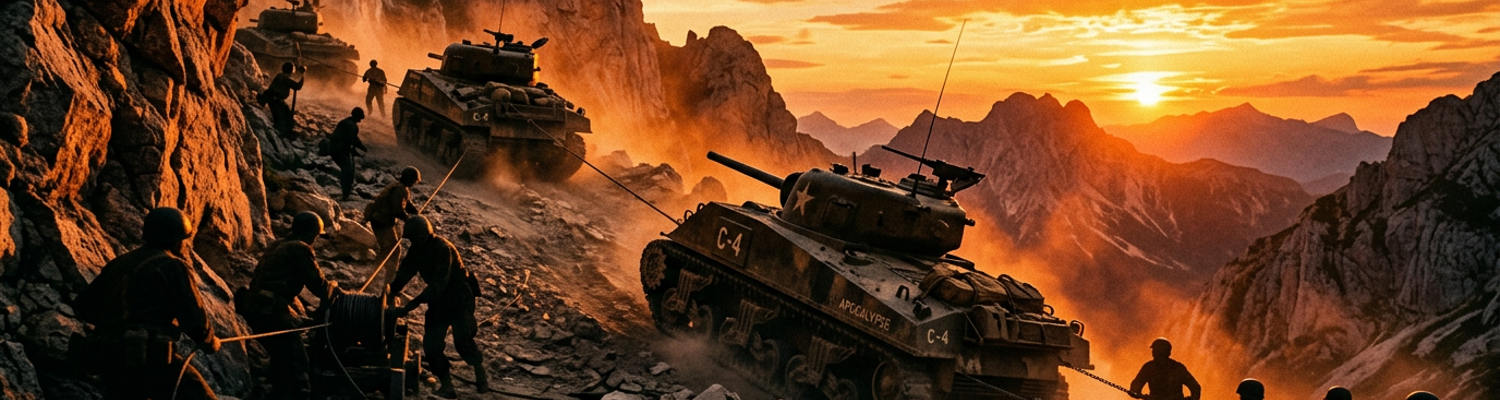
Sherman medium tanks from the 1st Armored Regiment rumbled toward those shallow rifle pits to deliver the heavy fire support the pinned infantrymen were awaiting. Steep cliffs and loose limestone scree barred the tracked vehicles from normal approach routes, presenting slopes that military doctrine and Axis commanders considered completely impassable to armor. Tank crews and combat engineers solved this barrier by winching M4 Sherman tanks up steep mountain goat tracks using cables and support vehicles to scale sheer slopes. Heavy armored recovery vehicles and tracked wreckers anchored themselves to solid rock outcroppings higher up the ridges, unreeling thick steel winch cables down the bluffs to hook into the front towing shackles of the Shermans. Tank drivers kept their radial engines roaring at full throttle while the support vehicle winches ground away, dragging the thirty ton fighting vehicles inch by inch up the forty degree inclines as rubber padded tracks spun against bare limestone. Sweating soldiers blocked the tank tracks with wooden timbers and rock chocks whenever cables strained near snapping, gradually hauling the armor onto the narrow stone terraces directly below the German positions.
Tankers loaded high explosive 75 mm shells into their breeches as soon as those newly elevated tanks leveled their turrets at the summit. Tank gunners brought about the employment of tank main guns at point blank range as direct fire bunker busters against fortified stone redoubts. Solid rock apertures that had easily deflected high angle field artillery fire crumbled when flat trajectory armor piercing and high explosive tank rounds detonated square against the chiseled machine gun slits. Gunners peered through optical periscopes from barely three hundred yards away, firing continuous rounds into the fortified redoubts of Flieger Regiment Barenthin until stone parapets collapsed inward onto enemy gun crews. Flying rock splinters and concussive shockwaves silenced the interlocking machine guns inside the caves, punching holes through the fortress network that had stalled the American battalions for days. Paratroopers tried to bring anti tank weapons to bear against the unexpected armor, but rapid direct fire from the tank guns shattered the remaining rock shelters and blew away the forward defenses.
Staff officers inside the rear corps headquarters received early telephoned reports of these tank ascents with utter disbelief, isolated as they were from the improvised reality of the front line. Generals and planners sat around paper situation maps miles to the rear, insulated inside their quiet headquarters bubble where doctrine stated tanks could never operate on such vertical terrain. Messengers arrived hours late with grease pencil sketches of the winching operations, leaving high ranking commanders unable to grasp that field officers had abandoned rear echelon manuals to drag thirty ton vehicles up goat paths. Rear directors continued to transmit cautious radio advisories demanding that the tanks remain in the valley to protect the division flanks, but these messages reached the forward combat teams long after the direct fire bombardment had already broken the enemy strongpoints. The severe communication lag meant that the actual assault was guided entirely by forward officers on the slopes rather than the isolated staff planners studying contour intervals at distant desks.
Infantrymen of the 135th Infantry Regiment rose out of their rock scrapes the moment the tanks battered open the limestone redoubts, rushing through the smoke to secure the shattered German positions. Rifle squads moved directly alongside the idling Shermans, clearing remaining sniper crevices with fragmentation grenades and suppressing German pockets that attempted to pull back toward the summit. Tank commanders traversed their turrets to lay down heavy coaxial machine gun fire across the upper draws, preventing the Axis garrison from shifting its reverse slope mortars forward to shell the breaching point. Platoons from the supporting assault battalions filed through the newly cleared gaps, establishing a firm defensive perimeter across the rocky terraces to repel anticipated German counterattacks. Forward observers scrambled onto the highest captured stone ledges, unfolding their artillery field maps and unspooling fresh telephone lines to direct massed divisional fire onto the retreating enemy columns.
Infantry Weapon Modifications and the Collapse at Mateur
Artillery shells crashed down into the dry ravines where the retreating Germans attempted to regroup, kicking up thick clouds of rock powder and airborne silica that drifted directly back into the American rifle positions. Fine sand and powdered limestone coated the exposed mechanisms of standard weapons, causing constant cycling stoppages as infantrymen fired down from the captured ledges. Squad leaders and company armorers resolved these persistent weapon stoppages by carrying out front line modifications to M1 Garand rifles and Browning machine guns, operating them dry to resist desert grit and sand fouling. Riflemen stripped the standard issue lubricating oil from their receiver tracks with clean rags and scraped heavy grease off their bolt assemblies, discovering that unlubricated steel components cycled smoothly without attracting the abrasive rock dust. Machine gun squads disassembled their Browning M1919A4 receivers on clean poncho halves, drying the internal linkages and feeding dry canvas ammunition belts into the feed mechanisms to ensure uninterrupted automatic fire across the open draws.
Gunners raked the scrub filled draws with unbroken bursts, keeping German paratroopers from mounting an organized counterstroke against the newly won ledges. Couriers racing rearward through the communications blackout brought word of these localized tactical successes to corps staff officers, who still sat in rear command tents issuing directives based on morning map coordinates. Planners inside the headquarters bubble repeatedly delayed approving follow up advances because severed telephone lines and intermittent radio links gave them no clear picture of the collapsed enemy defenses. Staff officers feared that forward battalions were walking into an armored ambush, warning field commanders over crackling field sets to hold their positions until heavy artillery could execute systematic bombardments. Battalion commanders on the slopes ignored the timid messages from the rear, recognizing that hesitation would allow Flieger Regiment Barenthin to consolidate fresh fallback trenches along the reverse slopes.
Infantrymen of the 135th Infantry Regiment drove directly into the stubborn German strongpoints on May 1, 1943, achieving the final breach of the Axis perimeter across Hill 609. Fragmentation grenades and dry operating M1 Garands cleared the remaining cave entrances, forcing a German withdrawal off the battered heights as surviving enemy elements abandoned their heavy equipment. Colonel Walther Barenthin ordered his battered survivors to pull back under the cover of smoke screens and gathering darkness, relinquishing the mountain stronghold that had anchored Axis defenses across northern Tunisia for weeks. Abandoned machine guns, shattered ammunition crates, and discarded helmets littered the crest of Djebel Tahent as the last German rear guards retreated eastward through the valley. American patrols secured the high ground by midnight, setting up visual observation posts that looked down upon the broad open lowlands stretching unimpeded toward the northeast.
Lookouts on the summit scanned the open valley highways, confirming that the German retreat had unhinged the entire defensive sector and cleared the Allied path to Mateur. Tank columns and motorized reconnaissance units from the 1st Armored Division idled along the forward staging roads, awaiting orders to exploit the open corridor created by the regiment victory. Telephones at Allied headquarters finally rang with the verified report that Djebel Tahent had fallen, breaking through the headquarters bubble and prompting staff planners to discard their obsolete defensive phase lines. Staff officers scrambled to issue pursuit orders, redirecting logistical convoys and mobile artillery batteries down the newly opened mountain highways toward the vital road junction at Mateur. Drivers threw their supply trucks into gear, moving forward into the uncontested valley behind the armored scout cars to complete the Allied advance toward the sea.