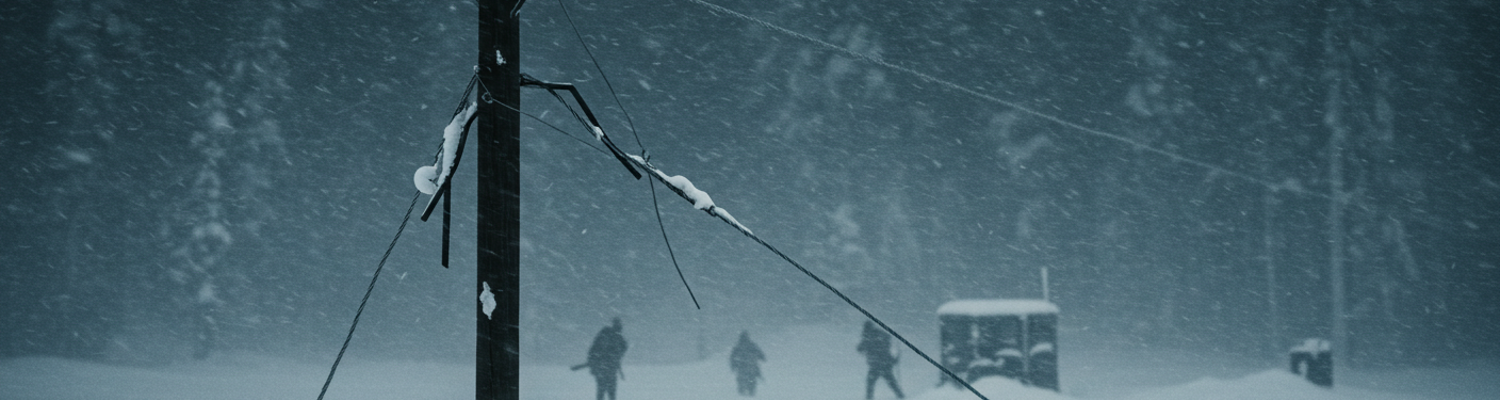

Alaskan Communication Blackout 1910
The click of the telegraph key returned only silence. Inside the Signal Corps station at Fort Egbert, the operator tapped the brass key again, his movements precise from years of training. Nothing. The rhythmic chatter from Valdez, the connection to the rest of the United States, had vanished mid-transmission. It was not a fade or a garble. It was an abrupt amputation of sound. A review of operational logs from similar events (NARA Record Group 111) shows the first reaction was technical troubleshooting. The operator would have checked his own connections, the battery’s galvanic potential, and the relay adjustments.
These actions were futile. The break was not in the hut.
It was somewhere in the abyssal depths of the Gulf of Alaska, where the armored submarine cable of the Washington-Alaska Military Cable and Telegraph System (WAMCATS) lay severed. Archival evidence shows the cable was a complex piece of late 19th-century engineering. A core of copper conductor, insulated by layers of gutta-percha, was wrapped in jute and then armored with heavy-gauge steel wires. While designed for durability, it was laid across a geologically active and unforgiving seafloor. Underwater landslides or abrasion against rock outcroppings could snap the connection. In the winter of 1910, the most likely culprit was ice. The shearing force of a grounding iceberg or the grinding action of pack ice near the Valdez terminus could have parted the cable. For the men of the Signal Corps detachment, the technical cause was irrelevant. They were adrift. Their purpose was to operate a relay in a vast network, and that network had ceased to exist.
The silence from the south was unnerving, but the immediate threat came from the north. As operators tried to raise Valdez, a blizzard was descending on the interior, shattering the remaining overland lines. The system connecting the Alaskan posts was a network of single-strand iron wires strung between wooden poles. These lines were the internal nervous system of the territory, connecting dozens of small, isolated detachments. The blizzard began with freezing fog, which coated every inch of wire with a thick layer of hoarfrost. As the ice accumulated, the weight on the lines increased exponentially. A wire designed to hold a few hundred pounds of tension was now supporting over a ton of ice per span. Then came the wind. The gale-force gusts placed an impossible strain on the wooden poles, which began to snap by the dozen, the sound of their splintering lost in the roar of the storm.
Where poles held, the wire itself failed. Extreme cold alters the molecular structure of iron, making it brittle. A sudden gust of wind or the simple contraction of the metal in the subzero temperatures was enough to cause a catastrophic fracture. Repair was not an option. A Signal Corps lineman attempting to find a break would be stepping into a whiteout with near-zero visibility and windchills capable of freezing exposed skin in under a minute. He could not see the next pole, let alone the glint of a snapped wire. The blizzard dismantled the overland network, post by post, creating a cascade of failures. An operator at Circle would try to raise the relay at Eagle, only to find the line dead. Eagle, already unable to reach Fort Egbert, would find its connection to the north severed as well. Within hours, every station was an island, surrounded by snow and silence, their logbooks now filled only with weather notations.
State Department Directive Flaws
An examination of the foundational documents governing the Signal Corps' mission in Alaska reveals a disconnect between policy and physics. The primary directive from the State Department was built around a single, ambiguous mandate: the observation and reporting of foreign movements along the coast and border regions. A review of the order itself shows it lacked any specific intelligence targets or operational parameters. Signal Corps detachments, staffed by technicians trained for maintaining circuits, were instead tasked as untrained intelligence-gathering outposts. This directive forced commanders to make impossible choices. They were compelled to decide whether to monitor for Russian naval vessels in the Bering Strait, Japanese fishing fleets near the Aleutians, or British Canadian survey parties along the 141st meridian. Without clear guidance, operators documented and transmitted vast amounts of low-value information. This practice consumed bandwidth, operator hours, and battery power. The telegraph lines, already strained by distance, became clogged with reports on every distant puff of smoke or unfamiliar sail, all to satisfy a poorly defined order from a desk 4,000 miles away.
The document’s most glaring omission was any acknowledgment of the Alaskan environment. There was no provision for extreme weather contingency planning. The authors in Washington D.C. treated the territory as a featureless expanse on a map, not a physical space governed by ice and cold. Operational records from posts like Fort Egbert and Circle City detail the consequences. The directive contained no allocation for caches of spare telegraph poles, extra spools of iron wire, or backup glass insulators to be staged along the line’s most vulnerable sections. When a winter storm snapped a wire at thirty below zero, repair crews had to retrieve supplies from a central depot, a journey that could take weeks. A properly engineered military plan would have established hardened shelters with repair materials every 20-30 miles along the route. The State Department directive, focused solely on its observational goal, made no such allowance. It presumed the telegraph system to be a static utility rather than a fragile mechanical system under constant assault from the natural world.
The system's entire architecture was warped by the demand for diplomatic reporting. The WAMCATS was not designed as a resilient network for governing the territory; it was constructed as a long funnel to pour information south into the capital. Archival analysis of Signal Corps internal regulations shows a clear prioritization. Maintaining the integrity of the primary line south from Fort Egbert to Valdez, and by extension the submarine cable to Seattle, superseded all other tasks. A local commander at Eagle, for example, would be compelled by standing orders to dedicate his linemen to ensuring the southern line was clear for a pending report on Canadian mining activity, even if his link north to the outpost at Circle was down. Resources, from repair crews to battery acid, were disproportionately allocated to serving the southbound traffic. This created a brittle, top-down structure with almost no redundancy. The internal lines connecting the Alaskan posts were treated as secondary, their maintenance often deferred in favor of transmitting diplomatic packets. The system was engineered to look outward, not inward, leaving the detachments inside the territory dangerously isolated from each other when the main line was severed.
Temperate Telegraph Design Limitations
An audit of quartermaster logs for the Alaska command reveals a critical acquisition failure. The equipment sent north was the standard-issue Signal Corps wireless set, a system composed of a spark-gap transmitter and a coherer receiver. These were the exact same units being shipped to Army commands in the temperate Philippines and the arid U.S.-Mexico border. A technical review of the hardware shows it was designed for universality, not specialization. The spark-gap transmitter functioned by generating a high-voltage spark across two electrodes, creating a broad burst of radio waves to carry a Morse code signal. The coherer, a glass tube filled with metal filings, would clump together in the presence of these waves, reducing its electrical resistance and closing a circuit. This was functional technology for most environments. Procurement orders from the period show no evidence of any specified modifications for arctic conditions.
The physical construction of the telegraph sets betrayed their temperate-climate origins. Each unit, comprising the transmitter, receiver, sending key, and batteries, was housed in a standard-issue varnished oak chest. The chest provided no thermal insulation. A review of operator maintenance logs from stations like Eagle and Circle details recurring complaints of key stiffness and motor seizure as temperatures fell below freezing. The standard petroleum-based grease (Signal Corps Spec. 4-B) used to lubricate the moving parts of the telegraph key and the rotary spark-gap motor would congeal into a thick, waxy solid. This effectively froze the machinery. Operators documented their dangerous workarounds, which often involved placing the entire brass key mechanism near the station’s stove to thaw it, risking fire and warped components. The wiring inside the sets was a point of failure. Insulation was made from gutta-percha or early rubber compounds that lost their flexibility in the cold, becoming brittle and cracking with the slightest movement, exposing bare wires to short circuits from condensation.
The system’s most acute vulnerability was its power source.
The wireless sets ran on a bank of wet-cell lead-acid batteries, a technology whose performance is directly tied to temperature. The chemical reaction that generates electricity inside a lead-acid battery slows dramatically in the cold. Archival data on the chemistry of these cells confirms that at 32°F (0°C), a battery’s effective capacity is reduced. At -20°F (-29°C), its power output plummets. Operators in unheated relay huts would watch their signal strength fade to nothing, not because of a line break miles away, but because the uninsulated battery box in the corner was being starved of its chemical power by the cold. Even worse, a discharged battery was a death sentence for the equipment. As a lead-acid battery loses its charge, the concentration of sulfuric acid in its electrolyte solution drops, and the liquid behaves more like water. A fully charged battery’s electrolyte might not freeze until -50°F, but a discharged battery’s could freeze solid at temperatures as high as 14°F (-10°C). When the electrolyte froze, it expanded, cracking the glass or vulcanized rubber battery jars. Linemen sent to investigate silent stations frequently filed reports noting the shattered remains of battery banks, with frozen, spilled acid marking the precise point of failure.
Arctic Equipment Malfunction Onset
A detailed analysis of operational records from the WAMCATS shows that the breakdown began at the component level. The standard-issue wireless sets started to seize up as temperatures in the unheated relay shacks plunged. The primary culprit was the petroleum-based lubricant applied to all moving parts. In the rotary spark-gap transmitters, this grease was essential for the smooth, high-speed rotation that produced a stable signal. As the lubricant congealed in the sub-zero cold, its viscosity changed from a fluid oil to a thick, resistant paste. This placed an enormous strain on the small electric motors driving the rotary gaps. Operators reported a noticeable change in the sound of the equipment; the crisp, high-pitched whine of a healthy transmitter devolved into a strained, low groan as the motor fought against the stiffening grease. Field reports document desperate attempts to counteract this, with operators moving the entire transmitter assembly dangerously close to wood-burning stoves to thaw the frozen lubricants.
The repeated cycles of intense heating and rapid cooling warped the precisely machined brass and steel components of the spark gaps and telegraph keys. Metal contracts in the cold, and the sudden, uneven expansion from localized heating caused microscopic fractures and misalignments. A telegraph key that felt sluggish in the morning would become loose and unresponsive after being warmed by the fire. The very act of transmission became a physical struggle. The smooth, rhythmic motion required for sending clear Morse code became impossible as operators had to apply significant force just to close the contacts on a key gummed up with near-solid grease. This mechanical resistance led directly to degraded, unreadable signals.
The second stage of the collapse occurred within the wiring itself. An examination of the equipment specifications reveals the widespread use of gutta-percha and early rubber formulations for electrical insulation. These materials were known to lose their plasticity at low temperatures, becoming hard and brittle. Any vibration or physical shock could cause the insulation to develop hairline cracks. This exposed the copper conductors to the air. Inside the small, crowded relay huts, the moisture from the operators’ own breath would condense on the cold metal surfaces, including these newly exposed wires. A single drop of condensation bridging two cracked wires was enough to create a short circuit. Operational logs from silent stations are filled with notations of acrid smoke or a burnt insulation smell as the final entries. These short circuits would not simply stop the signal; they would often cause a cascade of damage. The low-voltage wiring connecting the telegraph key would fuse, rendering it inoperable. A short in the high-voltage side of the spark-gap transmitter could draw a massive current from the battery bank, permanently damaging the induction coil and draining the power source. Repair was often impossible, as the damage was internal and the linemen lacked the fine-grained diagnostic tools to trace the source of the short within the complex web of hardened wires. These individual mechanical and electrical faults rapidly coalesced into a systemic breakdown. The WAMCATS system was built with minimal redundancy. It was a serial chain of relays, where the failure of one link would isolate every station upstream. As one station went silent, the burden of communication fell to its neighbors. But those neighboring stations were suffering the exact same equipment degradation. A review of transmission logs from the period shows a clear pattern: a station would report losing contact with the post to its north, and then, within hours, its own transmissions would become garbled and intermittent before ceasing altogether. Within a 72-hour window, dozens of individual component failures, driven by the inescapable physics of the cold, had dismantled a communication system that spanned hundreds of miles.
Improvised Telegraph Solutions
With the manufactured systems failing, the Signal Corps operators were forced into a new role: scavenger-technicians. A review of station logs from the period reveals a sharp pivot from standard operational procedure to desperate, field-expedient engineering. The men began to dismantle their environment, seeing not a frozen wilderness, but a collection of spare parts. The guiding principle was no longer the repair manual written for temperate climates, but a calculus of what might work, even for a few hours.
The most delicate of these improvisations concerned a handful of experimental wireless receivers equipped with an Audion, an early and exceptionally rare triode vacuum tube (a small number of which were designated 'Type H' for high-latitude testing). These sets, forwarded to Alaska for field testing, offered superior sensitivity compared to the standard coherer, but their function was mysterious and acutely dependent on temperature. Operators discovered that as the ambient temperature in the shack dropped, the Audion’s ability to detect faint signals would fade, a result of cooling on the electron-emitting properties of its filament. Lacking any official documentation for this fragile glass bulb, the technicians developed a nerve-wracking procedure entirely through trial and error. An entry from one post describes an operator first cupping the tube in his hands, using his own body heat to coax it back to life. This progressed to placing the entire receiver chassis on the least-hot corner of the wood stove. The process was a dangerous art. Too little heat and the signal remained lost; too much, and the delicate filament would burn out, permanently destroying the single most advanced piece of equipment in the territory. The men learned to judge the temperature by feel, finding the precise thermal equilibrium needed to keep the tube’s internal physics functioning.
Where operators fought to keep sensitive electronics warm, linemen waged a physical battle to replace shattered insulation on the overland wires. The original gutta-percha and rubber coatings, made brittle by the cold, had cracked and flaked away, leaving hundreds of yards of iron wire exposed to short circuits from wind-driven snow. The solution was drawn from the landscape itself. Repair crews were dispatched with orders to scavenge any and all animal hides available. A detailed report from a line detachment near the Tanana Crossing shows linemen cutting strips from caribou hides used as bedding and floor coverings in the relay huts. These fur-on strips were then wrapped tightly around the bare iron wire. The dense underfur of the caribou pelt served to trap air, creating an insulating layer, while the longer guard hairs helped shed snow. It was a messy, imperfect fix. The hide would absorb moisture and its insulating properties were inferior to manufactured materials. Yet, for a section of wire that had gone dead, this primitive re-insulation was enough to restore a usable, if weak, circuit.
For every exposed electrical contact, a new enemy emerged: condensation. The moisture from human breath, cooking, and melting snow would form as frost on every cold metal surface inside the telegraph stations. This was particularly dangerous on the open terminals of the batteries and the sensitive contacts of the telegraph keys, where a single drop of water could create a short circuit or a corrosive bridge. To combat this, operators turned to their medical kits. Jars of petroleum jelly became an essential tool. Its hydrophobic nature made it an excellent sealant. Technicians would painstakingly coat every exposed electrical connection, screw terminal, and switch contact with a thick layer of the grease. The non-conductive jelly formed a physical barrier, preventing frost from forming directly on the conductive metal and stopping moisture from completing a circuit.
Unforeseen Alaskan Blizzard Impact
The storm arrived without warning. A review of meteorological logs kept by the Signal Corps detachment at the Tanana Crossing shows a catastrophic drop in barometric pressure just after dawn, but the men on the line had no such instruments. For the 3rd Line Repair Crew, working a section of damaged wire twenty miles south of the relay station, the first sign was the sky. It turned a sickly, bruised yellow. Then the wind hit them, a physical blow that carried a wall of white. The temperature, already well below zero, plunged. Within minutes, visibility collapsed from miles to mere feet. The familiar shapes of the surrounding hills and the dark line of spruce trees vanished into a churning vortex of snow.
Navigation became an act of survival.
A detailed analysis of standard operating procedures for WAMCATS linemen reveals a system completely unprepared for such conditions. Men were trained to navigate by landmark and sight the next telegraph pole, but the blizzard erased all reference points. The ground became indistinguishable from the sky. Compasses, already unreliable in the northern latitudes, were rendered useless by the magnetic interference from their own equipment and the disorienting sensory deprivation of the whiteout. Field reports from the few survivors of these crews describe men tying themselves together with lengths of spare wire to avoid becoming separated by more than a few feet. Finding a snapped telegraph line was now a secondary concern. The primary mission became finding the crude shelters, often little more than canvas tents over a shallow pit, they had left that morning.
The blizzard’s assault on visibility was matched by its attack on the expedition’s energy reserves. An examination of quartermaster requisitions and fuel allotments for the forward repair detachments reveals a critical miscalculation. The mission planners in Valdez had allocated fuel based on temperate-climate consumption rates. The reality of the arctic environment was different. The expedition’s few experimental motor-sleds, powered by early two-stroke engines, saw their fuel economy plummet. Designed for cruising over packed snow, they now had to fight through newly formed, waist-deep drifts, a task that quadrupled their gasoline consumption. A sled with a projected range of fifty miles could now barely manage ten before its tank ran dry.
The most critical fuel supply was wood for the stoves that heated the relay shacks and line shelters. These small caches of split spruce and birch were calculated to last a standard winter season, assuming routine operations. But the storm was not routine. Trapped in their shelters by the zero-visibility conditions and sub-zero temperatures, crews were forced to keep their stoves burning at maximum capacity around the clock simply to prevent frostbite. A shelter’s three-week supply of wood was now being consumed in four days. A review of post-incident reports indicates crews began burning anything combustible: spare tool handles, wooden packing crates, and even the resin-impregnated canvas covers for the motor-sleds. The rapid depletion of fuel was a countdown. Every hour the storm raged, the finite supply of heat dwindled, pushing the isolated crews closer to a final, freezing silence.
Field Lantern Emergency Signaling
With their primary equipment frozen or electrically shorted, the isolated detachments of the Signal Corps turned to the most basic technology at their disposal: fire and light. A detailed review of post-incident logs shows a desperate but systematic effort to weaponize the standard-issue kerosene field lantern for communication. These lanterns were designed to cast a steady, omnidirectional glow, but the men needed to make them speak. The core problem was transforming that continuous light into the distinct dots and dashes of Morse code. The solution, documented in a report from the 3rd Line Repair Crew stranded near the Tanana Crossing, was the construction of a crude mechanical shutter.
Using metal snips from their toolkits, linemen cut the lids from empty tin food cans. A small hole was punched on either side of this tin disc, and a length of scavenged telegraph wire was threaded through to create a crude hinge. This assembly was then affixed to the lantern’s wire cage, positioning the tin disc directly in front of the glass chimney. Another length of wire was attached to the bottom of the disc, allowing an operator to manually pull it down to block the light and release it to create a flash. Transmitting code with this device was a slow, awkward process. The operator had to be positioned close to the hot lantern, and the wire pull was prone to icing up, but it allowed for the transmission of simple messages across the blinding snowscape.
The next challenge was amplifying the lantern’s feeble glow.
The unmodified kerosene flame was barely visible beyond a few hundred yards in the swirling snow. A signal needed to be focused. An examination of equipment recovered from the abandoned Glacier Creek Relay station reveals the next stage of this field engineering. The men began manufacturing reflectors. Using the same food tins that provided the material for the shutters, linemen would cut the cans open, hammer them flat, and then spend hours polishing the interior surface with grease and fine silt from the creek bed until it produced a dull sheen. This polished sheet of tin was then bent into a shallow curve and mounted behind the lantern’s burner assembly using more wire. The improvised parabolic mirror gathered the diffuse light of the flame and concentrated it into a single, brighter beam. It focused enough energy to triple the signal’s effective range, turning a faint glow into a discernible point of light that could cut through the falling snow for up to a mile. These modifications were not without their own failures. The focused heat from the reflector often caused the lantern’s glass chimney to crack in the extreme cold. Records show that some crews, having run out of spare chimneys, operated with an open, exposed flame, risking setting their shelter ablaze with a single gust of wind.
For crews caught in the open, away from the relative safety of a relay hut, even a modified lantern was a luxury they did not have. Navigation in the whiteout conditions of the blizzard had become impossible. A report from a survivor of a line crew operating south of Fort Egbert describes the creation of temporary navigation flares. The men were lost, unable to find their supply cache. Their solution was to create a series of bright, short-lived beacons. They took their standard-issue wool socks, soaked them in kerosene, and then packed them with a thick layer of the semi-solid lubricant used for the motor-sleds. To this mixture, they added an accelerant: the magnesium powder harvested by breaking open the cartridges for their signal pistols. The entire concoction was then packed into an empty food can and lashed to the top of a spare telegraph pole insulator spike, which was driven into the snow. When lit, the flare produced a brilliant, sputtering white light, visible for several minutes before burning out. The crews would light one, stumble towards its glow, and then light the next, leapfrogging their way across the frozen terrain in a desperate attempt to find shelter.
Detachment Operational Paralysis
The technological breakdown created an immediate crisis of purpose. The entire command structure in Alaska was built to facilitate a single mission: the observation and reporting of foreign activity for the State Department. Archival analysis of the WAMCATS administrative directives shows that every other function was secondary to this intelligence-gathering task. With all lines south completely severed, that mission was impossible. The detachments at posts like Fort Gibbon and Eagle were effectively neutered. Reports on Canadian mining claims or rumors of Russian vessels now piled up as unsent message chits. Operators trained for the constant chatter of the key now sat in profound silence, their primary function rendered obsolete.
For the men in the dozens of small, isolated relay stations, the silence was a death sentence.
A close study of quartermaster logs reveals the precariousness of their supply chain. These one or two-man posts, often little more than a single log cabin, were provisioned for a standard winter, with no contingency for being completely cut off. The blizzard that severed the lines also made resupply impossible. A detachment’s multi-week supply of firewood was now being consumed at an accelerated rate as they fought the plunging temperatures. Food was finite. Worse, the silence meant they could not report their status, nor could they receive warnings or orders. A lineman crew caught on the line twenty miles from shelter was simply gone, their fate unknown to the men at either station. The isolation was absolute, a condition enforced by hundreds of miles of snow-covered terrain and the dead wires that offered no hope of rescue.
Without communication, the military chain of command dissolved. Each small detachment became an autonomous and blinded entity. A lieutenant commanding a relay station at the Tanana Crossing was now the highest authority for his small group of men, with no new orders, no intelligence from neighboring posts, and no way to coordinate any action. An analysis of standard military procedure of the era shows that all tactical decisions flowed from information. Lacking any information, commanders were paralyzed. Should they risk sending a party on a multi-week trek through blizzard conditions to the next station, which might itself be abandoned? Or should they conserve their dwindling fuel and food, and wait for a rescue that might never come? Every possible course of action was a gamble with their lives. An examination of the station log for the Eagle outpost shows the final entry was not a message, but a temperature reading. Forty-two degrees below zero.