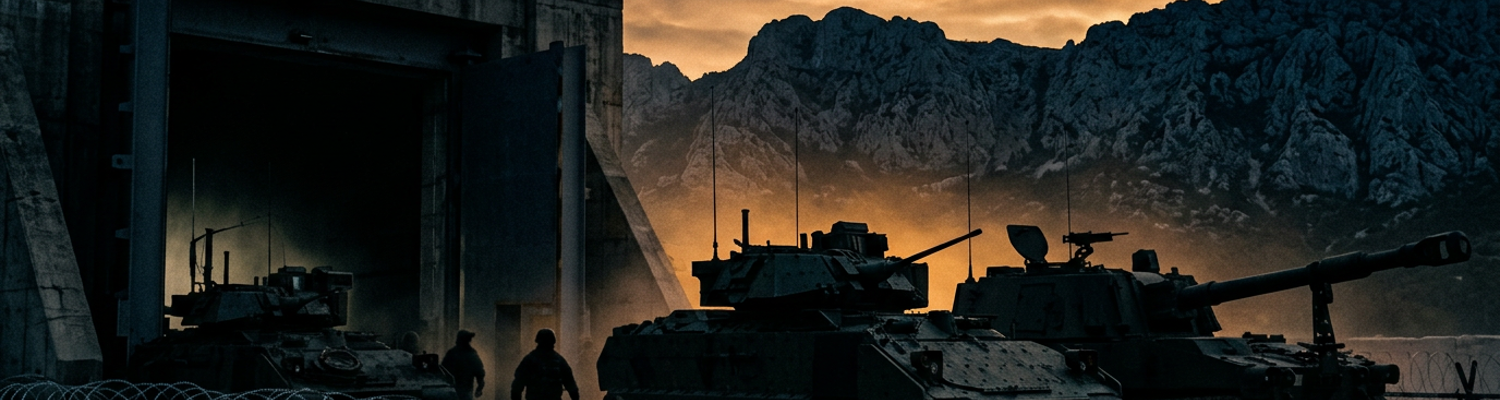

Standdown at Crna Rijeka Underground Complex
Specialist Darren Vance used a strip of dry cotton cloth to scrub wet carbon off the feed pawl of an M249 squad automatic weapon. He kneeled against the damp reinforced concrete footing of Portal Bravo. Cold exhaust from an idling M998 Humvee blew over his knuckles. The smell of unburned diesel drifted into the limestone tunnel mouth. Around him, the intrusive inspection of the Crna Rijeka subterranean bunker system was grinding to an abrupt close in the late afternoon of July 16, 1996. A close review of operational logs from National Archives Record Group 338 indicates that elements of Task Force Eagle pushed twenty-two personnel deep into the mountain complex near Han Pijesak. They operated under the 1st Armored Division. Their objective was to inventory heavy ordnance and verify command-and-control equipment. Serbian staff officers contested every step of the penetration. They disputed map coordinates and stalled access behind reinforced steel blast doors.
By 1740 hours, the American inspection team had accounted for six underground command trailers.
They found secure telephone routing banks and four sealed vault chambers dug into the granite. Inspectors documented the serial numbers of tactical switchboards before gathering their gear and stepping back toward the surface entrance. Nobody unchambered a round.
Archival evidence shows that establishing control over the portal threshold required immediate invocation of Annex 1A of the Dayton Peace Accords. Company commanders drew a grease-pencil boundary line directly across the asphalt apron fronting Portal Bravo. This designated the outer thirty meters as an exclusive IFOR security zone. Platoon leaders from Company B positioned two M2A2 Bradley fighting vehicles hull-down along the eastern approach road. Their 25mm Bushmaster cannons angled directly at the road junction linking the installation to the Han Pijesak highway. United States combat engineers ran concertina wire along the drainage culverts. This prevented lateral infiltration through the dense pine woods flanking the ridge. Inside the tunnel entryway, soldiers maintained tactical spacing of five paces along the reinforced ribs of the subterranean access gallery.
Dayton protocols gave the multinational force complete authority to secure their immediate working environment.
Field engineers set up sandbag fighting positions beside the primary transformer vault. Ten meters separated the opposing gun muzzles.
When examining the historical record, the physical friction between Task Force Eagle soldiers and the lingering garrison of the 65th Protection Motorized Regiment becomes immediately apparent. Approximately forty Bosnian Serb Army soldiers refused to vacate the adjoining administrative annex and surface barracks. They clustered in gravel parking bays with Kalashnikov rifles slung across their chests. VRS personnel smoked cheap Drina cigarettes. They watched every movement of the American perimeter security team through the open bay windows of the motor pool shed. Company leadership on the Serb side claimed administrative ownership of the surface facilities. They pointed out that residential barracks lay beyond the scope of subterranean inspection mandates. Tension spiked when a VRS sergeant chambered a 7.62x39mm round inside an open doorway. An American Bradley crew traversed its turret three degrees left and depressed the barrel. Radio operators on both sides worked continuously. They relayed situational updates up their respective chains of command to prevent localized skirmishes. Night fell over the Romanija plateau. Both formations locked in place under portable halogen floodlights.
At 2315 hours, Task Force Eagle logged zero rounds expended.
Engineer Route Clearance in Unmapped Blast Corridors
A close review of operational logs indicates that combat engineers from the 23rd Engineer Battalion pushed into the pitch-black lateral corridors at 0115 hours on July 17. They advanced ten paces ahead of the infantry security team. Standing water covered the uneven concrete deck up to the ankles. This obscured drainage grates and severed electrical conduits that had rotted after months of subterranean neglect. Sapper teams moved forward in two-man pairs using AN/PSS-12 metallic mine detectors. They swept the search head two inches above the pooled runoff. They looked for command wires leading to unexploded ordnance or buried antipersonnel mines.
Team leaders marked the cleared center path with strips of reflective engineer tape.
They anchored the tape to damp concrete ribs with industrial adhesive. Every doorway branching off the central blast corridor presented unmapped blind spots cut directly into the limestone mountain. Condensation constantly ran down the damp rock. This shorted out secondary utility cables and produced steady electrical sparks. The lead engineer disabled the local junction box with an insulated crowbar.
The mountain had no functional electrical schematics.
Archival evidence shows that Task Force Eagle had to build its own subterranean cartography from scratch. Retreating Bosnian Serb staff officers took all Yugoslav-era structural blueprints with them. Sapper sergeants unspooled 100-foot fiberglass surveyor tapes across the floor. They calculated distance by physical boot pacing. They called out yardage counts across the darkness to a radio operator recording data in a waterproof notebook. Magnetic compasses proved useless inside the concrete sleeves. They swung erratically due to dense iron rebar and abandoned diesel generator blocks resting in the service alcoves. Surveyors established physical line-of-sight reference points every fifteen yards. They marked structural pillars with chalked coordinates tied to an external GPS coordinate established outside Portal Bravo. Room dimensions were calculated by pressing surveyor tapes flat against moldering rock faces. They noted the exact placement of steel blast dampers, telephone distribution frames, and reinforced bulkheads.
By 0330 hours, engineers had hand-drawn eleven distinct subterranean galleries across seven leaves of grid paper.
They exposed two hundred yards of undocumented tunnel that bypassed the primary security checkpoints entirely. Two separate bypass corridors ended at reinforced steel escape hatches.
When examining the historical record, the primary physical threat emerged inside the vertical ventilation risers. These were cut through eighty meters of solid limestone above the command bunker. Combat engineers used handheld halogen spotlights, Draeger multigas detectors, and extendable inspection mirrors to check the concrete-lined intake shafts. They searched for tampering along the structural air dampers and heavy squirrel-cage exhaust fans. Structural shifts had already cracked the concrete liner along the primary intake shaft. Loose stone chunks rested against rusted intake screens directly above the sleeping quarters. Sabotage was an immediate hazard. Engineers discovered loose demolition wires hanging near a secondary air duct. These led down to an unprimed charge pocket carved into the bedrock footing. Sapper specialists crawled six yards into the horizontal vent duct to inspect the blast cavity. They confirmed that the detonation cord had been cut prior to the American entry. No secondary booby traps were active inside the plenum chamber.
The exhaust flues were declared mechanically clear at 0445 hours.
Photographic Documentation Under Hostile Garrison Surveillance
A close review of operational logs indicates that combat camera specialists from the 55th Signal Company entered the subterranean lateral galleries at 0515 hours. They carried flash-bracketed photographic rigs designed to penetrate complete darkness. Operating without utility power, the two-man documentation teams relied on Kodak DCS 420 digital camera backs paired with modified Nikon N90 body frames. They supplemented these with analog 35mm film SLRs for optical redundancy. High-output Nikon SB-26 strobe units were fastened to heavy aluminum extension arms. This elevated the flash heads fourteen inches above the optical axis. It prevented wash-back from water vapor suspended in the bunker atmosphere. CCD sensors, calibrated to an effective sensitivity of ISO 400, struggled against deep shadow zones. Wet limestone rock absorbed the beam. Assistant photographers swept the target bulkheads with narrow-beam Streamlight halogen lanterns. This provided sufficient illumination for the passive phase-detection autofocus arrays to lock onto damp surfaces.
Subterranean condensation drained the nickel-cadmium battery packs in less than forty minutes.
Hardware failures multiplied as damp air infiltrated the modular electronic assemblies. Water continually bridged the exposed hot-shoe contacts. This created short circuits that triggered premature strobe discharges or shut down the digital sensor interface entirely. Photographers carried dry cotton rags and brass wire brushes inside rubberized pouches. They periodically scrubbed the contact pins to maintain electrical connectivity between the body and flash. Advancing deeper into the unlit service corridors required technicians to drag heavy lead-acid battery belts strapped beneath their body armor. They traded physical mobility for operational uptime. Each step along the flooded concrete floor risked submerging spare equipment bags containing fragile flash tubes and PCMCIA memory cards.
Archival evidence shows that photographers directed their lenses into structural demolition pockets cut into the bedrock walls of Gallery Charlie. Armed VRS sentries watched from three paces away. Four Yugoslav-manufactured PROM-1 bounding antipersonnel mines sat concealed behind a rusted ventilation damper. They were wired directly to tension trip lines running along the base of a reinforced support column. Specialized visual documentation teams cataloged these configurations frame by frame. They captured the green lacquer on the steel mine casings, the tripwire anchor pins, and the detonation cord packed into pre-drilled blasting shafts. Serb soldiers from the 65th Protection Motorized Regiment paced along the narrow walkway. They smoked and voiced sharp objections whenever strobe lights illuminated the demolition wiring. One VRS lieutenant repeatedly stepped into the frame to block the camera angle. He argued that electronic flash bursts generated electrical induction capable of triggering sensitive blasting caps. American infantrymen positioned themselves physically between the sentries and the lens. They held their ground without raising weapon muzzles.
Serb sentries kept their index fingers along the trigger guards of their automatic rifles.
When examining the historical record, maintaining an unbroken evidentiary chain of custody was required. This denied VRS leadership any legal pretext for claiming treaty non-compliance under Annex 1A of the Dayton Accords. Every recorded image received an immediate paper ledger entry before personnel advanced to the next lateral tunnel. Photographers logged the camera body serial number, lens focal length, exact timestamp, and the surveyor reference chalked onto the adjacent concrete rib. They wrote this directly onto Department of the Army Form 4137 transfer sheets. Digital storage media could not be altered, formatted, or reviewed in the field. Each card was ejected, sealed inside a tamper-evident plastic sleeve, and secured within a waterproof Pelican case. This case bore dual signatures from the engineer team leader and the primary camera operator. Evidentiary isolation prevented allegations that Task Force Eagle had digitally altered the images or staged explosive charges inside the Yugoslav-era installation. Sealed transit cases were transferred directly to an armored vehicle for transit back to division intelligence officers at Tuzla Air Base.
By 0830 hours, ninety-six digital exposures and eight rolls of negative film were locked inside serialized steel dispatch cases.
Munitions Cache Discovery in Lateral Service Galleries
A close review of operational logs indicates that at 0915 hours on July 17, sappers probing Lateral Service Gallery Delta discovered a hidden compartment. It sat sixty yards beyond the third personnel blast door. Specialist Marcus Thorne tapped a fiberglass sounding rod against a painted steel partition wall. He noted an immediate hollow resonance that contradicted the structural drawings chalked earlier that morning. Prying the seam loose with a non-sparking beryllium pry bar revealed a secondary alcove measuring four meters wide by twelve meters deep. It was completely concealed behind two inches of drywall and acoustic paneling. Stacked four tiers high along the unpainted limestone rock face sat sixty-four green pine crates of 120mm M62P1 high-explosive mortar rounds. They had been untouched since the 1995 ceasefire. Beside the ordnance pallets, inspectors discovered Yugoslav-manufactured RUP-12 and RUP-33 tactical VHF radio transceivers. They found eight frequency-hopping crypto modules and three intact reels of hardened field telephone wire packed inside zinc-lined shipping bins. None of these military assets appeared on the declared equipment manifest. Bosnian Serb liaison officers had signed that document at the Han Pijesak checkpoint forty-eight hours earlier. American soldiers identified that the subterranean alcove had functioned as an active clandestine logistical node. It was intended to supply local VRS forces in the event of renewed hostilities across the Romanija plateau.
Every wooden crate lacked treaty-mandated disarmament seals.
Archival evidence shows that explosive ordnance disposal specialists from the 717th Ordnance Company initiated a rapid hazard calculation inside the unventilated gallery at 0940 hours. Stagnant air inside the dead-end chamber registered ninety-six percent relative humidity. Draeger gas-detection tubes recorded elevated levels of nitrogen dioxide vaporizing off deteriorating munitions. Decades of damp subterranean storage had caused the stabilizers within Yugoslav-era TNT demolition blocks and booster charges to degrade. This produced visible oily exudate across the exterior slats of several cases. EOD team leader Staff Sergeant Raymond Ortiz evaluated the geometry of the tunnel. He calculated that the reflective limestone surfaces would prevent explosive energy from dissipating outward. In an unventilated rock chamber measuring less than two hundred cubic meters, the detonation of a single 120mm mortar shell risked generating an instantaneous shock wave. This would trigger sympathetic detonations across adjacent pallets of heavy ordnance. The resulting subterranean blast overpressure would rip through structural blast bulkheads. It would channel lethal shock waves directly into the primary egress corridor and crush the lungs of any personnel within two hundred meters.
The calculated explosive weight exceeded four thousand pounds of net chemical equivalent.
When examining the historical record, the physical mechanics of stabilizing the subterranean munitions cache forced American commanders to halt all foot traffic through Gallery Delta. Division leadership at Tuzla Air Base rejected requests for immediate underground disposal. They recognized that blasting within the mountain complex would violate international inspection terms. It could potentially trigger structural collapses along the primary command bunker. EOD technicians laid grounding cables from the steel portal framing to copper grounding rods driven into wet gravel drainage troughs. This eliminated static electrical discharge hazards. Sapper teams rigged pneumatic air blowers connected to flexible vinyl ducts. They forced filtered surface air down through Portal Bravo at twelve hundred cubic feet per minute to sweep volatile organic fumes from the rock ceiling. Handlers rotated in five-minute shifts wearing fire-resistant flight gloves. They manually inspected crate joints with brass inspection mirrors before clearing each individual box for surface transport.
By 1120 hours, engineers had labeled thirty-eight crates with fluorescent inventory codes.
They staged them along the cleared center track for mechanical extraction by tracked M548 cargo carriers.
Armored Maneuver Limitations in Tunnel Choke Points
A close review of operational logs indicates that at 1145 hours on July 17, tactical planners from Company B, 1st Battalion, 6th Infantry Regiment tested the physical feasibility of inserting armor directly into the main entrance gallery of Portal Bravo. Mechanics positioned a 27-ton M2A2 Bradley fighting vehicle and an 11-ton M113A3 armored personnel carrier along the concrete approach ramp. They gauged entry clearances against the reinforced mountain portal. Concrete portal uprights measured precisely 3.65 meters across. The M2A2 Bradley hull, equipped with side skirts and mounting brackets for reactive armor tiles, spanned 3.28 meters. Operating with under eighteen centimeters of clearance on either flank eliminated all lateral safety margins. Tank commanders attempting to guide the tracked platforms through the aperture had to unbutton their hatches. They leaned completely outside the vehicle ring mounts to watch the road wheels. This exposed them directly to any elevated firing positions along the rock face. Optical periscopes inside the Bradley fighting compartment suffered instantaneous blind arcs. Subterranean humidity condensed across the external glass prisms. This blinded the driver to obstacles lower than thirty inches off the deck.
Track clearance measured less than four inches per side.
Archival evidence shows that mechanical strain escalated immediately once the tracked platforms engaged the interior grade. Driver crews attempted low-speed neutral-steering turns to align with the dogleg entrance corridor. Steel guide horns ground against the concrete approach. This shredded outer rubber track pads and placed excessive torque on the Bradley HMPT-500 hydromechanical transmission. The enclosed space prevented natural heat dissipation. Engine compartment temperatures on the Cummins VTA-903T diesel engine climbed past 230 degrees Fahrenheit within twelve minutes of stationary idling. At the same time, the M113A3 personnel carrier faced dangerous steering differential lockups. Its driver manipulated lateral steering levers across wet, oil-coated concrete. Exhaust gas from both vehicles concentrated inside the low-ceiling gallery at rates exceeding eight hundred parts per million of carbon monoxide. This overwhelmed the internal vehicular filtration packs and triggered audible hazard alarms. Faced with transmission fluid overheating and severe asphyxiation risks for the crew, Company B officers ordered both tracked vehicles backed out onto the gravel apron.
Sponson armor scraped bare rock.
When examining the historical record, combat engineers from the 23rd Engineer Battalion evaluated the structural consequences of heavy vehicle movement inside the bottleneck corridors. Point Kilo, situated fifty-five meters past the entrance archway, formed a tight horseshoe turn. It was supported by unreinforced masonry footings and precast concrete arch segments installed in 1978. Ground-vibration sensors placed along the tunnel ribbing registered sustained low-frequency acoustic pulses between fifteen and twenty-five hertz generated by the Bradley tracks. This produced visible stress spalling across the overhead limestone ceiling. Sapper officers calculated that a single track failure or mechanical breakdown at this specific bend would completely plug the single-lane gallery. It would create a physical barrier that no standard M88A1 recovery vehicle could bypass or tow clear from behind. Vehicle entrapment would block all subterranean medical evacuation routes. It would trap foot patrols behind thirty tons of immobilized steel and prevent sapper teams from reaching suspected ordnance caches deeper in the complex. Falling roof slabs threatened to crush vehicle engine decks directly. This would sever hydraulic lines and turn the access gallery into an impassable dead end.
Division records show maintenance officers issued an immediate directive barring all tracked armor from entering the Han Pijesak tunnel portals at 1310 hours.
Field Transmission of Engineering Reconnaissance Telemetry
A close review of operational logs indicates that at 1345 hours on July 17, debriefing teams established a forward tactical operations post. They set up inside an M577A2 command track positioned two hundred meters down the access road from Portal Bravo. Inside the cramped aluminum hull, operations sergeants from the 23rd Engineer Battalion began transcribing water-damaged grease-pencil diagrams and loose field notebooks into formal engineering reconnaissance overlays. Sapper squad leaders climbed out of their body armor and read off handwritten measurements taken along the main tunnel axis. They detailed concrete wall thicknesses, rebar spacing, and ceiling arch heights down to the quarter-inch. Radio telephone operators worked by the glow of red interior dome lights. They translated chalk marks and boot-paced yardage into standard ten-digit military grid reference coordinates. Hand-drawn obstacle plots identified four live PROM-1 bounding antipersonnel mines pinned behind Gallery Charlie ventilation grates. They marked the exact tension thresholds of the tripwires along with the presence of Yugoslav-manufactured electrical blasting caps. Draeger multigas detector readings were cross-referenced against surveyor logs to establish an atmospheric hazard profile. They documented lethal carbon monoxide concentrations and pockets of heavy nitrogen dioxide accumulating in the lateral alcoves.
Graphite snapped under the pressure of drafting raw tunnel profiles.
Archival evidence shows that engineering staff officers spent the next three hours compiling improvised subterranean breaching and clearance tactics. These were derived directly from the morning near-catastrophic armored entry attempt. Field engineers recognized that standard surface breaching doctrine was completely ineffective inside unreinforced limestone galleries. Reflective blast overpressure doubled the lethal radius of conventional plastic explosives. Captain Robert Mercer and senior non-commissioned officers formulated a series of immediate field modifications. They recorded them directly onto standard message pads for dissemination to following relief elements. Sappers eliminated the use of standard M183 demolition charges on interior subterranean blast bulkheads. They substituted low-grain flexible linear cutting charges placed exclusively along external door hinges to prevent overhead rock spalling. Mine-sweeping doctrine was completely rewritten for reinforced tunnels. High electromagnetic interference from internal structural rebar rendered AN/PSS-12 mine detectors erratic. Engineers mandated manual probing with non-sparking beryllium-copper rods angled at thirty degrees. Ventilation protocols were reorganized to require portable axial blowers running for twenty minutes before any infantry fire team stepped into dead-end service shafts.
Doctrine was being rewritten on damp field desks.
When examining the historical record, transmitting this raw engineering telemetry back to Task Force Eagle headquarters at Tuzla Air Base exposed severe tactical communications barriers across the Romanija mountain range. The limestone mass of the Han Pijesak plateau absorbed standard VHF-FM line-of-sight radio waves. This prevented AN/PRC-119 SINCGARS transceivers from reaching division relay antennas twenty-eight miles to the north. Signal corps technicians quickly rigged an OE-254 biconical antenna array to a pine tree atop the perimeter ridge. They coupled the feed line to an AN/PSC-5 tactical satellite terminal mounted in an M1097 heavy Humvee. At 1520 hours, field clerks initiated high-frequency radio teletype data bursts. They transmitted compressed digital packets containing thirty-two separate clearance sketches, obstacle maps, and atmospheric logs. Forward staff officers confirmed reception with the division engineer section at 1555 hours. They transmitted the exact physical dimensions of the Portal Bravo dogleg. This prevented the 1st Battalion, 6th Infantry Regiment from dispatching additional heavy armored columns into the mountain throat.
Division tactical dispatch logged the completed data transmission at 1604 hours.
Subterranean Doctrine and Post-Clearance Compliance Verification
A close review of operational logs indicates that at 1630 hours on July 17, compliance officers from Task Force Eagle initiated the formal logging of site verification telemetry inside the command bunker annex. Technical teams recorded ambient barometric pressure, acoustic signatures, and thermal baselines across forty-four discrete structural nodes. They constructed an evidentiary fingerprint of the facility. Sapper teams from the 23rd Engineer Battalion crimped serialized steel cable seals through the locking lugs of six reinforced steel blast doors. They stamped each clasp with alpha-numeric inspection dyes to prevent unmonitored entry. Captain James Thornton cross-checked the captured Yugoslav army inventory manifests against the sixty-four crates of 120mm mortar rounds discovered in Gallery Delta. He recorded lot numbers, fuze configurations, and factory production codes into a master compliance ledger. United States personnel entered these coordinates directly into the Joint Universal Data Interpreter network. This established an unalterable digital paper trail that barred the Bosnian Serb Army from utilizing the complex as a covert staging depot.
Every mechanical latch received an individual steel tag.
Archival evidence shows that preventing covert rearmament required physical barriers backed by continuous mechanical monitoring. VRS liaison officers watched in silence as American technical specialists anchored high-tensile security cables across the tracks of subterranean overhead cranes. They disabled the mechanical hoists once used to lower heavy artillery shells into lower storage vaults. Technicians poured quick-setting epoxy into the padlocks of secondary emergency exits. They sealed external escape shafts that vented onto the forested slopes above the Han Pijesak highway. To eliminate the risk of clandestine electronic reoccupation, signal specialists stripped fifty meters of copper trunk cabling from the main Yugoslav-era distribution frame. They tossed the severed bundles into the back of an open cargo truck. Division intelligence officers required this level of physical disruption because satellite overflights could not track weapons transfers conducted through natural limestone sinkholes. Compliance monitors completed the site verification sheet at 1815 hours. They confirmed that zero heavy weapons were left operational within the perimeter.
No weapons moved past the blast doors without tripping serialized seals.
When examining the historical record, the operational hurdles encountered at Crna Rijeka directly drove the establishment of baseline operational frameworks for NATO IFOR forces. These forces were executing future underground weapons inspections across Bosnia. Prior to the Han Pijesak penetration, Allied commands possessed no unified tactical doctrine for clearing and verifying fortified subterranean installations built under Cold War Yugoslav defense directives. Division operations officers at Tuzla compiled the structural sketches, gas readings, and communication logs generated during the clearance into a forty-eight-page standardized tactical manual. They distributed it to Multinational Division North units by late August 1996. The newly codified doctrine banned tracked armored vehicles from entering any tunnel portal possessing less than one meter of lateral clearance. This eliminated the risk of catastrophic choke-point entrapment. Inspection teams operating throughout the Republika Srpska were restructured into specialized four-element units. They paired sapper route clearers with Draeger gas-detection specialists, combat camera crews, and dedicated legal documentation officers.
The improvised procedures at Han Pijesak became division policy.
Archival evidence demonstrates that this institutional baseline was applied across thirty-two subsequent subterranean facility inspections in the Zvornik, Doboj, and Banja Luka sectors before the onset of winter. NATO weapons inspection teams arrived on target equipped with spark-resistant beryllium-copper sounding rods, lead-acid auxiliary battery packs for digital documentation gear, and specialized linear cutting charges. These charges were designed to sever locking pins without fracturing overhead concrete ceilings. Rules of engagement were formally adjusted to mandate a mandatory seventy-two-hour surface ventilation period using high-capacity mechanical blowers before infantry squads entered unmapped lateral chambers. This mitigated the severe respiratory hazards that had stalled engineers inside Gallery Delta. The resulting verification doctrine eliminated the legal ambiguities exploited by local VRS commanders. It bound both belligerent factions to uniform Dayton Accord compliance audits backed by unassailable physical evidence. Task Force Eagle transmitted the final standardized inspection checklist to Allied Land Forces Central Europe headquarters on September 4, 1996.
The inspection framework was archived under document control serial number 96-IFOR-088.