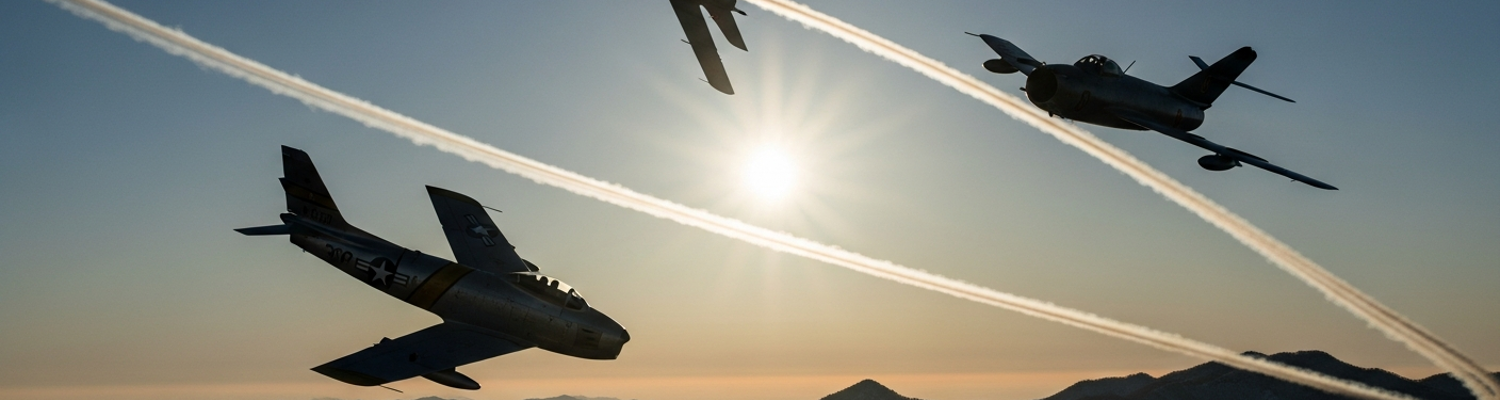

A New Red Star Rises Over Korea
The autumn air of 1950 carried a scent of victory for United Nations forces in Korea. The United States Air Force owned the sky. Its piston-engine F-51 Mustangs and straight-wing F-80 Shooting Star jets had systematically dismantled the small North Korean air arm. B-29 Superfortress bombers, the titans of World War II, flew with a confidence born of total air supremacy, hammering supply lines and infrastructure deep within North Korea. The ground campaign pushed relentlessly northward toward the Yalu River, the border with China. Then, on November 1, 1950, that confidence shattered. American pilots on patrol near the town of Sinuiju reported a new, terrifying shape in the sky. It was fast, it climbed like a rocket, and it was utterly lethal. The Mikoyan-Gurevich MiG-15 had entered the war.
The appearance of the MiG-15 was a strategic and technological shock of the highest order. The Soviet-built fighter, with its sharply swept wings and powerful Klimov VK-1 engine, a reverse-engineered British Rolls-Royce Nene, represented a quantum leap in performance. It could climb to altitudes above 50,000 feet, far beyond the reach of the F-80, and its top speed exceeded 670 miles per hour. Its armament, a brutal combination of a single 37mm cannon and two 23mm cannons, was designed to dismember a B-29 with a single trigger pull. The USAF’s Far East Air Forces (FEAF), commanded by Lieutenant General George E. Stratemeyer, faced an immediate crisis. His bombers were suddenly vulnerable, and the air superiority that guaranteed the safety of UN ground troops had vanished. Reports of B-29s falling from the sky sent shockwaves all the way to the Pentagon, landing directly on the desk of USAF Chief of Staff General Hoyt S. Vandenberg. The air war had been reset to zero.
America's Swept-Wing Answer
The immediate answer to the MiG crisis was a fighter that shared its German aerodynamic heritage, the North American F-86 Sabre. The Sabre, with its own 35-degree swept wing and powerful General Electric J47 axial-flow turbojet, was the only aircraft in the American arsenal capable of meeting the MiG-15 on its own terms. While the MiG held a distinct advantage in climb rate, acceleration, and operational ceiling, the Sabre possessed superior transonic handling, a faster diving speed, and a more robust airframe. Critically, it also carried a technological ace, the A-1C radar-ranging gunsight. Its armament of six .50-caliber M3 Browning machine guns, though lighter than the MiG's cannons, offered a higher rate of fire and a flatter trajectory, which the advanced gunsight could exploit.
The decision from Washington was swift and absolute. The F-86 had to get to Korea, and it had to get there immediately. This directive triggered a massive logistical effort, a race against time to move the nation’s most advanced fighter across the Pacific. The 4th Fighter-Interceptor Wing, the first USAF unit equipped with the Sabre, received its deployment orders. In late November 1950, F-86A models were disassembled, crated, and loaded onto the decks of escort carriers like the USS Cape Esperance and USS Sitkoh Bay for the perilous journey to Japan. At air depots in Japan, maintenance crews worked around the clock to reassemble, test, and prepare the complex jets for combat. On December 15, the first elements of the 4th FIW, led by Colonel George F. Smith, began flying missions from a forward airstrip at Kimpo, South Korea. Just two days later, on December 17, 1950, Lieutenant Colonel Bruce H. Hinton led a four-ship flight and scored the first confirmed Sabre kill against a MiG-15, signaling that the USAF was back in the fight.
The Crucible of MiG Alley
The northwestern corner of North Korea, a roughly 150-mile-long corridor stretching from the Chongchon River to the Yalu, quickly earned its infamous name, MiG Alley. This airspace became the world's first dedicated arena for large-scale, sustained jet-versus-jet combat. The geography defined the conflict. MiG-15s, often flown by elite Soviet pilots from the 64th Fighter Aviation Corps in a clandestine but direct involvement, operated from a network of secure airfields across the Yalu in Manchuria. UN rules of engagement strictly forbade American pilots from crossing this border, creating a sanctuary from which the MiGs could launch attacks and to which they could flee if damaged or outnumbered. The primary mission for Sabre pilots was to establish a protective screen, an aerial barrier to shield the vulnerable B-29s and F-84 Thunderjet fighter-bombers striking targets south of the river.
A mission into MiG Alley was a grueling, high-stakes affair. A typical sortie lasted about 90 minutes, with only a fraction of that time spent in the actual combat zone. Pilots flew hundreds of kilometers over hostile territory, their senses strained to pick out the tiny silver specks of enemy aircraft against the vast, empty canvas of the high-altitude sky. Fuel was a constant, tyrannical concern. The early J47 engines were thirsty, and pilots flew with one eye on their fuel gauge, knowing that the call of "bingo fuel" meant an immediate, non-negotiable return to base. They fought not only the enemy but also physics. The thin air above 30,000 feet demanded precise control, and the extreme speeds turned gentle maneuvers into bone-crushing high-G turns. Air superiority was never a permanent condition. It was a temporary state, won each day through skill, aggression, and the constant, nerve-shredding pressure of combat at the speed of sound.
Forging the Doctrine of Jet Combat
The unprecedented velocities of MiG Alley rendered traditional World War II aerial tactics obsolete. Dogfighting formations like the Lufbery circle, designed for slower, more agile propeller aircraft, were suicidal in the jet age. A pilot who tried to fight a purely turning battle would quickly find himself out of energy and a target. In response, USAF pilots, many of them seasoned veterans of the European and Pacific theaters, developed and perfected new tactics on the fly. The most significant of these was the "fluid four" or "finger-four" formation. This tactic divided a four-ship flight into two elements, a leader and a wingman. The elements provided mutual support, with each wingman's primary job being defensive, scanning the rear quadrants to protect their leader from ambush. This freed the leaders to focus entirely on hunting and destroying the enemy. This concept of element integrity and mutual support, born of necessity over Korea, became the foundational doctrine for all Western fighter forces for decades.
Technology provided a critical edge. While the Sabre pilot fought his aircraft, the G-suit fought for his consciousness. During violent, high-G turns, centrifugal force would drain blood from a pilot's brain, leading to grey-out, tunnel vision, and ultimately G-induced Loss of Consciousness (G-LOC). The G-suit, an inflatable garment wrapped around the legs and abdomen, automatically squeezed the pilot's lower body during these maneuvers, physically preventing blood from pooling and giving the Sabre pilot a precious few seconds of clear-headedness that his MiG-driving counterpart lacked. This advantage allowed Sabre pilots to sustain tighter turns and gain a superior position in a dogfight. Combined with the A-1C gunsight, which used radar to calculate the precise lead needed to hit a maneuvering target, the Sabre became a far more effective killing machine than its raw performance numbers suggested. The gunsight allowed pilots to score hits from deflection angles that were nearly impossible with the MiG's simpler gyroscopic sight.
The decisive factor, however, was the human in the cockpit. The USAF committed its best to the Korean fight. The pilot pool was rich with experienced combat leaders from World War II, men who understood aerial combat in their bones. Leaders like Colonel Harrison Thyng and Major Frederick "Boots" Blesse codified the new rules of engagement. Blesse's tactical manual, "No Guts, No Glory," became required reading for a generation of fighter pilots. This experience gap proved decisive. While the Soviet pilots were skilled, the Chinese and North Korean pilots who also flew the MiG were often undertrained. The USAF's rigorous training standards and the combat wisdom of its veteran pilots consistently tipped the scales. Pilots like Captain James Jabara, who became the world's first jet ace on May 20, 1951, and Captain Joseph McConnell, the top-scoring American ace of the war with 16 victories, demonstrated a level of situational awareness and aggression that defined the Sabre community. The duels in MiG Alley were far more than a sideshow to the ground war. They were the crucible where the United States Air Force hammered out the theories, tactics, and technologies of modern air superiority. The lessons in leadership, training, and technological integration learned in that narrow, dangerous strip of sky over North Korea would define the service and ensure American air dominance for the rest of the Cold War.