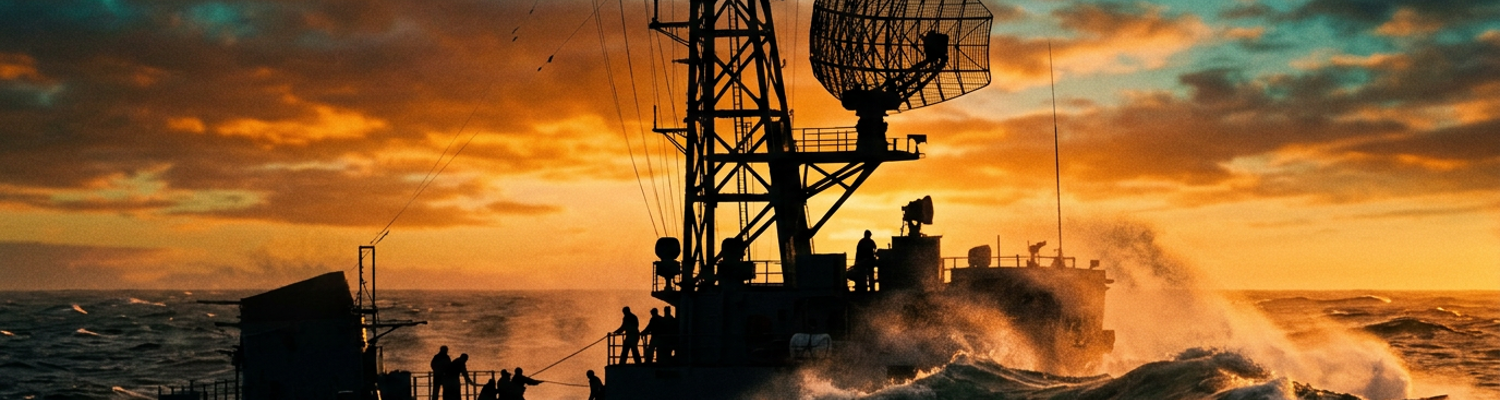

Activation of the Atlantic Barrier Radar Picket Line
Bearing rings inside the rotating pedestal of the AN/SPS-8 radar cracked with a sharp metallic snap under the violent roll of the North Atlantic sea. Bronze drive gears stripped their teeth inside the mast housing as fifty-knot wind gusts slammed into the massive parabolic reflector dish high above the rolling deck. Technicians scrambled up the icy ladder wells with heavy canvas tool bags, grease guns, and replacement shims to secure the rocking antenna array before the drive motor burned out completely. Bridge officers immediately reduced ship speed and turned into the heavy swell to ease the sickening pitch, watching their air search radar display freeze into useless green clutter right in the middle of their oceanic patrol box. Electricians down in the radar distribution room reset tripped circuit breakers and pumped water out of leaking cable runs, fighting to keep auxiliary power flowing to the combat information center. Every man on watch understood that any prolonged equipment failure created an unmonitored opening in the regional air defense net.
Destroyer escorts of the Edsall and John C. Butler classes served as the primary surface ships of this defense net, having been pulled out of the reserve fleet and rebuilt as specialized radar pickets known as DERs. Naval shipyards had stripped away the original torpedo tubes and heavy depth charge racks, packing the narrow hulls with heavy search radars, air-conditioned combat information centers, and tall communication masts. These alterations created top-heavy ships that rolled up to forty degrees in rough water, turning living spaces into hazardous compartments filled with loose gear and sliding mess trays. Crews maintained five continuous ocean stations strung out along a jagged fifteen-hundred-mile line between Newfoundland and the Azores, enduring weeks of punishing gales where gray waves smashed over the forecastle and tore deck lockers from their welds. Officers accepted the brutal battering of both machinery and personnel because their strategic mission parameters required continuous surveillance to provide early warning against Soviet long-range strategic bombers.
Planners in the Office of the Chief of Naval Operations formally activated the Atlantic Barrier, designated BARLANT, in July 1957 to close the open oceanic route into the North American heartland. Naval strategists had analyzed the flight capabilities of Soviet Tu-95 Bear and M-4 Bison bombers, calculating that hostile aircraft could fly around land-based radar stations in Greenland and Canada unless picket ships maintained unbroken radar coverage across the ocean. Maintaining that coverage required an unyielding mathematical commitment, forcing sixteen radar picket ships and dozens of airborne radar planes into an endless rotation just to keep five surface stations staffed around the clock. Fleet commanders in Washington understood the staggering toll this schedule imposed on ships designed for coastal convoy defense, yet they viewed the operational strain as a necessary gamble against the threat of a surprise nuclear strike. Operational orders dictated that no vessel could leave its assigned station circle for routine mechanical casualties or foul weather, making continuous electronic surveillance the single non-negotiable priority of the entire command.
Sailors lashed themselves to the exposed radar platforms with canvas safety harnesses, replacing burned-out vacuum tubes and sheared drive pins while freezing spray coated the superstructure in heavy rime ice. Damage control parties below decks welded steel plates over cracked frame bulkheads and pumped leaking fuel tanks to balance ship weight in the towering seas. Engineers in the boiler rooms bypassed secondary pressure safety valves and manually adjusted feedwater injectors to keep turbine generators running, ensuring that the ship never lost electrical power to the search transmitters. Skippers kept their vessels turned directly into the oncoming swells at bare steerageway, using twin screws to hold position inside their designated forty-mile patrol boxes while the radar antennas turned steadily through the North Atlantic dark.
Severe North Atlantic Gales and Topside Icing
Propeller shafts groaned under severe strain as sustained winter gales generated continuous sea states that forced DER hulls into rolls exceeding fifty degrees. Enormous ocean swells slammed against the low forecastles, shearing steel stanchions and twisting forward weather decks under thousands of tons of moving water. Inclinometer pendulums on the bridge swung violently past the fifty-degree tick marks on every third wave, holding the ships on their beam ends for several seconds before the keels righted themselves. Inside the narrow hulls, unsecured tools, coffee mugs, and steel spare-parts boxes broke free from their canvas lashings, rocketing across compartments and denting aluminum bulkheads. Officers on watch gripped welded overhead grab rails with both hands, shouting rudder commands through the engine noise to prevent the escort vessels from falling into the wave troughs. Cold ocean water poured into open ventilation cowls and leaked around gasketed bridge windows, soaking electrical switchboards and trickling into the passageways below.
Seawater entering exposed upper deck fittings froze almost instantly in the bitter air, with sub-zero sea spray creating rapid topside ice accumulation that threatened vessel stability and deck access across the entire ship. Gale-force winds drove dense clouds of ocean mist against the radar tripods and gun mounts, building up thick layers of solid rime ice that grew heavier with every passing hour. This expanding frozen weight concentrated high above the main deck, shifting the vessel center of gravity upward and bringing top-heavy radar pickets dangerously close to capsizing. External dog-latches on watertight hatches jammed solid under sheets of clear ice, sealing escape routes and cutting off deck access between the combat information center and exterior lookout platforms. Captains ordered off-watch personnel to form emergency deck parties, issuing heavy wooden mallets, fire axes, and copper chisels to shatter the frozen buildup before the superstructure became overloaded.
Sailors stepped into howling gale winds with safety lanyards clipped to wire lifelines, swinging sledgehammers against iron railings while freezing breakers crashed over their boots. Sub-zero wind chills penetrated wet wool sweaters and canvas parkas, leaving men shivering violently with numb fingers and blue lips within fifteen minutes on deck. Sudden fifty-foot vertical drops hurled crew members across the ice-slicked plates, snapping wrists, dislocating shoulders, and smashing knees against hard steel angle irons. Rampant hypothermia, acute fatigue, and severe orthopedic injuries spread rapidly among deck and engineering crews during barrier patrols as the relentless Arctic cold and nonstop rolling took their toll. Stretcher bearers struggled through icy passageways to drag semi-conscious, soaked sailors down into the boiler rooms, where men were stripped near furnace casings to restore their core body temperatures.
Corpsmen converted the ship small mess deck into an auxiliary dressing station, setting compound bone fractures and wrapping frostbitten extremities in dry wool blankets. Engineering personnel below the waterline fared little better, burning hands on hot steam pipes and suffering torn ligaments as violent fifty-degree rolls threw watchstanders off wet bilge grates. Off-duty watchstanders wedged their bodies tightly into canvas bunks using life jackets and sea bags, yet the continuous violent heaving prevented restorative sleep for weeks at a time. Physical exhaustion degraded reaction times across every department, but operational orders required commanding officers to keep radar antennas turning and boilers steaming inside the station grid. Watch officers ordered the next shivering damage-control party back out onto the ice-covered forecastle with replacement mallets, keeping the ship search beams sweeping across the northern horizon.
Bureau of Medicine Physical Qualification Directives
Corpsmen logged each crushed finger, torn shoulder, and frostbitten hand into official health records as battered deck parties retreated from the freezing spray. These mounting physical casualties immediately collided with strict peacetime personnel readiness criteria enforced by the Navy Bureau of Medicine and Surgery, known across the fleet as BUMED. BUMED regulations established rigid health standards designed for calm waters and predictable port schedules, assuming that every active sailor possessed complete physical mobility, sharp vision, and steady endurance. Bureau instructions bound naval physicians to formal qualification manuals that judged a sailor as either fully fit for unrestricted sea duty or officially disabled. Peacetime rules provided no legal leeway for doctors to assign partially injured men to light duties or permit modified watchstanding during an active mission. Corpsmen stacked completed disqualification forms on the medical officer folding desk, stripping half of the deck division from the active watch list.
BUMED directives enforced mandatory medical disqualification thresholds that legally prohibited injured watchstanders from serving at primary operational posts such as the bridge, the radar consoles, or the boiler throttles. Navy regulations specifically dictated that any crew member suffering from fractured limbs, severe head trauma, or the side effects of narcotic painkillers could not remain on active watch. Radar plotters with splinted arms could not rapidly mark hostile contacts with grease pencils on vertical plexiglass plotting boards, while sonar technicians with ruptured eardrums were barred from acoustic listening gear. Concussed lookouts and boiler technicians with blistered steam burns crossed precise medical limits that stripped them of their operational clearance. These hard disqualification lines were designed to protect sailors from further harm and prevent critical errors during routine peacetime cruises, but on a destroyer escort carrying only one hundred and fifty men, they rapidly depleted entire duty sections. Watch supervisors crossed injured names off the duty roster with red grease pencils, leaving primary radar scopes unmonitored during the midnight rotation.
Captains confronted fleet manning frameworks requiring immediate shore evacuation for incapacitated crew members under standard naval regulations whenever injuries exceeded the treatment limits of an escort ship small sickbay. Standard naval directives instructed a commanding officer to break away from his patrol track and steam toward the nearest deep-water port or rendezvous with a dedicated hospital ship when crewmen required orthopedic surgery or extensive recovery. Obeying these evacuation procedures meant pulling the vessel out of its forty-mile patrol box and steaming for days toward Argentia, Newfoundland, leaving a massive radar gap in the Atlantic defense line. Navy personnel planners designed these manning frameworks under the assumption that fresh relief vessels and replacement crews were always waiting in coastal harbors to step into the rotation. Ocean station patrols offered no such luxury, because Atlantic Command possessed barely enough converted destroyer escorts to keep five radar pickets afloat simultaneously. Captains plotted the five-day return voyage to Halifax on paper navigation charts, measuring how many hundred miles of ocean would sit completely exposed to Soviet bomber flights.
Skippers rejected those withdrawal routes because leaving ocean station boxes unattended violated the core operational directive of the Atlantic Barrier command. Ships could not maintain continuous surveillance with half of their radar specialists confined to sickbay bunks, but neither could they steam for port without creating an open corridor for hostile nuclear bombers. Senior skippers drafted urgent radio dispatches to fleet headquarters in Norfolk, reporting that rigid peacetime physical standards were actively destroying their ability to hold the barrier line. Medical officers refused to sign off on compromised watchstanders without higher authorization, forcing line officers to confront the military chain of command directly. Commanding officers held their vessels on station in the towering seas, waiting for fleet commanders to decide whether peacetime health rules or continuous nuclear deterrence would govern the Atlantic Barrier.
Emergency Medical Waiver Petitions to OPNAV
Teletype machines in the communication shacks began chattering around the clock as captains bypassed normal bureau channels to send an administrative deluge of emergency petitions directly to the Office of the Chief of Naval Operations. Ship commanders typed out high-priority message ribbons that documented the rapid physical breakdown of their duty sections, reporting radar rooms with half their scopes unmanned and engineering spaces operating on skeleton shifts. These urgent petitions requested blanket medical waivers that would suspend routine physical standards and allow commanding officers to assign injured, splinted, or medicated sailors back to active watch stations. Captains stressed that sickbays lacked the beds and supplies to treat severe fractures and internal trauma, while shore evacuations were completely impossible without pulling ships off their patrol tracks. Every petition drove home the same blunt reality, warning that enforcing ordinary peacetime regulations made it impossible to keep radar transmitters radiating into the northern sky.
Planners inside OPNAV reviewed these emergency dispatches and drafted urgent command evaluations warning that strict BUMED compliance would de-man radar pickets and collapse the detection line. Staff officers ran the deployment numbers against fleet readiness reports and found that the Atlantic Fleet possessed no spare destroyer escorts in coastal harbors ready to relieve battered pickets ahead of schedule. Strict adherence to bureau medical instructions would immediately sideline over one third of every crew, forcing at least two vessels at a time to abandon their patrol boxes for emergency medical port calls. Evacuating those ships would open an unmonitored air corridor four hundred miles wide between Newfoundland and the Azores. Soviet long-range bombers flying across that blind sector could cross the Atlantic perimeter without detection, stripping North American air defense commands of critical early warning time.
OPNAV leaders accepted a calculated institutional gamble to tolerate elevated personnel injury risks rather than abandon strategic picket stations. Chief of Naval Operations staff members weighed the certainty of worsening crew injuries against the strategic necessity of continuous radar surveillance, choosing to place the survival of the early warning line above individual health regulations. Bureau doctors argued forcefully that compelling concussed sailors, men with broken bones, and crewmen taking narcotic painkillers to stand watch in violent fifty-degree rolls invited permanent physical disability or fatal falls. Naval leadership overruled those medical objections, concluding that peacetime safety rules had to yield to Cold War deterrence requirements. Staff officers encoded emergency operational directives granting commanding officers broad discretionary authority to waive medical disqualifications and retain injured watchstanders on station.
Destroyer escorts across the northern barrier received the waiver authorizations over encrypted radio teletype, allowing corpsmen to clear bandaged men for immediate watch duty. Medical officers unbolted the sickbay doors and returned semi-ambulatory crewmen to active rosters, taping cracked ribs, wrapping fractured wrists in fiberglass casts, and dispensing codeine pills so sailors could tolerate the pain. Watch supervisors guided sailors on crutches into the combat information center, lashing men securely into their console chairs with canvas straps to prevent them from sliding across deck plates during heavy rolls. Technicians with stitched head wounds and black eyes sat back down before glowing cathode-ray tubes, tracking oceanic air contacts with grease pencils as fifty-knot gales hammered the hull. Skippers logged the OPNAV waiver serials into their operational records, ordered the engine rooms to maintain position in the patrol box, and kept their search radars turning through the Arctic dark.
Severed Radio Communications and Watchstander Retention
Radio receivers in the communication shacks hissed with deafening static as intense geomagnetic storm activity cut off high-frequency radio contact between patrol ships and Naval Station Argentia. Solar particle streams disrupted the upper atmosphere across the northern latitudes, wiping out scheduled broadcast channels and preventing teletype units from printing incoming fleet traffic. Radio operators adjusted vacuum-tube frequency selectors and retuned their transmitters, but atmospheric disturbances smothered every outgoing report before it could reach the shore command center in Newfoundland. Ship commanders realized that the administrative safety net established by OPNAV medical waivers had vanished with the loss of the long-range radio network. Commanding officers stood alone on their rolling bridges without any way to report newly injured personnel, request updated waivers, or receive operational instructions from shore authorities.
Captains took full personal responsibility and made autonomous shipboard decisions to bypass peacetime administrative doctrine while completely cut off from command authority. Standard naval regulations prohibited ship captains from modifying physical qualification rules or assigning incapacitated men to hazardous duty on their own initiative. Skippers ignored these administrative barriers, knowing that strict compliance with peacetime manuals would force them to shut down surveillance radars as duty sections lost men to exhaustion and injury. Commanding officers wrote temporary directives in their night order books, declaring that military necessity superseded normal Bureau of Medicine guidelines for the duration of the communication blackout. Executive officers took those handwritten instructions down to the sickbay compartments, creating an informal chain of command designed to keep every operational watch station manned at any cost.
Corpsmen enforced the compulsory retention of medically disqualified sailors on critical watch rosters to sustain continuous tactical air search rotations. Medical personnel cleared men with fractured fingers, concussions, and bandaged burns directly from examination tables back into the combat information center. Watch supervisors assigned semi-ambulatory sailors to radar consoles, pairing plotters with injured limbs alongside technicians who could still operate manual tuning dials. Electricians with cracked ribs and heavy splints stood eight-hour shifts beside the radar transmitters, wedging themselves between equipment racks to maintain cooling fans and high-voltage power lines. Duty section leaders checked each console every fifteen minutes, ensuring that injured sailors stayed awake and kept their eyes fixed on the rotating sweeps of the radar display scopes.
Canvas harnesses held splinted sailors firmly inside their operator chairs so the violent rolls of the ship could not throw them across the steel deck plates. Plotters worked with their uninjured hands, pressing grease pencils against vertical plexiglass tracking boards to record every detected radar contact. Relief crews dragged themselves out of damp bunks at the change of the watch, swallowed pain tablets, and strapped into console seats without interrupting the continuous sweep of the search beam. Skippers remained on the bridge to track these plotted contacts against oceanic navigation charts, keeping twin screws turning into the heavy seas while high-frequency antennas stood silent above the masthead.
Improvised Steam Lines for Frozen Radar Pedestals
Ice accumulated rapidly across the silent mastheads as freezing ocean spray swept over the superstructure, encrusting the topside AN/SPS-12 search radars in thick rime. Heavy frozen layers locked the exposed rotation mechanisms and mechanical drive pedestals solid, halting the circular sweep of the antenna reflectors mid-turn. Radar operators in the combat information center watched their scopes suddenly freeze into fixed radial lines of green electronic interference as drive motors hummed under catastrophic mechanical resistance. Technicians rushed out onto the rolling catwalks with wooden mallets and scrapers to smash the frozen crust around the turning rings, but the sub-zero wind froze new ocean water over the steel gears faster than men could chip it away. Duty officers realized that manual de-icing could not keep pace with the storm and that continuing to force the drive motors would strip the bronze gears or trigger an electrical fire. Bridge officers alerted the engineering spaces below that the ship was completely blind in the northern air corridor unless someone found a way to deliver constant mechanical heat to the frozen mast.
Engineers in the forward fire room confronted this tactical failure by proposing an unauthorized engineering improvisation tapped directly into the ship high-pressure boiler steam lines to route a heated bypass to the mast. Standard naval engineering regulations strictly forbade modifying or tapping live steam manifolds at sea without shipyard authorization, because an uncalculated pressure drop could disrupt boiler water circulation and starve propulsion turbines in sixty-foot seas. Engineering officers calculated the volumetric loss against boiler capacity, evaluating whether the steam generators could sustain several hundred pounds of pressure while feeding an uninsulated exterior pipe. Doubt gripped the engineering department because drawing high-pressure steam through makeshift rubber hoses carried the severe risk of catastrophic ruptures that could scald watchstanders to death inside the narrow compartments. The chief engineer accepted this extreme operational gamble because leaving the picket station blind created an open corridor for Soviet bombers, justifying the physical hazard to ship and crew. Boiler tenders cut into an auxiliary steam manifold, clamped threaded fittings and reinforced high-pressure hoses into a jury-rigged bypass, and prepared to send live steam upward to the mast.
Sailors assigned to topside work details hauled the pressurized bypass lines out of the engine room hatches and up the exterior ladders toward the frozen radar mast. These deck crews risked severe cold exposure and debilitating burns to ensure continuous radar sweeps along the barrier. Freezing seawater splashed over the uninsulated canvas wrapping of the lines, producing clouds of vapor that blinded the deck party in forty-knot sub-zero winds. Crewmen lashed themselves to the search radar platform with canvas straps, gripping the blistering hose nozzles with wet leather work gloves that offered almost no thermal protection against the heated metal. Live steam hissed under tremendous pressure as sailors directed the thermal jet directly against the frozen drive pedestal, melting the thick ice encrustations into scalding runoff that splashed back onto their hands and faces. Hospital corpsmen waited on the rolling bridge deck to treat men who collapsed from cold shock or suffered second-degree scalds across their exposed skin.
Steel gears inside the AN/SPS-12 drive pedestal broke loose with a heavy mechanical clatter as the last chunks of ice disintegrated under the continuous heat. Electricians down in the distribution spaces engaged the pedestal drive circuits, watching the antenna dish resume its steady rotation across the northern horizon. Deck crews clamped the steam bypass nozzles firmly to the mast framework using safety wire and steel brackets, maintaining a steady heat source that prevented new ice from seizing the mechanical gears. Technicians with bandaged fingers and burned palms secured the steam supply lines, climbed down the icy ladders, and reported back to their operational watch stations in the radar room. Radar scopes in the combat information center cleared of fixed clutter and painted continuous sweeps across the ocean sector, confirming that the picket line was fully operational once again. Bridge watchstanders logged the unauthorized boiler line in the damage control log and kept the destroyer escort moving along its designated patrol track.