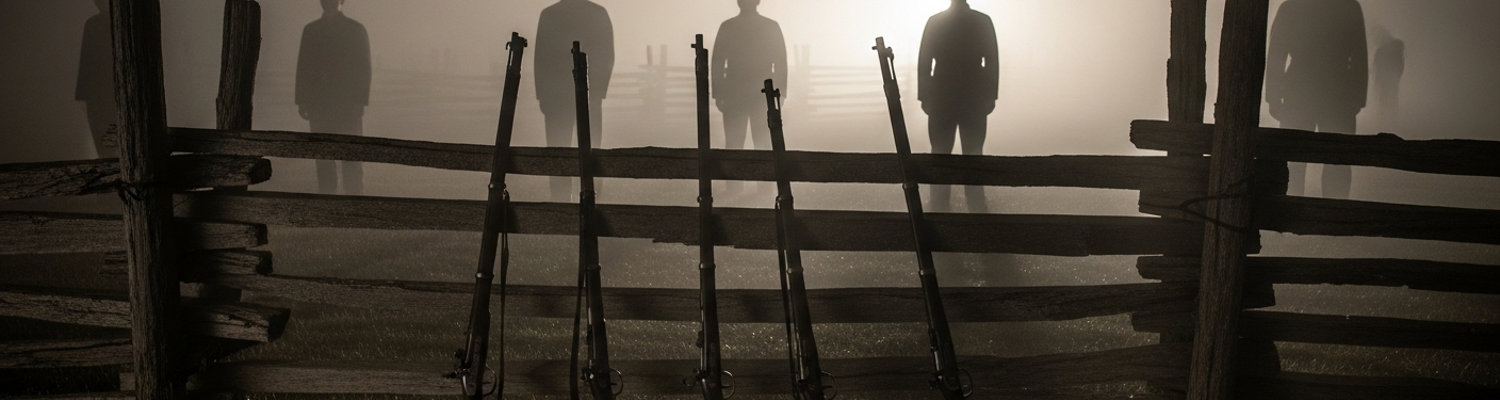

Historical records for the Osage County Home Guard contain a void where the details of Private William A. Coffey’s death should be. No muster roll or casualty list from the summer and fall of 1861 documents the loss of a soldier by this name to friendly fire. The absence of a file does not invalidate the event. It is evidence of the disorganized nature of the Home Guard’s mission in a state tearing itself apart. These were not professional soldiers. They were farmers and mechanics, often outside the age for regular service, organized under General John C. Frémont’s authority in mid-1861. Their function was to protect infrastructure, like railroad bridges over the Gasconade River, and counter pro-Confederate bushwhackers. The operational environment was defined by confusion and a near-total lack of standardization. A tragedy like the death of a Private Coffey was an inevitability engineered into the very structure of these militia units.
A nocturnal engagement for the Osage County Home Guard was a formula for disaster. These were not battles. They were panicked, sporadic bursts of violence in the dark. A sentry guarding a wooden railroad trestle, a small patrol probing a treeline for partisans, or a hasty picket line near towns like Linn or Chamois were the settings for tragedy. Lacking professional training or reliable communication, the primary method of identifying friend from foe in the Missouri countryside was the muzzle flash of a rifle. A review of similar incidents shows how easily mistakes were made. A detachment returning from patrol could be mistaken for an approaching enemy. A nervous sentry, hearing a rustle in the woods, might fire blindly into the darkness. He would only discover at dawn that his target was a fellow guardsman. The psychological pressure was intense, operating in communities where neighbors had taken up arms against each other. Every shadow was a potential threat, and every unexpected sound could trigger a volley.
The death of a soldier like William A. Coffey would have stemmed from this combination of amateurism and terror. The first shot, fired in error, would trigger a chain reaction. Other guardsmen, startled from a tense silence, would open fire in the direction of the first shot, believing they were under attack. The return fire from the friendly patrol, now being engaged by their own comrades, would only confirm the initial misidentification. For several minutes, two groups of Union men, separated by only a few dozen yards of darkness, would exchange fire. Each was convinced they were fighting the enemy. It would only end when a cease-fire was desperately called, or when the shooting sputtered out, leaving behind silence and casualties. The discovery that the men lying dead and wounded were their own neighbors was a uniquely horrifying feature of Home Guard service.
Operational logs from Missouri Home Guard units in 1861 reveal a persistent pattern of misidentification. These were not formal armies. They were hastily assembled companies of local men whose primary charge was protecting infrastructure and defending against pro-Confederate partisans. Uniforms were a luxury they did not possess. Men reported for duty in the same civilian clothes they wore on their farms, creating an impossible situation for sentries in low-light conditions. In the tense, neighbor-against-neighbor environment of central Missouri, any approaching group of armed men in civilian attire was perceived as a threat. The problem was compounded by the weapons. With no standardized issue, guardsmen carried personal firearms, from old flintlock muskets to modern percussion hunting rifles. The resulting muzzle flashes from a volley of black powder weapons would instantly create a thick, acrid cloud of smoke, further obscuring visibility. A sentry post, seeing the orange flare of a musket from an unexpected direction, had only seconds to decide if it was friend or foe. Firing back was the tragically logical response.
Command and control within the Osage County Home Guard was inadequate for combat operations. A company captain was often a respected local figure, a town merchant or a significant landowner, not a man with military training. His authority was based on social standing, not tactical expertise. In 1861, there was no established American general staff system and no formal training for controlling military formations, a deficiency magnified at the militia level. Communication technology was nonexistent. Orders were what a man could shout over the din of gunfire, or what a runner could carry through the dark. In a chaotic nocturnal engagement, voice commands were useless. A runner dispatched to halt a firing line could easily be misidentified in the darkness and shot by the very men he was trying to reach. Once shooting began, a commander had almost no mechanical means to stop it. He could not coordinate movement between separated groups, nor could he verify the identity of a force engaged by his pickets. This paralysis transformed commanders into horrified spectators of their own units' self-destruction.
These failures were amplified by the fog of war in the Missouri borderlands. The operational environment was not open battlefields, but a landscape of dense woods, steep ravines, and twisting creek beds that broke up lines of sight and distorted sound. A group of men moving through underbrush 50 yards away could sound as if they were nearly on top of a position. Acoustic anomalies were common. The sound of a firefight just two miles away could be completely inaudible, while on other occasions, it could be heard from ten miles out. The psychological pressure on these civilian-soldiers was severe. They were not hardened regulars but men defending their own communities from bushwhackers who were often their former neighbors. This bred a state of constant, high-strung alert where every shadow could be interpreted as an imminent guerrilla attack. The sensory experience of a night skirmish was one of pure chaos: the pitch-black of a rural night, the sudden, blinding flash of dozens of rifles, the disorienting booms, the smoke that smelled of sulfur, and the shouting of men who were terrified and firing at muzzle flashes they could not identify.
The operational structure of the Osage County Home Guard reveals a dangerous disconnect between their assigned mission and their actual capabilities. Organized in the summer of 1861, these units were expected to function as a counter-guerrilla force. This mission demanded tactical flexibility, disciplined fire control, and clear command. The Home Guard possessed none of these. Their command structure was a fiction, built on social standing rather than military experience. A company captain was often an influential town figure, not a trained officer, and his authority evaporated in the pandemonium of a night skirmish. Without the institutional backbone of a professional non-commissioned officer corps to enforce orders and maintain fire discipline, units would effectively dissolve into a collection of frightened individuals acting on instinct.
The task of hunting bushwhackers or guarding captured partisans was a tactical nightmare. A patrol might successfully detain several suspected guerrillas in the Missouri woods. Instantly, the unit’s mission changed. It was no longer just a patrol, but a prisoner escort. The patrol’s manpower was now divided between guarding its own perimeter and watching the captives. These bushwhackers were not uniformed soldiers. They were local men in civilian clothes, indistinguishable from the Home Guardsmen who had captured them. Any approaching friendly patrol would see only a tense cluster of armed men in farm clothes surrounding another group of men. In the poor light and thick underbrush, with no established signals or procedures for identifying a prisoner detail, the situation was lethally ambiguous. It was a scenario primed for misidentification, where a relief column could easily mistake the captors for a hostile force and open fire.
The battlefield itself was an agent of chaos. The contested border counties of Missouri were not open fields of fire but a tangled geography of steep ravines, thick forests, and winding creek beds that broke up formations and distorted sound. This terrain was perfectly suited to the hit-and-run ambush tactics of pro-Confederate partisans, who could strike quickly and vanish. This constant, unpredictable threat forced Home Guard units into a reactive, defensive posture. They were often relegated to static guard duty at fixed points like railroad trestles, making them predictable targets. The psychological toll on these citizen-soldiers, tasked with fighting former neighbors on their own home ground, was immense. The fluid nature of this guerrilla conflict meant the enemy was both everywhere and nowhere, feeding a state of high-strung paranoia where every snapped twig could be interpreted as an impending attack.
An examination of the Osage County Home Guard’s equipment status in 1861 reveals a failure in armament. Unlike regular army units that received standardized-issue rifled muskets like the Springfield Model 1861, Home Guard companies were expected to arm themselves. Men arrived for duty carrying personal weapons, resulting in a logistical nightmare. There was no uniformity. A single company picket line might feature a new percussion hunting rifle next to an obsolete flintlock musket, flanked by a man with a double-barreled shotgun. Civilian firearms ownership from the period indicates an assortment of calibers, ignition systems, and states of repair. This chaotic collection made centralized ammunition supply impossible. Each man was responsible for his own powder, shot, and percussion caps, creating disparities in readiness. A man with a well-maintained rifle stood next to a man whose powder horn might contain damp powder or whose lead balls were poorly cast. This was not an army. It was an armed mob, and their weapons were a primary point of failure.
The percussion lock system itself, while an improvement over the flintlock, was vulnerable to the conditions these men faced. The entire firing sequence depended on a small, hollow metal cone known as the nipple, onto which the percussion cap was placed. When the hammer struck the cap, it was supposed to send a jet of flame through the nipple’s flash channel and into the main powder charge. These were not arsenal-kept weapons, but personal firearms exposed to the humidity of the Missouri river lands. Rust was a constant threat. A small amount of corrosion inside the narrow flash channel was enough to block it. This blockage would lead to a hang fire, a dangerous delay between the cap’s detonation and the main charge firing, or a total misfire. In the terror of a nocturnal skirmish, a guardsman experiencing a misfire would instinctively lower his weapon or begin reloading, only to have the delayed charge fire at an unpredictable moment.
After only a few shots, a rifle could become useless. The black powder used in the 1860s was inefficient, and each shot deposited a thick, corrosive residue, fouling, inside the barrel. After as few as three to five shots, this buildup of potassium sulfide would make it physically difficult to ram the next round home. Accounts exist of soldiers having to slam their ramrods against trees to force a bullet down a fouled barrel. For the untrained Home Guard, this problem was magnified. They lacked the standardized tools and constant drill of regular soldiers, who were taught to manage fouling in combat. As a firefight progressed, the time to reload would stretch. Accuracy degraded as the fouling stripped lead from the bullet and ruined the seal needed to engage the rifling. Soon, the weapon would become so clogged that it was impossible to load at all. The guardsman was then faced with a choice: abandon his post to find water and tools to clean the weapon or stand his ground with an inoperable firearm.
The orders authorizing the Osage County Home Guard reveal a void where a training doctrine should be. The authority from General Frémont was for organization, not instruction. There was no established system for turning farmers into soldiers, no professional cadre of drill instructors, and no single, universally adopted training manual like Hardee's or Scott's. Any training that did occur was dependent on local leadership. A company whose captain was a veteran of the Mexican-American War might practice a few outdated drills, while a neighboring company led by a landowner might do little more than informal target practice. Antebellum militia musters were more social gatherings than serious military exercises. The men of the Osage County Home Guard had no shared tactical language. The commands to form a line of battle, to advance as skirmishers, or even to load and fire their weapons were not uniform. This absence of a common operational baseline meant they were not a cohesive force. They were a collection of disparate armed bands.
The direct result of this training vacuum was the erosion of unit cohesion under pressure. Cohesion is a mechanical function built on thousands of repetitions of shared, standardized actions. It is the ingrained, automatic response of a group of soldiers drilled to move and fire as a single body. The Osage County Home Guard had none of it. Lacking a professional non-commissioned officer corps to enforce discipline, fire control was nonexistent. Instead of controlled volleys directed by an officer, firing was individual and instinctive. In the chaos of a night encounter, this devolved into every man firing as fast as he could at any muzzle flash he saw. The ability to maneuver was equally compromised. Critical battlefield movements like shifting from a marching column to a fighting line were complex actions that regular troops spent months mastering. For the untrained Home Guard, attempting such a maneuver under fire would lead to the disintegration of the unit into a confused mob.
This failure to instill basic military discipline made them unprepared for combat in the Missouri borderlands. Their primary mission was to counter guerrillas and protect infrastructure, tasks that demanded small-unit proficiency in patrolling and picket duty. Yet these were precisely the skills they were never taught. There were no standardized procedures for challenging a person approaching a picket line in the dark, a fatal oversight when friendly patrols were constantly moving through the same territory as enemy bushwhackers. Without relentless drilling, the first response of green troops to sudden contact was not to seek cover or await orders, but to stand and return fire. In the context of the Osage County Home Guard, this meant that a single nervous sentry firing at a perceived threat could trigger a chain reaction, with his comrades blindly firing in support. The returning patrol, now under fire from their own side, would naturally fire back. For several minutes, two groups of Union men, separated by nothing more than a few dozen yards of darkness and a lack of training, would tear each other apart.
Official military archives for the Osage County Home Guard reveal nothing about the death of Private William A. Coffey. No muster roll, after-action report, or regimental return (NARA Record Group 94) documents the friendly-fire incident. The chaos and poor record-keeping endemic to these early-war militia units meant that such a tragedy was likely never formally recorded. An embarrassing and demoralizing event like a fratricide was often deliberately omitted by a commander. The official story was silence. Yet, historical proof of the event exists, not in military files, but in the bureaucracy of the U.S. Pension Bureau. Years after the war, Coffey’s widow, seeking to prove her husband died in the line of duty, began a process that would unintentionally create the only substantive record of the event. The pension file became the incident’s de facto autopsy report.
The contents of a Civil War widow’s pension file are a testament to a bureaucratic ordeal. For a woman like Mrs. Coffey, the death of her husband was a financial catastrophe, and the federal pension was often the only protection against destitution. To secure it under the provisions of the Act of July 14, 1862, she had to prove not only that her husband had served, but that his death was a direct result of that service. This was a high bar for a member of a poorly documented Home Guard unit. The process forced the applicant to become a historian. She, or a pension agent working on her behalf, had to track down surviving members of her husband’s company, men who had long since scattered back to their farms. She needed them to provide sworn affidavits, detailed personal recollections of the night of the incident, signed before a court clerk. The resulting file would contain a patchwork of these testimonies, describing the confusion, the darkness, and the fatal volley from multiple perspectives. It would also contain the widow’s own declaration, proof of her marriage, and sometimes even birth records for her children to establish their dependency. These files, which can run to a hundred pages or more, are not simple forms. They are dense, narrative archives of loss, created out of financial desperation.
This paper trail stands in stark contrast to the void in official military documentation. The Missouri Home Guards were temporary, local defense forces that often dissolved after only a few months of service. They lacked the administrative staff and standardized procedures required to maintain the kind of detailed records expected of a regular army. A company muster roll might exist, but it was often just a list of names, compiled once, with no updates on casualties or discharges. Following a chaotic night action that resulted in fratricide, the immediate priorities were caring for the wounded and burying the dead, not filing paperwork. Surviving accounts from Missouri in 1861 paint a picture of undisciplined units, making the deliberate suppression or simple neglect of records for a friendly-fire incident a near certainty. The pension application, therefore, became the final, accidental testimony, a detailed account of operational failure compelled into existence by a widow’s fight for survival.