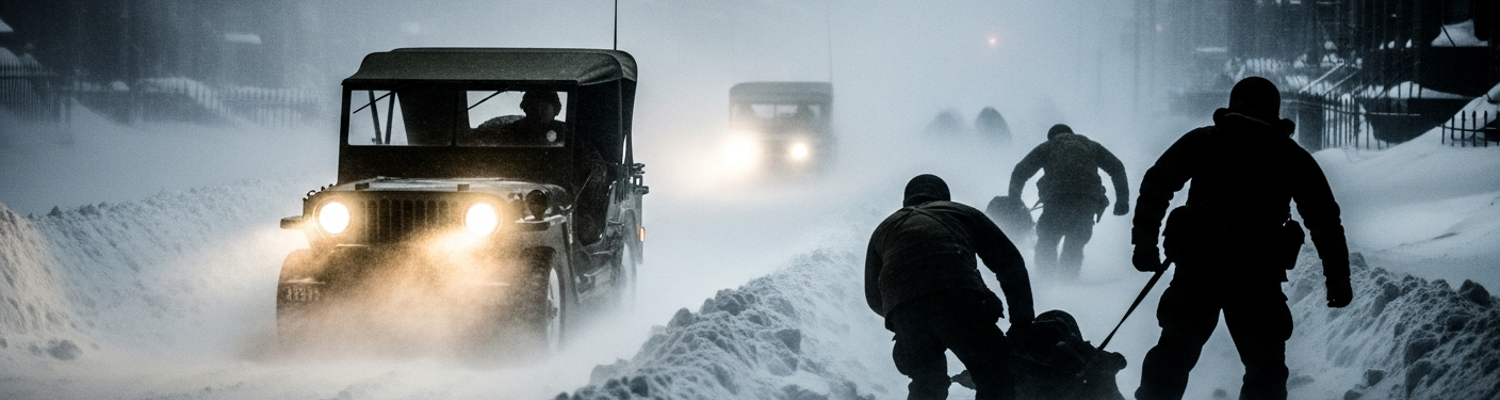

A close review of operational logs from the Massachusetts National Guard’s 26th Infantry Division during the March 1959 blizzard reveals a crisis that began not with a command failure, but with a physics problem. The Guard had recently been equipped with new vehicular and man-portable UHF radio systems operating in the 225-400 MHz band. This was a technological leap intended to provide clear, line-of-sight communication for urban operations. The doctrine, however, had never been tested against the atmospheric conditions of a New England blizzard.
As heavy, wet snow blanketed the city, the air itself began to degrade radio wave propagation. UHF signals, which travel in straight lines, were severely attenuated by the dense curtain of falling and accumulated snow. Water molecules within the snowflakes absorbed and scattered the radio frequency energy, reducing signal strength by as much as 70 percent in open areas. Compounding this was the rapid accumulation of ice on vehicle whip antennas and the shorter antennas of the AN/PRC-6 handheld units. This coating of ice altered the antennas' electrical properties, de-tuning them from their designated frequencies and causing a massive impedance mismatch. A functional radio transmitter was suddenly broadcasting its power into an antenna that could no longer efficiently radiate the signal.
The problem of atmospheric attenuation was magnified exponentially by the topography of downtown Boston. The narrow streets flanked by tall granite and brick buildings, particularly in the Financial District surrounding the John W. McCormack Post Office and Courthouse, created a near-perfect urban canyon. UHF signals, already weakened by the snow, could not penetrate the dense building materials. Instead, they reflected off flat surfaces in a chaotic phenomenon known as multipath interference. A signal from a platoon on Congress Street would bounce between buildings, arriving at a command post receiver as multiple, out-of-phase echoes that cancelled each other out.
This effect carved the operational area into invisible communication voids. A guardsman could take two steps and fall into a dead zone, their radio rendered completely useless. After-action reports from the 101st Signal Battalion (NARA Record Group 407.326) contain hand-written notes mapping these zones. Entire blocks, including sections of Pearl and Franklin Streets, were marked as black spots where all contact was lost. This unpredictable radio environment made coordinated movement nearly impossible.
Inside the federal building, the situation was worse.
The primary mission involved supporting a contingent of US Marshals who had established positions inside the McCormack building. Initial plans relied on a Guard liaison officer with a compatible radio to coordinate between the two forces. Archival evidence shows this single point of failure collapsed within the first hour. The liaison’s radio became subject to the same dead zones plaguing the area. For a 94-minute period beginning at 17:30, all direct voice contact with the Marshals was lost. The Guard command post, located just a half-mile away at the South Station armory, received only intermittent bursts of static. A partial transmission logged at 18:04 contained the words 'west entrance' and 'compromised,' but the rest of the message was unintelligible. Acting on fragmented information, the division commander dispatched his Quick Reaction Force, a platoon from the 726th Military Police Company, to the building’s western face. The actual crisis was an escalating confrontation at the northern sally port, a detail the Marshals had been trying desperately to communicate. The mis-deployment, born of radio failure, left the Marshals without support at their most vulnerable point for a full 22 minutes.
Analysis of the command-and-control failures reveals a fundamental inability for the three primary organizations on the ground to communicate. The Massachusetts National Guard units, primarily from the 26th Infantry Division, were equipped with the AN/PRC-10 man-portable radio. This vacuum-tube-based FM transceiver operated in the 38.0 to 54.9 MHz low-band VHF spectrum. The small contingent of US Marshals used their own federal law enforcement radios, which operated on a separate set of frequencies in the high-band VHF range, between 150 and 174 MHz. The Boston Police Department, attempting to maintain a cordon several blocks out, relied on a city-wide analog system on yet another distinct VHF frequency.
There was no electronic bridge between these systems. A guardsman with an AN/PRC-10, a federal marshal, and a BPD patrolman standing side-by-side were electronically isolated. Their radios were physically incapable of receiving transmissions from one another due to the hardwired frequency ranges of their respective tuners. No single command post possessed the equipment to monitor all three networks simultaneously, creating three distinct, isolated bubbles of information.
The electronic divide forced a retreat to 19th-century methods.
Operational logs from the 101st Signal Battalion and the 726th Military Police Company paint a grim picture of the resulting workaround. With direct radio links impossible, command posts had to rely on runners and the public telephone system. Young guardsmen were designated as couriers, tasked with physically carrying handwritten messages between the Guard perimeter, BPD barricades, and the nearest accessible point to the federal building. Accounts describe these men struggling through knee-deep snow and blinding wind on the exposed streets of the Financial District. Simultaneously, officers at the South Station armory command post engaged in a frantic battle with the Bell System’s rotary telephone network. They maintained a log of payphone numbers near BPD positions and attempted to pass updates through civilian operators, competing with a city full of residents for a clear line.
This fractured communication architecture directly led to a 30-minute delay in identifying a coordinated breach attempt. A post-event timeline, reconstructed from the separate logs of all three organizations, shows the failure in stark detail. At approximately 19:00 hours, a BPD patrol car on High Street observed a group moving with intent toward the McCormack building’s eastern loading docks and reported it over the BPD frequency. At the same time, a second group was forcing a maintenance entrance on the building’s northern side, a fact the cornered US Marshals were trying to communicate over their federal channel. Neither the Guard nor the other agency could hear these developing reports. It took twelve minutes for the BPD dispatcher to secure a working phone line to the National Guard command post. By 19:20, the Guard commander, possessing only information about the loading dock, dispatched a runner to Kilo Company, 3rd Battalion, the unit closest to that position. It was not until 19:28 that the runner reached the platoon leader. As Kilo Company began to redeploy at 19:30, the northern maintenance door was breached, an event the Guard forces remained unaware of for another fifteen minutes. The two-pronged attack, clearly visible when combining all radio traffic after the fact, appeared to the Guard on the ground as a single, isolated incident.
The after-action report filed by the 26th Infantry Division’s G-3 Operations Officer listed three runners as treated for frostbite and one for a sprained ankle sustained on icy pavement near Post Office Square.
The logistical support structure began to fracture at its most basic levels. A deep analysis of maintenance logs from the 26th Infantry Division reveals the communications failure was not just a matter of signal propagation, but of simple electrical power. The man-portable AN/PRC-10 radios relied on the BA-279/U dry cell battery. This zinc-carbon battery was notoriously vulnerable to cold. The chemical reactions required to generate a current slow dramatically as temperatures drop, causing a severe reduction in power output. In the sub-freezing conditions, a fully-charged BA-279/U could only deliver a fraction of its rated power. The 16 vacuum tubes of the PRC-10 required consistent voltage, and the failing batteries could not provide it. Guardsmen reported their radios dying with no warning. Some attempted to keep batteries warm inside their field jackets, a tactic learned from Korean War veterans, but this required removing the battery from the radio, rendering it useless for long periods.
This power crisis was not confined to the individual soldier. It scaled upwards, crippling command infrastructure. At rear-echelon posts like the South Station armory, larger vehicle-mounted radios and lighting were powered by military auxiliary generators. Maintenance records show these generators, standard gasoline or diesel models, faced their own set of failures. The primary issue was fuel. As temperatures plummeted, the paraffin wax naturally present in the diesel fuel began to crystallize. This process, known as gelling, thickened the fuel until it could no longer flow through fuel lines and filters, starving the engines. Reports from the 101st Signal Battalion describe maintenance crews frantically trying to clear clogged fuel filters and manually warm fuel tanks to keep generators running. Standard-issue winter fuel additives were insufficient for the severity of the cold.
With the generators failing, command posts went dark. The primary power for the larger, more powerful AN/GRC-series vehicle radios, which should have served as the backbone of the communications network, was lost. This forced command elements to become reliant on the same underpowered and failing AN/PRC-10 handhelds used by the frontline platoons. A review of the G-4 (Logistics) logs for the 26th Division shows a series of requests for bulk shipments of replacement BA-279/U batteries and for different grades of fuel. None could be delivered through the impassable city streets. For a period of nearly three hours, the entire division communications network was atomized, reduced to isolated pockets of guardsmen.
A review of operational logs from the 26th Infantry Division’s support elements reveals the blizzard crippled the Guard’s mobility long before the first radio went silent. The division’s primary tactical vehicle, the M151 ‘Mutt’ jeep, was a recent replacement for the Korean War-era M38 and was mechanically unsuited for the rapid plunge in temperature. Archival maintenance records from the 726th Military Police Company show a failure at the molecular level. Standard-issue military gear oil of the era, specifically GO-80/90 grade lubricant used in the differentials and transmissions, was a petroleum-based product with a high wax content. As temperatures dropped, this lubricant did not freeze solid but instead congealed, thickening into a dense, paste-like substance.
Within the vehicle’s manual transmission, the thickened fluid prevented the synchronizer rings from matching gear speeds, effectively locking the shifter. Drivers reported being physically unable to move the gear lever. For vehicles already in motion, the lubricant in the differentials began to channel, a condition where the spinning ring gear carves a trough through the semi-solid grease, starving the pinion gears and bearings of lubrication. This led to rapid overheating and, in several documented cases, complete seizure of the differential. A platoon from the 101st Infantry Regiment dispatched to establish a perimeter around Post Office Square reported two of its four M151s becoming immobile within fifteen minutes of leaving the South Station armory. The engines were running, but the drivelines were frozen.
The cold attacked the copper as well. The M151 featured a 24-volt electrical system, adopted to provide more reliable cold-weather starting and support a growing suite of radio equipment. A post-event analysis by the division’s ordnance battalion found that a significant portion of the M151 fleet had not undergone scheduled electrical system servicing. On dozens of vehicles, the two 12-volt batteries wired in series were connected by frayed cables and terminals coated in corrosion. The extreme cold dramatically reduced the chemical efficiency of these lead-acid batteries, and the corroded connections created high resistance, preventing what little power remained from reaching the starter motor. The very M151s assigned to logistical tasks, the jeeps intended to ferry replacement BA-279/U batteries to the radio operators on the line, sat inert in their motor pools, unable to start.
The failure of vehicle mobility directly prevented the resupply of failing communications equipment. Maintenance crews from the division’s 3rd Battalion, 26th Infantry, were dispatched on foot with toolkits to attempt field repairs. Their reports describe a hopeless situation. Attempts to jump-start the dead jeeps were largely futile. The cold had made the thick insulation of the jumper cables stiff, while the clamps could not bite through the corrosion on the battery terminals to establish a good connection. Maintenance logs note several instances of crews using blowtorches to try and heat the frozen transmission and differential casings, a hazardous practice that risked cracking the cast iron housings. By 21:00 hours, a consolidated report from the G-4 logistics officer stated that over 60 percent of the division’s M151 vehicle fleet within the Boston operational area was non-mission-capable.
The cascade of failures paralyzed the Massachusetts National Guard forces. The combination of immobile M151 jeeps and powerless AN/PRC-10 radios meant that company and platoon commanders could neither move their forces nor report their status. An entire infantry platoon from the 3rd Battalion, dispatched to form a blocking position near Post Office Square, was rendered combat-ineffective without a single shot fired. Two of its four jeeps suffered driveline seizure from gelled lubricants, while the remaining two could not start due to cold-soaked batteries. Their platoon leader’s radio, its BA-279/U battery failing, was unable to transmit a coherent signal back to the command post. For a period of 75 minutes, the platoon vanished from the operational picture, creating a significant, unreported gap in the security perimeter.
The division’s Quick Reaction Force, centered on the 726th Military Police Company, was mission-incapable for nearly three hours. Its M151s sat inert in the motor pool. When the Marshals inside the McCormack building finally established a link via a runner to report the breach on the northern side, the Guard had no mechanized assets available to respond. The tactical plan had relied on speed. The operational reality was a relief force dispatched on foot, moving at the speed of a heavily-laden soldier through deep snow.
A post-event analysis conducted by the division’s G-3 Operations section exposed systemic deficiencies. Ordnance inspection teams discovered that the majority of the M151 vehicle fleet had never been properly winterized. Standard-issue monograde gear oils had not been replaced with the appropriate multi-viscosity lubricants. Maintenance logs were either missing or showed that mandatory pre-winter servicing was pencil-whipped or deferred. The crisis with the AN/PRC-10 radio batteries was traced to a quartermaster failure; procurement records showed the division was stocked almost exclusively with zinc-carbon batteries instead of maintaining a stock of lithium-based batteries then becoming available for specialized applications.
The investigation into inter-agency protocols found a complete absence of planning. The after-action report noted that no joint communications plan existed between the National Guard, the US Marshals, and the Boston Police. No liaison officer was equipped with a multi-band radio capable of monitoring the different frequency spectrums. The Guard’s low-band VHF, the Marshal’s high-band VHF, and the BPD’s own distinct VHF system were electronically isolated, creating three separate operational pictures of the same battlespace. The report bluntly stated that the reliance on foot-messengers and the civilian telephone network was an unacceptable regression. One of the report's key recommendations led directly to Ordnance Technical Bulletin ORD-TB-221-59, mandating the immediate replacement of all GO-80/90 lubricants in tactical vehicles operating in climates below 32 degrees Fahrenheit.