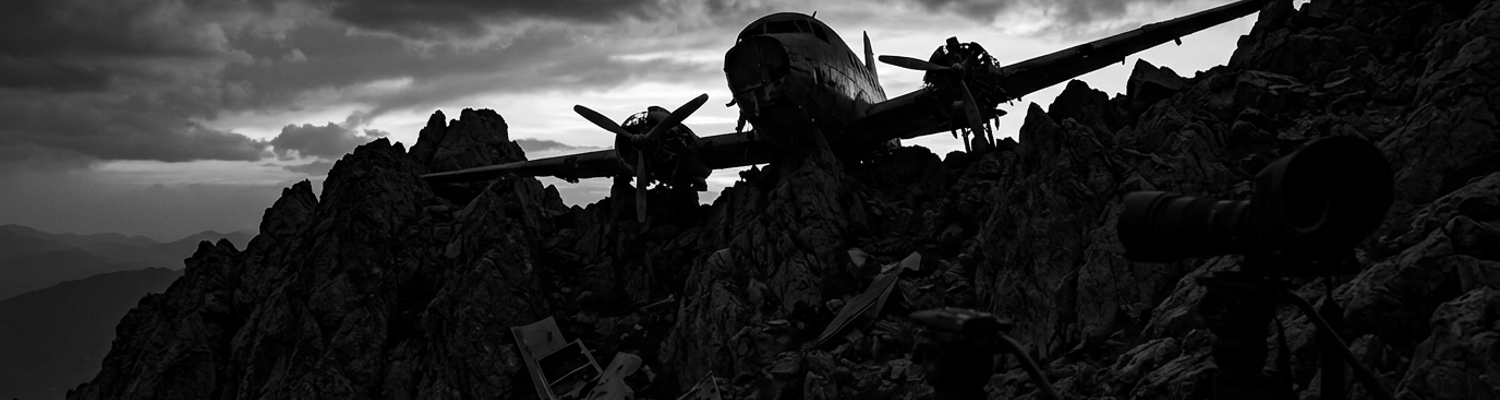

Crash Site Recoveries in the Gaoligong Range
United States Army Air Forces technical orders promised that the twin-engine Lockheed F-5 reconnaissance aircraft could clear weather fronts on a single operational engine. Flight crews of the 8th Photo Reconnaissance Group discovered the opposite when traversing the eastern Himalayas. Downdrafts sweeping off the Tibetan plateau exceeded four thousand feet per minute. These winds forced aircraft down through heavy cloud banks directly into jagged ridgelines.
The mountains did not leave survivors.
Archival evidence shows search operations revealing an unforgiving terrain sequence between 1943 and 1945. Surgical search-and-recovery parties moved on foot into the Gaoligong range and the dense rainforests of the Naga Hills. Flight surgeons from the 80th Station Hospital accompanied them. These details climbed along elevations between nine thousand and fourteen thousand feet. They cut paths through thick bamboo jungle. They traversed vertical rock chimneys where an F-5C or F-5E had vanished from flight logs.
Guided by indigenous hill tribesmen.
Teams spent three to five weeks tracing wreckage tracks marked by clipped fir tops and scorched granite. The physical airframes rarely held together. Recovery personnel arrived at impact coordinates along the Salween River divide. They found twin booms sheared off. Fuel tanks were ruptured and compressed into flat sheets of metal. Heavy Fairchild K-17 aerial cameras were thrown hundreds of yards past the point of initial ground contact.
Medical officers conducted recovery assessments on sheer rock faces.
They logged serial numbers from burned Allison V-1710 engine blocks. They collected scatter patterns of aluminum and human casualties. Every crushed cockpit exhibited an identical mechanical pattern. Flight surgeons conducted forensic autopsies directly inside the crushed remnants of F-5 cockpits. They needed to determine why high-altitude reconnaissance flights were diving directly into terrain. Field post-mortems documented violent forward deceleration forces. These forces drove instrument casings straight into pilot armor plating.
Control columns were bent flat against the main instrument panels.
Rudder pedal linkages showed heavy impact warping. The pilots skeletal fractures told an entirely unexpected truth. Expected compound fractures in wrists and forearms are the standard signature of a conscious pilot bracing against the yoke during an impending crash. These fractures were completely absent in multiple recovered airframes. The physical position of the bodies showed relaxed musculature and unbraced limbs. Medical officers matched throttle quadrant settings against autopsy findings.
They determined that aircraft were striking terrain at cruise power settings with the pilot already unconscious.
Altitude-induced hypoxia was incapacitating pilots long before their airframes impacted the Gaoligong granite. The Type A-12 and early A-14 diluter-demand oxygen regulators fitted to the 8th Photo Reconnaissance Group F-5s lacked adequate heating elements. Temperatures dropped to sixty degrees below zero above twenty-five thousand feet. Moisture from normal respiration condensed. It froze inside the delivery valves. Breathing gas was cut off without triggering an audible warning.
Starved of oxygen within minutes.
Pilots slumped forward into their harnesses. Their trimmed aircraft continued flying straight ahead on automatic pilot. Fuel ran out or mountain terrain intersected their descent path. Flight surgeons confirmed this sequence after discovering unbent emergency bailout bottles still secured in their cockpit brackets. Field teams found the oxygen selector valves frozen shut in three separate wrecks along the ridge.
Physiological Trauma and High-Altitude Hypoxia
A close review of operational logs indicates consistent heating duct failures on high-altitude mapping runs out of Jorhat and Barrackpore. Missions plotted across northern Burma and western Sichuan forced unarmed Lockheed F-5C and F-5E aircraft above twenty-eight thousand feet. They needed to clear cloud banks topping the crests of the Patkai Range. Cabin heating relied on early exhaust heat muff systems and internal combustion heaters. These units routinely fouled at high altitudes. Raw fuel flooded the combustion units.
They flamed out within twenty minutes of climb.
Exhaust muff ducting cracked under continuous high-manifold pressures. Ambient cockpit temperatures dropped immediately below minus forty degrees Fahrenheit. Unpressurized cockpits allowed freezing air to blast through unsealed canopy joints and camera access hatches in the nose compartment. Frost layered the interior Plexiglas surfaces in sheets up to a quarter of an inch thick. This blinded the pilot to his wingtips and engine cowlings. Condensation froze inside the flight instruments.
Frostbite locked bare skin to cockpit metal upon contact.
Archival evidence shows flight surgeons from the 80th Station Hospital recording severe physical breakdowns tied to sustained thermal exposure. Pilots wore Type F-2 or F-3 electrically heated shearling suits. The 24-volt electrical systems of the F-5 could not sustain the heavy amperage draw. Continuous operation of the Fairchild K-17 and K-22 reconnaissance cameras overloaded the system. Circuit breakers popped repeatedly behind the right shoulder of the pilot.
Resetting them in heavy gloves was impossible once peripheral blood flow retreated from fingers and toes.
Localized hypothermia rapidly stiffened hands into rigid claws. Men were unable to grasp the throttle levers or actuate the mechanical wing flap controls. Numbness climbed upward through the lower limbs from boots resting directly against the uninsulated aluminum rudder pedals. Muscle tremors gave way to severe lethargy. This physical decline directly impaired cognitive processing at the exact point in the flight profile where precision instrument navigation was mandatory to avoid ridge lines.
Core body temperatures plummeted below ninety-three degrees.
Extreme cold worked in direct conjunction with oxygen supply failures to cause rapid-onset hypoxia. Atmospheric pressure drops to less than one-third of sea-level density at altitudes exceeding twenty-eight thousand feet. The effective time of useful consciousness collapsed to less than sixty seconds without constant supplemental oxygen delivery under positive pressure. Condensation from exhalations routinely plugged the rubber flapper valves in the Type A-12 and A-14 diluter-demand oxygen masks.
Ice pellets formed and blocked airflow entirely.
Pilots starved of oxygen rarely recognized their own physical deterioration. The initial stages of severe hypoxia produced profound sensory disorientation. It stripped away peripheral vision. The pilot was left staring vacantly down a narrowing visual tunnel. False sensations of horizontal flight took over as the inner ear vestibular system failed in the sub-zero environment. Aircraft drifted out of level flight into descending spiral turns.
Pilots mistook altimeter unwinds for normal descent profiles.
Crews remained entirely detached from their true geographic position above the Salween River gorges. Consciousness vanished while the engines ran at full cruising throttle. Tenth Air Force medical post-mortems logged the final physical toll across flight crews recovered near Myitkyina and Fort Hertz. Flight surgeons noted that the men suffered profound cerebral anoxia and frozen corneas. Their airframes remained stable on automatic directional trim.
Control yokes showed no evidence of emergency evasion.
Autopsies identified unconstricted pupils and completely relaxed cervical vertebrae. Sensory incapacitation and deep unconsciousness claimed every pilot long before the aluminum airframe shattered against the granite walls of the eastern Himalayas.
SCR-522 Radio Synchronization Failures
Signal officers across Tenth Air Force installations struggled continuously to keep airborne communications functional. The four push-button crystal channels of the SCR-522 VHF transceiver proved unreliable. Installed in the aft radio compartment of Lockheed F-5 airframes. The Western Electric unit relied on BC-625 transmitters and BC-624 receivers operating between 100 and 156 megacycles. Each channel required physical insertion of paired quartz crystals ground down to exact millimetric tolerances.
Ground crews at Dinjan Airfield in Upper Assam routinely tuned these sets inside open-air bamboo revetments.
Tropical ambient humidity hovered above ninety percent. Technicians aligned the variable tuning inductors and trimmer capacitors using signal generator test rigs before sealing the chassis covers. An F-5 climbed into the thin air over the Patkai Range. Cockpit temperatures plummeted past forty below zero. This caused the chassis frame and quartz wafer mounts to contract unevenly.
Thermal shock pulled crystals off their designated carrier frequencies by as much as twenty-five kilocycles.
Pilots punched Channel B to execute crossing handoffs with forward stations. The receiver front-ends were deaf to incoming traffic. Push-button channel changes repeatedly jammed the motorized tuning assemblies inside freezing radio bays. Forward positioning created continuous signal loss when examining the historical record of line-of-sight VHF networks between Assam and northern Burma. Dinjan served as the primary operational hub in the Brahmaputra Valley.
It housed the photo laboratories and maintenance shops