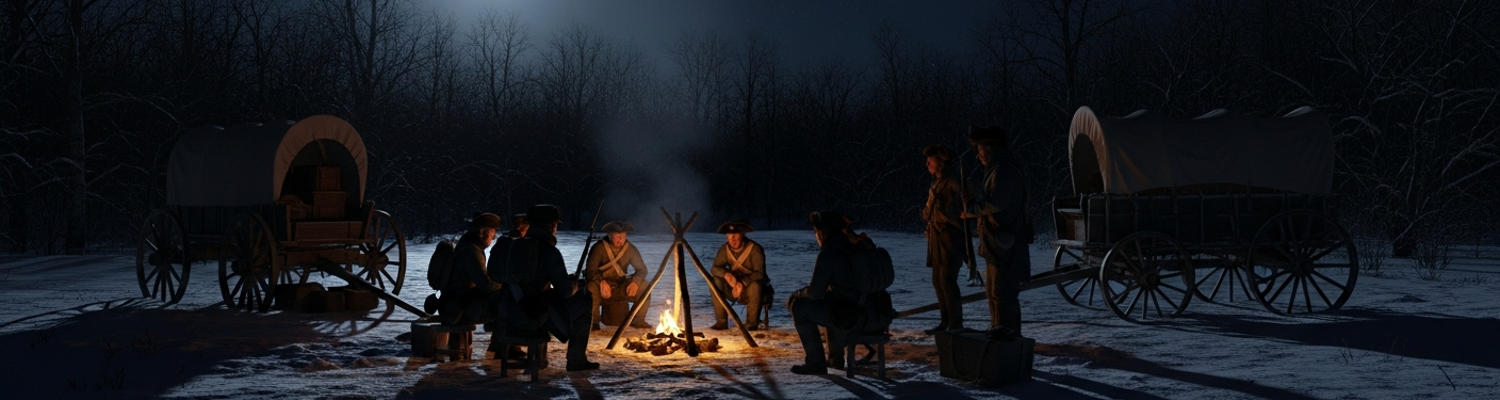

A raw, nascent army, born from colonial militias and revolutionary fervor, faced a formidable enemy not only across the battlefield but within its own ranks. This internal adversary was the specter of starvation and exposure. The Continental Army’s fight for American independence was perpetually undermined by a logistical nightmare, a direct consequence of a flawed supply system that threatened to dissolve the very force fighting for the nation’s existence. This struggle for basic sustenance shaped strategy, shattered morale, and ultimately forged hard, enduring lessons in military resilience. The war was not just won with muskets and cannons, but with flour, salted meat, and serviceable shoes, commodities that proved far more elusive than battlefield glory.
A System Built for Failure
The Continental Congress, a revolutionary body with limited authority and no power to levy direct taxes, initiated the war effort by placing the burden of supply squarely on the thirteen individual states. This decentralized approach proved catastrophic. Congress could pass resolutions defining soldier rations, such as the one on November 4, 1775, which stipulated daily allotments of bread, beef, and beans, but it lacked the executive machinery to procure them. It fell to each state to raise, equip, and feed its own quota of troops for the Continental Army. This created a patchwork of thirteen competing, inconsistent, and often indifferent supply chains. The first Commissary General, Joseph Trumbull of Connecticut, found himself pleading and negotiating with state committees rather than commanding a unified logistical corps. His authority was nominal, his resources dependent on the political will of state assemblies that frequently prioritized their own local militias over the Continental line. The immediate consequences were dire. During the Siege of Boston in 1775, General George Washington arrived to find an army that was ill equipped and motley clad. Shortages of gunpowder were so severe that sentries were warned not to fire their weapons unless absolutely necessary. Washington expressed grave concerns in his letters that the lack of proper covering would force soldiers to desert as the harsh New England winter approached. The system was one of temporary expedients. A weak transportation network, a scarcity of hard currency, and the absence of significant domestic manufacturing compounded the problem. Farmers and merchants, initially supportive, grew wary of accepting depreciating Continental currency, which rapidly became almost worthless. This forced commissary officers to resort to impressment, the seizure of goods with promises of future payment, a practice that alienated the very populace the army was meant to protect.
Greene's Gambit: Reforming Supply Lines
The nadir of this systemic failure came during the brutal winter encampment at Valley Forge between 1777 and 1778. The army, reeling from defeats at Brandywine and Germantown and the loss of Philadelphia, faced a disastrous supply crisis. The Quartermaster Department, then under General Thomas Mifflin, had effectively collapsed. Thousands of soldiers were unfit for duty, lacking shoes and adequate clothing, while starvation and disease claimed an estimated 1,700 to 2,000 lives. Wagons sat idle for want of horses or drivers. Barrels of salted meat spoiled in depots hundreds of miles away, unable to reach the starving men. The breakdown was a complete failure of neglect by Congress and the inherent weaknesses of the state based system. In the face of this collapse, Washington turned to Major General Nathanael Greene, one of his most trusted subordinates. In March 1778, Greene reluctantly accepted the appointment of Quartermaster General, inheriting a department in total chaos. He immediately set about implementing sweeping reforms. Acknowledging the failures of his predecessors, Greene promised to pay fair rates in sounder currency whenever possible to farmers and merchants, seeking to restore their trust. He reorganized the 3,000 person department, establishing a network of strategically placed supply depots, or magazines, across the states to improve distribution and shorten supply lines. Greene’s methods were vigorous. He dispatched foraging parties under disciplined officers far from camp to secure provisions, a necessity to supplement what little arrived through official channels. He personally lobbied the Pennsylvania legislature to amend laws regarding the impressment of wagons, a vital component of transportation. The results of Greene’s efforts were felt relatively quickly. By the spring of 1778, supplies began to flow more consistently into Valley Forge. His successes, however, were partial. The depreciation of the Continental dollar continued to hamper procurement, and he could not reverse months of neglect overnight. Hundreds of army horses still perished from lack of forage. His methods and the power he wielded drew intense criticism from members of Congress, who harbored a deep seated fear of a powerful standing army and its logistical apparatus. This political friction culminated in his resignation in July 1780 after Congress attempted to make him personally liable for debts incurred by his department.
The Human Cost of Empty Wagons
The persistent logistical failures had a devastating effect on the soldiers. The winter at Valley Forge became a symbol of hardship, but it was not unique. The encampment at Morristown, New Jersey, during the “Hard Winter” between 1779 and 1780, was by some accounts even more severe. The army endured more than twenty major snowfalls, with one January blizzard dumping four feet of snow, while temperatures remained below freezing for weeks. Soldiers went days without bread or meat. Private Joseph Plumb Martin wrote of his comrades roasting their old shoes to have something to chew. Though surrounded by farms, the army struggled to acquire food due to poor harvests, impassable roads, and the continued unwillingness of farmers to accept worthless currency. This constant hardship directly fueled a crisis in morale. Desertion rates were high, with some estimates suggesting a quarter of the army deserted over the course of the war. Frustration over the lack of pay and basic necessities led to open mutinies. In January 1781, the Pennsylvania Line, seasoned veterans of many campaigns, marched on Congress in Philadelphia, demanding their back pay and better conditions. A similar mutiny by the New Jersey Line followed. These were not acts of cowardice but of desperation by men pushed beyond the limits of endurance. These logistical constraints profoundly shaped Washington’s strategic decisions. His primary task often became simply keeping the army from dissolving. The choice of winter encampments like Valley Forge and Morristown was dictated by strategic necessity, offering defensible positions from which to monitor the British while grappling with the internal battle for survival. The constant shortages forced Washington to adopt a Fabian strategy, avoiding large scale engagements his fragile army could not sustain. The decision to dispatch foraging parties under generals like Anthony Wayne was a direct, tactical response to the failure of the central supply system. Washington’s experiences with the ineptitude of the state led supply effort are even cited as a contributing factor to his later advocacy for a stronger, more centralized federal government under the Constitution.
Enduring Lessons in Expeditionary Logistics
The Continental Army’s struggle for sustenance offers a stark historical parallel to the challenges faced by modern expeditionary military forces. The “tyranny of distance” that plagued the British in the 18th century is mirrored in the vast operational theaters of today, particularly in contested environments like the Indo Pacific. While communication is now instantaneous, the fundamental problem of sustaining forces far from home, across vulnerable lines of communication, remains a core military problem. Modern adversaries understand that targeting supply chains through physical, electronic, or cyber means can cripple a technologically superior army’s ability to fight. Just as Nathanael Greene established a system of distributed depots, modern logistics relies on pre positioned supplies and forward deployed resources to ensure rapid response and reduce vulnerabilities. The Continental Army’s reliance on impressing wagons and supplies from a sometimes unwilling populace is a historical echo of the modern need for robust host nation support and resilient local infrastructure in expeditionary settings. The war in Ukraine underscores that the ability to sustain a high intensity fight, to keep ammunition, fuel, and food flowing to the front, is as decisive as tactical brilliance. The use of drones to deliver medical supplies and ammunition to frontline trenches is a modern solution to the age old problem of getting provisions to soldiers under fire, a problem a Continental Army quartermaster would have understood perfectly. The American Revolution demonstrates that victory depends on a mastery of logistics. The fight against hunger, disease, and the elements is a constant battle. The experience of the Continental Army serves as a foundational case study in military logistics, highlighting the absolute need for centralized, professionalized, and adequately funded logistical organizations. The ability to project and sustain power is the bedrock of military capability, a principle forged in the crucible of places like Valley Forge and Morristown, and one that demands ongoing vigilance and innovation.