
Emergency San Diego Staging and MEB Alert
DEFCON THREE DECLARED AIRLIFT MOUNT OUT ALL DESIGNATED READY UNITS PROCEED IMMEDIATE.
The teletype message arrived at 1100 hours on October 19.
Months of scheduled peacetime training vanished instantly. Major General Herman Nickerson commanded the 1st Marine Division at Camp Pendleton. He summoned Lieutenant Colonel William Geftman to division headquarters. Geftman commanded the 2nd Battalion, 1st Marines. His unit was stationed at Camp Horno. They maintained a nominal sixty-hour alert status for regional contingencies. Nickerson collapsed that timeline down to ten hours. He issued immediate redeployment orders. This shifted the battalion from routine garrison readiness into active amphibious combat staging. Supply sergeants in Area 53 broke weapons racks open. They distributed live 7.62mm ammunition along with crated 3.5-inch rocket launchers.
The battalion command calculated a severe mathematical risk.
Committing combat infantry into an escalating Caribbean nuclear theater without advance reconnaissance violated standard operational phasing. Exhausted motor pool mechanics struggled to keep aging M35 six-by-six trucks running. Head gaskets blew on the steep grades toward Interstate 5. All three rifle companies stood fully packed in combat gear by 2100 hours. They boarded civilian charter buses destined for Marine Corps Air Station El Toro.
Turboprop transports lifted the riflemen directly into the outer defense perimeter of Guantanamo Bay by early morning on October 21.
Geftman directed his men to dig defensive trenches along the perimeter ridge. A wider mobilization unfolded across Southern California simultaneously. Headquarters Marine Corps activated the 5th Marine Expeditionary Brigade. This consolidated thousands of combat troops across Camp Pendleton and San Diego under Brigadier General William T. Fairbourn. Command doctrine dictated weeks of joint coordination before assembling a brigade-sized Marine Air-Ground Task Force. Fairbourn organized roughly eleven thousand men within ninety-six hours. The order pulled the 1st and 3rd Battalions of the 1st Marines directly out of their training schedules. The 1st and 3rd Battalions of the 7th Marines followed immediately.
Logistics personnel converged on Naval Amphibious Base Coronado.
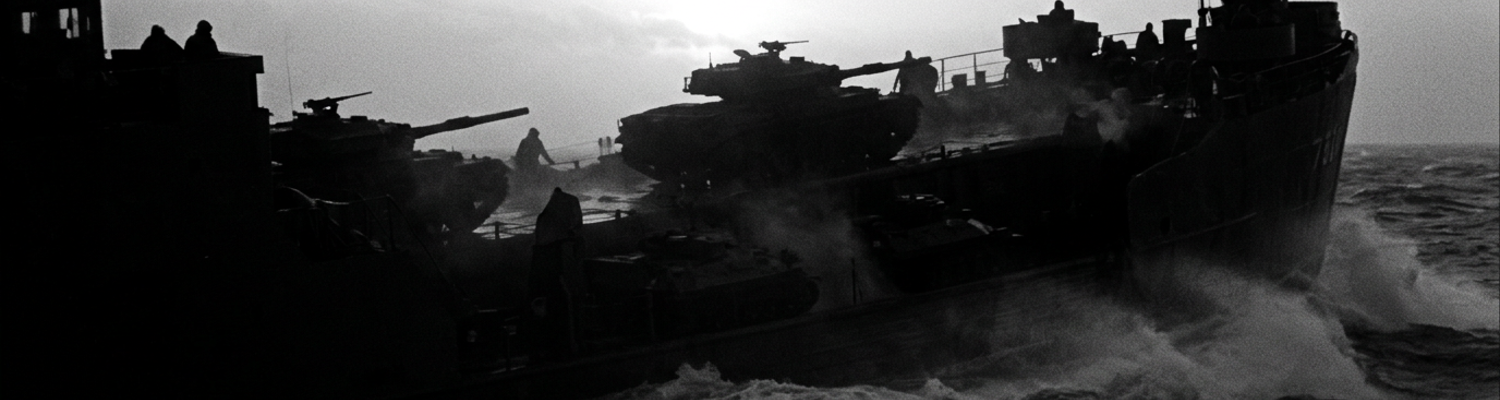
They moved to the 32nd Street Naval Station piers to load heavy weaponry. Winches overheated aboard older transport vessels. Hydraulic lines burst as stevedores worked through the night. They hoisted dozens of M48 Patton tanks and 105mm howitzers into dark cargo holds. Pacific Command emptied its primary amphibious assault capability. They assigned twenty-two amphibious ships of Amphibious Group Three to move the brigade toward the Panama Canal. This included the amphibious command vessel USS Eldorado and the helicopter carrier USS Iwo Jima.
Staff officers openly questioned the mathematical risk.
Stripping the West Coast bare meant leaving forward bases in Japan without their primary amphibious reaction force. The brigade combat echelon faced five thousand miles of ocean transit before it could influence operations around Cuba. Forces would spend nearly two weeks locked at sea aboard cramped transports without heavy airstrip access. General Fairbourn carried sealed operational orders. These directed an amphibious assault on the Cuban coast near Santiago if diplomacy failed. The final elements of the 5th Marine Expeditionary Brigade cleared San Diego Harbor by October 26.
Twenty-two grey amphibious warships cleared Point Loma before nightfall.
Amphibious Transport Loading and Combat Re-Stowage
Dockside officers at the 32nd Street Naval Station tore up peacetime loading books within hours of the alert.
Standard naval doctrine demanded administrative cargo loading. This rigid mathematical formula calibrated cargo weight across lower decks to preserve ship balance and metacentric height. Combat Cargo officers assigned to Amphibious Group Three received verbal orders from brigade planners to throw that protocol out entirely. Speed outweighed vessel hydrodynamics. Dock cranes hoisted crated 106mm recoilless rifles directly into open hull space aboard attack transports like USS Paul Revere. They loaded palletized small-arms rounds and communications vans into the attack cargo ship USS Tulare. Heavy forklift tines punctured fuel drums on Pier 5.
Civilian longshoremen and Marines from the 1st Shore Party Battalion worked shoulder to shoulder in forty-eight-hour shifts.
Cargo manifests degenerated into grease pencil scribbles on torn cardboard boxes. Working parties packed rations and spare engine blocks into single holds on top of frontline combat assets. Balance calculations yielded to brute force. This haste broke critical shore and shipboard machinery. Electric winches on the auxiliary cargo ship USS Bellatrix repeatedly blew circuit breakers at the San Diego repair basin. The dead weight of fifty-ton M48A1 Patton tanks from the 1st Tank Battalion overloaded the primary lift motors. Riggers rigged double-sheave blocks to force the armor down into the lower flats.
The sudden downward strain snapped a steel boom cable.
A tank chassis dropped four feet onto the steel deck plates below. Mechanics from Force Troops Pacific scrambled across the docks with oxyacetylene torches. They cut off bent tie-down rings. They welded improvised deck eyes directly to bulkheads. Shore party personnel drove thirty-five LVTP-5 amphibious assault vehicles straight through surf breaks. They drove up the stern gates of the dock landing ship USS Monticello. Drivers parked them nose to tail without the wooden shoring timber mandated by safety regulations. Bilge pumps on the lower decks choked on floating grease and hydraulic fluid.
The convoy sailed with its fighting equipment buried under thousands of wooden crates.
Brigade planners realized the ships would arrive off the beaches of Santiago de Cuba in a state of complete disorganization. Rifle companies would wait hours while cranes dug through layers of camp cots to reach machine gun ammunition. Captains ordered an improvised combat re-stowage while underway. They forced working parties below into suffocating holds rolling through eight-foot Pacific swells. Marines and sailors unlashed heavy pallets. They manhandled high-explosive 81mm mortar rounds and radio batteries forward toward the primary cargo squares.
This internal reorganization inverted the calculated center of gravity aboard each vessel.
Working parties piled fighting gear high on upper cargo flats. Assault waves could strip them out instantly over landing nets. This left the lower hulls dangerously light. Ship stability degraded with every ton shoved upward toward the weather decks. USS Paul Revere developed a persistent six-degree list to starboard. USS Tulare ran heavily down by the head. Her bow dragged into oncoming green water. This reduced convoy speed down to eleven knots.
Chief engineers fought the rolling momentum.
They constantly transferred fuel oil and seawater between port and starboard double-bottom ballast tanks. They ran auxiliary transfer pumps at maximum operational limits to keep the hulls from broaching. Toxic exhaust fumes from gas-powered tow motors accumulated in the lower compartments belowdecks. Sixteen Marines went to sickbay with carbon monoxide poisoning. Auxiliary blower fans were eventually lashed into the intake vents. Marine working parties completed the final cargo tie-downs off the coast of Guatemala at 0300 on October 29.
Emissions Control and Severed Command Communications
Amphibious Group Three imposed absolute emissions control across all twenty-two vessels immediately after clearing the Coronado roads.
Transmitters aboard the amphibious command ship USS Eldorado went offline under naval condition Alpha directives. This ended outgoing high-frequency traffic to Pacific Fleet headquarters in Pearl Harbor. Radio technicians uncoupled power leads from AN/URT-23 high-frequency transmitters. They pulled main fuses on bridge-top whip antennas. They grounded directional arrays to prevent stray radio-frequency leakage. Soviet trawlers or diesel submarines could detect ungrounded arrays using direction-finding equipment. Primary tactical voice circuits ceased broadcasting entirely.
Captains aboard attack transports had to rely exclusively on visual signals.
They used carbon-arc searchlights and directional Aldis lamps. Signalmen waved visual semaphore flags while standing on spray-drenched bridge wings. Signal lanterns failed to penetrate dense squalls off the coast of Central America. Ships had to maintain tight station-keeping within three hundred yards of each other in pitching seas. They operated without radar altimeters or surface tracking active. Every primary transmitter key across the entire amphibious task force sat locked inside mechanical safe boxes.
This electromagnetic silence severed tactical coordination between transport skippers and brigade leadership.
Engineering rooms could not pass urgent mechanical casualty warnings across the formation. Steam line gaskets blew on overloaded auxiliary vessels. Fuel transfer pumps failed repeatedly. Ships encountering mechanical drag drifted out of convoy alignment during zero-illumination nighttime transits. This risked mid-ocean hull collisions. Officers kept navigation lights extinguished to avoid visual detection by commercial merchantmen. Shipboard Marine commanders had no direct line of inquiry to ask Amphibious Group Three commanders about altered course headings.
Visual shutter lamps simply could not relay complex tactical data packets.
Company commanders remained isolated within steel hulls without any direct confirmation of their exact operational mission. The task force moved through waters south of the Gulf of Tehuantepec in complete tactical isolation from national command networks. Receive-only low-frequency teletype broadcast systems aboard the Eldorado operated on narrow channels. These channels were vulnerable to severe equatorial sunspot degradation and heavy atmospheric static. Operational intelligence updates regarding Soviet and Cuban military posture ceased reaching the brigade staff.
General Fairbourn sailed without knowing that Soviet air defense batteries had fired an SA-2 Guideline missile near Banes on October 27.
That missile destroyed an American U-2 reconnaissance aircraft. Task force intelligence officers possessed no operational data detailing the twenty-four operational R-12 intermediate-range missile launch sites in western Cuba. American naval intelligence could not relay real-time coordinates of four Project 641 Foxtrot-class submarines. These submarines patrolled the Caribbean shipping approaches armed with nuclear-tipped torpedoes. Eleven thousand combat Marines headed toward a hostile coastline without knowing if their assault corridors had been targeted with tactical nuclear rockets.
Brigade planning staff spent their transit watches drawing manual tactical overlays based on four-day-old intelligence estimates.
Battalion landing teams assigned to 2nd Battalion, 1st Marines maintained operational plans that assumed an enemy garrison composed of standard light infantry. Staff officers had no knowledge of thirty-six FKR-1 Meteor cruise missile launchers positioned along Cuban coastal approaches. Each launcher was capable of striking amphibious transports with fourteen-kiloton warheads. Operations officers inside shipboard command spaces calculated beach landing intervals for the shores near Santiago de Cuba using outdated black-and-white aerial photographs. Radio rooms logged incoming cipher strings that arrived broken. Tropical weather scrambled the signals into permanent undecipherable text.
Rolling Sea Conditions and Cargo Hold Failures
Heavy sea swells slammed Amphibious Group Three broadside off the Gulf of Tehuantepec on the night of October 30.
North-northeasterly gale winds descended from the Sierra Madre mountains. These winds generated twelve-to-fifteen-foot breaking waves that caught the overloaded amphibious convoy across its beam. Roll angles repeatedly exceeded twenty-seven degrees at violent eight-second intervals aboard attack transports such as USS Paul Revere. Deck crews had pushed thousands of tons of combat supplies from the bottom cargo flats up to upper deck spaces during the hasty combat re-stowage. The ships operated with an elevated center of gravity and diminished righting arms.
Green water broke across forward weather decks.
The angular acceleration placed severe torsional strain on the longitudinal framing and riveted deck girders inside holds number three and four. Marine watchstanders heard structural steel groaning. Hull plates flexed against the dynamic torque of each wave cycle. Welded hatch coamings buckled under the lateral shearing forces. Seawater seeped into dry cargo holds through failed rubber seals. Bilge wells filled with greasy runoff at a rate of four hundred gallons an hour.
This threatened lower compartment electrical conduits.
This dynamic hull twisting proved catastrophic for the improvised tie-downs securing heavy armor belowdecks. Half-inch forged steel binder chains secured fifty-ton M48A1 Patton tanks from Company A, 1st Tank Battalion in Hold Number Two aboard the Tulare. These chains snapped under the sudden shock load. An improvised deck padeye ripped clean through its heat-weakened surrounding metal. Shore party mechanics in San Diego had hastily welded that fitting to the deck plate. Forty-eight tons of cast armor lurched three feet to port on a heavy roll.
The remaining turnbuckle threads stripped instantly.
Three-eighth-inch restraining cables snapped like twine. The runaway tank slammed its steel tracks into a row of palletized 105mm artillery shells belonging to the 1st Battalion, 11th Marines. The impact crushed five wooden packing crates. It ruptured a twenty-gallon auxiliary fuel cell mounted on an adjacent M38A1 utility truck. Gasoline and hydraulic oil poured across the steel deck. The cargo flat turned into a slick hazard where maintenance crews could find no traction.
Similar mechanical failures hit the well deck of the dock landing ship USS Monticello.
Thirty-nine-ton LVTP-5 amphibious tractors broke free from their wheel chocks. Lateral g-forces sheared the pins off their heavy-duty ratcheting load binders. Unsecured tractors slid across the wet steel decking with each starboard roll. Their steel tracks gouged deep channels into the ship internal bulkheads. The sliding metal severed low-voltage shipboard lighting circuits. Damage control parties from the 1st Shore Party Battalion and ship company entered the unlighted hold with battle lanterns.
They carried sledgehammers and timber baulks.
They worked in waist-deep bilge wash to wedge heavy four-by-four Douglas fir shoring against the shifting vehicle hulls. Mechanics burned through twelve replacement chain binders per hour. They dodged free-swinging turnbuckles that cracked two Marines ribs and fractured a machinist mate ankle. Crews secured the last broken lashing off the coast of El Salvador at 0440 hours.
The Unorthodox Command Override of Safety Norms
Naval safety doctrine strictly prohibited sending men into cargo spaces containing unrestrained heavy machinery during high sea states.
Damage control regulations issued by the Bureau of Ships explicitly forbade personnel entry into lower cargo holds whenever unsecured deck cargo exceeded five tons in sea states above force four. Commanding officers were required to dog down the hatch coamings under peacetime naval protocol. They were instructed to flood lower void spaces if necessary to alter vessel trim. They had to wait for sea conditions to moderate before attempting salvage. Lieutenant commanders serving as combat cargo officers aboard attack cargo ships like USS Tulare deliberately overrode these standard directives off the coast of Central America on the morning of October 31.
Fifty-ton M48A1 Patton tanks belonging to Company A, 1st Tank Battalion had broken clean from their deck fittings.
They slid across steel deck plates with every roll. Transport officers calculated that waiting out the Tehuantepec gale would allow the free-sliding armor to batter through the internal framing of Hold Number Two. Deck officers ordered working details from the 1st Shore Party Battalion and shipboard damage control divisions down sixty-foot vertical escape trunks directly into the pitching hold. These men descended without safety harnesses into pitch darkness. They carried heavy ratcheting binders and four-by-four timber wedges. They brought five-ton screw jacks while forty-eight tons of cast steel armor slid across the deck ten feet away.
Every roll turned loose armor into a battering ram against the ship.
Ship commanders fully accepted the risk of horrific physical trauma to their working parties to prevent vehicles from breaching the outer hull. The structural calculation was severe. A fifty-ton tank sliding twelve feet across a slick twenty-six-degree deck incline generated massive kinetic force. It possessed enough momentum to shear longitudinal web frames and punch through five-eighths-inch medium-tensile steel hull plating. Thousands of tons of Pacific seawater would rush into the lower flats if the hull gave way below the waterline.
This would overwhelm bilge manifolds.
It would trigger an immediate capsize due to the unstable top-heavy combat stowage completed days earlier. Officers recognized that crewmen sent into the hold faced near-certain injury from whipping wire cables and uncontrolled tank treads. Marine maintenance specialists and sailors crawled across grease-soaked deck plates under the tracks of rocking vehicles. They manually positioned wooden shoring against churning bogey wheels. Broken binder chains lashed through the air with enough force to sever steel stanchions.
Medical logs from the transit record two crushed pelvises.
They document three compound leg fractures and eight severe crush injuries among shore party personnel trapped against bulkhead ribs during sudden roll excursions. Sickbays administered morphine and set broken bones on mess decks while repair parties above them continued driving timber blocks into shifting track links. This command override occurred repeatedly on five separate vessels between the Gulf of Tehuantepec and the Gulf of Fonseca. Dock landing ship USS Monticello sustained three buckled transverse frames.
Thirty-nine-ton LVTP-5 amphibious tractors struck the inner wing walls before mechanics could weld emergency angle-iron stops against the deck plates.
Boiler technicians and infantrymen wedged eight-inch oak baulks against sliding 105mm howitzer carriages aboard USS Paul Revere. They worked in three feet of oily bilge water contaminated by leaking battery acid. Transport commanders recorded these actions in ship logs as emergency damage containment. They deliberately omitted the naval safety code violations to protect deck officers from immediate court-martial inquiries. Repair parties completed the primary hull reinforcement welds at 1120 hours on November 1.
Below-Deck Triage and Bilge Medical Response
Casualties accumulated sixty feet below the waterline.
Navy hospital corpsmen assigned to the medical section of 2nd Battalion, 1st Marines and the 1st Shore Party Battalion performed emergency trauma stabilization directly inside the bilge spaces of USS Tulare and USS Paul Revere. The convoy traversed heavy Pacific swells off the coast of Nicaragua near 11 degrees 45 minutes North, 86 degrees 50 minutes West on the night of October 31. Shifting fifty-ton M48A1 Patton tanks and runaway five-ton cargo trucks pinned repair party personnel against structural bulkheads. Corpsmen climbed down grease-coated vertical ladders into Hold Number Two.
They carried canvas medical kits packed with Thomas splints.
They brought wire-mesh ladder splints and units of freeze-dried plasma. Medical personnel stabilized three compound femur fractures and five crushed pelvic girdles. They treated numerous traumatic limb amputations while working in ankle-deep bilge water contaminated with 90-weight transmission oil and high-octane gasoline. Medical technicians pushed half-grain morphine tartrate syrettes directly through grease-soaked dungarees into injured men. They held manual compression on severed femoral arteries with their bare fingers.
Shifting machinery blocks constantly threatened to crush both the patients and the medical teams.
Corpsmen lacked orthopedic reduction frames. They lashed traction splints to overhead steam piping with hemp rope. They reset fractured tibias by hand while ship hulls rolled through twenty-seven-degree arcs. Flight quarters across Amphibious Group Three stayed completely locked down under strict naval directives. Gale-force beam winds exceeding forty knots and severe eighteen-foot Pacific swells made flight-deck recovery impossible aboard the helicopter carrier USS Iwo Jima.
Thirty UH-34D Seahorse helicopters sat secured to deck tracks with ten-point wire lashings.
Strictest emissions control protocols forbade the transmission of high-frequency homing beacons or tactical UHF radio clearance to guide aircraft across the open ocean. This eliminated any possibility of long-range air evacuation to military hospitals in the Panama Canal Zone. Surgical triage was trapped entirely within the lower cargo flats. Medical officers converted narrow handling rooms and adjacent ammunition flats into improvised surgical stations. Alternating-current electrical runs had shorted out when shifting vehicle tracks severed deck conduits.
This plunged the lower deck compartments into complete blackness.
Navy surgeons worked by the dim yellow glare of six-volt battle lanterns and red-lens anglehead flashlights held by infantrymen. Deck plates beneath their boots were coated in hydraulic fluid and seawater wash that sloshed over their soles with every wave cycle. Surgical teams on the Tulare operated across unbolted aluminum mess tables held level against the ship violent list by teams of four riflemen. Surgeons performed emergency cutdowns.
They clamped shredded brachial arteries with curved Kelly forceps.
They debrided necrotic tissue without specialized suction apparatus. They used hand-pumped aspirators that repeatedly jammed on coagulated blood and bilge grit. Whole-blood reserves were nonexistent in the lower holds. Medical personnel reconstituted dried plasma using glass bottles of sterile water heated over portable immersion heaters borrowed from galley mess kits. Sterile surgical drapes became saturated with engine oil within minutes of contact with the deck plates.
Doctors irrigated exposed abdominal wounds with saline solutions poured from plastic canteens.
Corpsmen had processed fourteen critically injured personnel inside the bilge hold of USS Tulare by 0600 hours on November 1. They expended the battalion entire immediate reserve of penicillin G procaine and forty-eight battle dressings.
Arrival in the Caribbean and Tactical Readiness
Amphibious Group Three cleared the Gatun Locks of the Panama Canal on November 2.
They steamed directly into the western Caribbean Sea at latitude 9 degrees 40 minutes North, longitude 79 degrees 55 minutes West. Fleet commands ordered the twenty-two vessels into an immediate dispersed combat deployment. Ships formed a four-column tactical screening disposition spaced twenty-five hundred yards apart. This formation diluted vulnerability to Soviet torpedo attacks and tactical nuclear surface burst strikes. Fletcher-class and Gearing-class destroyers took up active anti-submarine patrol boxes five miles ahead of the amphibious core.
They pinged low-frequency AN/SQS-23 active sonars to sweep for four Project 641 Foxtrot diesel submarines tracked nearby.
Tactical coordinators aboard the flagship USS Eldorado ordered Condition 1A amphibious readiness set across the convoy. This required all primary gun crews, damage control central stations, and combat cargo handlers on watch around the clock. Troops assigned to reinforcing rifle companies unpacked waterproof covers from their M14 rifles. Flight deck teams on USS Iwo Jima spotted twenty-four UH-34D Seahorse helicopters along the deck tracks with blades spread. They pre-loaded them with combat rations, spare 7.62mm linked belts, and litter stanchions.
The landing force operated under strict combat assault configurations despite the political de-escalation developing in Washington and Moscow.
Brigade staff officers had designated primary boat lanes and helicopter landing zones behind Playa Cazonal and the coastline east of Santiago de Cuba. Crewmen of Company A, 1st Tank Battalion topped off the internal 378-gallon fuel tanks of their M48A1 Pattons with combat gasoline inside the tank decks of USS Monticello. Engines idle-cycled to clear moisture from spark plugs. Armourers distributed twenty-round magazines of ball ammunition and white phosphorus rifle grenades directly to squad leaders on the troop decks of USS Paul Revere.
Signalmen passed course corrections between bridge superstructures using directional signal lamps fitted with red glass infrared filters.
This evaded Soviet trawler observation. Visual lookouts stood four-hour shifts on the shipboard flying bridges. They scanned sea lanes with 20x120 naval binoculars for Soviet merchantmen or Cuban patrol craft approaching the Windward Passage. Naval engineers faced a severe post-crisis evaluation of the structural devastation left behind by the Tehuantepec transit. Hull inspectors and damage control officers descended into the lower flats under ongoing radio blackout.
Naval condition Alpha directives barred them from broadcasting damage reports to shipyards or fleet headquarters in Norfolk.
A technical survey across five transport hulls uncovered forty-six fractured transverse frames. It found eight severely buckled watertight bulkheads and sheared hull stiffeners where heavy vehicles had slammed into vessel framing. Engineers documented that seven improvised padeyes welded by shore party mechanics in San Diego had torn clean out of five-eighths-inch deck plating inside Hold Number Two of USS Tulare. This ripped two-inch jagged gashes into the tops of double-bottom fuel oil tanks below.
Repair parties worked with portable carbon-arc gouging tools and oxyacetylene torches.
They cut back warped steel beams and welded six-inch structural angle irons directly across stressed bulkheads to arrest fatigue cracking. Cargo officers re-tensioned every wire sling and load binder. They replaced failed wire lashings with two-inch braided manila shoring lines wedged against heavy wooden balks. Engineers cataloged twenty-eight compromised hull welds before the convoy reached its final holding station southwest of Jamaica.