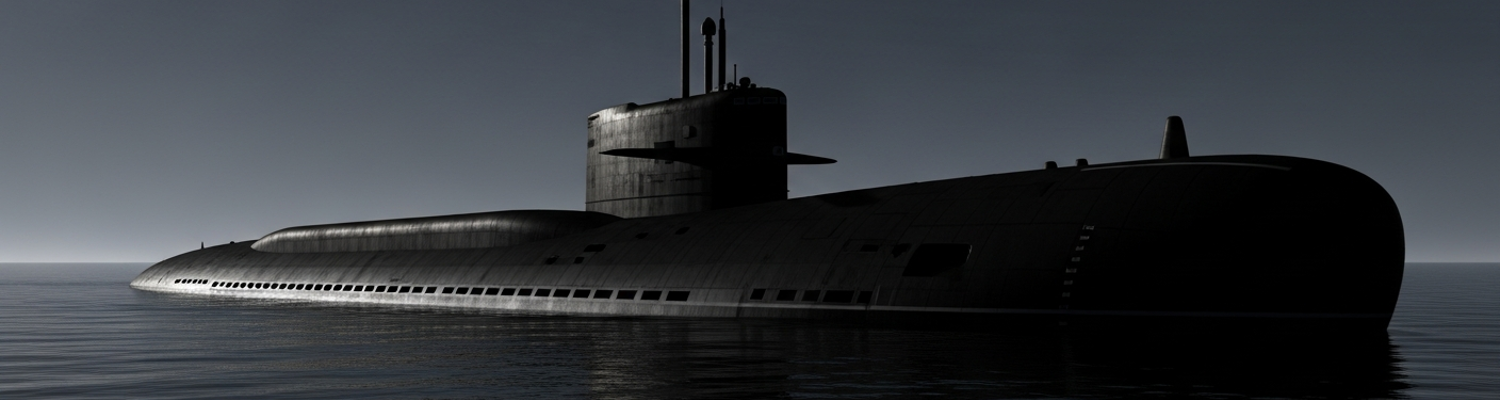

The black, diesel-electric hulls of World War II were instruments of ambush. They were submersibles, not true submarines, shackled to the surface by the need for air and the short life of their batteries. Their operational calculus was one of patience and opportunity, a brief and violent underwater attack followed by a desperate escape. This paradigm shattered in the frozen waters off Groton, Connecticut, on January 17, 1955. On that day, the USS Nautilus (SSN-571) signaled, "Underway on nuclear power," and the nature of naval warfare changed forever. This was not merely an evolution. It was a violent break from the past, driven by a handful of determined individuals who forced a new reality upon a skeptical world.
Rickover's Unforgiving Vision
The revolution began with one man’s iron will, Captain, later Admiral, Hyman G. Rickover. A brilliant and abrasive engineer, Rickover saw that harnessing the atom for submarine propulsion was a strategic necessity. Sent to Oak Ridge in 1946 to learn nuclear technology, he returned to Washington with a singular focus. He established the Naval Reactors branch, a joint office of the Navy and the Atomic Energy Commission, giving him unprecedented control over the entire program. Rickover’s methods were unorthodox and his standards unforgiving. He personally interviewed every officer candidate, seeking not just intellect, but a capacity for relentless operational rigor and personal accountability. His famous "Rickovergrams," memos demanding absolute precision from contractors and subordinates, became legendary symbols of his demanding management style.
His team at the Westinghouse-operated Bettis Atomic Power Laboratory faced a monumental engineering challenge: shrink a theoretical reactor to fit within the confines of a submarine hull. This required solving problems of intense radiation, heat, and pressure in a confined space. The result was the Submarine Thermal Reactor, later designated the S2W, a pressurized water reactor. The design was a masterpiece of compact power. Highly enriched uranium fueled a core that heated pressurized water. This water transferred its thermal energy to a secondary loop, creating steam to drive the turbines. This system generated 13,400 shaft horsepower, allowing for sustained underwater speeds exceeding 20 knots. Before it went to sea, a full-scale prototype, the STR Mark I, was built in the Idaho desert to prove the concept and train the first generation of nuclear-qualified sailors.
When the Nautilus put to sea for its shakedown cruise, the operational implications were immediate. On its way to Puerto Rico, it remained submerged for 89.8 hours, covering 1,381 miles. This was the longest submerged transit at the highest sustained speed ever recorded. It outpaced most surface anti-submarine assets of the era, rendering World War II-era tactics obsolete. The submarine was no longer a diving boat. It was a true undersea warship. This new capability was dramatically demonstrated during "Operation Sunshine" in 1958, when the Nautilus, under Commander William R. Anderson, traveled 1,830 miles under the Arctic ice cap to reach the geographic North Pole. The boat had opened the arctic as a new theater of operations, proving its strategic mobility was global and no longer constrained by the availability of diesel fuel.
A Silent, Invulnerable Deterrent
The endurance of the Nautilus created a new possibility. A submarine that could remain hidden for months could serve as more than a hunter. It could become an undetectable launch platform for nuclear weapons, ensuring a devastating second-strike capability. In an era of growing fear over a potential surprise Soviet attack on vulnerable land-based bombers and missiles, this concept was a strategic imperative. The Navy’s Special Projects Office, under Rear Admiral William F. "Red" Raborn, was tasked with developing the solution.
Early concepts involving liquid-fueled missiles like the Jupiter were deemed too dangerous for submarine use. The breakthrough came with the development of the UGM-27 Polaris, a two-stage, solid-fuel ballistic missile. Lockheed was commissioned in 1956 to create a compact missile that could be launched from a submerged submarine. The Polaris A-1 was 28 feet long and used a compressed gas system to eject it from its launch tube before the rocket motor ignited, protecting the submarine from the violent launch. To carry this new weapon, the Navy moved with incredible speed. The hull of an under-construction Skipjack-class attack submarine was literally cut apart and a 130-foot missile compartment was inserted. Christened the USS George Washington (SSBN-598), it became the world’s first ballistic missile submarine. The pressure on its first "Blue Crew" and their commander, James B. Osborn, was immense. On July 20, 1960, off Cape Canaveral, the George Washington successfully launched a Polaris missile from a submerged position. Osborn famously messaged President Eisenhower, "POLARIS - FROM OUT OF THE DEEP TO TARGET. PERFECT."
On November 15, 1960, the George Washington departed on the first-ever strategic deterrent patrol, carrying 16 Polaris missiles. It remained submerged for 66 days. This patrol marked the operational beginning of the sea-based leg of the nuclear triad. To maximize time on station, the Navy instituted the two-crew system, Blue and Gold, ensuring the submarine spent as little time in port as possible. The "41 for Freedom," the 41 Polaris-equipped SSBNs that followed, created a survivable and unseen deterrent that fundamentally altered the geopolitical balance of power. A significant portion of America’s nuclear arsenal was now hidden beneath the waves, its location unknown, its crews standing a silent and constant watch, living with the psychological weight of their world-ending mission in complete isolation.
The Art of Acoustic Invisibility
The existence of these high-value SSBNs, and the increasingly capable nuclear attack submarines (SSNs) designed to hunt them, intensified the Cold War beneath the surface. The Soviet Union invested heavily in anti-submarine warfare (ASW), deploying vast fleets of ships, aircraft, and hunter-killer submarines like the potent Victor-class. This forced a rapid evolution in American submarine technology, focused on one primary attribute: stealth. The key to survival was to hear without being heard.
This drove a shift away from active sonar, which reveals the sender’s position, to passive sonar. The centerpiece of this evolution was the development of large, spherical bow sonar arrays. Systems like the AN/BQQ-5, integrated on the Los Angeles-class attack submarines, used a massive transducer-filled sphere in the bow to listen for the faint acoustic signatures of enemy vessels. This digital system could process signals from the bow sphere, conformal arrays along the hull, and towed arrays trailing hundreds of feet behind the submarine, providing a comprehensive acoustic picture. The skill of the sonarman became paramount, an art of distinguishing the sound of a Soviet propeller from the cacophony of marine life and ambient ocean noise. These operators trained for years to recognize the unique sound signatures of individual enemy ships.
Just as sonar allowed submarines to hear better, new hull designs and silencing techniques allowed them to hide better. The development of high-yield 80 (HY-80) steel was a materials science breakthrough. This low-alloy steel possessed a high tensile strength, allowing hulls to be constructed that could withstand the immense pressures of deep-ocean operations. Submarines built with HY-80 steel, like the Permit-class, could operate at depths far below their predecessors, giving them a third dimension in which to evade detection. A submarine could use thermal layers in the water, known as thermoclines, to mask its acoustic signature from surface ships, then dive deep into the crushing dark to escape a pursuing hunter. Engineers developed machinery rafting, where heavy equipment was mounted on massive internal platforms isolated from the hull, preventing vibrations from transmitting into the water. Anechoic tiles were applied to the exterior, absorbing active sonar pings and further deadening the boat's own sound.
The combination of a limitless power source, a strategic nuclear payload, and the technological mastery of stealth completed the submarine’s transformation. It had gone from a tactical coastal threat to a planetary-level strategic asset. The men who crewed these steel hulls lived for months in isolation, bearing a burden of responsibility unlike any other in military history. Their work was unseen, their successes unheralded, but their silent revolution under the waves fundamentally reshaped the landscape of global power and defined the shadowy contours of the Cold War.