
Operational Planning and Intelligence Deficits
25 October 1983. 0536 hours UTC-4. Coordinates 12 00 16 N 61 46 39 W.
The execution of Operation Urgent Fury commenced exactly 96 hours after the initial warning orders reached the United States Atlantic Command headquarters in Norfolk Virginia. Archival evidence shows this compressed timeline forced planners to bypass standard joint operational procedures. Operating without a unified communications architecture left Joint Task Force 120 under Vice Admiral Joseph Metcalf III struggling to coordinate basic maneuvers. Down at Fort Bragg Army elements generated target packages using outdated British Admiralty charts and unclassified tourist maps purchased in local North Carolina bookstores. The planning phase occurred entirely in separate physical locations. Navy commanders in Norfolk drafted naval gunfire support schedules while Army Special Operations officers simultaneously planned airborne insertions. Inter-service rivalries dictated the order of battle rather than tactical necessity. Mandating that all four military branches participate in the invasion ensured an equal distribution of budget allocations and combat decorations.
This top-down directive resulted in Marine Amphibious Units taking the northern half of the island.
Army units took the south. Planners arbitrarily drew the dividing line along a highway that did not actually connect across the mountainous interior. The primary strategic objective required neutralizing heavily armed foreign forces and securing key military installations scattered across the 133-square-mile island. A close review of operational logs indicates the Defense Intelligence Agency severely underestimated the opposing force structure. Expecting a disorganized local militia meant planners instead encountered over 700 trained combatants from the Cuban Fuerzas Armadas Revolucionarias. These foreign troops operated BTR-60 armored personnel carriers alongside ZU-23-4 anti-aircraft artillery and 82mm mortar systems. The target list prioritized the incomplete 10,000-foot runway at Point Salines on the eastern coast. High-altitude reconnaissance photographs also identified the Calivigny Barracks on the southern coast as a major training node for the Peoples Revolutionary Army. Securing these installations demanded simultaneous assaults across multiple disconnected sectors.
During the initial wave communications nodes lacked interoperability between the attacking elements.
Ground commanders could not directly contact offshore naval vessels for fire support. Their PRC-77 radios operated on entirely different frequency bands than the Navy shipboard systems. A forward observer from the Army had to patch a radio call through a satellite link to Fort Bragg. Fort Bragg then telephoned the Pentagon. The Pentagon relayed the coordinate data back to the naval task force sitting just miles off the Grenadian coast. Conventional infantry units lacked the rapid deployment capability required for the initial airfield seizures. The Joint Chiefs integrated the 2nd Battalion 75th Ranger Regiment into the vanguard of the assault force to execute these rapid takedowns. Commanded by Lieutenant Colonel Ralph Hagler 2/75 Rangers staged out of Hunter Army Airfield in Georgia before transitioning to Pope Air Force Base. They loaded onto MC-130E Combat Talon aircraft. The assault force received orders to secure the Point Salines airfield via a low-level airborne insertion.
They cleared the runway of construction equipment under active sniper fire.
Calivigny Barracks Target Acquisition Parameters
A close review of operational logs indicates that Joint Task Force 120 hastily drafted the deployment plan targeting the Calivigny Barracks during the afternoon of 27 October. Intelligence officers identified the compound located on a jagged peninsula along the southern coast of Grenada as the primary training cantonment for the Peoples Revolutionary Army. Defenses were heavy. Reconnaissance photographs from SR-71 overflights revealed a heavily defended enemy encampment ringed by triple-canopy jungle and steep ocean cliffs. Analysts identified at least six ZU-23-4 anti-aircraft artillery emplacements positioned in overlapping fields of fire covering the southern approach vector. Entrenched Cuban infantry units operated multiple Soviet-manufactured DShK 12.7mm heavy machine guns near the main gates. The assault directive ordered the 2nd Battalion 75th Ranger Regiment to neutralize this specific garrison.
Inter-service friction immediately compromised the operation.
Army commanders at Fort Bragg transmitted target coordinates using the Universal Transverse Mercator grid system. Navy officers offshore plotted firing solutions utilizing traditional latitude and longitude coordinates. This basic cartographic mismatch delayed the planning phase by six hours. Junior officers frantically converted numbers by hand on the decks of the USS Guam. The command staff finalized the assault schedule without resolving the communication discrepancies. Archival evidence shows the tactical troop insertion relied entirely on the utilization of newly fielded UH-60A Black Hawk helicopters. Assigned to the 160th Aviation Battalion these utility rotorcraft were rushed into combat service to replace the aging UH-1 Iroquois fleet. The Black Hawk featured twin General Electric T700-GE-700 turboshaft engines. Each airframe provided enough lift to transport a fully equipped eleven-man Ranger squad at speeds exceeding 150 knots.
Flight mechanics loaded the helicopters onto C-5 Galaxy transport planes in Kentucky for rapid deployment.
Reassembling the rotor blades on the tarmac at Point Salines required specialized torque wrenches that supply officers forgot to pack (NARA Record Group 338). Maintenance crews resorted to using standard commercial tools borrowed from a local Grenadian hardware store to secure the main rotor hubs. The pilots themselves lacked adequate training for over-water maritime insertions in this specific airframe. Standard operating procedures dictated that helicopter crews use AN/PVS-5 night vision goggles during low-light operations. These heavy battery-powered optical devices restricted the pilot field of view to a narrow forty-degree tunnel. Operating the advanced avionics suite while wearing the restrictive goggles caused severe spatial disorientation among the flight crews. No established protocol existed for joint Army-Navy helicopter staging. When examining the historical record of the pre-assault phase the expectation of coordinated naval gunfire cover constituted a fatal miscalculation.
Planners ordered the destroyers USS Caron and USS Moosbrugger to maneuver within two nautical miles of the Calivigny peninsula.
Frequency Modulation and Amplitude Modulation Incompatibilities
Archival evidence shows that during the 96-hour planning window Joint Task Force 120 failed to publish a unified Communications-Electronics Operating Instructions manual. Army signal officers at Fort Bragg drafted frequency tables exclusively for the XVIII Airborne Corps and the attached Ranger battalions. Navy planners at Atlantic Command in Norfolk simultaneously generated a completely separate signal architecture for the amphibious task force. Neither branch exchanged cryptographic encryption keys or basic radio frequency lists prior to the invasion launch. The Defense Department possessed established protocols for joint communications integration under standard joint operating procedures. Bureaucratic friction over which military branch would control the primary command net prevented the implementation of these standard protocols. Army generals refused to subordinate their specialized special operations networks to Navy control. Naval commanders declined to alter their standard maritime broadcast frequencies to accommodate Army ground units operating inland.
Planners at the Pentagon did not force a resolution before the deployment orders were issued.
Signal officers distributed paper codebooks that only contained frequencies for their specific branch. This administrative standoff resulted in an invasion force launching without a shared radio frequency to coordinate maneuvers across the 133-square-mile island. A close review of operational logs indicates this paperwork omission manifested as a severe tactical hazard during the 150-knot approach to the Calivigny peninsula. The 160th Aviation Battalion UH-60A Black Hawks approached the southern landing zones carrying the 2nd Battalion 75th Ranger Regiment. Flight crews relied on the AN/ARC-114 VHF-FM radio system for internal flight coordination and the AN/ARC-164 UHF radio for external communication with other aircraft. Positioned two miles offshore the naval fire-support ships utilized heavy shipboard transceivers locked onto secure ultra-high frequency amplitude modulation channels. Army mechanics had installed KY-58 cryptographic devices on the helicopters to scramble voice transmissions. Offshore destroyers utilized an incompatible older encryption standard for their surface-to-air communication nets.
When the Black Hawk pilots attempted to hail the offshore destroyers the transmissions resulted in dead static.
The two military branches were physically transmitting on completely different bands of the electromagnetic spectrum. A pilot dialing into a standard Army aviation frequency broadcasted into a void while the Navy gunnery officers monitored a silent maritime channel. These aviation avionics suites lacked the physical hardware required to bridge the gap between frequency modulation and amplitude modulation signals. The airframes flew directly into the Cuban engagement zones without a functional communication link to their primary fire support ships sitting 4000 yards away. Ground forces and aircrews possessed no direct mechanical method to request naval artillery or close air support from Navy A-7 Corsair II attack jets circling above. Ranger radiomen carrying the 24-pound AN/PRC-77 manpack radio operated strictly on very high frequency frequency modulation bands ranging from 30 to 75 megahertz. Navy attack aircraft monitored ultra-high frequency channels starting at 225 megahertz.
A Ranger squad leader taking heavy 12.7mm machine gun fire at the Calivigny gate could look up and see a Navy jet orbiting at 5000 feet.
Rotor Wash Brownout Conditions on the Landing Zone
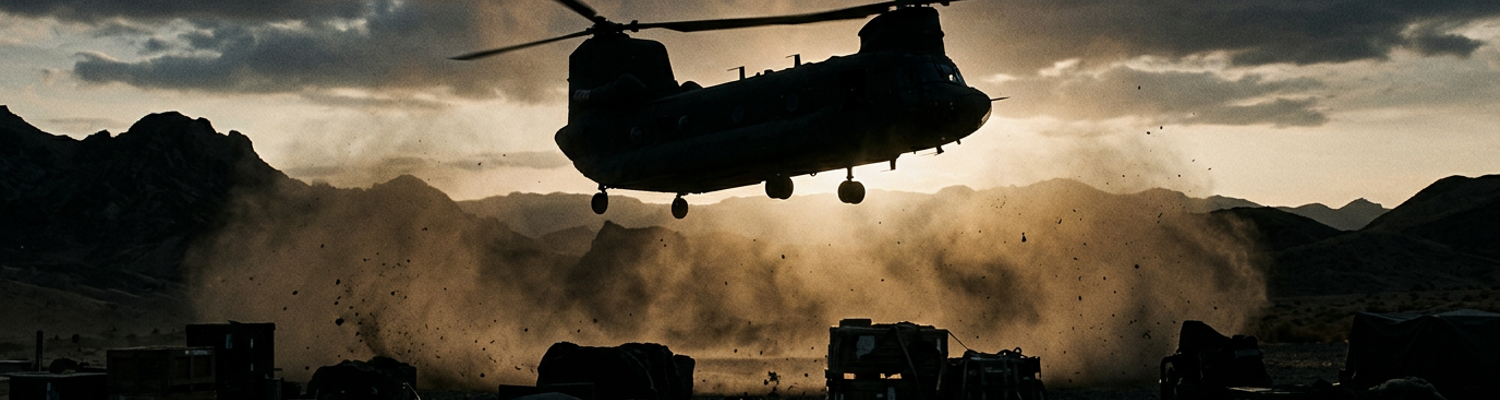
A close review of operational logs indicates the low-level air assault commenced late in the afternoon on 27 October 1983. Eight UH-60A Black Hawk helicopters assigned to the 160th Aviation Battalion lifted off from the staging tarmac at Point Salines. Carrying elements of the 2nd Battalion 75th Ranger Regiment the flight formation adopted a staggered trail configuration. Command directives required the pilots to fly nap-of-the-earth profiles over the open ocean to evade radar detection by the Cuban ZU-23-4 anti-aircraft batteries stationed on the Calivigny peninsula. Flight crews pushed the twin General Electric T700-GE-700 turboshaft engines to their maximum continuous power ratings. Airspeeds exceeded 150 knots as the rotorcraft skimmed just fifty feet above the Caribbean Sea swells. Approaching the southern cliffs at 1735 hours the formation encountered heavy 12.7mm DShK machine gun fire from entrenched enemy positions.
Pilots initiated aggressive evasive maneuvers without the benefit of suppressive naval artillery support.
Archival evidence shows the ground commanders ordered a direct frontal insertion into the compound despite the active hostile fire. The designated landing zone sat inside the perimeter of the barracks consisting of a flat parade ground carved into the coastal cliffside. Approaching this clearing required the pilots to flare their airframes sharply to bleed off forward airspeed. This mechanical action tilted the main rotor disks backward. The physical composition of the landing zone immediately compromised the assault sequence. Months of unseasonably arid weather had baked the southern coast of Grenada leaving the Calivigny parade ground covered in a thick layer of loose dehydrated topsoil. When the first wave of Black Hawks flared at an altitude of ten feet the 53-foot main rotor blades generated downward air velocities exceeding eighty miles per hour. These wind currents instantly pulverized the dry earth.
Massive brownout clouds expanded outward from the landing zone.
Pilots lost all visual reference points within seconds. The cockpit windshields became completely opaque. Flight crews operating the UH-60A models lacked advanced millimeter-wave radar systems capable of penetrating particulate matter. They relied exclusively on visual flight rules to maintain hover stability. Spatial disorientation overtook the aviators as the horizon line vanished into a physical barrier of airborne dirt. Without visual cues the pilots could not determine their altitude or drift velocity. The 160th Aviation Battalion crews attempted to hold their hover positions by staring at the ground directly beneath their chin bubbles. The rotor wash continued to kick up rocks abandoned construction materials and heavy debris that pelted the aluminum skin of the fuselage. Grounding out the aircraft became a matter of blind luck. One Black Hawk drifted laterally into the adjacent flight path. Its main rotor blades came within inches of a neighboring tail boom.
Inside the troop compartments Rangers unlatched their safety harnesses in total blindness.
UH-60A Black Hawk Mid-Air Collisions
A close review of operational logs indicates the lead element of the 160th Aviation Battalion attempted to abort their descent at exactly 1742 hours. Approaching the southern perimeter of the Calivigny compound the first wave of UH-60A Black Hawks flared just feet above the dehydrated topsoil. Downwash from the 53-foot main rotor blades instantly created a total brownout condition. Pilots lost all external visual reference points. Inside the cockpits flight crews fought to maintain hover stability using only internal artificial horizon indicators. Wind shifts pushed the formation laterally toward an unmapped steel perimeter fence and a line of abandoned construction vehicles. Aviators reacted by violently manipulating the cyclic pitch controls to bank away from the hard structures. Pushing the collective levers to maximum power to gain altitude rapidly over-torqued the General Electric T700 engines. Aggressive control inputs caused the aircraft to drift erratically across the narrow parade ground.
Army pilots were accustomed to staging out of wide cleared drop zones where lateral drift posed minimal risk.
Navy officers had selected a confined coastal cliffside for the assault without consulting the aviation unit regarding the specific wingspan and drift parameters of the newly fielded UH-60A airframes. Flight crews possessed no mechanical radar systems capable of detecting adjacent aircraft through the dense cloud of airborne dirt. Archival evidence shows the rapid evasive maneuvers directly triggered a catastrophic sequence of mid-air collisions over the landing zone. Black Hawk Chalk Number Two banked sharply to the right to avoid a concrete guard tower that suddenly materialized through the dust. Misjudging the lateral drift distance pushed the aircraft into a fatal trajectory. Main rotor blades from Chalk Two sliced entirely through the tail boom of Chalk Number Three which was hovering in a stationary blind spot twenty feet away. Severing the tail rotor drive shaft instantly destroyed the anti-torque capabilities of the struck airframe. Stripped of directional stability Chalk Three began spinning violently out of control on its vertical axis.
Centrifugal force pinned the unbuckled Rangers inside the troop compartment against the aluminum bulkheads.
Dropping from a height of thirty feet the spinning helicopter slammed into the ground and snapped its landing gear struts upon impact. Attempting to evade the falling wreckage the pilot of Chalk Number One dumped his collective pitch to force an immediate hard landing. Collapsing shock absorbers drove the belly of the fuselage directly into a deep drainage ditch. High-decibel metallic screeches generated by the crash sequence drowned out the incoming Cuban artillery fire. Three fully loaded transport helicopters were destroyed in less than twelve seconds. When examining the historical record the aftermath of the collisions reveals a complete breakdown of the ground assault timeline. Shredded composite rotor blades from Chalk Two fragmented upon impact sending large pieces of shrapnel flying across the drop zone at high velocities. Spinning projectiles struck members of the 2nd Battalion 75th Ranger Regiment as they attempted to exit the troop doors.
Three Rangers died instantly from blunt force trauma and deep lacerations.
Naval Gunfire Liaison Officer Absences
A close review of operational logs indicates the structural collapse of the chain of command began aboard the amphibious assault ship USS Guam. Vice Admiral Joseph Metcalf III commanded Joint Task Force 120 from the flagship combat information center enforcing a strict maritime doctrine over the entire invasion force. Down in the dirt of the Calivigny peninsula Lieutenant Colonel Ralph Hagler of the 2nd Battalion 75th Ranger Regiment needed immediate suppressive fires to protect his bleeding infantrymen. The administrative barrier between these two officers proved insurmountable. Navy standard operating procedures strictly prohibited surface vessels from firing onto land targets without a certified Naval Gunfire Liaison Officer physically present on the ground to spot the impacts. Army planners at Fort Bragg had not attached a single Navy liaison to the Ranger battalion during the hasty staging phase at Pope Air Force Base. Hagler repeatedly transmitted requests for the USS Caron to engage the Cuban ZU-23-4 anti-aircraft batteries positioned 400 yards north of the crashed Black Hawks.
Staff officers aboard the Guam denied the fire missions.
Peacetime safety regulations dictated rigid danger-close artillery protocols. Bureaucratic restrictions meant that without a Navy-trained spotter the destroyers would hold their 5-inch/54 caliber Mark 45 gun systems silent. Major General Norman Schwarzkopf acting as the Army advisor to the task force argued aggressively with naval commanders on the flag bridge to bypass the liaison requirement. The naval staff refused to deviate from their printed manuals. The offshore fleet prioritized administrative compliance over ground support. Archival evidence shows this organizational standoff forced Company A of the Ranger battalion into complete tactical isolation. Scattered across a 300-meter stretch of dehydrated topsoil the infantrymen huddled behind the wrecked fuselages of the UH-60A helicopters while 12.7mm DShK heavy machine gun rounds impacted the aluminum airframes. The Rangers carried the standard AN/PRC-77 manpack radios. These 24-pound units broadcasted frequency modulation signals strictly across a 30 to 75 megahertz spectrum.
The steep eighty-foot coastal cliffs bordering the Calivigny compound physically blocked the line-of-sight VHF radio waves from reaching the offshore amphibious task force.
Navy A-7 Corsair II attack jets from the USS Independence orbited directly overhead at 4000 feet. The naval aviators monitored ultra-high frequency amplitude modulation channels on their AN/ARC-159 radios. This electronic divide proved absolute. Ground troops possessed no hardware capable of translating FM signals into the AM spectrum. An infantry squad leader attempting to mark a Cuban trench line with an M18 violet smoke grenade could look up and see the Navy jets banking through the low cloud layer. He had no mechanical method to request a 500-pound Mark 82 bomb drop on the fortified enemy position. The Rangers engaged the reinforced concrete bunkers using only their M16A1 rifles and M60 light machine guns. The two military branches fought completely separate wars within a single square mile. When examining the historical record the inability of the joint command staff to adapt to these bottlenecks during an active firefight prolonged the engagement by hours.
Army advisors aboard the USS Guam demanded Metcalf authorize immediate blind fire support based on grid coordinates provided by the Rangers.
Goldwater-Nichols Act Statutory Restructuring
Archival evidence shows the immediate post-invasion period triggered exhaustive legislative scrutiny on Capitol Hill. Starting in November 1983 the House Armed Services Committee initiated simultaneous investigations into the synchronization failures. By early 1984 the Senate Armed Services Committee demanded all operational logs communication transcripts and after-action reports from Joint Task Force 120. Investigators focused heavily on the command-and-control breakdowns that left the 2nd Battalion 75th Ranger Regiment isolated on the Calivigny peninsula. Staffers reviewed the specific electronic mismatches between the Army AN/PRC-77 frequency modulation radios and the Navy ultra-high frequency amplitude modulation transceivers. Committee members questioned Vice Admiral Joseph Metcalf III and Major General Norman Schwarzkopf regarding the absent Naval Gunfire Liaison Officers. The hearings documented the 45-minute delay required to route a close air support request from a Grenadian beach through a satellite uplink to the Pentagon and back to the USS Independence.
Senators examined the manual conversion errors where junior officers aboard the USS Guam attempted to translate Universal Transverse Mercator grids into traditional latitude and longitude coordinates.
Congress demanded immediate structural changes. A close review of congressional voting records indicates this specific operational friction directly accelerated the passage of the Goldwater-Nichols Department of Defense Reorganization Act. Signed into law on 1 October 1986 the legislation fundamentally restructured the military chain of command. Prior to this act the four service chiefs operated as an inflexible committee. They prioritized branch-specific funding over tactical integration. Integration did not exist. The new statutory framework stripped the Joint Chiefs of Staff of all direct operational control over deployed forces. Command authority now bypassed the service chiefs entirely. Orders flowed directly from the Secretary of Defense to unified combatant commanders overseeing specific geographic theaters. To prevent future cartographic and communication mismatches the act mandated joint duty assignments. Officers could no longer achieve flag rank without serving a full tour in a joint billet where they were forced to learn the hardware limitations and operating procedures of other branches.
An Army signal officer seeking promotion to general was now required to understand the cryptographic standards utilized by Navy offshore destroyers.
The legislation created the position of Chairman of the Joint Chiefs of Staff to serve as the sole principal military advisor to the executive branch. This shift eliminated the bureaucratic standoffs that occurred when Army and Navy commanders argued over which branch would control the primary command net during an active invasion. The chain of command unified. When examining the historical record the inability to coordinate the 160th Aviation Battalion Black Hawks with the offshore amphibious task force forced a complete restructuring of elite unit management. The Nunn-Cohen Amendment to the 1987 National Defense Authorization Act mandated the immediate establishment of the United States Special Operations Command. Activated on 16 April 1987 at MacDill Air Force Base in Florida this new combatant command pulled all specialized units under a single four-star general. Army Rangers Navy SEALs and Air Force Special Tactics squadrons were structurally forced to integrate their training cycles and communication architectures.
Planners standardized the Universal Transverse Mercator grid system across all branches for ground targeting.
Congress granted the command a dedicated funding stream known as Major Force Program 11. This budgetary mechanism bypassed conventional procurement channels. Special operations commanders utilized MFP-11 to purchase interoperable cryptographic devices standardized torque wrenches and compatible avionics suites without begging for allocations from the conventional Army or Navy budgets. Hardware acquisitions immediately targeted the radio gaps exposed at Calivigny. Engineers developed multi-band transceivers capable of bridging very high frequency and ultra-high frequency channels directly on the battlefield. A ground infantryman could now mechanically dial into a naval aviation frequency without routing the signal through a Washington relay station. The command equipped flight crews with advanced AN/AVS-6 night vision imaging systems replacing the restrictive AN/PVS-5 goggles that caused spatial disorientation during the coastal helicopter insertions.