
The Stroke of a Pen on June 12th
On June 12, 1948, President Harry S. Truman applied his signature to Public Law 625, the Women's Armed Services Integration Act. This was no mere bureaucratic formality. It was a fundamental reordering of the United States military's personnel structure, born from the hard lessons of a global war and the chilling realities of a new one. The act granted women permanent, regular status in the armed forces. For the Army, this meant the Women's Army Corps (WAC), an auxiliary body since its 1942 inception, would now be a component of the Regular Army and the Army Reserve. The era of women serving as a temporary wartime expedient was officially over. This legislation provided the legal foundation for a professional female cadre within the nation’s land power, a decision driven by the stark strategic calculations of the nascent Cold War.
The push for integration came from the highest echelons of command. General Dwight D. Eisenhower, then Army Chief of Staff, had evolved from a skeptic to a staunch supporter after witnessing the performance of over 150,000 WACs during World War II. He, along with other military planners, understood that the post-war demobilization had dangerously thinned the Army's ranks just as the Soviet Union solidified its grip on Eastern Europe. The looming confrontation demanded a larger, more flexible, and technically proficient force. Integrating women on a permanent basis was a direct answer to this manpower problem, a strategic necessity for an Army facing global commitments from occupied Germany to Japan. The legislative battle was not without friction. Some congressmen voiced concerns about the effect of women on military discipline and the traditional family structure. Yet, the arguments for military readiness prevailed. The bill passed the House of Representatives by a vote of 206 to 133 and achieved unanimous consent in the Senate. On that same day, Colonel Mary A. Hallaren, the third Director of the WAC and a relentless advocate for the bill, was sworn in as the first woman to receive a regular commission in the U.S. Army, a direct result of the law she fought to enact.
The Two Percent Solution and Its Limits
The Integration Act was a landmark victory, but its text contained compromises that reflected the deep-seated institutional and societal biases of the era. The law was not a charter for equality. It came with severe limitations. A restrictive quota, known as the two percent solution, capped the total number of enlisted women in the Army at two percent of the overall enlisted force. The number of female officers was capped at ten percent of the female enlisted strength. Promotions were managed through separate lists, effectively creating a glass ceiling and preventing direct competition with male officers. The highest permanent rank a woman could attain was lieutenant colonel, with the sole exception of the WAC Director, who could hold the temporary rank of colonel. These regulations were explicitly designed to preserve the male-dominated command structure and prevent women from holding authority over men in operational units.
Societal expectations further shaped policy. Regulations mandated the discharge of women for pregnancy or for becoming a parent to a minor child through birth or adoption. For a period, married women without prior service were barred from enlisting, a rule that reflected the prevailing view of a woman's primary role as a homemaker. Recruitment campaigns struggled against this cultural backdrop. Initial enlistment numbers were low. By June 1950, on the eve of the Korean War, a mere 3,200 women were on active duty in the WAC. The Army's recruitment posters attempted to appeal to patriotism and the promise of new skills, but they competed with a powerful domestic narrative that pushed women back into the home after the war. These pioneers entered a military culture that was often uncertain of their place and sometimes openly resentful. They navigated an institution built by and for men, where they had to consistently outperform their male peers just to be considered competent. The establishment of the permanent WAC Training Center at Camp Lee, Virginia, provided a centralized location for training these new regular soldiers, focusing on administrative skills, military customs, and physical conditioning tailored to non-combat roles.
Cold War Frontlines from Seoul to Frankfurt
The true value of these first regular Army women was demonstrated not in Washington policy debates but in their operational deployments. The Korean War (1950-1953) became the first major test of the new force. While law and policy barred them from combat specialties, their support was indispensable to the war effort. Army nurses, granted permanent commissioned rank a year before the Integration Act, served in Mobile Army Surgical Hospitals (MASH) and evacuation hospitals. These units operated perilously close to the shifting front lines, and nurses often faced direct enemy fire. Nurses of the 1st MASH unit, for example, were forced to take cover in ditches when their hospital was overrun during a North Korean advance. Beyond the medical corps, WACs formed the backbone of the administrative and logistical apparatus. They were not simply clerks. They were the personnel specialists in replacement depots processing records for soldiers heading to the front. They were the communications technicians operating the switchboards at Eighth Army headquarters in Seoul, connecting vital command links. They were the postal clerks ensuring the flow of mail, a critical morale factor, reached combat units. WAC detachments like the 8228th Army Unit, stationed in Tokyo, provided essential support for General MacArthur's Far East Command, managing the immense flow of paperwork that a modern army generates.
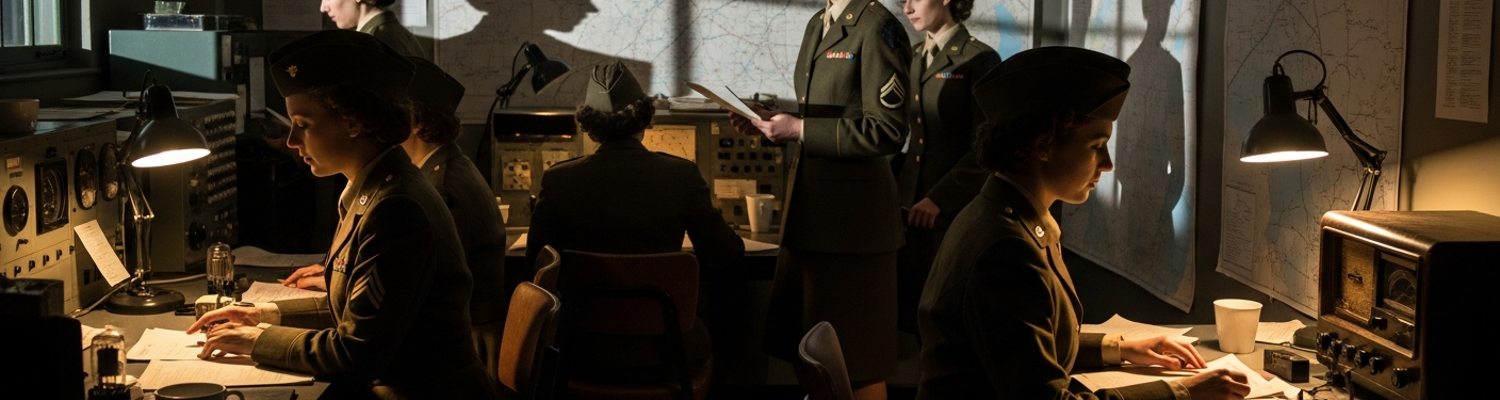
As the Cold War settled into a long stalemate in Europe, the strategic importance of Army women grew. In West Germany, WACs were integral to the American military presence confronting the Warsaw Pact. They served at major headquarters such as U.S. Army Europe (USAREUR) in Heidelberg and Supreme Headquarters Allied Powers Europe (SHAPE) outside Paris. Here, they moved beyond traditional administrative work into more technical fields. Women served as intelligence analysts, poring over reports on Soviet troop dispositions and equipment. They worked as cartographers, updating the detailed maps of potential European battlefields like the Fulda Gap. They were photographic and signals intelligence technicians in the Army Security Agency (ASA), contributing to the electronic surveillance of Eastern Bloc forces. The presence of uniformed American servicewomen on the streets of Frankfurt, Berlin, and Heidelberg also served a powerful diplomatic and psychological purpose. It was a visible projection of American modernity and commitment, a stark contrast to the rigid social structures of the Soviet Union. Their competence and professionalism directly impacted international relations, demonstrating to NATO allies the depth of the American manpower pool.
Laying the Groundwork for a Modern Force
The slow, methodical expansion of roles continued throughout the 1950s and 1960s. As the Army’s reliance on technology increased, so did its need for skilled technicians, regardless of gender. Women began working as air traffic controllers, in missile guidance support roles for the Nike Hercules air defense system, and in advanced medical research laboratories at the Walter Reed Army Institute of Research. Each successful placement chipped away at the institutional resistance. The performance of these women provided Army leadership with undeniable evidence of their capabilities. This data became the foundation for arguments to lift the restrictive quotas and open more career fields.
The process was gradual. The two percent ceiling was not lifted until 1967, under a new law championed by Representative Patsy Mink and signed by President Lyndon B. Johnson. This same law removed the caps on female officer promotions to colonel. It took another decade for the final structural change to occur. On October 20, 1978, the Women's Army Corps as a separate branch was formally disestablished. Its members were fully integrated into all other branches of the Army, with the exception of direct combat arms. This final step would have been impossible without the foundation laid by the first generation of regular Army women who joined after 1948. By quietly and professionally executing their duties under restrictive policies, they proved that they were not an auxiliary to be used in emergencies. They were an essential, permanent component of the United States Army, whose skill and dedication enabled the nation to maintain its global military posture through the most dangerous decades of the Cold War.