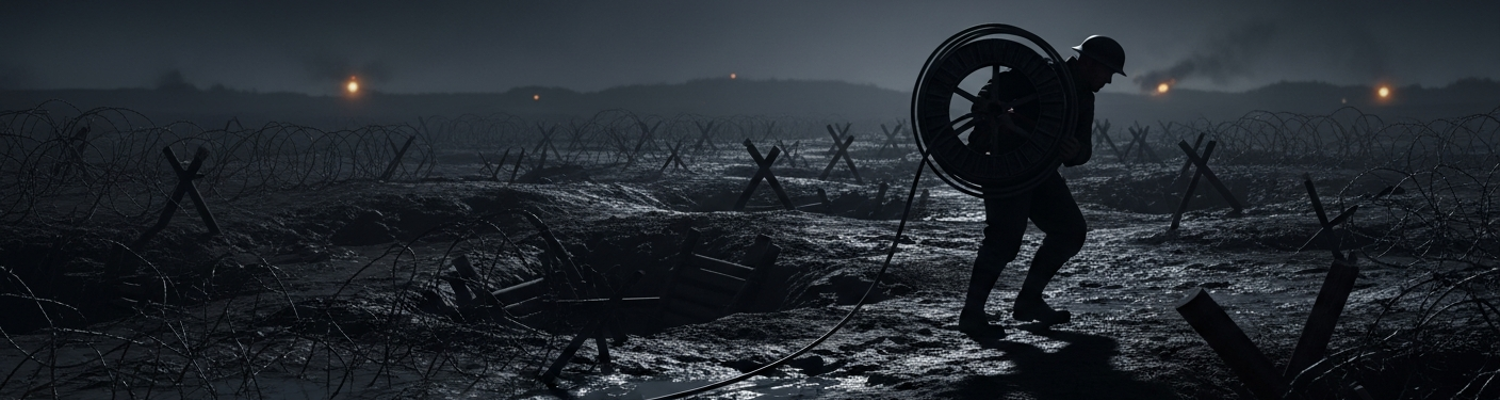

The men were already broken. Before the main assault to erase the St. Mihiel salient began, the soldiers of the American Expeditionary Forces were pushed past their limits. They marched only at night, through driving rain and glutinous mud, a desperate measure to hide their massing from German observation aircraft. Sleep was a commodity, taken in minutes, not hours, in dripping forests and sodden fields. Hot food was a fantasy. Cold rations did little to fight the deep, penetrating damp of the French autumn. This was the condition of the men preparing to attack a position the Germans had fortified for four years. They were underfed, exhausted, and about to receive a violent education in the physics of industrial warfare.
A close review of operational logs from September 1918 exposes the cost of this physical decay and the enemy’s invisible weapon. In the days before the primary attack on September 12th, American divisions like the 89th and 26th moved into forward positions. They conducted localized raids to test defenses and secure jump-off points. During one such action, a patrol from an American infantry regiment received orders for a reconnaissance mission into a dense forest near the Moselle River, a known center of German activity. The plan was transmitted over a newly laid field telephone line. It specified their route, timing, and objective. They moved out under the cover of a rainy, moonless night. They walked directly into a perfectly arranged kill zone.
German machine guns, sited with unnerving accuracy, opened fire from three sides. The first volley was overwhelming, cutting down most of the patrol before they could react. German artillery, instead of firing speculative patterns, had the patrol’s exact route already registered. Shells began to fall with precision. The few survivors who made it back to American lines did not describe a chance encounter. They described a deliberate, well-informed slaughter.
The post-action analysis by G-2 intelligence officers was immediate and chilling. The specificity of the German preparations pointed toward foreknowledge, not simple observation. The investigation focused on the Signal Corps’ field telephone network. In the rush to emplace thousands of miles of wire for the offensive, lines were laid with speed as the only priority. They were buried in shallow trenches or simply strung along the ground. These rubber-insulated, single-wire lines were acutely vulnerable to compromise.
Archival evidence shows German intelligence teams were masters of telephone interception. They used specialized listening sets, often designated as Moritz devices, which could detect the faint electromagnetic leakage from telephone lines without a direct physical tap. These devices, connected to long metallic probes driven into the wet soil (NARA Record Group 111), could overhear conversations from thousands of yards away. Captured German documents and prisoner interrogations after the main offensive confirmed the AEF’s fears. A German intelligence summary recovered from a dugout near Thiaucourt detailed information taken from American telephone traffic. It specifically mentioned patrol routes and timings that corresponded exactly with the ambushed unit’s mission. The wires meant to command American forces had become a direct conduit for German intelligence.
The Lineman’s War
The Signal Corps lineman of 1918 was a specialist who shared the universal misery of the front. Before the offensive began, these men were depleted. Days of forced night marches through rain and mud had left them drained and constantly hungry. The infantryman carried a rifle and pack. The lineman carried heavy spools of copper-clad steel wire, climbing irons, and a toolkit of pliers and splicers. Their work started when the infantry stopped, under the same environmental and enemy pressures. A review of logs from Signal Battalions attached to the I and IV American Corps shows a constant, attritional loss of manpower. The persistent, harassing fire from German artillery was a feature of the work environment. Every nearby shell explosion, even if it caused no casualties, could sever the delicate field telephone wires that formed the army’s nervous system.
For the lineman, this meant crawling into the open, usually in darkness, to find and repair the break. This cycle of exertion, exposure, and high-stress repair, performed on cold rations with minimal sleep, created a state of chronic fatigue that degraded their performance.
The saturated ground itself became a weapon.
Medical records from the AEF (Record Group 112) detail the consequences: high rates of trench foot and combat exhaustion. Trench foot, a non-freezing cold injury, was a direct result of prolonged exposure to the damp, unsanitary conditions. For linemen wading through mud-filled ditches to lay and mend wire, it was an occupational hazard. The condition started with numbness and progressed to painful swelling that made it impossible to wear boots. A lineman with a moderate case found his mobility severely limited. Hauling a heavy wire spool became an exercise in agony. Compounding this was the psychological erosion of combat exhaustion, then called shell shock. The strain of performing a precise technical job, like splicing a wire no thicker than a pencil lead, while under fire took a heavy toll. Shaking hands could not make a clean splice. A mind clouded by fatigue could not troubleshoot a fault along miles of identical wire.
This degradation of the linemen led to a measurable compromise of communication integrity. The speed of line repair is a key metric of signal effectiveness. At St. Mihiel, that speed dropped significantly. After-action reports from the 89th and 2nd Divisions note repeated instances of communication loss with forward battalions for long periods. Restoring contact was a process defined by friction. A shell severs a line. A repair team of exhausted linemen is dispatched into the mud. Finding the break meant tracing the wire by hand through a cratered landscape. The repair itself, simple in a quiet setting, became a monumental challenge. With numb fingers, under the threat of machine-gun fire, a lineman had to strip insulation, clean the wire, twist a secure connection, and insulate the splice against the dampness that could short the circuit. Each fumbled attempt added minutes. Those minutes stretched into hours of silence for a commander desperate for fire coordinates.
Improvised Security, Inevitable Failure
The AEF arrived at St. Mihiel with new technology, including recently developed field telephones and early radiotelephone sets like the SCR-77. The promise was immense. The reality was a failure. The novelty and rapid deployment of the equipment created deep vulnerabilities. Early wireless sets were cumbersome, heavy, and unreliable. Their fragile vacuum tubes were not suited for the shock of an active front. Field telephones, while more dependable, required a vast and hastily built wire network that was an open book for German intelligence. The standard, high-level cryptographic systems were too slow and complex for the urgent, tactical communication required during an assault. A request for artillery support could be obsolete by the time it was properly encoded, transmitted, and decoded.
This gap forced frontline units to devise their own desperate solutions.
The result was the spontaneous creation of unsanctioned and rudimentary code systems at the lowest echelons. A close review of after-action reports from the 26th and 89th Divisions reveals a chaotic array of improvised security. These were not sophisticated ciphers. They were simple substitution codes, scribbled on paper by a battalion intelligence officer and distributed by runners hours before an operation. Over a crackling field telephone, a platoon leader would not speak of artillery or machine guns. He might instead use code words, where the word baker stood for artillery and typewriter for machine guns. Key terrain features received changing designations. The town of Thiaucourt might be referred to as Headache on September 12th and Sunshine on September 13th. Map coordinates were obscured by naming reference points with arbitrary words, with the entire code list, or trench code, being replaced every 24 hours. The system was built on necessity, but its weaknesses were profound. Confusion was common, with units sometimes using an outdated code sheet. The capture of a single runner with the day’s code list could compromise an entire sector.
For the Signal Corps telegraph and wireless operators, the challenge was different but no less intense. Morse code transmissions were harder to intercept than voice conversations, but German signals intelligence was adept at traffic analysis. To counter this, operators became field cryptographers. Before transmitting, they had to apply a simple cipher, perhaps a pre-arranged transposition that shifted the letters of the alphabet. This placed an extreme mental load on soldiers already working in horrific conditions. The operator in a muddy dugout, often under shellfire, now had to translate a commander’s verbal order, mentally apply the day’s shifting cipher, and then flawlessly transmit the enciphered message using Morse code.
The margin for error was zero.
A single slip on the telegraph key could corrupt the cipher and render the message unintelligible. A small mistake could transpose coordinates, sending an artillery barrage onto friendly troops. This ad-hoc system of codes, born from technological failure, pushed the mental endurance of Signal Corps operators to its absolute limit.
The German Advantage
German signals intelligence archives from the period show a highly organized and technically proficient apparatus. By 1918, the German Army had dedicated wireless detachments, the Armee-Funkerabteilung, at the army and corps level. For the St. Mihiel salient, a comprehensive system of listening stations was already in place, refined by four years of static warfare. These units used the Moritz listening set, an apparatus that proved exceptionally effective at intercepting battlefield telephone traffic. The system did not require a direct tap. Instead, it used metallic probes driven into the ground to detect the electromagnetic leakage from the single-wire, ground-return field telephones used by the AEF. The perpetually damp, conductive soil of the salient amplified the effectiveness of these German listening posts, allowing them to overhear conversations from over 3,000 yards away.
This raw intelligence flooded into German analysis sections. German intelligence had developed a sophisticated capacity for traffic analysis and cryptanalysis. They understood that the complex, official AEF ciphers were too slow for frontline use, forcing American units to improvise. German analysts were trained to rapidly dissect the simple substitution trench codes. These ad-hoc codes were broken with startling speed. German cryptanalysts cross-referenced intercepted code words with other intelligence. An intercepted message calling for a specific action at a map point, followed minutes later by the arrival of an American artillery barrage at that location, provided immediate confirmation of the code word’s meaning. Within hours of a new American code list being distributed, German intelligence often possessed a working translation.
Every American plan transmitted by wire was potentially compromised before the first soldier moved. The operational consequences were severe. German artillery commanders could bring down precise, targeted fire on massing American infantry, supply dumps, and command posts whose locations had been discussed over the field telephone. The element of surprise was systematically eroded. German commanders could anticipate the timing and axis of American attacks, allowing them to position machine guns and reserves to meet them. The accurate German fire that plagued the Signal Corps linemen was a direct result of this intelligence success. It was a deliberate tactic to keep the compromised lines open, ensuring the flow of intelligence continued.
A New Doctrine, Written in Blood
The communications breakdown at St. Mihiel forced a revolutionary shift in the U.S. Army’s approach to signal doctrine. Post-war analysis conducted by the Army Signal School dissected the German interception methods and led to fundamental changes. The vulnerable single-wire, ground-return telephone was abandoned. In its place came two-wire, or twisted pair, circuits. This design, later seen in equipment like the W-110-B field wire, effectively canceled the electromagnetic leakage that had made eavesdropping so simple. The ordeal gave birth to the modern discipline of Communications Security (COMSEC). The chaotic and easily broken trench codes were replaced by the development of standardized, more robust field cipher systems. A new emphasis was placed on procedural security. Soldiers were rigorously trained on the importance of wire discipline, the necessity of burying cable, and the need to use runners for the most sensitive information. The Army established its first dedicated signal security organizations, units tasked not with transmitting information, but with protecting it. This was to ensure its own communications network could never again be turned into such an effective weapon by an enemy.