
The Rusting Shield of the Republic
The American Civil War's conclusion left the United States Navy in a strange state. It possessed, by measures of the day, one of the world's most advanced fleets, a massive force of steam-powered, iron-armored warships that had proven the obsolescence of wooden navies. This technological victory, however, concealed a deep and corrosive weakness. The very ships that guaranteed the Union’s survival were decaying from within. Their revolutionary engineering was beset by systemic flaws that threatened to render the entire fleet inert. For the US Navy, the Gilded Age started not with polished brass and global prestige, but with the immediate, pervasive threat of rust, mechanical failure, and strategic impotence.
The heart of the issue was the material science of the new technology. Iron hulls, unlike their tarred and copper-sheathed wooden predecessors, were extraordinarily vulnerable to marine biofouling. In the warm, nutrient-rich coastal waters where the fleet operated, a thick carpet of barnacles, tubeworms, and seaweed would colonize a hull with astonishing speed. This growth created immense hydrodynamic drag, severely crippling a ship’s performance. A vessel’s designed speed would plummet, while its coal consumption, the finite logistical lifeblood of a steam navy, could easily double or triple. A monitor-class ironclad designed for ten knots might struggle to make five. This problem was a nuisance for European navies with their dense networks of nearby dry docks. For the US Navy, with its vast coastlines and critically limited repair facilities, it was a constant, losing battle against nature.
Below decks, the situation was just as precarious. The engine rooms were a frontier of noise, heat, and extreme danger. Early steam propulsion systems were notoriously unreliable. Boilers, particularly the common Martin water-tube designs favored for their rapid steam generation, were prone to frequent and often catastrophic failures. The metallurgy of the era was inconsistent, and the constant thermal stress led to cracked tubes and weakened plates. A more insidious problem came from the surface condensers. Designed to recycle fresh water for the boilers, they often leaked, introducing corrosive saltwater into the system. This contamination caused rapid internal scaling and corrosion, drastically reducing thermal efficiency and creating hotspots that could lead to a boiler explosion, an event that would tear through the confined, uncompartmented spaces of an early ironclad with lethal force.
The complex reciprocating engines, a labyrinth of pistons, connecting rods, and valves, demanded constant, expert attention. The severe shortage of skilled mechanics and formally trained engineers meant this complex machinery was often operated and maintained by personnel with only a rudimentary understanding of its tolerances. Engine breakdowns were a common occurrence, leaving ships stranded at sea or forcing them to limp back to port under their often-pathetic auxiliary sail rigs, a deep embarrassment for a modern steam navy. The transition from sail to steam was not a clean technological shift; it was a brutal contest against the limits of early industrial manufacturing and human skill.
The 1873 Virginius Affair threw this state of decay into the harsh light of national politics. When Spanish naval forces captured the filibustering vessel Virginius and executed dozens of its crew, including American citizens, the United States was pushed to the brink of war. Public outrage demanded action, but the Navy was in no condition to deliver it. Its most powerful ironclads, many of them low-freeboard monitors designed for riverine and coastal combat during the Civil War, were barely seaworthy enough for the short voyage to Cuba. They were certainly not capable of a transatlantic campaign against Spain’s modern fleet. The crisis exposed the Navy’s profound weakness. It revealed that its impressive fleet was, in reality, a hollow force crippled by a maintenance catastrophe. This national humiliation became a powerful catalyst for change, forcing a reluctant political and naval leadership to confront the deep-seated problems they had ignored for nearly a decade.
The Rise of the Engineering Officer
The response to the Navy’s engineering crisis was institutional. It took the form of a slow revolution centered on the establishment and empowerment of a professional corps of naval engineers. The seeds of this change were planted during the Civil War with the creation of the Bureau of Steam Engineering in 1862. This act was a formal recognition that the steam engine was not merely an auxiliary to sail but the vital heart of a modern warship.
The Bureau’s first chief, Benjamin F. Isherwood, was a figure of immense consequence. Appointed Engineer-in-Chief in 1861, Isherwood was a relentless advocate for technical rigor and empirical data. He was a controversial leader who prized reliability over raw performance. He championed rugged, heavy, and relatively inefficient engines that could withstand the abuse of combat and the mishandling by poorly trained crews. This put him in direct conflict with industrialists and other naval officers who were impressed by the lighter, faster, but more fragile engine designs coming from Europe. Isherwood’s stubborn insistence on durability proved correct during the war, as he oversaw the design and construction of machinery that expanded the steam-powered fleet from just 28 vessels to nearly 600.
In the postwar years, the challenge shifted from rapid wartime expansion to long-term professionalization. The Navy was dominated by a conservative hierarchy of “line” officers, men of the deck and sail who viewed the engine room and its occupants with deep suspicion. Engineers were “staff” officers, considered mere technicians who could not command a ship. Their greasy, soot-stained work was seen as beneath the station of a true naval officer. This created a deep cultural and professional chasm. The line officers held the authority, but the engineers possessed the technical knowledge without which that authority was meaningless. The friction was constant. Could an engineering officer give a direct order to a line seaman in the engine room? The answer was often a contentious no, leading to operational paralysis.
The institutionalization of engineering expertise began properly at the U.S. Naval Academy. In 1864, Congress authorized a separate curriculum for cadet-engineers, creating a formal pipeline for training technically proficient officers. Their studies in thermodynamics, metallurgy, and mechanical drawing stood in stark contrast to the line cadets' focus on seamanship and gunnery. These new engineers entered a service often hostile to their existence. They fought a protracted battle for recognition, pay, and status, a conflict known within the service as the “line and staff controversy.” Engineers argued for positive rank equivalent to their line counterparts, a move fiercely resisted by traditionalists who feared it would destroy the fundamental chain of command. Men like George W. Melville, a survivor of the Jeannette arctic expedition and later Engineer-in-Chief himself, embodied the toughness and competence of this new corps, slowly winning respect through sheer capability.
The undeniable reality of broken-down ships and the stark strategic lessons of the Virginius Affair gave weight to their arguments. Their expertise became indispensable. The Navy could not function without them, and this functional necessity gradually eroded the old prejudices. The process was slow and bitter, but by the end of the century, the cultural shift was clear. The Naval Personnel Act of 1899 finally amalgamated the engineering corps into the main line officer structure, making engineering a path to command and marking the official end of the schism. The ideal of the naval officer had been transformed from a gentleman sailor to a college-educated, scientifically-minded professional.
Iron Foundations for an Iron Fleet
The institutional revolution in naval engineering was matched by a physical transformation of the Navy’s industrial base. The wooden-era navy yards, with their small slipways, ropewalks, and modest workshops, were utterly unprepared for the demands of an ironclad fleet. Ships were now wider, deeper, heavier, and vastly more complex. Repairing them required an industrial infrastructure on a scale previously unseen.
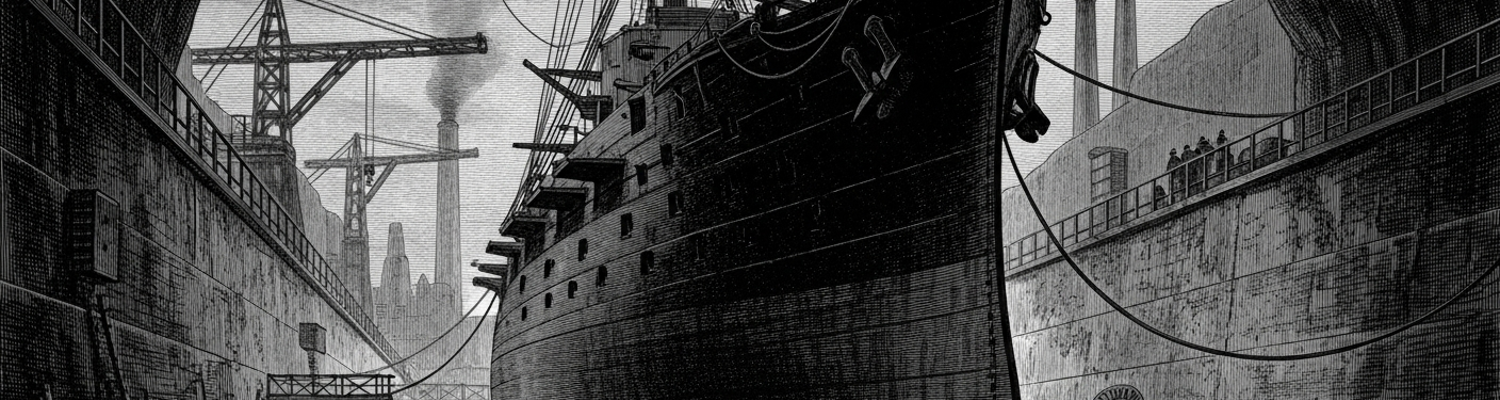
Beginning in the late 1860s and accelerating after the Virginius wake-up call, the Navy embarked on a strategic modernization of its key shipyards, particularly those at Brooklyn, Norfolk, and Mare Island in California. The centerpiece of this effort was the construction of massive new dry docks. The Brooklyn Navy Yard’s Dry Dock No. 1, a colossal granite structure completed in 1851, served as a prototype, but new docks were needed. The Mare Island dock, begun in 1872 and completed in 1891, was an engineering marvel over 500 feet long, built with deep granite and concrete foundations and powerful steam-driven pumps capable of lifting the 10,000-ton weight of a modern warship clear of the water for hull scraping, painting, and repair.
Inside the yards, a new ecosystem of heavy industry emerged under the direction of leaders like Secretary of the Navy William C. Whitney in the 1880s. Huge steam-powered cranes were erected, capable of lifting entire gun turrets, massive engine components, and 12-inch-thick armor plates. Workshops swelled into vast machine shops filled with the latest industrial tools. These included powerful lathes for turning propeller shafts, heavy-duty boring mills for finishing cannon barrels, hydraulic presses for shaping iron, and rows of drills and planers for fabricating components to precise tolerances. Foundries were expanded to cast enormous metal parts, such as propeller struts and rudder posts, which were previously impossible to produce in-house. The yards at Brooklyn and Norfolk became sprawling, self-sufficient industrial complexes, functioning as integrated factories that moved raw pig iron and coal from barges to foundries, then to machine shops, and finally to the dry dock for assembly.
The strategic implications of this investment were profound. A robust, government-owned industrial base freed the Navy from its dependence on private contractors, ensuring quality control, cost containment, and national security. It allowed for the standardization of parts and practices, which streamlined maintenance across the fleet. Most importantly, it gave the nation the sovereign capability to build and sustain a modern naval force. This industrial might was the physical backbone of American sea power. The readiness of the fleet was no longer left to chance; it was forged in the fire and steam of the modernized naval yards. These Gilded Age investments in concrete, iron, and machinery were the direct foundation upon which the “New Steel Navy” of the 1880s and 1890s, including the famous ABCD ships, was built, ultimately enabling the United States to project power across the globe.