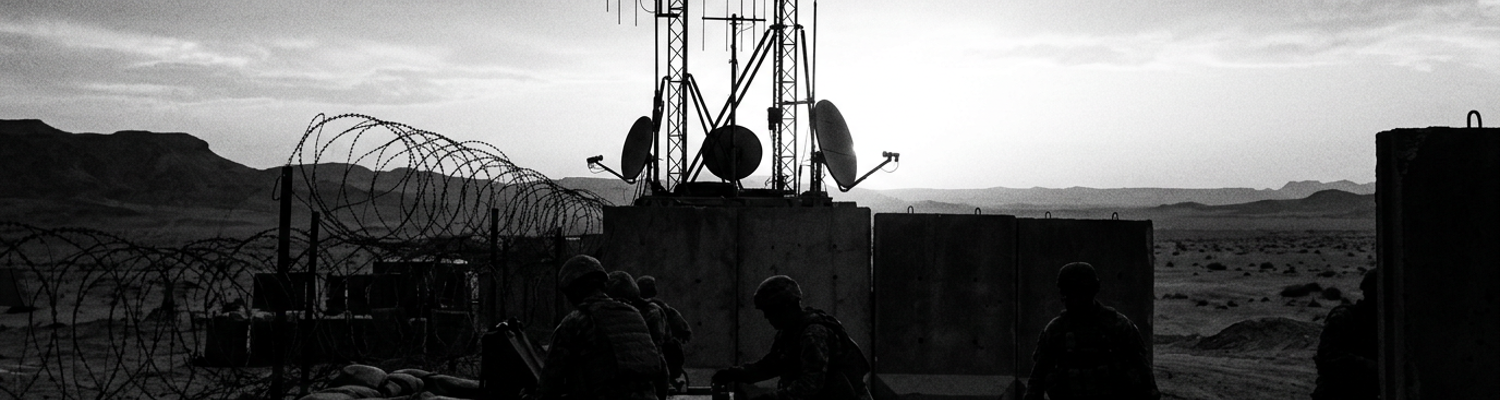

Agent.btz Infiltration and SIPRNet Quarantine
Red status lights flashed across the server racks inside the tactical operations center at Balad Air Base. The cooling fans roared against the ninety-degree exhaust heat. Outside, the percussive shudder of 122-millimeter mortar impacts rattled the corrugated steel roof of the command trailer. Three tactical automated switchboards went dead simultaneously. Digital maps displaying blue-force tracking icons for the 18th Military Police Brigade vanished from the wall monitors. They were replaced by frozen command prompts and cascading network error codes. Communications operators hit the emergency circuit breakers when the system monitors locked up completely.
Every secure tactical screen across the brigade footprint went dark.
A close review of operational logs indicates that the breakdown originated months earlier far outside the wire. In late 2008, an unauthorized USB flash drive inserted at an undisclosed US Central Command forward operating base introduced the Agent.btz worm into classified military networks. The hardware component contained malicious code engineered to execute automatically via the Windows autorun.inf utility. This execution required zero user intervention. Once plugged into a standard desktop computer wired to the Secret Internet Protocol Router Network, the software created an encrypted dynamic-link library inside the operating system directory. Its routine scanned internal IP ranges. It copied its executable payload to every attached storage medium. It collected system configuration files for exfiltration. Foreign command-and-control servers were configured to receive this stolen routing data whenever infected machines connected to outward-facing gateways. The program spread across local networks before signature-based antivirus definitions could identify the binary profile.
Classified Pentagon networks had sustained an unprecedented electronic intrusion.
Archival evidence shows that senior leaders in Washington recognized that ordinary software patches would fail. The Department of Defense initiated Operation Buckshot Yankee. This enforced a theater-wide digital quarantine that abruptly severed tactical SIPRNet architectures. Under direct instructions from Joint Task Force-Global Network Operations, network engineers across Iraq were ordered to physically disconnect transmission lines to halt data exfiltration. Cryptographic switches were powered down across the entire theater. Physical Category 5 ethernet cables were manually pulled from patch panels inside the brigade communications shelters at Balad. This cut the 18th Military Police Brigade off from division headquarters at Camp Victory in Baghdad. Deputy Secretary of Defense directives mandated an immediate ban on all removable flash drives and optical storage disks across all Department of Defense computer systems.
Inside the communications bunker, signal soldiers from the 18th Military Police Brigade had to identify infected hard drives by hand while incoming mortar fire shook the concrete floor. Technicians stripped the cover plates off Dell PowerEdge 2950 rack servers with basic multi-tools. They pulled drive sleds out one by one under battery-powered task lamps. Without active SIPRNet connectivity, battle captains could not verify convoy clearance routes through the Diyala River Valley. They could not process detainee transfer manifests through central databases. Troops in the tactical operations center resorted to unclassified radio nets and paper map boards to track armed patrols operating between Balad and Baqubah. Specialists in the brigade S-6 shop began re-imaging hundreds of individual computer workstations from scratch using verified local compact discs. They hand-labeled each wiped drive with grease pencils to confirm clean baseline operating systems.
The purge required technicians to scrub fourteen thousand separate hard drives across the Central Command area of responsibility.
Signal Reconnaissance Misdiagnoses and Jamming Theories
SIPRNet connectivity dropped at 0400 hours. The outage did not register as a cyber intrusion at the brigade level. Early reports from forward operating bases across the Sunni Triangle suggested localized electronic warfare. Signal reconnaissance detachments initially misdiagnosed the network failure as targeted telemetry jamming by insurgent forces.
Recent tactical patterns in the Diyala province drove this assumption.
A close review of operational logs indicates that enemy combatants had previously utilized commercial radio frequency jammers to disrupt unclassified communication nets. When the secure routing switches at Balad dropped offline, brigade electronic warfare officers deployed mobile spectrum analyzers to scan for hostile interference. They utilized Anritsu Site Master handheld cable and antenna analyzers. They monitored the frequency bands between 2.4 gigahertz and 5.8 gigahertz for anomalous signal spikes. The equipment registered standard ambient noise. No localized jamming signals were detected near the perimeter.
The absence of radio frequency interference forced a reevaluation of the network collapse.
Archival evidence shows that diagnostic teams from the 332nd Expeditionary Communications Squadron began tracing the physical data pathways. They examined the fiber optic trunk lines connecting the tactical operations center to the main base distribution frame. Technicians used optical time-domain reflectometers to check for physical cable breaks or sabotage. The glass fibers were intact. The hardware layer functioned perfectly. The failure existed entirely within the software routing protocols.
Network administrators at Camp Victory eventually disseminated the Operation Buckshot Yankee directives via unclassified voice channels.
The realization that a malicious worm caused the outage shifted the operational focus. Signal soldiers transitioned from hunting external electronic threats to isolating internal network components. The 18th Military Police Brigade S-6 shop established a localized quarantine zone inside their communications shelter. They physically disconnected every server rack from the base wide area network. This isolation prevented the Agent.btz executable from transmitting stolen configuration files to external command servers.
The tactical network was secure but completely nonfunctional.
Paralysis of Tactical Biometric and Detainee Systems
The physical severance of SIPRNet instantly neutralized the core digital intake apparatus across the 18th Military Police Brigade. Central to this collapse was the Biometric Automated Toolset. This enterprise software architecture operated across ruggedized field servers to cross-reference iris scans, ten-print digital fingerprints, and facial recognition data against national intelligence targets. When technicians cut the physical data cables feeding the brigade hub, local field computers lost direct access to the master database. This database was hosted at the Biometrics Task Force node in West Virginia and theater servers at Camp Victory.
Concurrently, the Detainee Reporting System failed.
Military police personnel used this classified database to assign Internment Serial Numbers. They tracked evidentiary packets for Central Criminal Court of Iraq prosecutions and monitored detainee transfers. Without an active network handshake, client terminals defaulted to read-only states or outright system termination routines. Handheld Interagency Identity Detection Equipment devices (model 4.0) brought in by field patrols could not offload raw biometric captures. They could not receive updated tactical watchlists.
Every digital detention ledger in the Iraqi theater froze overnight.
Archival evidence shows that the immediate fallout struck hardest at Joint Base Balad and the sprawling Theater Internment Facility at Camp Bucca. At Balad, the 18th Military Police Brigade worked in concert with the 332nd Expeditionary Security Forces Group. They policed the perimeter and processed thousands of Third Country Nationals and Iraqi civilian contractors entering through heavily fortified Entry Control Points each morning. When the network connection broke, security personnel could no longer authenticate entry manifests against real-time biometric threat databases. Gate guards were left with completely static local caches that lacked recent insurgent tracking bulletins.
Outside Entry Control Point 1 at Balad, supply convoys hauling thousands of gallons of aviation fuel and water pallets idled along the exposed approach roads.
These convoys were directly vulnerable to indirect fire from local insurgent mortar teams positioned in the surrounding palm groves. Guard shifts attempted to establish ad-hoc visual checks. They cross-referenced paper badge credentials against laminated spreadsheets printed forty-eight hours earlier. At Camp Bucca, five hundred miles south near Umm Qasr, Task Force 134 held more than twenty thousand high-risk detainees across separate barbed-wire enclosures. Intake processing stalled entirely. Compound commanders could not process incoming detainees transferred from forward battle spaces. They could not confirm the identities of individuals scheduled for court-ordered releases.
The entire theater internment pipeline backed up within twelve hours.
When examining the historical record, the improvisations implemented by military police administrators exposed the severe vulnerability of centralized electronic systems. Non-commissioned officers at Balad set up isolated, unnetworked commercial laptops at the vehicle inspection bays. They manually typed names, vehicle registration numbers, and tribal identifiers into localized Microsoft Excel sheets. Without live network queries, guards could not determine whether an arriving local national driver had been flagged as a bomb-maker in Diyala province the preceding night. Technical support teams from the 18th Military Police Brigade attempted to transport updated biometric records by physically moving verified standalone optical discs between command shelters. Strict defensive protocols prohibited unauthorized media insertion.
MP dispatchers reverted to analog tactical radio nets.
They transmitted phonetic spellings of suspect names over secure frequency-hopping channels to central operators who manually checked hardcopy card files. Detainees arriving from tactical sweeps in Baqubah sat handcuffed in the holding bays for days while staff verified their identities using dry-erase boards and carbon-paper intake forms. At the Camp Bucca perimeter gate, four separate convoys carrying sixty-five new transferees waited under armed guard in open desert heat. Reception clerks could not generate digital tracking files or print custody transfer receipts.
Manual Drive Re-Imaging Under Desert Conditions
The mandate to eradicate the Agent.btz worm required a complete baseline restoration of every affected machine. Software patches were insufficient to guarantee network integrity. The Department of Defense required a physical wipe and re-installation of the operating system on thousands of individual hard drives.
This task fell to the brigade signal detachments.
A close review of operational logs indicates that the 18th Military Police Brigade S-6 shop mobilized every available technician for the re-imaging process. The work environment was highly restrictive. The ambient temperature inside the un-air-conditioned storage containers used for triage frequently exceeded one hundred and twenty-five degrees Fahrenheit. Dust from the Mesopotamian desert infiltrated the server chassis. It coated the internal cooling fans and motherboard components in a fine, abrasive powder.
Technicians wore headlamps to illuminate the cramped workspace.
They systematically dismantled desktop towers and Panasonic Toughbook CF-30 laptops. Each hard drive was physically removed from its bay. The serial numbers were logged on paper clipboards. The drives were then connected to isolated, air-gapped wiping stations. Signal soldiers utilized specialized Department of Defense disk-wiping utilities to overwrite the magnetic platters with random data patterns multiple times. They followed the DOD 5220.22-M data wipe standard requiring a three-pass overwrite. This ensured the complete destruction of the malicious dynamic-link libraries.
The process was mechanically intensive.
Archival evidence shows that a single drive wipe could take up to four hours depending on the storage capacity. Once sanitized, the drives were reinstalled into their original chassis. Technicians then booted the machines using verified, write-protected optical discs containing the clean Windows operating system image. The installation process required manual input for network configuration settings, security certificates, and local user accounts.
Every step was documented with grease pencils on the metal drive casings.
The physical toll on the signal soldiers was significant. They worked in rotating twelve-hour shifts. They consumed liters of bottled water to stave off dehydration. The constant handling of sharp metal chassis components resulted in lacerated fingers and minor electrical burns. The S-6 shop maintained a strict chain of custody for every processed machine. They established a physical quarantine line inside the bunker. Unprocessed machines were stacked on wooden pallets on the left side of the room. Clean, re-imaged computers were placed on metal shelving on the right.
A single mislabeled drive could re-infect the entire localized network.
Improvised Copper Patching and Restored Perimeter Security
Forward support signal detachments from the 18th Military Police Brigade abandoned the base-wide fiber distribution network within forty-eight hours of the SIPRNet shutdown. Technicians scavenged spools of standard Category 5e Unshielded Twisted Pair solid copper cable from depot conex containers near the Balad flightline. Working out of the bed of an M1151 up-armored Humvee parked behind concrete Texas barriers, signal soldiers hand-crimped eight-pin RJ-45 modular connectors using manual crimping pliers.
Forward support teams jury-rigged isolated copper patch cables and standalone air-gapped switches to circumvent compromised central routing infrastructure.
Instead of routing data through the central Cisco Catalyst 6500 series switch chassis at the base processing center, the specialists installed commercial unmanaged 24-port Cisco Catalyst 2960 Series switches directly inside fortified guard bunkers. The central switches remained locked down under Joint Task Force-Global Network Operations quarantine mandates. S-6 personnel physically laid temporary copper wiring across five hundred yards of packed gravel and concertina wire. They secured the lines to precast concrete revetments with industrial zip ties and adhesive clamps.
Copper cabling replaced the disabled tactical data architecture.
Archival evidence shows that these physical runs bypassed every patch panel tied to the brigade main distribution frame. Signal soldiers operated in hundred-degree ambient heat. They ducked behind barriers whenever base sirens warned of incoming 122-millimeter rockets launched from the surrounding Diyala farmlands. Each cable pair was hand-tested using basic LED continuity checkers to confirm pinout integrity before connecting to field equipment. By establishing localized eight-port and sixteen-port islands, technicians eliminated all dependence on the wider base network.
Independent five-kilowatt tactical quiet diesel generators supplied the electricity.
This ensured no line feedback touched the primary power grid. The air gap remained absolute. When examining the historical record, these physical workarounds restored localized biometric verification and personnel processing at perimeter checkpoints without breaching theater-wide quarantine protocols. Military police screeners at Entry Control Point 1 connected their Biometric Automated Toolset laptops to the newly laid copper local area network. Handheld Interagency Identity Detection Equipment devices were docked directly to peripheral USB hubs mounted inside the blast-hardened guard shacks.
Local operator accounts queried internal hard-drive partitions containing cached biometric databases.
These databases were updated via verified, read-only optical discs. Contractor badging clerks verified iris scans and fingerprints against the regional watchlist without sending a single transmission across the SIPRNet gateway. Detainee intake processing resumed inside the holding enclosures as soldiers manually printed fingerprint identification cards and paper custody manifests. Supply convoys carrying aviation fuel and structural concrete passed through inspection lanes after hours of dead stop. Guards cleared three hundred and eighty trucks before the evening mortar barrage struck the south perimeter. Three individuals flagged for suspicious munitions transport were detained using the local matching files and moved to holding cells at 1800 hours.