
Vibrating Lever Engines and Construction Delays
Engineers at the Delamater Iron Works poured buckets of tallow and cold river water over the smoking main drive shaft. Severe friction threatened to weld the journals to their brass housings during early machinery tests. Inventor John Ericsson designed the single turret ocean monitor USS Dictator to counter heavily armed foreign ironclads that the Union Navy feared Britain or France might build for the Confederacy or send across the Atlantic. Ericsson subcontracted the construction of the giant ironclad and its radical vibrating lever engines to Cornelius H. DeLamater and his firm in New York. Ericsson expected the shipyard to rapidly assemble an ocean going warship capable of withstanding heavy seas. Workers at the Manhattan facility struggled constantly with the unprecedented scale of the vessel. Foundrymen cast engine cylinders over eight feet in diameter and forged a propulsion shaft that pushed contemporary foundry equipment beyond its safe limits. Thermal expansion warped the misaligned shaft during bench tests. The grinding metal surfaces choked the dark bilge compartments with dense white smoke.
Bearings ground into rough iron shavings by this friction forced yard mechanics to shut down the plant. Mechanics unbolted the massive pillow blocks and manually scraped the scarred journals. Persistent main shaft bearing defects and accompanying engineering delays steadily wrecked the construction timetable. The warship remained tied to its New York outfitting berth while crucial naval campaigns progressed along southern coastlines without it. Commander John Rodgers arrived to take command of the vessel. Rodgers spent months in the damp hull directing industrial modifications and lodging formal complaints about the flawed alignment of the machinery. Successive trial runs down New York Harbor ended in near disaster as the friction repeatedly returned. Navy Department planners postponed the ship deployment to combat squadrons week after week. Unresolved mechanical breakdowns and structural revisions ultimately prevented USS Dictator from participating in active Civil War operations until November 1864. Rodgers finally accepted the ironclad for formal commissioning on that date.
Seawater immediately washed across the armored deck when Rodgers led the vessel into open coastal waters. The completed monitor suffered from severe excess weight. Stacks of overlapping iron side armor combined with heavy oak backing and the immense bulk of the midships gun turret to push the hull far below its intended waterline. The ship retained an inadequate freeboard of only sixteen inches. Green waves swept unobstructed over the low iron deck. The flat surface remained almost completely submerged as water slammed violently against the circular walls of the turret. Sluggish handling hampered every movement of the monitor. The waterlogged hull refused to respond promptly to the helm and swung through turns with dangerous inertia. Firemen and engineers below deck labored in near total darkness behind iron deadlights. These men listened to ocean water roar above their heads while trying to keep ventilation blowers clear of incoming spray.
Engineers battled renewed overheating in the main bearings as mechanical unreliability returned the moment Dictator encountered rhythmic open ocean swells. Deep ocean troughs repeatedly lifted the stern and altered propeller drag. Harsh shockwaves traveled along the rotating shaft and battered the fragile journal brasses. Bilge pumps choked on oily sludge as water leaking around the deck hatches gathered in the bottom of the hull. Boiler crews cleared the strainers by hand to avoid flooding the fireboxes. Commander Rodgers recognized that his vessel could not safely maneuver or fight in heavy Atlantic seas without risking complete power failure and foundering. Rodgers steered the battered ironclad into Hampton Roads. The commander ordered the anchor dropped and signaled shore authorities for an immediate overhaul of the propulsion machinery.
Dominican Annexation and Samana Bay Strategy
Machinists at the Norfolk Navy Yard stripped the overheated journals and scraped the scarred propulsion shafts. Peacetime budget reductions and unresolved engineering flaws soon forced the Navy Department to decommission USS Dictator and lay up the ironclad in reserve. Fleet engineers drained the boilers. Yard workers coated the exposed engines in protective grease and battened down the low iron hatches. The Grant administration shifted naval policy toward strategic expansion in the Caribbean basin during this layup period. President Ulysses S. Grant prioritized the annexation of the Dominican Republic to establish a strategic naval coaling station at Samana Bay. Grant understood that the modern steam navy required dependable and fortified overseas refueling stations. These stations would protect vital commercial sea lanes and secure the Atlantic approaches to any future canal across the Central American isthmus. Naval strategists considered Samana Bay to be the finest natural harbor in the entire West Indies. The bay offered deep and calm anchorages protected by mountain ridges where American coal piles and repair facilities could operate safe from foreign interference. Grant decided to secure this coveted maritime foothold by sending trusted military envoys directly to the island to negotiate a comprehensive annexation treaty.
Envoys Orville Babcock and Delos Sackett arrived in Santo Domingo aboard the naval gunboat Albany to treat directly with local leaders. Local authority was collapsing under widespread domestic unrest. Washington negotiated directly with Dominican President Buenaventura Baez. American diplomats pledged military backing to sustain his contested regime. Baez faced a relentless armed rebellion commanded by General Gregorio Luperon. Neighboring Haitian leaders supplied the insurgents with weapons, gunpowder, and border sanctuaries to prevent American expansion on the island. Baez recognized that his hold on power was slipping. The Dominican president offered the United States full annexation and territorial sovereignty in exchange for immediate financial bailouts and American military protection. Babcock concluded two formal treaties in late November 1869. These pacts provided for the integration of the Dominican Republic into the American Union alongside an immediate lease of the Samana Bay naval station for one hundred and fifty thousand dollars. These diplomatic pacts formally obligated the United States to shield Baez from external invasions and internal rebellions while the treaty awaited ratification in Washington.
Secretary of the Navy George Robeson directed the North Atlantic Squadron to project maritime force and suppress foreign or regional interference in Hispaniola. Robeson issued strict orders to Rear Admiral Charles Poor. Squadron commanders received instructions to position American warships inside Dominican anchorages. Captains prepared to intercept rebel supply boats and warn Haitian authorities that any hostile action would meet armed naval retaliation. Wooden steam sloops like the Severn and Nantasket patrolled the jagged coastline. Naval commanders recognized that vulnerable wooden hulls provided limited psychological intimidation against entrenched insurgent shore positions. Robeson decided that the squadron required heavily armored capital warships to cow regional opposition. The secretary wanted to deter interested European navies and reinforce the American diplomatic presence off the Dominican coast. Yard mechanics received urgent instructions to pull the giant ocean monitor USS Dictator out of ordinary reserve. Workers scraped the encrusted rust from its hull plates and rebuilt its unproven vibrating lever engines. Ordnance crews loaded fifteen inch shot into the midships turret for extended tropical service.
Naval Intimidation in Port au Prince Harbor
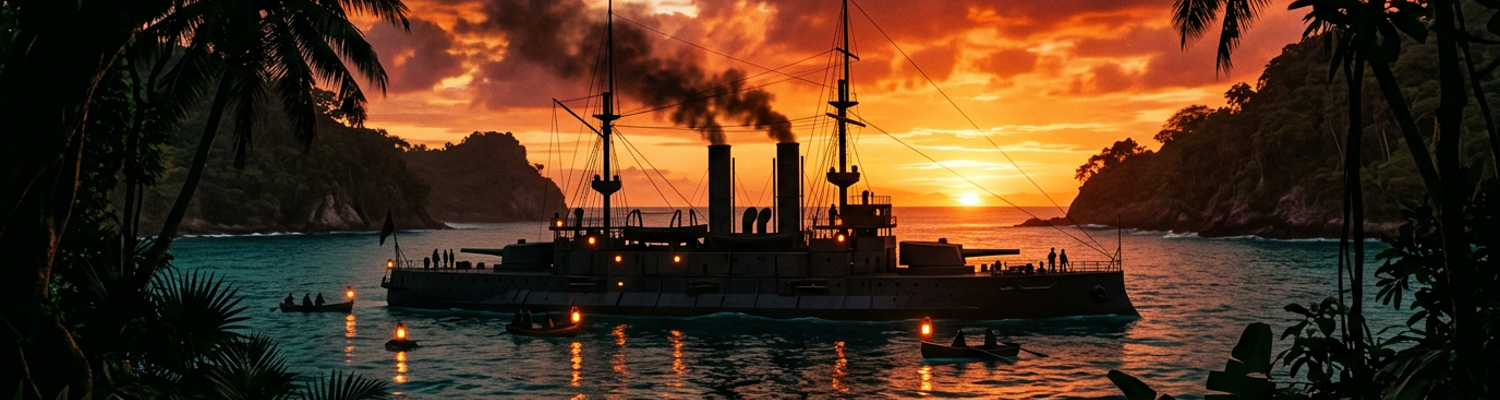
USS Dictator steamed south toward the Caribbean to rendezvous with the North Atlantic Squadron. The voyage forced its crew to endure suffocating living conditions inside the sealed iron hull. Tropical heat raised temperatures inside the cramped berthing compartments to dangerous levels. Heavy ocean swells routinely washed across the low deck and flooded through seams around the turret base. Ventilation blowers continually sucked damp salt air into the engine spaces. The blowers failed to cool the vibrating lever machinery and drove compartment temperatures past one hundred and ten degrees. Firemen collapsed from heat exhaustion as they shoveled coal into the boilers. The ironclad maintained its course to provide heavy naval firepower off the island of Hispaniola. Rear Admiral Charles H. Poor anchored the squadron flagship USS Severn alongside the monitor USS Dictator in Port au Prince on February 9, 1870. The two warships swung their bows toward the harbor shoreline. Deck crews dropped heavy iron anchors within direct cannon range of the presidential mansion and the surrounding town.
Poor delivered a formal ultimatum to the Haitian government. The admiral declared that any armed intervention against Dominican President Buenaventura Baez would be treated as an act of hostility against the United States. Haitian authorities had actively supported General Gregorio Luperon and his insurgent forces by supplying arms, ammunition, and cross border sanctuaries along the shared Dominican frontier. Poor warned the ruling council in Port au Prince that the North Atlantic Squadron held explicit orders from Washington to intercept any vessels transporting rebel supplies. The squadron would destroy shore batteries aiding the anti annexation revolt. Dominican diplomats in Washington had guaranteed full territorial rights to Samana Bay. This guarantee made Baez and his political survival the central objective of American foreign policy across the West Indies. Haitian officials recognized that their small coastal forces could not resist the combined firepower arrayed in the harbor. Their ministers held no diplomatic leverage to resist the American demands.
USS Dictator functioned as a psychological centerpiece. The monitor utilized the imposing visual threat of its two fifteen inch Dahlgren smoothbores to coerce Haitian non interference despite the ship limited open sea agility. Seaworthiness flaws had nearly foundered the ironclad during its ocean passage. The quiet waters of the sheltered bay hid the vessel severe mechanical unreliability and dangerously low freeboard from shore observers. Haitian gunners manning the port fortifications looked out at a low iron hull that rose barely sixteen inches above the water. The ship offered no target except for an impenetrable armored turret. Sailors aboard Dictator periodically traversed the heavy turret mechanisms. Gun crews kept the wide black muzzles of the Dahlgren guns pointed toward key defensive points along the water edge. The sheer mass of the four hundred and forty pound cast iron projectiles sitting in Dictator magazines convinced Haitian commanders that their masonry fortifications would crumble under a single coordinated barrage.
Ministers in Port au Prince yielded to the naval intimidation by halting formal logistical support for the Dominican rebellion. The government promised complete neutrality along the border. Poor received written assurances from government ministers that Haitian ports would remain closed to Luperon supply vessels. This agreement neutralized the external supply routes that had sustained the anti Baez insurgency. Dictator remained stationary at its anchorage through the following days. Engineers maintained steam in its boilers and kept its guns manned to ensure strict compliance with the American terms. Poor utilized the ironclad presence to enforce the Grant administration annexation policy without firing a single live round into the city. Captains throughout the squadron prepared their crews to weigh anchor and shift patrols along the southern coast of Hispaniola. Dictator remained on guard over the subdued capital.
Coal Rationing and Tropical Disease Cordon
Sailors aboard the gunboat USS Nantasket and the screw sloop USS Swatara hauled their heavy anchor chains through the hawseholes and shaped a course eastward toward the Dominican coastline. The gunboat USS Nantasket and screw sloop USS Swatara maintained an armed naval cordon around Samana Bay and Dominican coastal waters throughout early 1870. Both vessels patrolled the outer anchorages. Lookouts intercepted local fishing smacks and challenged every commercial schooner attempting to unload unauthorized cargo on the beaches. Squadron patrols actively deterred regional insurgent forces operating under Dominican nationalist General Gregorio Luperon. The blockade prevented his rebel regiments from securing the firearms, powder, and field artillery needed to overthrow President Baez. Armed boarding parties regularly rowed whaleboats into shallow mangrove creeks. The sailors searched for hidden insurgent supply caches and confiscated weapons destined for the interior. Steaming along these jagged shorelines required constant vigilance from the deck watch. Lookouts tracked breaking surf and sounding crews cast their lead lines continuously over coral reefs.
Engineers throttled back their steam boilers to navigate these shallow reef passages while squadron commanders enforced severe coal rationing across the fleet. Supply colliers from northern navy yards arrived weeks behind schedule. Captains extinguished boiler fires and relied strictly on canvas sails whenever offshore trade winds blew across the bay. Dictator consumed enormous quantities of precious fuel simply to keep its auxiliary bilge pumps running and maintain steam pressure inside its massive boilers. This consumption drained reserves that cruising sloops needed for active intercept missions. Boiler room supervisors weighed every bucket of coal on hanging iron scales. The supervisors penalized firemen who burned more than their designated shift allowance. Stoking gangs dragged heavy iron barrows across hot deck plates to feed the furnaces. The men worked in near darkness while thick black dust settled over their bodies and stung their eyes. Ash handlers shoveled glowing clinkers into iron buckets and hoisted them through vertical vents to dump overboard before the burning debris scorched the wooden decking above.
Iron bulkhead plates inside the unventilated machinery spaces trapped this intense heat until compartment thermometers recorded suffocating ambient temperatures between one hundred and twenty and one hundred and forty degrees. Enlisted crews endured tropical fevers, severe coal rationing, and suffocating ambient temperatures inside unventilated, iron plated machinery spaces that lacked opening ports or cross drafts. Steam escaping from corroded pipe flanges filled the dark engine rooms with damp mist. The air turned so thick that men struggled to fill their lungs. Mechanical blowers driven by auxiliary engines routinely broke down or sucked burning boiler exhaust directly into the lower compartments where off duty sailors attempted to rest. Firemen collapsed onto the greasy floorboards during their four hour shifts. Shipmates rigged block and tackle lines to drag unconscious men up through the turret hatch into the open air. Machinists climbed back down into the scalding bilges as soon as they revived. The mechanics wrapped wet burlap strips around their hands to hold wrenches against blistering copper fittings.
Mosquitoes swarming from coastal mangrove swamps attacked these physically depleted mechanics and topmen while sailors slept on the open decks to escape the stifling air below. Tropical fevers spread swiftly through the crews. Malaria and yellow fever struck down dozens of sailors within days of entering Dominican anchorages. Sick bays aboard Nantasket, Swatara, and Dictator filled beyond capacity with groaning men suffering from shaking chills, violent nausea, and severe dehydration. Medical officers dispensed heavy doses of liquid quinine. Hospital stewards washed the lower decks with buckets of carbolic acid and hung canvas windsails to force fresh air through the lower berthing spaces. Naval commanders kept their sick warships anchored across the bay entrances despite the rising casualties. Gunners trained their main battery guns directly over the coastal approaches. Gun crews maintained around the clock watches behind their cannons. The sailors held the naval blockade firmly in place until fresh orders arrived from Washington.
Treaty Rejection and Deteriorating Hulls
Dispatches from the Navy Department finally reached the squadron with word that the United States Senate decisively rejected President Grant Dominican annexation treaty in June 1870 following vigorous opposition led by Senator Charles Sumner. Sumner spearheaded the legislative assault from the Senate floor. The senator denounced the deployment of warships to coerce regional governments and accused executive envoys of using the fleet to prop up Baez without constitutional authority. The decisive legislative defeat eliminated the legal foundation for acquiring Samana Bay. President Grant refused to withdraw naval forces from Hispaniola despite the political setback. Captains received strict orders to cease active blockading while continuing to show the flag inside Dominican anchorages to deter insurgent uprisings. Navy Secretary George Robeson relieved Admiral Poor of his duties. Robeson ordered a change of leadership to oversee the politically compromised Caribbean force.
Samuel Phillips Lee assumed control as the newly appointed squadron commander. Lee maintained an ambiguous naval presence across Caribbean waters through June 8, 1871. Rear Admiral Lee struggled to enforce contradictory diplomatic mandates while managing deteriorating Civil War era hulls amid volatile insurgencies in both Hispaniola and Spanish controlled Cuba. Orders from Washington required him to shield Baez from anti annexation rebels led by General Luperon and prevent Haitian interference. The Navy Department simultaneously forbade any aggressive action that might trigger a foreign war or prompt congressional investigation. Maritime turmoil intensified further westward off Cuba. The Ten Years War between local insurgents and Spanish colonial authorities endangered American merchant shipping and invited hostile boardings by Spanish gunboats. Lee dispersed his small and overburdened squadron along thousands of miles of tropical coastline. The admiral stationed wooden sloops like Nantasket and Swatara off Cuban harbors while attempting to keep watch over Samana Bay and Port au Prince. Shipwrights and boiler mechanics aboard these vessels struggled daily against dry rot, fouled copper sheathing, and leaking steam lines that crippled cruising speeds.
USS Dictator suffered the most debilitating physical breakdown among Lee warships. The monitor deteriorated rapidly in tropical waters that its shallow draft design was never built to endure. Thick encrustations of barnacles and seaweed accumulated along the monitor iron bottom. This marine growth added dead weight to a hull already burdened by an inadequate sixteen inch freeboard. Thermal stress warped internal pipe joints inside the sealed engine spaces. Steam hissed from corroded valve chests and filled the unventilated compartments with scalding vapor. Machinists wrapped saturated canvas around leaking exhaust tubes and continually poured lubricants over the main shaft bearings to prevent the vibrating levers from seizing. Frequent swells sweeping across open roadsteads forced seawater past the canvas seals at the base of the gun turret. The water drowned the lower magazines and forced gun crews to haul heavy ammunition boxes to dry storage.
Lee recognized that these flooded magazines and damaged machinery made Dictator an unsustainable burden on his depleted supply lines. Naval officials in Washington realized that keeping a Civil War era ironclad stationed off Hispaniola consumed excessive coal and yielded no diplomatic benefit following the treaty demise. The Grant administration gradually scaled down naval operations as congressional opposition intensified. Washington ordered Lee to prepare the monitor for a return voyage to a northern yard. Tugs and auxiliary steamers escorted Dictator out of Caribbean waters. The tugs towed the sluggish warship up the Atlantic seaboard through seasonal gales. Yard workers at the New York Navy Yard hauled the ironclad alongside the repair wharf on June 28, 1871. Mechanics secured the hatches and shut down its engines to place the ship out of commission.
Boiler Degradation and League Island Scrapping
Boiler inspectors crawled through the opened mud drums and fire tubes. The inspectors found widespread heat fractures, warped stay bolts, and thick layers of calcified salt inside the machinery spaces. Saltwater leakage and constant high pressure steaming in tropical climates had ruined the power plant. The warship remained unable to generate sufficient steam without risking a massive boiler explosion. USS Dictator decommissioned at the conclusion of its Caribbean tour in June 1871. The monitor returned battered by severe boiler degradation and structural wear from warm water cruising. Shipyard workers found that warm ocean currents had eaten through protective hull coatings. The saltwater corroded the exterior rivets and rotted the thick oak backing beneath the waterline armor belt. Naval officials determined that repairing the giant ironclad would require extensive labor and replacement parts that the department could not afford. Yard mechanics towed the silent monitor out into the stream and transferred it south to League Island Navy Yard in Philadelphia. The ship sat alongside dozens of mothballed Civil War vessels.
League Island shipkeepers coated the iron armor plates with cheap black varnish. The keepers pumped stagnant bilge water from the monitor double bottom to slow the pace of corrosion. Severe Gilded Age budgetary reductions curtailed fleet modernization. Ironclads deteriorated in ordinary at League Island Navy Yard. Congress slashed peacetime naval appropriations to reduce the national debt. The Navy Department canceled new warship construction and discharged thousands of experienced shipyard mechanics. Department administrators spent their small maintenance budgets patching obsolete wooden cruising vessels rather than building modern steel warships. Silt from the Delaware River gathered around the submerged hulls of the laid up monitor fleet. The mud rusted through iron bottom plates and left the Civil War vessels trapped in river sediment. Telegraph dispatches from Washington shattered this neglect in late 1873. Spanish authorities in Santiago de Cuba captured the American chartered steamer Virginius and executed fifty three passengers and crew members. The executions triggered an immediate threat of war.
Navy Secretary George Robeson ordered navy yard commanders to reactivate every available ironclad. Robeson directed workers to scrape the rust from USS Dictator and rush the ship back into commission. Machinists patched the corroded boiler tubes with iron plugs and replaced fractured steam valves. Ordnance crews loaded fresh powder and fifteen inch shells into the central turret. Dictator steamed south to join the North Atlantic Squadron at Key West in early 1874. The aging monitor managed only a few knots of speed in open water and broke down repeatedly on the voyage. Squadron officers realized that the slow and unseaworthy ironclad could not engage modern and fast steaming Spanish cruisers if hostilities erupted over the executed crewmen. American and Spanish diplomats eventually resolved the Virginius Affair through cash reparations. The Navy Department dispersed the assembled flotilla before Dictator suffered a catastrophic mechanical failure in the Gulf of Mexico. Fleet commanders ordered the limping warship back to Pennsylvania. Yard workers hauled the monitor into its berth on June 1, 1877. The navy decommissioned the vessel for the last time.
Shipwrights disconnected the main steam piping and drained the corroded boilers. Mechanics locked the turret ports as USS Dictator remained laid up in ordinary through six years of administrative neglect. USS Dictator was definitively decommissioned in 1877 and sold for scrap in September 1883. The ship exemplified post Reconstruction naval decay. Naval engineers recognized that European powers were launching fast and steel hulled battleships with heavy rifled guns. American monitors slowly sank into river mud without crews or maintenance funds. Congressional committees investigated corrupt repair contracts and wasteful naval spending. The investigations confirmed that the nation possessed virtually no warships capable of defending its own coastal harbors. Navy auctioneers finally listed the useless ironclad on the public auction block. The government sold the hull to the Philadelphia metal salvage firm A. Purves and Son for scrap value on September 28, 1883. Demolition crews tied heavy lines to the monitor and dragged the hull to a commercial breaking wharf. Laborers cut the iron deck plates and vibrating lever engines into raw scrap metal.