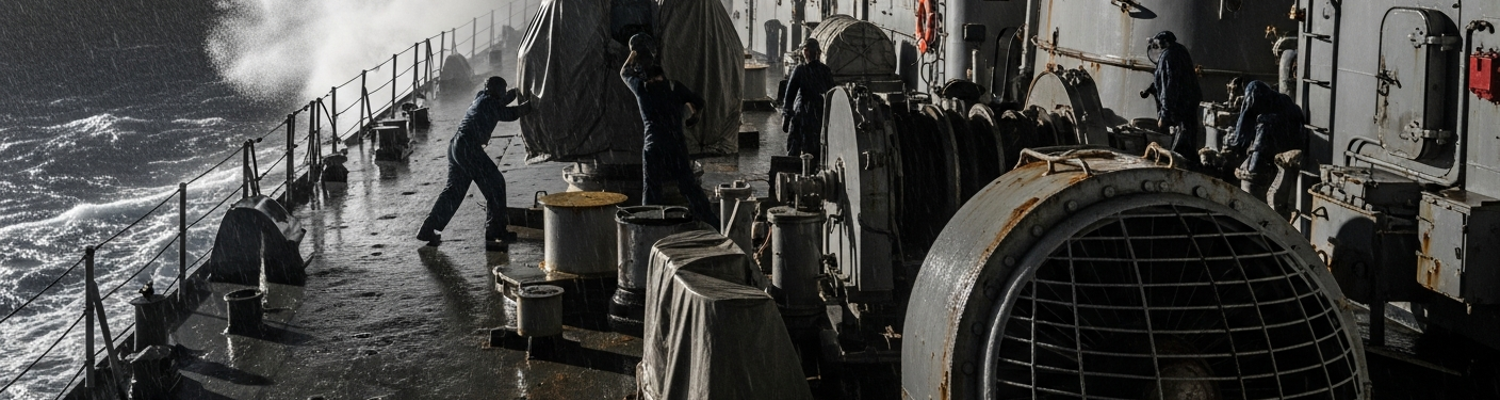

The Craig's Arrival
The orders for the Western Pacific arrived in June 1969. The USS John R. Craig (DD-885), a Gearing-class destroyer, was to proceed to Yankee Station. A product of World War II design, its keel laid in 1944, the ship had undergone a Fleet Rehabilitation and Modernization (FRAM) overhaul to extend its service life. By late 1969, however, it was a vessel showing its age. The Craig departed San Diego on June 3, 1969. After a stop in Japan and anti-submarine drills, it reported for plane guard duty with the carrier USS Ticonderoga. Yankee Station was a designated point in the Gulf of Tonkin from which Task Force 77 carriers launched air strikes into North Vietnam. For a destroyer like the Craig, this meant sailing in constant, grueling circuits, screening the carriers and standing ready to rescue downed aircrews. By August, the ship was providing naval gunfire support for U.S. Army Ranger units. The operational tempo was relentless. The tropical environment of the South China Sea, with its corrosive salt spray and high humidity, began its assault on the ship’s mechanical and electrical systems.
These systems were already relics.
Onboard Electronic Systems
The ship's electronic warfare suite depended on 1960s-era technology ill-suited for the realities of continuous combat. The primary passive surveillance system was the AN/WLR-1, a radar warning receiver designed to detect and identify enemy radar signals. This system was the ship’s electronic sensor, intended to provide early warning of threats like North Vietnamese 'Fan Song' guidance radars used with SA-2 surface-to-air missiles. The WLR-1 was a manually operated system. It demanded constant attention from its operator to scan its nine frequency bands. Its technological core was based on vacuum tubes, components that generated significant heat and were highly susceptible to failure from vibration and moisture. Operational logs (NARA Record Group 38) consistently show that the sensitive, precisely calibrated tuners and power supplies of the WLR-1 were a constant source of maintenance issues. The high-voltage power supplies required for certain frequency bands were particularly prone to breakdown. This effectively blinded the ship to specific threats until repairs could be improvised.
Working with the WLR-1 was the AN/ULQ-6 deception jammer. This was the active component of the ship’s electronic countermeasures. Once the WLR-1 detected a threat, the ULQ-6 was tasked with transmitting deceptive signals to confuse enemy radar, breaking a missile’s lock. The effectiveness of this entire defensive process hinged on the flawless function of both systems. A failure in the WLR-1’s receiving capabilities meant the ULQ-6 had nothing to respond to. A functional WLR-1 was of limited use if the ULQ-6’s transmitters were down. The ULQ-6, itself a complex piece of high-power electronics, was known to be difficult to maintain. It was already being phased out on more valuable ships in favor of the newer AN/SLQ-32 system. For the crew of the John R. Craig, this meant they were operating a legacy system where replacement parts were becoming increasingly scarce. The combination of an aging destroyer, a high-intensity combat environment, and a reliance on fragile, heat-sensitive electronic equipment created a deep vulnerability.
EW Capabilities and Doctrine
On paper, the electronic warfare suite of a Gearing-class destroyer represented a formidable sensor and countermeasures capability. The ship’s electronic intelligence (ELINT) function was a shield. Its primary defensive purpose was to provide early warning of threats to the carrier strike group, chief among them the North Vietnamese SA-2 missile systems guided by their associated 'Fan Song' radars. A review of operational logs shows the WLR-1’s nine manually tuned frequency bands, stretching from 50 MHz to over 10 GHz, were intended to be the fleet’s first line of defense. The system’s high sensitivity was designed to detect a radar emission at least 1.5 times beyond that radar’s own effective range, giving the task force minutes to react. This electronic over-the-horizon view was also meant to map the enemy’s coastal defense network, identifying and locating shore-based search and fire-control radars.
The system’s other primary function was offensive.
The same sensitive receivers were also a potent tool for Communications Intelligence (COMINT). Tactical doctrine required hunting for the enemy. The EW suite was designed to intercept communications from People’s Army of Vietnam (PAVN) and Viet Cong units. Archival evidence shows that Communications Technicians (CTs) were tasked with monitoring specific VHF and HF frequency bands used by enemy ground forces. These low-power transmissions could provide actionable intelligence for immediate use. An intercepted message might reveal the location of a supply dump, a concentration of troops, or the movement of logistical watercraft at night. This made the destroyer an active hunter. The entire process hinged on the flawless integration of the WLR-1 receiver, its antennas, and a trained operator. Once a transmission was captured, the direction-finding equipment was supposed to provide a bearing, allowing the ship’s Combat Information Center to triangulate a position and direct the ship’s own 5-inch guns or call in an air strike.
This synthesis of ELINT and COMINT was intended to create a self-contained cycle of detection and destruction. Intelligence derived from intercepted communications could provide precise coordinates for targets that were otherwise invisible from the sea. A PAVN logistics hub hidden a few miles inland could be pinpointed through its radio emissions. The ship could then bring its guns to bear, firing on targets it could not see but knew were there based on the electronic intelligence its own crew had gathered. This capability transformed the aging destroyer from a simple escort into a sophisticated intelligence-gathering asset. The execution of this mission depended entirely on the material condition of a complex web of vacuum tubes, sensitive tuners, and corrosion-prone antenna connections.
Environmental Degradation
The operational environment of the Gulf of Tonkin was itself a weapon. For the aging hull and systems of the USS John R. Craig, the enemy was the very air and water. Temperatures often exceeded 95 degrees Fahrenheit with humidity near 90 percent. This super-saturated, salt-laden air infiltrated every compartment. Naval maintenance practices from the period show that while designers accounted for some environmental hardship, the reality of continuous operations on Yankee Station far exceeded any theoretical resilience. Cooling fans essential for the ship’s vacuum-tube electronics became choked with salt crystals, their motors seizing. Without this airflow, the internal temperatures of units like the AN/WLR-1 and AN/ULQ-6 would skyrocket, shortening the life of their delicate vacuum tubes. Antenna assemblies, waveguides, and external connectors were under a constant, visible attack. A fine, abrasive crust of salt formed on every exposed metal surface, compromising electrical contacts and providing a foothold for deeper oxidation.
This was not a slow decay. It was a rapid collapse.
The relentless humidity acted as an electrolyte, accelerating galvanic corrosion wherever different metals met. Inside the ship’s electronic warfare spaces, this translated to a storm of system malfunctions. Naval maintenance reports from the 1960s highlight the vulnerability of the era’s electronics, which lacked the conformal coatings and sealed components of later generations. On the John R. Craig, microscopic salt deposits on printed circuit boards could, when combined with moisture, create new, unintended electrical pathways. The result was a series of intermittent, unpredictable faults. A radar receiver might function perfectly for hours, only to fail when a slight change in temperature and humidity allowed a salt bridge to form between two traces on a circuit card. The high-voltage power supplies for the AN/ULQ-6 jammer were particularly susceptible. Moisture ingress around power connections could lead to electrical arcing and catastrophic failure of capacitors and transformers. This phenomenon, where the silver coating on copper wires was compromised by moisture, allowed the copper to rapidly oxidize and fail.
Repair was often impossible. The operational tempo on Yankee Station left almost no time for complex maintenance. A destroyer could not simply go offline. Furthermore, the ability to fix a diagnosed fault at sea was severely limited. Attempting to solder a replacement capacitor onto a delicate circuit board was a futile exercise on a ship that was constantly pitching and vibrating. The most significant obstacle, however, was the collapsing supply chain. The John R. Craig was a low-priority asset. The specific vacuum tubes, high-tolerance resistors, and specialized capacitors needed for the AN/WLR-1 and AN/ULQ-6 were being phased out and were not stocked in meaningful quantities at forward depots like Subic Bay. Maintenance records reveal a desperate pattern of cannibalization, where technicians would strip working components from one damaged black box to try and resurrect another. This only accelerated the downward spiral of the ship’s overall EW capability. A specific, irreplaceable vacuum tube for the WLR-1’s S-band receiver might fail, effectively blinding the ship to a common North Vietnamese radar frequency, with no replacement available in the entire Seventh Fleet.
The Seventh Fleet's Supply Failure
Operational logs from Task Force 77 during the latter half of 1969 reveal a systemic breakdown in the underway replenishment system. For a low-priority destroyer like the John R. Craig, this was a terminal problem for its electronics. The process of underway replenishment, or UNREP, was a physically brutal maneuver where supply ships would steam in close formation with combatants, transferring materiel via heavy cables. The entire Seventh Fleet was dependent on this constant flow from depots like Subic Bay in the Philippines. By late 1969, this system was failing. The supply chain was optimized for high-volume consumables like 5-inch shells and JP-5 jet fuel, not for the low-volume, high-tech demands of electronic warfare suites. A specific request from the Craig’s technicians for a single power supply module (Part No. 78-A-443B) for the AN/WLR-1 would enter a system where it was misfiled alongside requests for paint and paper towels. There was no priority system capable of distinguishing between a component for the guns and one for the ship's only electronic sensor system.
The depots themselves were hollow.
The shortage of proprietary spare parts for the EW suite was a direct consequence of the Navy’s own modernization cycle. The AN/WLR-1 and AN/ULQ-6 were legacy systems. Archival evidence shows that key components, such as the specialized high-voltage power supplies for the WLR-1’s upper frequency bands, were designated as proprietary. The original equipment manufacturer was the sole source for replacements. Those manufacturers, however, were already under contract to produce the next generation of EW systems, like the AN/SLQ-32. Production lines for the older parts had been disassembled. A requisition for a new receiver chassis for a WLR-1 did not trigger a shipment from a warehouse. It initiated a request for a new, small-batch manufacturing run with lead times often exceeding six months. For the technicians on the John R. Craig, this meant entire functional units of their EW suite were designated as depot-level repair only. The depots at Subic Bay or Sasebo lacked both the parts and the test equipment to perform the work.
This logistical paralysis extended to specialized parts that were not proprietary but were equally unavailable. The humid, salt-rich air induced a specific galvanic corrosion that attacked the silver-plated copper wire used in high-frequency circuits. Cuprous oxide would form at any microscopic break in the silver plating, rapidly degrading the conductor and causing signal loss. Requisitions for replacement wire meeting the required military specifications were consistently returned unfilled. Technicians’ logs from the period detail a desperate search for even the most basic elements of electronic repair. High-tolerance resistors, essential for the precise tuning of the WLR-1’s receiver circuits, were unavailable. Specific vacuum tubes, though not proprietary, were being phased out of production worldwide and the Navy’s logistic forecasters had failed to procure a sufficient lifetime supply. A review of supply requisitions shows that the consumption rate for these components in the tropical environment of Vietnam far exceeded any peacetime engineering estimate. This forced the Craig’s technicians into a cycle of cannibalization, stripping parts from a damaged jammer to keep a receiver online. The process guaranteed the eventual failure of both.
The Resulting Intelligence Void
The equipment failures aboard the USS John R. Craig created a debilitating intelligence blind spot. The relentless corrosion and unavailability of replacement vacuum tubes meant that by late 1969, entire frequency bands on the AN/WLR-1 receiver were permanently dark. A review of operational logs from this period indicates that the S-band and C-band receiver modules were almost continuously non-functional. This was a catastrophic failure. These specific bands were precisely the frequencies used by North Vietnamese 'Fan Song' guidance radars, the electronic component of their SA-2 surface-to-air missile batteries. The silence from the EW operators’ consoles was not an indication of safety, but of deafness. The ship was sailing blind to a lethal threat. Concurrently, the failure of high-frequency receivers, plagued by moisture-induced shorts in their antenna couplers, erased the ship’s ability to conduct Communications Intelligence. The tactical chatter from PAVN coastal units, which could reveal troop movements or the location of supply depots for naval gunfire support missions, vanished.
This electronic void forced commanders in the Craig’s Combat Information Center to make decisions based on dangerously incomplete information. A mission directive from early November 1969 provides a stark example. Task Unit 70.8.9, the naval gunfire support group, ordered the Craig to a station just nine miles off the coast of Thanh Hóa province to interdict a suspected logistics route. The operational plan depended on the destroyer’s ability to detect any coastal defense radar activity. When the ship’s commander queried his EW supervisor, the report came back negative. The spectrum was clear. Based on this incomplete picture, a picture defined by what the broken equipment could not see, the commander ordered the ship to proceed. North Vietnamese records from that sector, however, show that a mobile P-15 'Flat Face' target acquisition radar had been moved into the area less than 48 hours prior. A functional WLR-1 would have detected its emissions from over 50 miles away. Because the Craig’s receiver for that band was offline, the ship unknowingly sailed directly into the engagement envelope of a prepared enemy. The first warning the captain had of the threat was not an electronic signal, but the visual sighting of incoming artillery shells.
Undetected Infiltration in I Corps
The electronic blindness of the USS John R. Craig directly contributed to a significant coastal infiltration event in the I Corps Tactical Zone in December 1969. Stationed as part of Task Force 115’s Market Time patrol, the destroyer’s primary mission was the interdiction of seaborne supply and personnel from North Vietnam. I Corps, the northernmost military zone in South Vietnam, was a constant focal point of infiltration due to its proximity to the Demilitarized Zone. Operational directives for this period show that destroyers like the Craig were expected to use their electronic warfare suites as their primary long-range detection tool, identifying North Vietnamese steel-hulled trawlers and smaller wooden junks by their communications or radar emissions. By December, the Craig’s AN/WLR-1 receiver was largely non-operational. The ship’s ability to conduct Communications Intelligence against low-power VHF transmissions, the type used by infiltration craft to coordinate with on-shore reception parties, was nonexistent.
This specific intelligence failure had a direct tactical consequence.
Sometime during the monsoon-swept night of December 14, 1969, a North Vietnamese infiltration unit made landfall on the coastline of Quảng Nam Province, south of Da Nang. After-action reports and declassified intelligence summaries indicate the infiltration was conducted by three wooden-hulled junks, vessels with an exceptionally low radar cross-section. In the heavy sea states common during the northeast monsoon, the degraded AN/SPS-10 surface-search radar aboard the Craig was unable to distinguish the small craft from sea clutter. A functioning EW suite would have been the only reliable method of detection. The operators on the Craig heard nothing. The junks, carrying a specialized sapper team and a cache of RPG-7 anti-tank rockets and 82mm mortar rounds, landed undetected. The ship, which was on a patrol barrier intended to prevent this exact scenario, was effectively inert.
The undetected landing resulted in immediate tactical setbacks for allied forces. The sapper unit, having been successfully inserted, was responsible for a series of attacks on infrastructure and logistics nodes over the next several weeks. A post-event analysis links the infiltration to a surprise mortar and rocket attack on a U.S. Marine Corps combined action platoon (CAP) outpost near the Thu Bồn River on December 27. The attack, executed with a level of coordination and firepower not previously seen in that sector, resulted in American and South Vietnamese casualties and the destruction of a communications bunker. The infiltration represented a complete failure of the Market Time naval blockade in that sector, a failure directly attributable to the material decay of a single destroyer’s electronic systems.
Post-Mortem: The Cost of Decay
The weight of compromised intelligence fell squarely on the commanders in the USS John R. Craig’s Combat Information Center. A classified post-mortem of the Market Time failure in December 1969 reveals the direct tactical cost. Success depended almost entirely on the ship’s ability to use its AN/WLR-1 receiver to detect low-power VHF communications from North Vietnamese infiltration craft. On the night of December 14, with the Craig’s key receiver modules non-functional, a unit of three wooden-hulled junks landed undetected on the coast of Quảng Nam Province. In the heavy monsoon sea-state, the ship’s surface-search radar was rendered ineffective by clutter. The EW suite was the only viable sensor. The operators heard nothing.
The junks were not merely carrying supplies.
They inserted a specialized sapper team and a significant cache of munitions. The direct result of this failure became clear thirteen days later. On December 27, a U.S. Marine Corps combined action platoon outpost near the Thu Bồn River was hit with a surprise mortar and rocket attack of unusual intensity. Post-attack analysis linked the event directly to the undetected landing. The enemy had slipped through the naval blockade because the electronic sensor system designed to detect them had decayed into uselessness. The failure was not one of personnel, but of material.
A dismantling of the logistical sequence reveals a systemic breakdown rooted in procurement priorities. A review of naval supply records from the Seventh Fleet shows that the AN/WLR-1 and AN/ULQ-6 systems were already considered legacy equipment. Manufacturers had shifted production to the next generation of electronic warfare suites. This meant that components for the Craig’s systems were no longer in mass production. A request for a specific high-voltage power supply or a signal-processing module did not trigger a shipment from the naval supply depot at Subic Bay. It initiated a small-batch manufacturing order with a lead time of many months. The depot itself was optimized for high-volume consumables, not low-volume, high-technology components. A requisition for a single, irreplaceable vacuum tube for the WLR-1’s S-band receiver entered a bureaucratic queue where it was given no greater priority than a request for office supplies. The system guaranteed failure before the ship ever left port.