
E-2A Hawkeye Origins and Aerodynamic Flaws
Control cables in the empennage snapped taut as the port Allison T56 turboprop engine suffered a sudden turbine failure over open water. Commander Murdoch McLeod and Lieutenant Commander Thomas Eades immediately fought the shuddering flight controls, stomping the right rudder pedal and hauling back on the control yoke to counter the violent yaw. The pilots rapidly pulled the emergency fuel shutoff handle and engaged the propeller feathering switch, but the massive steel blades failed to align with the wind, creating asymmetric drag that dragged the nose downward. A YC-2A prototype suffered a fatal ditching in Long Island Sound during 1965 carrier qualification trials conducted from Naval Air Station Patuxent River when the severe aerodynamic forces overwhelmed the remaining engine. Bitter ocean water rushed through the buckled rear cargo hatch, flooding the cavernous cabin and dragging the heavy prototype beneath the gray waves before rescue crews aboard nearby helicopters could reach the trapped aviators.
Divers recovered shattered sections of the sunken prototype from the seabed to determine how the sudden loss of engine power had overcome the pilots. Grumman developed the C-2A Greyhound from the E-2A Hawkeye airframe in the early 1960s to replace the reciprocating engine Grumman C-1 Trader. Carrier strike groups required a modern turboprop logistics hauler capable of delivering heavy jet engines, cargo pallets, and passengers directly to flight decks without relying on slow shore supply chains. Designers removed the massive rotating radar rotodome of the Hawkeye, widened the central fuselage into a cavernous square cabin, and added a heavy aft loading ramp while retaining the original folding wings, twin Allison engines, and reinforced tricycle landing gear. This bulbous cargo fuselage altered the airflow moving toward the rear of the aircraft, creating turbulent wakes that starved the flight controls of clean air whenever pilots operated at low approach speeds.
Grumman engineers analyzing the salvaged wreckage discovered that the four fin tail assembly could not generate enough directional control when turbulent air swirled off the blunt cargo fuselage. The crash exposed severe empennage aerodynamic flaws and structural saltwater vulnerability across the aft section of the airframe, forcing Grumman to redesign the tail surfaces and cargo ramp. Impact forces during the water landing had cracked the framing around the rear opening, proving that the original cargo ramp lacked the structural rigidity needed to survive ocean impacts. Saltwater had also quickly penetrated unsealed service panels, threatening to corrode internal hydraulic lines, electrical harnesses, and flight control linkages during routine carrier operations. Naval evaluators immediately grounded the remaining test aircraft and demanded comprehensive structural revisions before allowing any operational flights onto carrier decks.
Draftsmen at Grumman revised the tail surfaces and cargo ramp blueprints to eliminate the fatal flight handling and flooding risks. Technicians altered the four vertical stabilizers, expanded the rudder surface area, and installed spring loaded control tabs to give pilots positive control authority during single engine flight emergencies. Factory metalworkers reinforced the rear ramp with heavier aluminum crossbeams, integrated high strength locking pins, and installed continuous rubber gaskets along the cargo door frame to block saltwater intrusion. Ground test crews repeatedly flooded the redesigned fuselage mockups with pressurized salt brine to verify that the improved seals kept the interior dry. Factory lines at the Grumman Bethpage facility incorporated these structural modifications directly into the initial production run of C-2A airframes, clearing the renewed transport for carrier delivery operations.
Carrier Strike Group Logistics from Vietnam to Desert Storm
Fleet Tactical Support Squadron Fifty accepted these initial production transports directly from the Bethpage factory lines to haul critical supplies to combat carriers in the Gulf of Tonkin. The C-2A entered frontline fleet operations in 1966, sustaining carrier onboard delivery missions across high tempo combat deployments during the Vietnam War. Pilots flew seven hour round trips from staging bases in the Philippines and South Vietnam, landing on carriers stationed at Yankee Station with full cargo bays of replacement jet engines, avionics components, urgent mail, and fresh blood plasma. Arrested deck recoveries slammed the heavy steel tailhooks into thick arresting wires hundreds of times each deployment, jarring the entire fuselage and placing intense mechanical strain on the landing gear shock struts, wing spars, and engine mounts. Maintenance crews struggled in tropical heat to replace worn hydraulic seals and frayed arresting hook cables as the relentless pace of combat flight operations kept the small detachment flying day and night.
Metal fatigue fractured the wing fold joints and fuselage bulkheads after thousands of those violent cable arrested deck impacts. The US Navy launched the 1980s Reprocured C-2A(R) program to construct 39 modernized airframes to address airframe fatigue across carrier logistics squadrons. Grumman engineers redesigned the interior electrical distribution systems, added updated radar and navigation equipment, and treated every aluminum panel with improved anti corrosion primers to survive harsh ocean environments. Factory technicians installed beefier Allison T56-A-425 turboprop engines, giving the reprocured transport enough extra lift capacity to carry ten thousand pounds of cargo or twenty six passengers in rear facing crash attenuating seats. Delivery flights began routing the new C-2A(R) transports directly to operational carrier squadrons in Norfolk and San Diego, allowing naval planners to retire the worn original airframes.
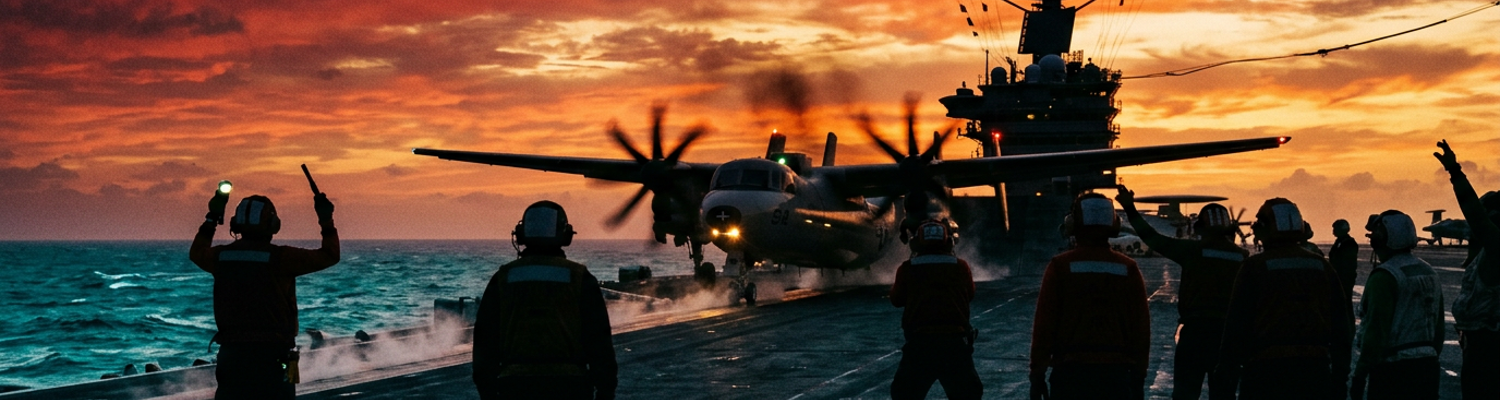
Fleet Logistics Support Squadron Forty deployed these newly delivered airframes across forward staging bases in Italy, Spain, and Bahrain to support carrier battle groups patrolling distant crisis zones. The Greyhound maintained continuous carrier strike group logistics through sustained maritime operations in the Persian Gulf and Mediterranean Sea. Flight crews operated out of Mediterranean hubs like Naval Air Station Sigonella, ferrying urgent replacement parts, secure communications gear, and mission orders to carriers enforcing freedom of navigation lanes off the coast of Libya. Ground crews in the Persian Gulf worked through blowing desert sand and blistering surface temperatures, blowing out choked air filters and wiping abrasive grit from the propeller governors between back to back flights. Deck crews on the carriers caught incoming transports around the clock, hooking tow tractors to the nose gear and rolling cargo pallets out the rear ramp within minutes of touchdown.
Catapults hurled loaded Greyhounds off carrier bow tracks at an unprecedented pace when Operation Desert Shield shifted into the massive air campaign of Operation Desert Storm. Six carrier battle groups operating simultaneously across the Red Sea and Persian Gulf demanded a relentless aerial supply bridge from shore stations in Saudi Arabia and Bahrain. Greyhounds hauled thousands of tons of high priority cargo, including precision guided bomb components, replacement engine turbines, secure targeting tapes, and battle damaged electronic warfare pods. Pilots flew through dense anti aircraft missile threats and burning oil field smoke plumes to touch down on pitching flight decks in zero visibility weather conditions, keeping combat air wings at peak sortie rates. Aviation boatswain mates unchained the cargo pallets, dragged empty shipping skids down the lowered rear ramp, and signaled deck tractors to tow the transport onto the catapult shuttle for the next outbound supply run.
Airframe Service Life Extensions and Propulsion Modernization
Catapult shuttles slammed forward into the carrier deck troughs on those continuous outbound supply runs, but the violent accelerations warped internal bulkheads and loosened structural fasteners throughout the aging fleet. Constant arrested landings and heavy sea salt corrosion pushed the airframes toward their certified engineering limits of fifteen thousand deck landings and ten thousand flight hours. Naval Air Systems Command addressed this severe structural decay by initiating the Service Life Extension Program in the early 2000s to keep the carrier delivery pipeline functioning. Depot workers at Fleet Readiness Center Southwest stripped each transport down to its metal frame, replacing cracked fuselage ribs and reinforcing the primary wing fold joints. Structural enhancements and digital instrumentation upgrades reduced cockpit vibration and extended operational service life limits across active airframes, raising allowable flight time to fifteen thousand hours and thirty six thousand arrested deck landings. Technicians installed modern digital avionics and flat panel glass cockpit screens, which reduced the constant cockpit vibration that had long blurred instrument dials and exhausted aviators on long logistics hops.
Aviators tested these calm digital cockpits alongside overhauled powerplants as the Service Life Extension Program upgraded propulsion systems with eight bladed NP2000 composite propellers and upgraded Allison T56-A-425 turboprops. The curved composite blades replaced the traditional four bladed steel units, dramatically lowering cabin noise while producing additional thrust during heavy deck launches. Mechanics on the flight deck gained the ability to replace individual damaged composite blades in less than an hour without removing the whole propeller assembly, eliminating the need to crane entire engines off the ship. Digital electronic propeller control units replaced the troublesome mechanical governors that had frequently leaked oil and drifted out of calibration during long overseas flights. Ground crews ran the upgraded turboprops through high power engine runs on carrier deck spots, observing instant throttle response and stable turbine temperatures. Flight evaluators cleared the modernized transports for fleet operations, proving that the increased thrust easily pulled the Greyhound through single engine wave offs while hauling maximum internal cargo loads.
Cargo bays inside the modified airframes were specifically rebuilt to carry the heavier propulsion hardware demanded by modern carrier air wings. Airframe modifications introduced specialized cargo handling deck rails capable of carrying crated General Electric F414 jet engines directly onto carrier arresting gear. Fleet logistics planners faced a major obstacle because the larger shipping container for the Super Hornet engine generated immense forward inertia during rapid cable arrested deck stops. Metalworkers anchored high strength steel deck rails and reinforced restraint locks directly into the main lower fuselage frames to absorb these violent decelerations. Loadmasters rolled the crated jet engines down the rails on specialized guide dollies, chaining the containers securely against the floor structure before carrier approach. Deck handlers on carriers in the Atlantic and Pacific unlatched the restrained containers within minutes of touchdown, rolling the crated engines down the lowered rear ramp straight into the hangar bay for immediate installation on frontline strike fighters.
Pratt and Whitney F135 Incompatibility and Cabin Constraints
Jet mechanics wheeled those crated F414 engines directly toward maintenance bays, but the fleet introduction of the carrier based F-35C Lightning II exposed the physical limits of the aging Greyhound. Strike fighter squadrons on deployed flattops depended on constant carrier onboard deliveries to keep their combat aircraft flight ready at sea. The fifth generation strike fighter relied on the massive Pratt and Whitney F135 turbofan, whose central power module was far wider and heavier than any previous naval jet engine. C-2A cargo compartments, originally designed in Bethpage drafting rooms during the early 1960s, measured just seven feet wide and five and a half feet high along the usable interior corridor. By the late summer 2023 aeronautical publication cycle, the airframe faced operational obsolescence due to an internal cabin cross section unable to carry unstripped Pratt and Whitney F135 engine power modules for the F-35C. Supply personnel could only squeeze the engine aboard by breaking the entire unit down into five separate components on shore, a complex disassembly process that added days of maintenance work and left carrier strike fighters grounded waiting for propulsion parts.
Engineers at Naval Air Systems Command drafted several structural modification proposals to widen the fuselage and raise the internal ceiling so whole engines could roll straight aboard on heavy handling dollies. Cargo cross section geometry constraints proved insurmountable for further airframe re engineering within existing carrier arresting gear parameters. Enlarging the cabin box required thicker structural bulkheads, wider skin panels, and a heavier overall airframe, which pushed the gross landing weight past the physical energy absorption limits of shipboard Mark 7 arresting gear engines. Any broader fuselage also pushed the main landing gear shock struts outward, threatening to exceed the narrow wheel track limits required to clear carrier deck obstructions and catapult tracks. Flight dynamics specialists confirmed that grafting a bulging cargo hold onto the half century old aerodynamic layout would ruin single engine climb gradients and destabilize pitch trim during critical carrier deck approaches. Naval leadership reviewed these structural calculations and concluded that no amount of metalwork could turn the Bethpage airframe into a viable carrier transport for fifth generation powerplants.
Commanders recognized that this shipboard supply bottleneck threatened forward carrier readiness, and the physical inability to transport fifth generation strike fighter power plants prompted the Navy to adopt the tiltrotor CMV-22B Osprey for long term logistics. The CMV-22B provided an expanded cabin volume, an enlarged rear loading ramp, and sponson fuel tanks that permitted long range overwater flights across Atlantic and Pacific transit lanes. Bell Boeing assembly workers built the tiltrotor cabin specifically to swallow the crated F135 power module whole, allowing aircrews to roll the crated engine straight across the lowered ramp without removing a single turbine stage. Rotating proprotors allowed the tiltrotor to lift twenty thousand pounds of payload and land vertically on carrier flight decks, eliminating the violent arresting cable snags and catapult launches that had punished Greyhound airframes for sixty years. Fleet Logistics Multi Mission Squadron Thirty took delivery of the frontline tiltrotors at Naval Air Station North Island and loaded the crated F135 engines for operational deployments aboard nuclear powered carriers. Flight deck directors marshaled the arriving tiltrotors onto aft landing spots, where deck crews unchained the crated engines and rolled intact fifth generation powerplants directly into the carrier maintenance bays.
Pacific Fleet VRC-30 Sunset and Atlantic Consolidation
Aviation machinists inside those carrier maintenance bays bolted the F135 engines into strike fighter airframes, leaving the twin engine Greyhounds parked on the flight deck periphery with declining tasking across western waters. Carrier air wings throughout the Pacific rapidly transitioned their operational supply pipelines to tiltrotor aircraft, stripping the Grumman transports of their traditional heavy lift mission. Pacific Fleet logistics squadron VRC-30 flew its final operational mission in September 2023 prior to stand down, completing fifty seven years of carrier onboard delivery service. Aircrews on that final September mission guided their twin turboprop transport through a routine carrier recovery, taxiing out of the arresting wires before departing for the California coastline for the last time. Naval aviators touched down on the concrete runway at Naval Air Station North Island, feathered the eight bladed composite propellers, and rolled up to the squadron hangar where ground personnel stood in formation. Squadron mechanics immediately set wheel chocks, drained auxiliary fuel lines, and packed detachment toolboxes as ferry crews prepared the displaced Pacific transports for cross country transit flights. Supply officers closed out the squadron maintenance logbooks, documenting thousands of successful arrested landings before transferring the aircraft titles to the Atlantic Fleet.
Pilots flew these surviving West Coast aircraft eastward across the United States to merge all remaining flight assets under one command structure. The US Navy consolidated all remaining operational C-2A airframes into Norfolk based Fleet Logistics Support Squadron 40, establishing the East Coast unit as the sole active Greyhound operator in the armed forces. Maintenance officers at Naval Air Station Norfolk absorbed the transferred airframes into their flight lines, running comprehensive diagnostic inspections across wing structures, hydraulic lines, and Allison T56 turboprop engines. Squadron metalworkers stripped decommissioned airframes for high value components, salvaging scarce propeller assemblies, flight control actuators, and cockpit instruments to create a centralized depot stockpile. Aviation machinists worked through rotating shifts inside the Norfolk hangars, swapping out worn engine parts and reinforcing landing gear struts to guarantee maximum reliability for departing carrier detachments. Logistics coordinators scheduled rigorous flight rotations for the enlarged fleet, assigning the best conditioned transports to support operational aircraft carriers embarking from naval stations along the Eastern Seaboard. Depot personnel repainted the fuselage sides with the distinctive Rawhides unit markings, loading spare tire assemblies and specialized deck handling tools into cargo holds to outfit new operational detachments.
Fleet Logistics Support Squadron 40 directed these gathered transports into continuous operational cycles, accepting sole responsibility for maintaining the Atlantic supply chain. VRC-40 retained exclusive operational responsibility to sustain the Atlantic Fleet carrier air bridge through concluding carrier strike group deployments. Detachments from the Norfolk squadron deployed aboard Atlantic Fleet aircraft carriers, establishing logistics hubs at forward airfields across the Mediterranean Sea and Arabian Gulf. Flight crews launched from coastal runways with full payloads of replacement jet components, avionics boxes, urgent medical crates, and military mail, steering their turboprops across hundreds of miles of open ocean. Deck handlers on nuclear powered carriers cleared landing areas as the Greyhounds trapped on arresting wires, quickly unloading cargo containers on the flight deck and loading outbound personnel for return flights to shore. Deck directors directed the transports back onto the catapult shuttles within minutes of delivery, aligning the nose wheels with the guide tracks to maintain the carrier air wing supply cycle. Catapult crews hooked the heavy nose gear launch bars to the steel steam shuttles, saluted the cockpit pilots, and stroked the firing triggers to launch each transport over the carrier bow into open maritime airspace.