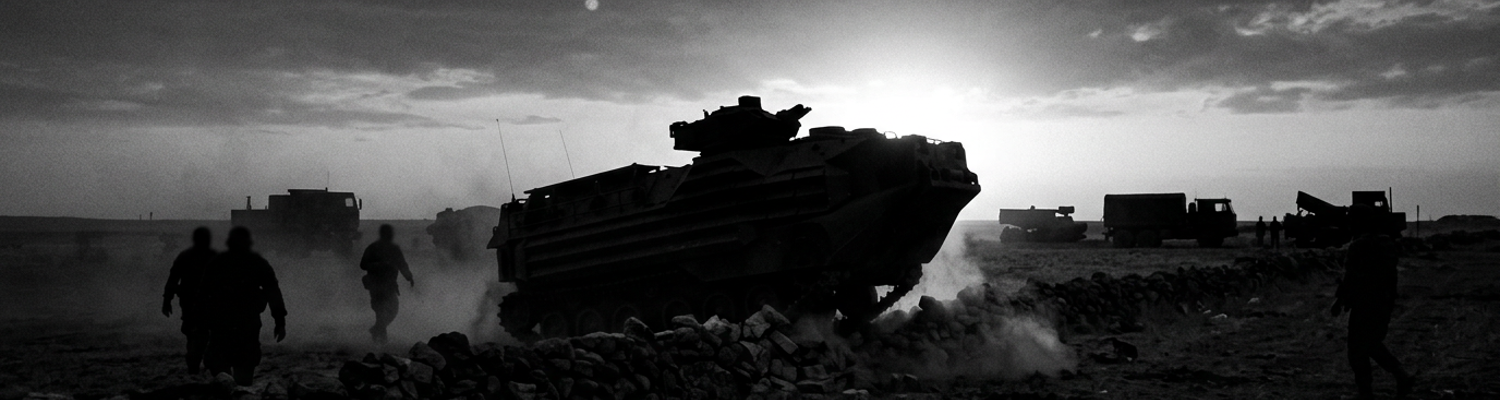

Assault Architecture of Operation Starlite
180630H AUG 65. Grid coordinates BS 701928. Sub-hamlet An Cuong 2, Van Tuong Peninsula, Quang Ngai Province.
On August 18, 1965, the 7th Marine Regiment launched Operation Starlite on the Van Tuong Peninsula in South Vietnam. Colonel Oscar F. Peatross established the regimental tactical command post offshore aboard the amphibious command ship USS Mount McKinley. He directed a synchronized amphibious and heliborne assault intended to trap the 1st Viet Cong Regiment against the South China Sea. Archival evidence shows that the operational plan required the 3rd Battalion, 3rd Marines to storm Green Beach aboard tracked amphibious vehicles. Concurrently, the 2nd Battalion, 4th Marines inserted into inland Landing Zones designated Red, White, and Blue aboard UH-34D Choctaw helicopters. Mechanical breakdowns immediately compromised the coastal advance. Tracked landing vehicles threw drive sprockets in the deep mud of coastal salt paddies. Flight crews from Marine Medium Helicopter Squadrons 261 and 361 took intense small-arms fire as they flared into LZ Blue just west of the hamlet perimeter. Heavy naval gunfire from the guided-missile cruiser USS Galveston struck the northern ridgelines. High-explosive 155mm artillery salvos from Battery K, 4th Battalion, 12th Marines followed seconds later. These high-explosive rounds detonated entirely outside concealed enemy assembly points. Field communications degraded almost at once. AN/PRC-25 radio sets failed under hundred-degree morning heat and corrosive sea spray.
Tactical momentum ceased along a narrow dry creek bed.
A close review of operational logs indicates that the 60th Viet Cong Battalion occupied prepared defensive positions throughout the An Cuong hamlet complex. They utilized reinforced stone structures, trenches, and underground redoubts. Engineers of the insurgent main force had spent months cutting deep zig-zag communication trenches between thick laterite masonry dwellings. This construction converted farming hamlets into fortified strongpoints. Subterranean tunnels linked stone dwellings directly to underground bunkers. These bunkers were covered by layers of heavy timber, coconut logs, and compacted soil capable of absorbing direct hits from Marine 81mm mortar fire. Firing apertures were bored at ground level through the thick stone base walls of houses in An Cuong 2. This provided interlocking grazing fire across open rice paddies toward Landing Zone Blue. Concealed beneath haystack camouflage and thatched outbuildings, Soviet-pattern Type 53 heavy machine guns held dead-space avenues under observation. Pre-sighted 60mm mortar crews waited in defilade. Snipers armed with bolt-action carbines climbed into dense palm canopies. They targeted Marine platoon leaders and forward air controllers. Defenders constructed narrow escape shafts leading down into natural caverns within the surrounding rocky hillocks. Whole squads could shift firing axes without exposing themselves to aerial observation.
A single stone hut anchored the crossfire.
When examining the historical record of Company I's movement inland from the littoral zone, an isolated decision to neutralize a squad of snipers holed up in a masonry dwelling altered the regiment's entire operational posture. Squad leader Corporal Robert E. O'Malley assaulted the stone structure with hand grenades and shotgun fire. He attempted to eliminate a fortified trench line that threatened to sever his platoon from the landing perimeter. Enemy fire intensified. This drew in two supporting platoons that encountered fortified subterranean redoubts beneath adjoining dwellings. Within forty minutes, Company I found itself fixed in place against stone walls and sunken trail embankments at grid BS 701928. Riflemen expended basic loads of 7.62mm ammunition. An unarmored supply column of five LVTs and three M48 tanks veered off course into a dry paddy ambush north of the hamlet. Battalion headquarters scrambled to redirect rifle companies from Landing Zone Blue to rescue the pinned amphibious elements. This shifted the regimental focus away from its broader sweeping mission directly into an attritional fight inside the fortified An Cuong complex.
The Tactical Breach at An Cuong
A close review of operational logs indicates that at 0715 hours, the lead elements of Company I, 3rd Battalion, 3rd Marines advanced northeastward across an open dry paddy. They moved toward the tree line skirting An Cuong 2. Pinned against an earthen paddy dike at grid coordinates BS 703927, the riflemen took single-shot, precision rifle fire from a south-facing masonry hut. The structure was reinforced with thick bamboo wattle and sun-baked mud. Ballistic analyses noted in after-action summaries identified the incoming rounds as rimmed 7.62x54mm cartridges. These were fired from a bolt-action Mosin-Nagant carbine. The marksman worked from an obscured aperture beneath the eaves of the thatched roof. He dropped two Marine riflemen in the center of the paddy within four minutes. First Platoon had orders to screen the battalion's eastern flank and maintain contact with Company K along the primary axis toward Hill 43. Instead of bypassing the isolated structure with covering smoke, the squad leader on the right flank initiated an immediate localized assault to eliminate the weapon position. The squad leader racked a twelve-gauge Remington Model 870 pump shotgun. He signaled three riflemen carrying M14 rifles to lay suppressive fire against the window frame. The team bounded forward across fifteen meters of exposed soil.
That individual decision halted the company advance.
When examining the historical record, physical inspection of the target dwelling revealed defensive modifications far exceeding those of a typical farm building. Archival evidence shows that Corporal Robert E. O'Malley crossed the final threshold alone. He kicked through the woven bamboo entryway to discharge multiple rounds of double-aught buckshot into two defenders positioned beside the doorway. Inside the three-room structure, the floor consisted not of packed dirt, but of timber-reinforced trenches dug eighteen inches below grade. This shielded occupants from grenade fragmentation. A second burst of fire emerged from a vertical shaft masked by rice sacks in the western corner of the rear storage area. Rather than a solitary sniper post, the dwelling formed the camouflaged cap of an entrenched subterranean tunnel entrance. Marine squad members hurled three M26 fragmentation grenades down the shaft. The subterranean detonations produced no secondary explosions. They merely blew acrid dust and cordite smoke back up into the room through concealed blowback vents.
The squad was fighting inside an enemy strongpoint.
Operational records from the 3rd Battalion command post confirm that neutralizing this single dwelling immediately altered the movement of the entire assault formation. Company I was assigned to push northwest along a designated lane of advance to establish a blocking screen north of LZ Blue. The localized fight inside the hut drew in the entire Second Platoon to suppress flanking fire. Moving toward the sound of the breach, the reinforcing squads stepped directly into pre-registered kill zones arranged by the 1st Viet Cong Regiment's 60th Battalion. Subterranean tunnels allowed enemy gunners to slip unseen into concealed bunkers positioned thirty meters south of the original breach point. Soviet-designed Type 53 heavy machine guns fired 7.62mm ammunition from water-cooled mountings behind thick earthen revetments. They caught the Marines in an intersecting crossfire along a sunken cart path. Two M14 rifles jammed when fine dust fouled their operating rods during the sustained exchange of fire. Insurgent mortar teams zeroed their 60mm tubes on the coordinates of the captured hut. They dropped eight high-explosive rounds across the courtyard within ninety seconds.
Company I sat immobilized four hundred meters south of its objective.
Subterranean Network of the 60th Battalion
A close review of operational logs indicates that the 60th Battalion of the 1st Viet Cong Regiment operated within a subterranean tunnel network excavated directly beneath the laterite stone dwellings of An Cuong 2. Rather than isolated foxholes, these passages formed an unbroken underground system linking sub-surface basements across a three-hundred-meter front. Sapper units had excavated narrow shafts four to six feet beneath the surface. They cut through dense clay and lined key junctions with hand-hewn timber beams and bamboo revetments. Marine fire teams from Company I, 3rd Battalion, 3rd Marines advanced across surface courtyards. They were completely unaware that entire enemy squads were shifting weapons, ammunition, and stretchers directly beneath their combat boots. Combat engineers of the 60th Battalion built horizontal communication galleries with ninety-degree blast baffles and camouflaged trapdoors masked by packed dirt or cooking hearths. These features allowed insurgent fighters to submerge during surface artillery barrages. They could maneuver under fire teams and re-emerge through concealed vertical egress ports behind Marine rear security elements. When squad leaders attempted to track moving hostile positions, the acoustics of gunfire vibrating through thick stone floorings disoriented their ears. Marine positions were repeatedly attacked from directions cleared five minutes prior.
The terrain beneath the hamlet belonged entirely to the defenders.
Archival evidence shows that these subterranean passages incorporated specialized engineering features designed specifically to defeat gas, blast overpressure, and fragmentation. The 60th Battalion excavated U-shaped water traps along main transit routes. This created liquid-sealed barriers that prevented tear gas agents like CS gas from spreading through the lower galleries. Surface-level ventilation shafts did not vent directly upward. Insurgent diggers bored angled chimneys that terminated inside termite mounds, hollow tree bases, or thick hedgerows dozens of yards away from the operational chambers. This mechanical arrangement dispersed weapon exhaust and smoke without exposing the subterranean chambers to aerial reconnaissance from circling OE-1 Bird Dog observation aircraft. Viet Cong squads utilized sub-surface staging rooms measuring eight by ten feet to store spare barrels for Type 53 machine guns, crates of Soviet 7.62x39mm ammunition, and pre-rigged stick grenades. When a Marine fire team took cover along a ditch or masonry wall, insurgent scouts tapped wooden signals through tunnel ceilings. This directed mortar adjustments or deployed subterranean counter-assault teams into adjoining cellars.
Every captured threshold revealed another sealed firing chamber.
When examining the historical record, close-quarters combat inside the stone structures and bunker entryways completely neutralized organic Marine fire superiority. Company I arrived with access to massive exterior fire support. This included 155mm high-explosive howitzers from Battery K, 4th Battalion, 12th Marines, five-inch naval gunfire from the cruiser USS Galveston, and strike aircraft from Marine Attack Squadron 214. Once Marine squads breached the perimeter of the stone dwellings, the distance between opposing forces shrank to five paces. This placed combatants well inside danger-close support thresholds. Fire support coordinators could not call in high-explosive artillery shells without risking fratricide against Marines pinned against the outer masonry walls. Heavy weapons organic to the infantry company also proved ineffective within the enclosed stone rooms. Backblast from 3.5-inch M20 rocket launchers created lethal pressure waves inside stone courtyards. The heavy forty-four-inch length of standard-issue M14 service rifles made the weapons clumsy to shoulder inside confined six-foot passageways. Insurgent defenders used compact, folding-stock weapons. They deployed Chinese Type 56 assault rifles and French MAT-49 submachine guns to sweep bunker entrances with automatic fire before Marine point men could clear the angles.
Bunker apertures and heavy stone door frames acted as physical funnels. They concentrated hostile small-arms fire directly onto entry points. Marine riflemen attempting to neutralize these points threw M26 fragmentation grenades through exterior doorways. Internal stone revetments and sandbag baffles absorbed the shrapnel patterns. The 60th Battalion constructed low-profile firing slits bored through reinforced stone footings barely four inches above grade. This allowed prone defenders to fire directly into the lower legs of advancing Marines while remaining completely impervious to horizontal small-arms fire. Inside the windowless basements, cordite smoke, pulverized masonry, and muzzle flash stripped away Marine squad integrity. Non-commissioned officers could not coordinate fire teams by voice or hand signals in the dark, concussive interior rooms. Every forward step through a breached doorway required individual Marines to engage in point-blank kinetic duels against fortified positions. Fire support, numbers, and mechanical air power meant nothing.
At 0845 hours, Company I reported sixteen casualties inside a twenty-meter radius of the central trench line.
Collapse of Tactical Communications and Regimental Control
Every radio antenna became an instant target.
A close review of operational logs indicates that by 0915 hours, tactical radio nets between First Platoon and the Company I command post ceased functioning entirely. Radio operators carried backpack-mounted AN/PRC-25 transceivers. They relied on three-foot tape whip antennas to maintain VHF-FM communications on designated company tactical channels. Inside the dense building clusters of An Cuong 2, these low-power signals failed to penetrate eighteen-inch laterite masonry blocks and sun-baked mud structures housing the platoon command element. High-explosive 60mm and 82mm mortar barrages fired by the 60th Viet Cong Battalion showered the stone courtyards with jagged fragmentation. The steel sliced through flexible ribbon antennas within minutes. Hot shrapnel punctured the magnesium-alloy casings of the transceivers. This destroyed internal module boards and leaked toxic chemical paste from dry-cell batteries into the dirt. Snipers positioned in surrounding palm trees singled out the distinctive silhouettes of the ten-foot multi-section whip antennas. They killed two company radiomen before backup operators could rig field-expedient wire antennas. Platoon commanders found themselves completely isolated within separate stone compounds twenty yards apart. They depended on hand signals and physical runners who were systematically shot along open lanes.
Voice contact across the company tactical net failed completely.
Archival evidence shows that this localized blackout produced an immediate breakdown of situational awareness up the command chain to the regimental tactical operations center aboard the USS Mount McKinley. Colonel Oscar F. Peatross and the fire support coordination center on the command ship depended on regular grid-reference position reports to establish safe bomb lines for incoming aircraft and battery fire missions. Without continuous telemetry from forward air controllers embedded with Company I, regimental staff could not locate the ragged, shifting perimeter where Marines fought hand-to-hand inside the stone dwellings. Battery K of the 4th Battalion, 12th Marines suspended planned 155mm high-explosive fire missions against northern escape routes. They feared that unobserved salvos would strike Marine squads pinned against outer compound walls. Strike flights of Marine A-4 Skyhawks and F-4B Phantoms carrying 500-pound Mark 82 bombs circled offshore at five thousand feet. They burned reserve fuel while air liaisons fruitlessly dialed through pre-assigned VHF and UHF frequencies. Forward air controllers aboard circling O-1 Bird Dog observation planes saw only churning dust, heavy black cordite smoke, and thatch fires obscuring the hamlet floor. Pilots were unable to confirm friendly smoke markers or clear aircrews to release ordnance near grid BS 701928.
Strike aircraft circled overhead with dry pylons until low fuel compelled them to divert to Chu Lai.
When examining the historical record of the 3rd Battalion command post, field commanders spent two critical hours attempting to verify whether Company I still held the southern edge of An Cuong 2 or had been overrun by counter-attacking sappers. Messengers dispatched on foot across the dried rice paddies to re-establish wire or vocal contact suffered heavy casualties. Three consecutive runners were shot along exposed dikes before reaching the battalion perimeter. The regimental commander withheld the commitment of mobile reserves from the 2nd Battalion, 4th Marines. He was reluctant to insert additional heliborne infantry into Landing Zone Blue without confirmed landing zone status or firing coordinates. Ammunition supply columns and M48 tank sections detached to relieve the pinned riflemen operated without updated map overlays. They blindly steered their tracks into entrenched recoilless-rifle kill zones north of the village. The breakdown of radio links transformed a localized squad-level firefight into an unobserved sector. Naval gunfire spotters, battery coordinators, and regimental staff could not calculate lethal safety envelopes. At 1030 hours, regimental log entries recorded four separate uncoordinated fire requests canceled in sequence because forward positions could not be validated.
Emergency Triage in the Contested Courtyard
Blood accumulated between the dry laterite cobblestones.
A close review of operational logs indicates that by 1100 hours, hospital corpsmen attached to Company I established an improvised casualty collection point inside an open walled courtyard at grid coordinates BS 704926. With over twenty wounded riflemen dragged from the surrounding fire lanes, the interior rooms of the adjacent dwellings proved too small and dust-choked to support triage. Medical personnel laid casualties across bare earth along the north masonry wall. This provided partial deflection against rifle rounds but zero overhead protection. The 60th Viet Cong Battalion maintained pre-registered sighting stakes on every open enclosure in An Cuong 2. They utilized Type 53 82mm mortars positioned behind an earthen revetment eight hundred meters north. High-explosive mortar shells burst against courtyard flagstones at intervals of roughly two minutes. Serrated steel casing fragments whistled across the prone wounded. Two corpsmen were wounded by fragmentation within thirty minutes of setting up the collection point. Dust and pulverized stone showered open abdominal lacerations. Unexploded ordnance and spent cartridges cluttered the dirt paths where litter teams crawled on their stomachs.
Helicopter evacuation was impossible.
Archival evidence shows that Navy medical personnel performed complex surgical interventions directly on the dirt without anesthesia or field lighting. High-velocity 7.62mm rounds impacted the low courtyard parapets. Corpsmen knelt in exposed mud to manage catastrophic arterial trauma. In three documented cases of blast injury caused by 82mm shrapnel shearing the femoral artery, corpsmen clamped and executed emergency vascular ligations using standard curved Kelly hemostatic forceps. They tied off severed vessels with non-absorbable silk sutures before hypovolemic shock caused total cardiac arrest. Facial trauma from close-range bullet impacts destroyed airways. Corpsmen performed emergency tracheostomies on two Marines whose oral cavities were blocked by shattered mandibular bone and aspirated blood. Operating with scalpel blades stripped of handles and improvising cannulas from cut plastic suction tubing, the medical staff sliced through cricothyroid membranes to secure respiration. These procedures occurred while the battalion's organic Unit 1 medical kits emptied completely. Compress bandages and field dressings ran out by noon. Personnel packed deep wound cavities with shredded utility shirts and dirty poncho liners. Units exhausted their basic load of serum albumin, whole blood substitutes, and morphine Syrettes. Critically wounded men remained conscious as heat inside the courtyard reached 104 degrees Fahrenheit.
When examining the historical record, emergency resupply runs to replenish the courtyard aid station collapsed along the southern approach. Tracked landing vehicles dispatched from the littoral staging area to deliver fresh plasma units and dry sterile dressings threw drive chains or burned out transmissions in deep drainage ditches four hundred meters south. Three UH-34D helicopters attempting emergency medical evacuation flared toward the compound perimeter. Concentrated machine-gun fire from the surrounding hedgerows punctured their fuel cells and severed hydraulic flight lines. This aborted the extraction attempts. Corpsmen gathered discarded ponchos and tied the corners around wooden bamboo poles to improvise litters. They stacked four casualties along the single remaining stone wall that shielded the compound from direct recoilless-rifle trajectories.
Twenty-two wounded men lay crowded across nine square yards of dirt.
Heliborne Extraction and Armored Resolution
Rotor blades threw plumes of dry red dust across the paddies as incoming automatic weapon fire penetrated aluminum airframes.
A close review of operational logs indicates that flight sections from Marine Medium Helicopter Squadrons 261 and 361 attempted repeated low-altitude approaches into LZ Blue and open paddy terrain directly bordering An Cuong 2. Flying the piston-engine Sikorsky UH-34D Seahorse, pilots flared out at eighty knots. They presented unarmored profiles to concealed Viet Cong positions ringing the tree lines. Soviet-designed 12.7mm DShK heavy machine guns and Type 53 gunners caught the aircraft inside an anti-aircraft envelope under two hundred feet. Ballistic impacts penetrated the nine-cylinder Wright R-1820 radial engines. This severed pushrods and ruptured unarmored hydraulic lines that governed the flight control servos. Archival flight sheets show that aircraft serial number 148762 sustained twenty-seven hits through its forward engine compartment. It suffered rapid oil pressure loss that forced an emergency autorotation onto an open sandbar two miles south. Hydraulic fluid sprayed into cockpits. This blinded flight crews and degraded collective pitch control as pilots struggled to hold hovering positions over the casualty collection point. Hostile fire deliberately targeted the main rotor mast and tail rotor drive shafts. This disabled directional control during approach. Three successive extraction flights aborted when armor-piercing rounds shattered cockpit canopy glass, wounding two copilots and perforating the main cabin fuel tanks.
Aviation could not bridge the gap.
When examining the historical record, field commanders recognized that air assets could not penetrate the airspace. They relied on ground armor to breach the perimeter. Orders dispatched by courier redirected a platoon of LVTP-5 amphibious tractors from Company A, 3rd Amphibian Tractor Battalion. These units had been idling near the coastal landing sector. Weighing nearly forty tons empty, these tracked steel vehicles were designed for ship-to-shore troop transport rather than inland urban breaching. They were driven by 810-horsepower Continental V-12 gasoline engines housed above a bottom hull containing hundreds of gallons of fuel. Marine drivers pushed four tractors forward across the dry irrigation dikes at grid BS 703926. They used the massive bow ramps to crush laterite stone field walls and collapse insurgent firing trenches. Insurgent squads armed with RPG-2 anti-tank rocket launchers and 57mm recoilless rifles fired directly into the tractors from concealed spider holes. Steel skirts absorbed glancing high-explosive hits. Small-arms rounds peppered the hull vision blocks. Drivers steered blind using periscopes caked with engine exhaust and pulverized clay. Gun crews manning the bow-mounted .30-caliber Browning M1919A4 machine guns expended continuous belts into the hedgerows. They suppressed bunker firing slits at ten paces.
Steel hulls shielded the wounded.
Archival evidence shows that the lead tractor ground to a halt against the courtyard masonry wall at 1340 hours. It lowered its hydraulic front ramp directly into the company triage area. Riflemen from Company I worked alongside tractor crewmen to haul twenty-six wounded Marines inside the dark troop compartment. They stacked litters four high along internal aluminum benches over blood-soaked deck plates. In exchange for the casualties, the tractor crews unloaded forty wooden crates containing 7.62mm linked ammunition for M60 machine guns, two hundred bandoliers of M14 magazines, and forty cases of clean drinking water in five-gallon cans. Internal temperatures inside the unventilated steel compartment exceeded 115 degrees Fahrenheit. This was compounded by heat radiating off the rear engine firewall. Shifting into reverse, the tractor drivers backed out over their own track ruts. They shielded the open ramp from direct fire with the vehicle bow while firing suppressive bursts into the flanking brush. By 1415 hours, the armored column had transported thirty-two injured men across the paddy dikes to the battalion aid station at Green Beach.