
Ignored Intelligence and Strategic Complacency
A close review of operational logs from the Union District of West Tennessee, specifically documents filed under NARA Record Group 393, reveals a clear pattern of dismissed intelligence in the days preceding August 21, 1864. Multiple, independent reports of significant Confederate cavalry movements were filtering into Union headquarters in Memphis. Scouts from the 2nd Iowa Cavalry, operating near the Mississippi border, provided unambiguous indications that Major General Nathan Bedford Forrest was massing his command. Additional warnings came from Union sympathizers and Confederate deserters, all pointing to a large-scale operation being staged out of the Oxford, Mississippi area. These dispatches consistently noted the consolidation of Forrest’s scattered brigades and an unusual level of preparation for a rapid, long-distance march. The intelligence was specific enough to identify Forrest’s command as the primary force, distinguishing it from other partisan units common to the region. The reports were forwarded to the desk of the district commander, Major General Cadwallader C. Washburn.
They were not acted upon.
The Union command structure in Memphis, a city garrisoned by approximately 6,000 Federal troops, had fallen into a state of strategic complacency. A significant portion of Washburn’s attention and available field forces were directed elsewhere. His primary focus was the progress of Major General Andrew J. Smith’s large Union column, which had been sent deep into Mississippi with the explicit objective of finding and destroying Forrest’s corps. The prevailing assumption inside Washburn’s headquarters was that Forrest was fully occupied fending off Smith’s much larger force. This created a powerful confirmation bias; any intelligence suggesting Forrest was moving north toward Memphis was interpreted as a feint or misinformation. The reports of cavalry movement were seen as evidence of Forrest reacting to Smith, not initiating a completely new and aggressive offensive. Generals Washburn and his subordinate, Stephen A. Hurlbut, operating under the protection of the formidable Fort Pickering and a large infantry presence, viewed the city as impervious to any serious threat. The raw data of Forrest’s location and trajectory was available, but it was filtered through a lens of institutional disbelief.
Multi-Pronged Infiltration and Tactical Deception
Archival evidence from August 21, 1864, details a Confederate entry into Memphis that was a study in coordinated infiltration. The 2,000-man cavalry force did not approach as a single body but split into distinct columns, each assigned a specific vector of approach and a series of internal objectives. This multi-pronged tactic was designed to overwhelm the Union picket lines at multiple points simultaneously, preventing a consolidated defense from forming and sowing confusion within the city’s command structure. One column, under Colonel Jesse A. Forrest, the general’s brother, took the Hernando Road, driving directly toward the heart of the city and the personal headquarters of the Union district commander. A second brigade advanced along the Pigeon Roost Road, while a third utilized the State Line Road. The operational plan was to have these columns converge on the city center almost simultaneously. The movement was timed for the deepest point of the pre-dawn darkness, around 4:00 AM. This hour was selected specifically because it represented the lowest point of vigilance for a garrison that had grown comfortable deep in Union-held territory. The columns moved with a speed that defied conventional Union military calculations, exploiting secondary roads and paths to bypass known Federal patrols.
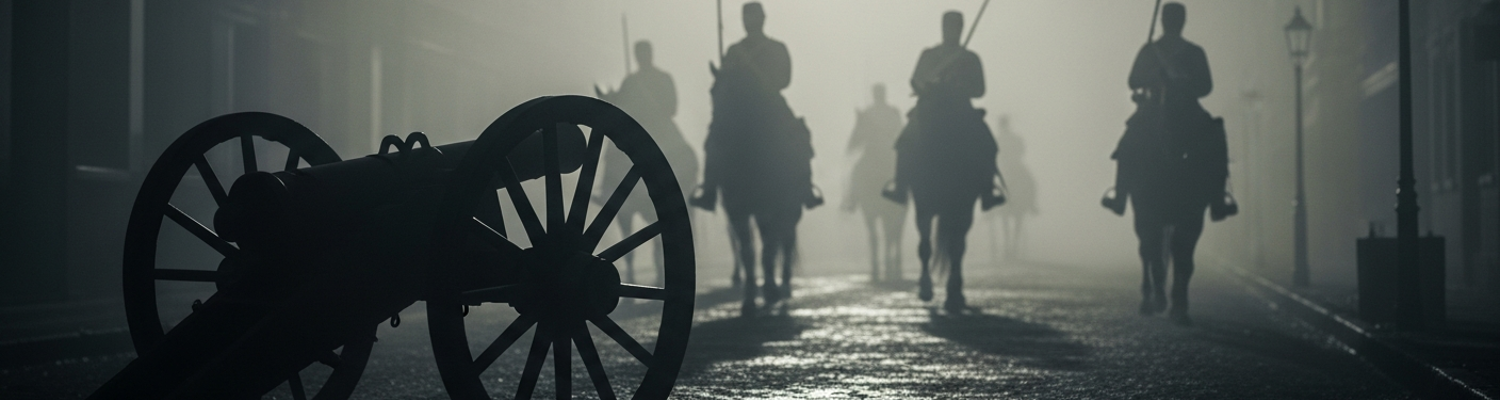
A thick, disorienting fog blanketed the area in the pre-dawn hours. The vanguard of the Confederate force approached the outer Union pickets. Instead of engaging immediately, the lead troopers employed a ruse. They claimed to be a returning Union patrol bringing in Confederate prisoners. This claim was plausible enough in the poor visibility and low state of alert to neutralize the sentries quietly and without a general alarm being raised. The fog was a critical, unplannable advantage that Forrest exploited to its fullest potential; it muffled sound, obscured movement, and created an environment where a small, disciplined force could easily be mistaken for a friendly one. By the time the lead Confederate elements were inside the city’s defensive perimeter, the Union garrison of 6,000 men was still largely asleep. The first indication for most that the city was under attack was the sound of cavalry galloping past their quarters and sporadic gunfire erupting from the city center.
Command Decapitation and Psychological Paralysis
Once inside the city, the separate columns moved with precision toward their primary objectives. Their goals were the capture of three Union generals, the liberation of Confederate prisoners from the Irving Block Prison, and the general disruption of the Union command and control apparatus. The assault on the Union headquarters was immediate and targeted. A detachment of about two hundred men under Colonel Jesse Forrest was tasked with seizing Major General Cadwallader C. Washburn from his residence on Union Street. Simultaneously, a separate body of troopers, some led by Captain Bill Forrest, another of the general’s brothers, rode directly for the Gayoso House Hotel. This luxurious hotel served as the headquarters for Major General Stephen A. Hurlbut and other ranking Union officers. The operational audacity was on full display as Confederate cavalrymen rode their horses directly into the lobby of the grand hotel in search of their targets.
The attack on Washburn’s personal quarters was a near success. The speed of the Confederate advance was such that the Union general was roused from his sleep with only moments to spare. As Colonel Forrest’s men burst into his bedroom, pistols drawn, they found it empty. Washburn, clad only in his nightshirt, had fled out a back door and made his way through an alley to the safety of Fort Pickering. The troopers captured his uniform and personal effects. The parallel assault on the Gayoso House was similarly chaotic, with officers scattering in the pre-dawn confusion. General Hurlbut also managed to escape capture. While the primary objective of capturing the generals failed, the psychological impact of having Confederate cavalry storming their private quarters and headquarters lobby was profound.
Command cohesion evaporated in the fog.
This initial shock was compounded by an almost immediate decapitation of the Union command structure. With the two senior generals completely out of communication and fighting for their own survival, the larger Union force of 6,000 men was paralyzed. Subordinate officers, lacking orders and a clear picture of the situation, defaulted to a defensive posture. Instead of organizing a coordinated sweep to clear the city, a task for which they had a three-to-one numerical superiority, the bulk of the Federal infantry either held their positions or fell back to the safety of Fort Pickering. For several hours, a 2,000-man raiding force held effective control over a city garrisoned by 6,000 Federal soldiers.
Fragmented Defense and Command Paralysis
A detailed analysis of Union actions during the approximately two-hour window of the raid, from 4:00 AM to 6:00 AM on August 21, 1864, reveals a complete breakdown of centralized command. This forced individual units into isolated and reactive defensive bubbles. The raid was an exercise in harassment, designed for speed and disruption, not occupation. Forrest’s 2,000 troopers never intended to hold the city. Their purpose was to sow chaos, capture key personnel, and withdraw before the 6,000-strong Union garrison could mount a coherent response. The entire operation was a fleeting, violent storm. It began with the quiet elimination of pickets in the dense morning fog and ended with Forrest’s columns withdrawing back south. The Confederates galloped through the city, targeting specific locations like the Gayoso House Hotel and General Washburn’s private residence before melting away. This rapid, hit-and-run nature meant that by the time most Union regiments were fully armed and assembled, the primary threat had already passed, leaving behind a confused and disorganized garrison.
The city was effectively leaderless.
Regimental and company commanders were left to their own devices, with no knowledge of the enemy’s size, location, or intent. Reports from units like the 113th Illinois Infantry and various “100-day” regiments from Wisconsin show them tumbling out of their barracks into a street fight already in progress. Instead of forming a unified line to sweep the Confederates from the city, these units adopted ad-hoc defensive postures. They fortified their own barracks, barricaded nearby streets, or began a cautious fighting withdrawal toward the city’s main stronghold, Fort Pickering. This created a chaotic city-wide skirmish, with pockets of Union resistance fighting their own separate battles, unable to support one another. The powerful guns of Fort Pickering, the strongest Union installation on the Mississippi, remained silent, as the intermingling of friend and foe in the city streets made it impossible to provide effective artillery support.
Material Degradation Under Duress
The sudden, violent shock of Forrest’s pre-dawn raid subjected the Union garrison’s military hardware to a level of stress it was never designed to withstand in such a compressed and chaotic environment. An examination of after-action reports and the technical limitations of 1860s-era weaponry reveals a rapid breakdown of mechanical function. This was most evident at the individual soldier level. Union infantrymen, likely from inexperienced “100-day” regiments alongside more seasoned units like the 59th and 61st U.S. Colored Infantry, were jolted from their bunks into a street fight. Grabbing their standard-issue Springfield Model 1861 rifled muskets, they attempted to establish firing lines from behind hastily assembled barricades. The standard sustainable rate of fire for these muzzle-loading weapons was two to three rounds per minute. In the terror and confusion of the fog-shrouded melee, fire discipline evaporated. Soldiers began firing as rapidly as they could manage, a pace that quickly caused rifle barrels to overheat. This excessive heat caused the black powder residue to bake onto the inside of the barrel, making it progressively more difficult to ram the next round home. The sustained, panicked firing degraded the weapon’s performance, reducing muzzle velocity and compromising accuracy.
The larger implements of war fared no better.
A review of artillery doctrine from the period shows that the field pieces available to the Memphis garrison, such as the 12-pounder Napoleon smoothbore or the 3-inch Ordnance Rifle, required calm, methodical teamwork to operate effectively. A gun crew had to sponge the barrel to extinguish any lingering embers, load the powder charge, ram the projectile, prime the vent, and fire. Rushing this sequence under the duress of a surprise cavalry charge was a recipe for catastrophic failure. Artillerymen scrambling to deploy their guns into city streets found themselves with no clear fields of fire. The psychological pressure to fire at the apparitions in the fog would have been immense. This desperation likely led to critical errors. A failure to properly sponge the barrel could leave embers that would prematurely detonate the next powder charge as it was being rammed, a devastating event known as a “cook-off” that could kill or maim the entire gun crew. The powerful cannons of Fort Pickering remained silent, unable to engage targets that were tangled with friendly forces in the urban labyrinth below.
Immediate Aftermath and Tactical Reassessment
An immediate and punishing lesson manifested in the condition of Nathan Bedford Forrest’s own command during the withdrawal. The very speed that guaranteed the raid’s success also ensured its high cost in cavalry mounts. The 2,000-man Confederate force had pushed relentlessly from northern Mississippi, covering nearly one hundred miles in under three days. This pace was unsustainable. Historical analysis confirms that Forrest lost approximately a quarter of his force even before reaching Memphis, as hundreds of horses gave out from exhaustion along the route. The animals that did make it into the city were then subjected to the stress of street fighting and a frantic withdrawal. The operational lesson for the Confederates was stark: such deep, high-velocity raids created a severe logistical boomerang. While Forrest’s men succeeded in capturing fresh horses from Union stables, the overall state of his command’s mobility was degraded. The necessity of seizing remounts was not a secondary objective but a core requirement for the raiding force to even make it back to its own lines.
In the hours immediately following the Confederate withdrawal, a frantic effort began within the Union garrison to document what had just happened. Inside the walls of Fort Pickering, to which Major General Washburn had fled, a picture of the morning’s disaster was slowly pieced together. Staff officers began the critical work of debriefing shell-shocked company commanders and regimental leaders. The initial reports were a chaotic blend of fact, rumor, and panicked estimation. Lacking firm intelligence, many Union officers wildly overestimated Forrest’s strength, their reports reflecting the terrifying illusion of a massive attacking army rather than a 2,000-man raiding party. Clerks recorded accounts of units like the 8th Iowa Infantry, which had been instrumental in preventing the breakout from Irving Block Prison, alongside the scattered reports from men who had been cut off from their commands. These first drafts of history, written in the immediate aftermath, were not clean narratives. They were a desperate accounting of casualties, a timeline of command failure, and an attempt to understand how a garrison of 6,000 Federal soldiers had been so completely paralyzed. The raw reports documented a force that was not physically defeated but psychologically routed, providing a stark lesson that a garrison’s belief in its own security was a tangible military asset that, once shattered, could lead to total operational collapse.