
OSS Reproduction Branch Field Operations in Bosnia
Two hundred and fifty kilogram SC-250 general purpose aerial bombs. Fifty kilogram SD-50 fragmentation canisters. Twenty millimeter explosive shells feeding onboard MG 151 cannons. Four million rounds of belted Mauser ammunition. Eighty one millimeter mortar projectiles. Ninety eight DFS 230 assault gliders. Thirty four Junkers Ju 52 transport aircraft. Two full battalions of specialized Fallschirmjager infantry.
Concentrated firepower accumulated along the airfields of Zagreb, Banja Luka, and Bihac throughout early May 1944.
Archival evidence shows that seventy miles south of those staging bases, American intelligence officers operated from inside the partisan redoubt of Drvar. Operating under Company B of the 2677th Regiment OSS Provisional, intelligence personnel embedded directly alongside the Supreme Staff at coordinates 44 degrees 22 minutes North, 16 degrees 23 minutes East. The field team tracked the supply corridors sustaining the Second Panzer Army across western Bosnia and the Dalmatian interior. Wehrmacht divisions stationed throughout the Independent State of Croatia depended on narrow gauge rail lines and vulnerable mountain road passes to transport fuel, munitions, and replacement draft animals. OSS operatives gathered intelligence on the Steinbeis railway network and the single track Una Valley trunk line connecting Bihac to Knin. They monitored train intervals, locomotive shed locations, and depot capacities. Every coal tender sabotaged by local assault brigades shifted German convoy schedules by days. American officers maintained hand written logbooks detailing bridge destruction, troop counts belonging to the 373rd Croatian Infantry Division, and fuel transfer points along the Vrbas river basin. These ground reports shaped Mediterranean Allied tactical bombing targets.
Gathering written intelligence proved insufficient for allied planners in Caserta.
Photographic confirmation was mandatory before Mediterranean Allied Air Forces authorized heavy supply drops of demolition stores or assigned B-25 Mitchell bombers to rail interdiction missions. Field operatives carried 35mm cameras supplied directly by the OSS Reproduction Branch. These were primarily olive drab Leica IIIc rangefinders and Kodak 35 units protected by vulcanized rubber gaskets. Operatives marched alongside assault units to photograph destroyed rail yards, blown steel truss bridges, and derailed freight engines across the Bosanski Petrovac and Jajce rail sectors. Operating conditions ruined equipment. Fine limestone grit from the Dinaric karst clogged the cloth focal plane shutters of the Leicas, causing shutter curtains to bind during sub second exposures. Chemical processing took place deep inside the Drvar cave complex using portable Reproduction Branch developing kits. Staff mixed dry pack chemical developer and sodium thiosulfate fixer using river water boiled over wood fires and filtered through wool field blankets. Light leaks occurred frequently when loading film into bakelite daylight tanks by hand inside unsealed blackout tents. High cavern humidity prevented the gelatin emulsions from hardening, forcing operatives to dry negative rolls over open sulfur lamps.
Chemical residue pitted the film surface.
A close review of operational logs indicates that laboratory technicians in Bari rejected multiple negative batches due to emulsion reticulation and water spotting. To satisfy demands from Fifteenth Air Force target analysts, the embedded Drvar mission began printing hard photographic proof on portable contact print frames instead of sending unprocessed film canisters across the Adriatic. Operatives exposed bromide paper using battery powered printing boxes, washing finished contact sheets in tin ammunition cans. Each batch required immediate aerial courier transport from the improvised landing strip at Drvar plain or immediate wireless transmission through experimental picture scanning transceivers. By the third week of May 1944, the OSS Reproduction Branch detachment held over two hundred photographic prints detailing damaged Axis rail infrastructure across western Bosnia. These documents awaited clear weather and operational clearance for outbound transport to Allied headquarters at Bari.
Karst Terrain Signal Attenuation and SSTR-1 Transceivers
Radio signals decayed into static against the limestone bluffs enclosing the Unac canyon.
Archival evidence shows that communications between the embedded Drvar mission and the OSS Mediterranean headquarters at Bari rested entirely on the SSTR-1 suitcase radio set. Known in operational inventories as the Strategic Services Transmitter Receiver Number 1, the modular system comprised three separate components. These included the SST-1 three tube transmitter, the SSR-1 nine tube superheterodyne receiver, and the SSP-1 dual voltage power unit. Packaged inside olive drab metal housing and transported within water repellent canvas valises, the entire apparatus weighed just under forty pounds. To push target intelligence and operational manifests across the two hundred mile vector separating Drvar from the OSS base station at Torre a Mare near Bari, American signalmen relied on a single 6L6 beam power tube. This tube output a modest fifteen watts across the 3 to 14 megahertz high frequency band. Operating security required manual encoding through silk one time pads. Radiomen converted each intelligence report regarding German railway positions into five letter cipher groups before keying the message in continuous wave telegraphy.
Battery depletion presented constant problems.
When local lead acid storage cells looted from captured Wehrmacht trucks failed, field operators rotated the hand crank of an auxiliary SSG-1 generator for two hours at a stretch. This produced sufficient plate voltage for a ten minute transmission window. Static smothered the scheduled midnight frequencies. When examining the historical record, the physical properties of the Dinaric Alps systematically broke down high frequency signal propagation. Drvar occupied a narrow limestone polje carved by the Unac River, bordered by the steep ridges of Mount Klekovaca reaching 1962 meters and the sheer stone wall of Vijenac. Porous limestone karst terrain presented zero effective electrical ground conductivity. Radio engineers had designed the standard fifteen watt dipole antenna for deployment over moist, conductive loam. Loam naturally acted as an earth reflector to bounce ground waves and angle skywaves toward the ionosphere. The dried, subterranean drained karst bedrock absorbed RF energy instead. Signal attenuation along the valley floor routinely degraded transmitter output by more than twenty decibels.
High frequency radio waves in the seven megahertz allocation bounced off the vertical cliff faces flanking the cavern headquarters.
This produced multi path phase cancellation and erratic skip distances. Bari ground stations reported receiving fragmented, unreadable carrier hums rather than discernible Morse code pulses. Operators attempted to bypass the dead zone by switching to pre assigned five megahertz evening frequencies. Low angle radiation patterns continually struck the surrounding limestone masses rather than reaching the reflective F2 layer of the ionosphere. A close review of operational logs indicates that by May 20, backlogged encrypted messages piled up in Drvar faster than signalmen could push them across the sea. German radio direction finding units belonging to the Luftwaffe and the Abwehr monitored the Adriatic ether day and night. Every repeated, unacknowledged call sign expanded the interception footprint. Technical frustration dictated dangerous operational expedients. The standard sixty foot horizontal wire antenna strung between pine stumps inside the Unac gorge failed to break through the acoustic and geological dampening of the basin. The mission lead communications sergeant detached the insulated copper lead from the low slung counterpoise ground stake. Signalers needed higher ground and an omnidirectional radiation pattern strong enough to pierce the atmospheric inversion layer over the Adriatic. Operatives hauled heavy coaxial lines and spooled phosphor bronze wire out of the valley floor, scaling the sheer rock face directly adjacent to the limestone cavern.
Improvised Long Wire Antennas and Electromagnetic Footprints
Copper wire tied into treetops changed the tactical balance across the Balkans.
Archival evidence shows that communications personnel of the 2677th Regiment OSS Provisional abandoned standard operating manual layouts on May 21. Trapped inside the limestone trench of the Unac riverbed, the unit faced a three hundred meter terrain mask that blocked skywave propagation toward the Mediterranean Allied wireless hub at Torre a Mare. Field manuals dictated laying a seventy five foot quarter wave dipole flat across cleared earth with counterpoise wires pinned into damp soil. The dry karst rock lacked mineral moisture, producing near infinite electrical ground resistance that smothered low wattage radio current. Operatives solved the impedance mismatch by unspooling three hundred feet of non insulated phosphor bronze wire from auxiliary supply drums. They spliced separate lengths together using mechanical crimp sleeves and friction tape. Two enlisted men climbed seventy feet up the rock face along the western rim of Vijenac ridge, ascending stands of dense Bosnian pine and hornbeam. Working in complete darkness, the signalmen pulled the spliced line across high tree forks. They tied off terminal ends with hemp rope and bakelite stand off insulators to isolate the bare wire from damp foliage.
This non standard inverted L antenna cleared the rim of the canyon.
It secured an unobstructed path above the limestone walls and angled the radiating wire along a south southwest bearing directly toward southern Italy. Transmission speed mattered more than radio discipline. When examining the historical record, tuning this long wire setup drastically warped the transmitter electrical properties. Field operators adjusted the SSTR-1 transmitter capacitive loading tap. They deliberately overrode factory limitations to push the single 6L6 beam power tube past its rated fifteen watt threshold up to twenty four watts of continuous wave output. This heightened radio frequency drive altered the electromagnetic footprint of the Drvar installation. The standard directional nulls generated by a low slung dipole vanished. Splicing hundreds of feet of unsheathed copper into the forest canopy formed an untuned, multi wavelength radiator. This cast off directional control in favor of an expansive, highly distorted transmission lobe. Parasitic excitation spread through the surrounding branches and mineral heavy cliff faces, acting as accidental secondary radiators.
Rather than beaming a narrow, focused skywave over the Adriatic basin to Bari, the station sprayed stray high frequency harmonic emissions across 360 degrees of azimuth.
The boosted signal bounced across tropospheric temperature boundaries throughout western Bosnia, blanketing the lower frequencies between four and eight megahertz with high amplitude sidebands. Every key stroke on the transmitter sent bursts of raw power across the Croatian interior. A close review of operational logs indicates that this magnified electromagnetic signature alerted Axis interception networks immediately. German monitoring stations operated by the Wehrmacht and the Luftwaffe 4th Signal Regiment maintained stationary Adcock direction finding arrays in Knin, Bihac, and Banja Luka. Prior to May 21, the low wattage valley transmissions had registered only as intermittent ground static below the detection thresholds of regional listening posts. The altered antenna profile produced sharp, persistent signal spikes that registered on the cathode ray indicators of German Telefunken FuPE-c receivers forty miles away. Abwehr evaluators logged three distinct daytime transmissions between May 22 and May 24, noting identical transmitter chirps and keying characteristics matching OSS traffic. Bearing angles taken from Knin at 038 degrees intersected with lines plotted from Banja Luka at 214 degrees and Bihac at 141 degrees. The resulting tactical triangulation error polygon covered less than four square kilometers centered squarely on the cave headquarters above the Drvar railway yards.
German Funkabwehr Triangulation of Allied Signals
Headphones clamped over ears inside blackout vans tracked every cycle of the Adriatic ether.
Archival evidence shows that radio direction finding detachments answering to the Oberkommando der Wehrmacht Funkuberwachungsnetz and Abwehrstelle Agram maintained continuous interception watches across Bosnia and Croatia. Operating under the tactical control of the Second Panzer Army signals intelligence branch, specialized platoons of the Nachrichten Aufklarungs Abteilung 4 manned stationary and mobile intercept stations in Zagreb, Banja Luka, Sarajevo, and Knin. Technicians rotated through four hour shifts on Telefunken FuPE-c shortwave direction finders and EP2 heterodyne receivers. They scanned allocations between 3000 and 10000 kilocycles. These monitors tracked daily communication schedules maintained between the Yugoslav Partisan Supreme Staff and British Special Operations Executive missions. They cataloged transmitter quirks, distinctive Morse fist rhythms, and crystal drift variations. Ground posts utilized U-Adcock antenna arrays consisting of four vertical twenty foot aluminum masts spaced symmetrically around a subterranean goniometer cabin. By matching receiver frequency responses against calibration charts, German operators isolated individual wireless networks operating deep within Partisan controlled zones.
Logbooks recorded call signs, operating frequencies, and transmission durations down to the second.
Silence on the airwaves broke completely on the morning of May 22. When examining the historical record, the spliced phosphor bronze long wire antenna deployed by the OSS team along Vijenac ridge flooded Axis direction finding nets with overwhelming signal strength. Field operators in Drvar repeatedly keyed the SSTR-1 transmitter to push backlogged negative photographic manifests and cryptographic traffic to Bari. They sent continuous wave pulses over six separate transmission windows between May 22 and May 24. These prolonged emissions provided intercept detachments with steady, high amplitude radio carrier waves. Inside the concrete goniometer station at Knin, forty miles southwest of Drvar, signal personnel adjusted capacitive balance controls to lock onto the incoming 6840 kilocycle transmission. They registered a sharp line of bearing at 038 degrees. Simultaneously, the mobile Funkpeil detachment stationed outside Bihac recorded an azimuth bearing of 141 degrees using an auxiliary rotating loop collector. The station at Banja Luka fixed the signal along a 214 degree vector.
Plotting officers at Second Panzer Army headquarters transferred these bearings directly onto 1:50000 military topographic maps of the Bosanska Krajina.
The lines converged into a tight intersection box measuring less than four square kilometers directly over the limestone gorge of the Unac River. Signal strength analysis confirmed the transmitter stood against the vertical rock bluffs behind the Drvar municipal railway junction. This pinpointed the cavern entrance where allied liaison teams resided. Radio bearings stripped away geographical concealment. A close review of operational logs indicates that the evaluated coordinates bypassed standard bureaucratic reviews and landed directly on the desk of Generaloberst Lothar Rendulic at Slavonski Brod on May 24. Rendulic used the triangulation fix to finalize target zones for Operation Rosselsprung. German staff cartographers converted the radio intersection into precise coordinate grids for Luftwaffe Kampfgeschwader 4 bombing runs. They defined the primary landing drop zone for the 500th SS Parachute Battalion. Tactical aerial reconnaissance flights over the valley were cancelled to prevent alerting the encampment. Assault planners relied entirely on the electromagnetic plot to assign Fallschirmjager glider teams to the flat fields directly adjacent to the cave entrance.
Operation Rosselsprung and the Airborne Strike on Drvar
At 0630 on May 25, 1944, thirty four Junkers Ju 52 transport aircraft and forty DFS 230 combat gliders crossed the mountain perimeter enclosing the Unac valley. Stuka dive bombers from Schlachtgeschwader 7 and medium bombers of Kampfgeschwader 4 opened the attack with twenty minutes of carpet bombing. They hammered the Drvar rail hub, barracks, and the communication huts at coordinates 44 degrees 22 minutes North, 16 degrees 23 minutes East. Explosions pulverized the stone structures on the valley floor, blanketing the landing grounds in gray dust and burning cordite. Seconds after the bombing runs broke off, the 500th SS Parachute Battalion launched a surprise glider and parachute assault directly on the Drvar pocket. SS-Hauptsturmfuhrer Kurt Rybka directed the assault force from a lead glider. He divided the initial wave of 654 men into drop and landing groups tasked with seizing town crossroads, suppressing resistance, and sealing all mountain escape defiles.
Tow ropes detached across the ridge line.
Archival evidence shows that the mechanical deployment encountered instant friction as the gliders touched down on rough terrain. Plywood wings of the DFS 230 craft sheared off against drainage ditches and stone sheep pens across the limestone fields. Glider borne paratroopers kicking through fabric fuselages took intense rifle and machine gun fire from the Officer Cadet School situated inside the local hospital compound. Wind shear off Mount Klekovaca blew parachutists dropping from the Ju 52 transports three hundred yards off their assigned landing sectors. This scattered them directly across open kill zones commanded by concealed machine gun nests along the Unac river bluffs. Rybka directed his second assault group straight across the open sports ground toward the redoubt beneath the Vijenac cliff. They took forty percent casualties within forty five minutes of touchdown as automatic fire raked the gravel flats. Survival hinged on raw room clearing momentum.
When examining the historical record, German forces prioritized the capture of command staff and the seizure of Allied cryptographic gear over clearing the surrounding hills.
Second Panzer Army intelligence officers had drafted specialized priority target dossiers. They gave assault platoons explicit instructions to isolate the cave entrance. A dedicated technical detachment moved with the first glider echelon, carrying bolt cutters, canvas bags, and photographic equipment to recover intelligence hardware before operatives could burn their files. The detachment specific task centered on seizing Allied cryptographic systems, silk one time pads, SSTR-1 code keys, and Anglo American transmission logs known to be held by the embedded British military mission and the OSS Reproduction Branch team. Intercept officers needed intact cipher tables to reconstruct the communications network linking Bari, Caserta, and the Balkan field stations. German combat teams breached the lower telegraph depot at 0845. A close review of operational logs indicates that SS search parties entering the ground installations found smashed bakelite radio chassis, charred paper remnants inside burning tin ammunition bins, and abandoned telephone switchboards riddled with pistol rounds. Paratroopers swept the cavern mouth. Rear guard squads held the cave platform with a heavy Browning machine gun, pinning the lead SS platoon fifty yards down the talus slope. German assault teams expended heavy mortar rounds against the rock overhang. The immediate operational staff slipped through a concealed water drainage shaft at the rear of the cavern, pulling themselves up the cliff face on ropes to reach the mountain trail toward Bastasi.
Alpine Evacuation Across the Dinaric Karst
Thermite burned white through the steel casing of the radio transmitters.
Archival evidence shows that personnel from Company B of the 2677th Regiment OSS and the British Military Mission carried out systematic destruction protocols while 7.92mm rounds from German MG 42s chewed through the timber walls of their field quarters. Staff Sergeant radiomen smashed quartz channel crystals against the limestone floor using entrenching tool blades. Cryptographic specialists ignited M14 incendiary grenades directly atop silk one time pad booklets. This reduced the five letter cipher transposition charts to gray ash inside fifty five gallon metal drums. Outside, Reproduction Branch specialists broke exposed glass photographic plates across basalt rocks. They ground the shards under their combat boots to pulverize images showing repaired rail spurs along the Una river. Operatives doused two hundred freshly processed bromide contact prints and negative rolls with aviation gasoline inside five gallon water cans. They set the chemical emulsions ablaze before clearing out the back door. British signals officer Major Vivian Street ordered the immediate firing of all wireless traffic manifests, operational cipher keys, and liaison appointment schedules.
Nothing legible survived on the desks when the first SS reconnaissance fire raked the inner compound.
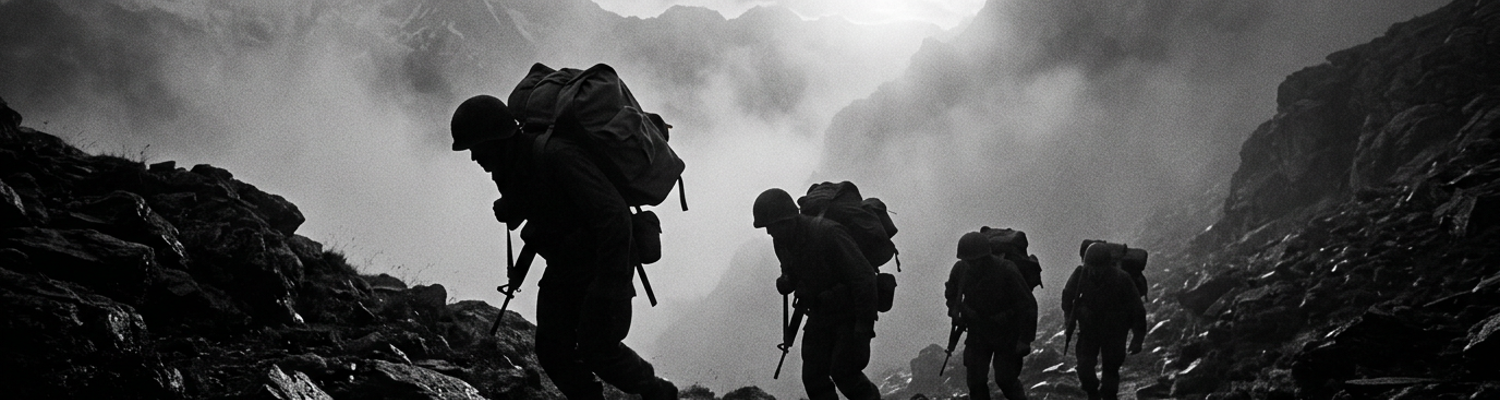
Survival required scaling vertical limestone under sustained daylight air attacks. When examining the historical record, Allied intelligence teams fell in beside the First Proletarian Division to execute an organized fighting withdrawal into the Dinaric Alps. German motor columns belonging to the 7th SS Mountain Division Prinz Eugen pressed eastward from Bosanski Petrovac, attempting to close the mountain defiles. Rearguard defense fell directly to the 3rd Krajina Assault Brigade. Their squads occupied natural rock parapets above the Unac gorge with water cooled heavy Maxim guns and captured German MP 40 submachine guns. Allied personnel traversed the sheer stone inclines of Mount Klekovaca, ascending past the 1600 meter tree line along goat trails littered with loose scree. Men hauled pack mules laden with surviving SSTR-1 transceivers and emergency battery packs up forty degree slopes. Luftwaffe Henschel Hs 126 spotter planes circled overhead, calling in mortar barrages whenever dust plumes betrayed movement.
A close review of operational logs indicates that the mixed withdrawal column marched forty five miles across waterless karst expanses toward designated emergency extraction strips in the Kupres polje.
Limestone sinkholes and subterranean fissures swallowed draft animals that stumbled off the unpaved tracks connecting Potoci and Mliniste. Operatives drank pooled rainwater filtered through cloth uniforms, rationing hard biscuits as German blocking detachments from the 373rd Croatian Infantry Division engaged their northern flanks. The Allied teams moved exclusively at night along coordinates 43 degrees 59 minutes North, 17 degrees 17 minutes East. They used hand drawn maps to plot their march across the treeless karst plateau approaching the Kupres basin. Scouts marked out a flat six hundred yard grass expanse near the village of Bajramovci. They cleared rocks by hand to prepare a temporary landing surface for incoming Dakota transport aircraft from Bari. Signal fires of kerosene soaked straw were prepared along the edge of the Kupres airstrip at dawn on June 3.