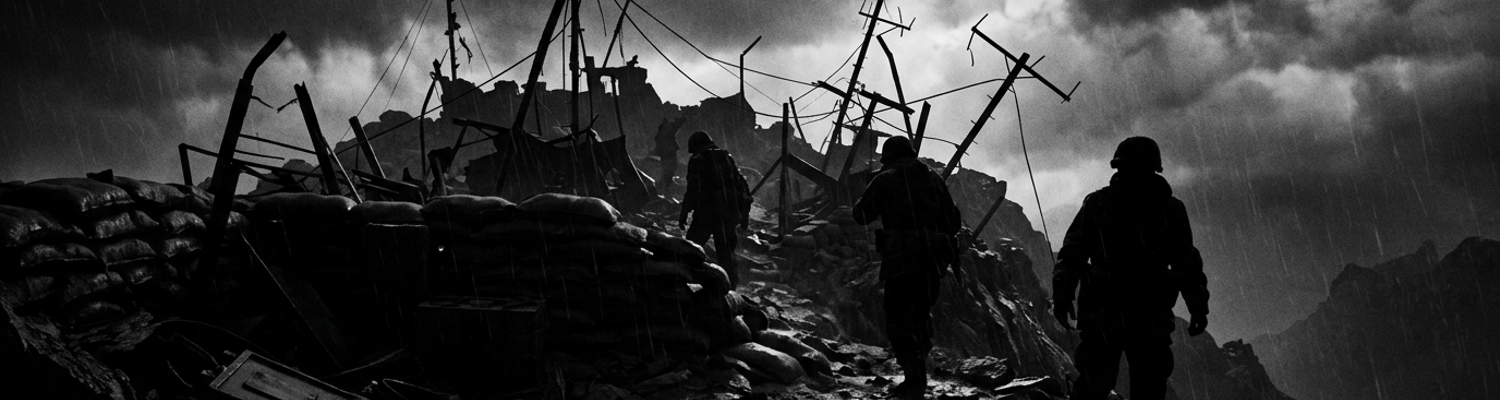

Operation Mameluke Thrust and Charlie Ridge Geography
Rotor wash from a Sikorsky CH-53 Sea Stallion sheared the jungle canopy back over the razorback edge. Aluminum mast guy wires snapped before the skids touched granite. Shrapnel from incoming 82mm mortar rounds tore through an unbolted AN/MRC-62 radio terminal housing. Scorched Freon vented into the wet mountain air. Two riggers fell into the ravine. Static drowned out the tactical command net across three infantry battalions below. An emergency deployment meant to establish a high-altitude transmission footprint disintegrated in less than ninety seconds. Grease, burning hydraulic fluid, and battery acid seeped into the crushed rock around the primary landing pad. Downslope, North Vietnamese Army automatic weapons fire ripped through the lower transport sling. Three thousand pounds of gasoline generators dropped into the brush.
The ridge sat four thousand feet above the rice paddies.
A close review of operational logs indicates that this immediate chaos on the high ground threatened the foundation of Operation Mameluke Thrust. The 1st Marine Division launched the offensive on May 18, 1968. It targeted deep enemy staging complexes situated twenty-five miles west of Da Nang. General Donn J. Robertson directed multi-battalion sweeps. He committed elements of the 5th Marines, 7th Marines, and 26th Marines across the rugged river corridors flanking Happy Valley and the Song Vu Gia. Intelligence assets had pinpointed base areas belonging to the North Vietnamese Army 2nd Division and the 368B Rocket Regiment. These units were using the ridgelines to stage 122mm rocket strikes directly against Da Nang Airbase. Marine infantrymen faced sheer slopes rising at sixty-degree angles. Triple-canopy jungle blocked ordinary radio traffic from penetrating back to command posts at division headquarters. Without continuous fire support coordination, field batteries stationed at An Hoa could not deliver counter-battery barrages to shield maneuvering rifle companies.
Terrain severed the command chain.
Archival evidence shows that overcoming this masking effect required deploying a specialized detachment from the 5th Communication Battalion directly onto Charlie Ridge in mid-May 1968. This unit was commanded out of Marine Corps Base Camp Pendleton and operated under Force Logistics Command. They hauled AN/TRC-27 microwave radio terminals, heavy lead-acid battery banks, and fragile multiplexers into the mud of Hill 1062. Marine signalmen were pushed onto an isolated, cloud-choked knife-edge flanked by deep ravines. They worked under unrelenting sniper fire to anchor fifty-foot antenna poles into solid rock with hand drills. Diesel generators had to be stripped down into individual components. These parts were winched up slippery shale cliffs by hand and reassembled using field wrenches while enemy mortar crews registered the coordinates of the clearing. Battalion engineers calculated that an elevated relay atop Charlie Ridge would maintain line-of-sight microwave links across eighty miles. This bridged isolated rifle companies to the 1st Marine Division combat operations center at Da Nang.
Every transmitter drew mortar fire.
When examining the historical record, the performance of this hilltop link dictated whether the tactical defensive perimeter could absorb the coordinated attacks of the Mini-Tet offensive. Enemy regiments initiated renewed assaults on May 5. They saturated allied installations across Quang Nam Province with heavy artillery barrages and ground incursions. Infantry units fighting deep in the ravines found their PRC-25 manpack radios completely blocked by sheer limestone bluffs whenever they attempted direct contact with Da Nang. The high-altitude relay site converted these dead zones into active circuits. It routed ultra-high-frequency traffic directly above the terrain barriers to coordinate close air support strikes by Marine A-6A Intruders and F-4B Phantoms. During the peak fighting around the Thuong Duc corridor, the Charlie Ridge relay maintained twelve dedicated voice channels and six teletype circuits without interruption for forty-eight consecutive hours. Enemy sappers from the 31st NVA Regiment closed to within fifty meters of the perimeter wire at midnight on May 22. They detonated satchel charges against the lower diesel fuel depot.
Multichannel Radio Relay Equipment and Logistics
Archival evidence shows that mounting heavy equipment on Charlie Ridge forced the 1st Marine Division communication officers to gamble on the AN/MRC vehicular radio relay systems. Rather than relying on fragile manpack sets, technical crews pushed these truck-mounted terminals directly into the forward assault footprint. Technicians operated the AN/MRC-62. This was a mobile ultra-high-frequency carrier station designed to bolt inside the bed of an M151A1 quarter-ton utility truck. Transporting the vehicles intact proved mechanically impossible when low-hanging cloud decks forced cargo helicopters to drop their sling loads short of Hill 1062. Marine detachment specialists dismantled the shock-mounted radio racks from the vehicle bodies at the base staging area in An Hoa. They uncoupled the RT-196 transmitter-receivers, TD-660 multiplexers, and 24-volt electrical alternators. Field mechanics unbolted heavy steel baseplates and transferred hundreds of individual electronic vacuum tubes into canvas gear bags. Rebuilding the vehicle-borne terminal configurations by hand inside wet canvas tents exposed raw soldering points to ninety-degree heat and dense mountain moisture. Internal insulation degraded and shorted primary transformer coils within hours of power-up.
Heavy iron components slipped into the ravines.
A close review of operational logs indicates that the physical burden of manhandling communications shelters up the steep rock faces pushed signal detachments to total bodily exhaustion. Marine technicians could not rely on heavy tracked vehicles or tractor winches along the seventy-degree shale chutes flanking the northern approaches to Charlie Ridge. Crews confronted the unyielding bulk of the S-250 equipment shelters. These were rigid aluminum enclosures weighing over two thousand pounds when loaded with line amplifiers, patch bays, and terminal equipment. Riggers from the 5th Communication Battalion improvised drag sleds by lashing split bamboo logs beneath the shelter corners. They threaded five-eighths-inch steel tow cables through forward lifting rings. The Marines worked in squads of eight men tied together by nylon climbing webbing. They anchored snatch blocks into cracked limestone boulders with star drills and cold chisels. Every five yards of elevation gained required manual hauling against greasy granite faces. Falling rocks stripped bark from trees and sheared through telephone drop wires. Men strained against hand-operated come-along winches until hydraulic seals popped. Gear ratchets stripped out under the dead weight. Shelter boxes were left dangling over five-hundred-foot drops.
The weight broke human muscle.
When examining the historical record, establishing secure multichannel links back to III Marine Amphibious Force headquarters required precise alignment of high-gain directional antennas across twenty-five miles of open valley. From Camp Horn in Da Nang, III MAF commander Lieutenant General Robert E. Cushman Jr. required uninterrupted voice trunks to track multi-regimental movements between Happy Valley and the Laotian border. Signalmen anchored fifty-foot mast sections using guy wires staked into wet soil. The ground gave way under forty-knot ridge gusts. Marines utilized the twelve-channel voice capacity of the AN/MRC-62 systems. They linked the radio relay directly into AN/TCC-7 telephone carrier terminals to multiply traffic lines across the tactical network. Technicians routed secure high-speed teletype circuits using KW-7 crypto units. These machines demanded steady line voltages that fluctuating gasoline generators could barely provide. Radio operators rotated directional corner-reflector arrays by fractions of an inch. They used hand-crank adjustments to peak signal margins while enemy 82mm mortar fragmentation slashed through coaxial feeds.
A single dropped frequency broke the entire command grid.
Maintenance logs from May 24 reveal that moisture within the S-250 terminal shelters degraded receiver sensitivity to minus eighty-five decibels. This cut three of the twelve primary voice trunks running between Charlie Ridge and the III MAF combat operations center. Wiremen worked through incoming rocket fire to strip back oxidized copper wiring on the TD-660 channel combiners. They restored battery power across the main patch panel at 0340 hours.
Combat Camera Documentation on the Perimeter
Archival evidence shows that an embedded photographer from the 1st Marine Division Combat Information Bureau reached Hill 1062 on May 20. He carried two primary camera systems into the signal compound. Hanging from his web belt was a 35mm Leica M3 rangefinder fitted with a 50mm Summicron lens. It was packed inside a rubberized waterproof bag to protect its mechanical shutter from rain. Slung across his chest was a clockwork Bell and Howell Filmo 70 16mm motion picture camera equipped with a three-lens rotating turret. Sand and crushed shale constantly threatened to foul the spring-wound motor assembly. The operator was forced to hand-crank the mechanical drive mechanism behind sandbag revetments between shooting sequences. High mountain humidity regularly condensed across the front optical elements. This required continuous cleaning with lens tissue before the emulsion surface of the daylight-loading film rolls could fog. The photographer worked with Tri-X panchromatic black-and-white stock rated at ASA 400. He captured high-contrast images of signalmen clearing splintered bamboo to make room for generator frames.
Shutter curtains degraded rapidly in the heat.
A close review of operational logs indicates that the motion picture footage recorded the rapid degradation of troop stamina. Ambient temperatures across Charlie Ridge reached 108 degrees Fahrenheit. Men belonging to the communications security detachment worked without shirts. They exposed skin covered in severe heat rash and weeping open sores caused by continuous friction against web gear. North Vietnamese 82mm mortar strikes repeatedly severed the lower footpaths to local water collection points. The detachment was forced to cut individual daily rations down to a single plastic canteen per man. The Bell and Howell captured Marines stumbling under the weight of ninety-pound wet-cell lead batteries. Their hands shook from severe electrolyte depletion as leg muscles locked in painful cramps. Navy corpsmen were filmed inserting intravenous needles filled with normal saline solution into the arms of collapsed radio technicians lying flat on poncho liners beneath the radio antennas. At least nine Marines suffered acute heat prostration during the midday hours of May 21 alone. Their body temperatures spiked past 104 degrees while supervisors poured warm water over their shaved heads.
Canteens ran dry by noon.
When examining the historical record, the motion picture rolls and still contact sheets focused primarily on the installation of triple-strand concertina wire along the exposed northern perimeter. Enemy spotters from the 31st North Vietnamese Army Regiment occupied high ground across the draw. They tracked every movement on the forward slope through binoculars and directed intermittent sniper fire against working parties. Marines had to drive heavy steel U-shaped pickets into the shale with eight-pound sledgehammers. They alternated between strikes and dropping flat to avoid 7.62x54mm rounds fired from distant tree lines. The 35mm Leica documented wiremen crawling through thorn bushes on their elbows. They pulled razor wire coils taut with heavy leather work gloves while dragging trip-flares and M18A1 Claymore anti-personnel mines behind them. Enemy fire repeatedly severed the guide wires. Soldiers were required to re-tie loose strands with linemans pliers while exposed on sixty-degree rock faces.
Snipers fired every time a hammer struck steel.
Still frames from the second 36-exposure film magazine preserved the positioning of the defensive perimeter exactly forty yards outside the main multichannel antenna farm. Wire teams completed four separate belts of standard concertina wire by the afternoon of May 23. They secured the lower apron stakes directly into rock fissures using cold chisels and explosive ramset charges. Shrapnel from a 122mm rocket explosion punctured the photographers Bell and Howell lens housing during the final roll. Fragments lodged in the empty film chamber while the exposed negative canisters were evacuated south on a returning Sikorsky CH-46 Sea Knight at 1615 hours.
Artillery Bombardment and Severed Tactical Links
Archival evidence shows that by midday on May 25, North Vietnamese Army gun crews had calculated the exact firing data required to hit the narrow peak of Hill 1062. Spotters from the 368B Rocket Regiment occupied concealed observation posts along the higher ridgelines across the Song Vu Gia basin. They tracked radio antenna reflections with tripod-mounted periscopes. Enemy gunners began registration fire using single 85mm D-44 divisional guns and 122mm field howitzers dug into the reverse slopes of Charlie Ridge, four miles west of the Marine redoubt. White phosphorus spotting rounds burst fifty yards short of the rocky crest. Burning chemical plumes were thrown against the bare granite faces. Forward observers walked impact points up the sixty-degree slope in fifty-meter corrections. They timed flight trajectories to bracket the Marine communication clearing. By 1330 hours, mixed batteries of 120mm heavy mortars joined the bombardment from camouflaged pit positions inside the Happy Valley draw. They launched fin-stabilized high-explosive ordnance along steep plunging arcs. Shrapnel sliced through sandbag parapets, showering generator positions with razor-sharp steel.
Shell splinters sheared every aluminum antenna mast on the western perimeter down to jagged stumps.
A close review of operational logs indicates that at 1410 hours, two delay-fuzed 122mm artillery rockets struck the primary AN/MRC communications facility. The shelter was an S-250 aluminum enclosure containing the AN/MRC-62 ultra-high-frequency radio terminal. It suffered direct structural penetration through its reinforced ceiling panels. Detonation inside the confined equipment bay tore the electronics racks clean off their heavy shock mounts. RT-196 transceiver chassis were ripped into distorted fragments. High-voltage transformers ruptured, spraying superheated polychlorinated biphenyl oil over the TD-660 channel multiplexers. This triggered immediate internal electrical fires. Copper buss bars melted beneath twenty-four-volt short circuits. Primary junction boxes burst apart under concussive overpressure. Signal technicians attempting to pull dead operators from the wreckage found the shelter doors wedged shut by warped exterior framing. Carbon dioxide fire bottles discharged inside the compartment failed to control the chemical fire. The primary transmission links that connected the 1st Marine Division combat operations center to frontline infantry battalions in Happy Valley were consumed.
Burning insulation filled the sandbag trenches with acrid black smoke that blinded the surviving technicians.
When examining the historical record, the annihilation of the multichannel radio shelter forced the Marine detachment to depend on field landlines. Miles of twin-conductor WD-1/TT infantry telephone wire had been unspooled by hand down the sheer shale cliffs. The wire dropped toward company command posts belonging to the 7th Marines and supporting 105mm artillery batteries. Shrapnel from air-bursting 82mm and 120mm mortar rounds raked the rocky draws. The plastic insulation was sliced and the inner steel-copper conductors were severed every few paces. Wire teams from the 5th Communication Battalion crawled into open ravines carrying TL-13-A linemans pliers and rolls of black friction tape. They attempted to splice broken leads while automatic weapons fire swept the rock face. Rockslides triggered by repeating secondary explosions dragged hundreds of feet of tangled wire down the gorge. Freshly repaired splices snapped and terminal junction blocks were pulled out of forward infantry foxholes. Field telephones yielded nothing but open-line buzz. Isolated rifle platoons along the lower ridges were cut off from fire direction centers.
Repair crews documented twenty-two separate line ruptures along a four-hundred-meter section of wire by dusk.
Cryptographic Protocol Breakdown and Perimeter Isolation
Archival evidence shows that the 122mm rocket strike on the Hill 1062 communication shelter eliminated the detachments ability to transmit secure tactical traffic. Inside the burning S-250 aluminum enclosure, concussive force sheared the shock-mounting bolts holding the primary TSEC/KW-7 cryptographic teletype units to the electronics racks. High-voltage power surges arced across the logic boards. Delicate germanium diode arrays fused and solid-state circuit cards turned into scorched ash. Fire consuming the floor compartment destroyed the secondary TSEC/KY-38 NESTOR speech security hardware before technicians could disconnect the 24-volt direct-current supply lines. Rotor assemblies and permuted code disks inside the reserve cipher boxes warped under temperatures exceeding one thousand degrees. The physical keying mechanisms were rendered mechanically inoperable. Signalmen pulled three surviving AN/PRC-25 manpack transceivers and two vehicle-mounted RT-524 sets out of the smoldering trench line. Every single automated encryption module on the razorback ridge lay melted in the rubble. Without functional decryption matrices or intact paper key lists, the signal detachment lost all technical capability to scramble outgoing voice signals.
The radio racks contained only melted copper and charred diodes.
When examining the historical record, this hardware destruction collided directly with strict Marine Corps communications security regulations. Fleet Marine Force operational standing operating procedures and directives from Commander Naval Forces Vietnam strictly forbade unencrypted voice broadcasts of tactical target coordinates, defensive unit positions, and artillery call signs over combat radio nets. Communications security monitors from the Naval Security Group routinely surveyed high-frequency and ultra-high-frequency traffic across I Corps. They noted unauthorized plain-language speech for immediate administrative discipline. Operational planners enforced this ban because the North Vietnamese Army 403rd Radio Reconnaissance Battalion maintained intercept stations throughout the Annamite Range. They scanned open frequencies to plot American coordinates. Intercepted coordinates allowed enemy mortar crews to retarget allied positions within four minutes of an unencrypted transmission. Radio operators understood that breaking encryption protocols constituted a serious violation of the Uniform Code of Military Justice. This brought automatic court-martial charges against any detachment commander who deliberately authorized voice transmissions in the clear. Signalmen sat beside functioning VHF transmitters, silenced by standing orders while frontline battalions below operated blind.
Regulations treated unencrypted radio coordinates as treason.
A close review of operational logs indicates that this doctrinal gridlock became an immediate crisis as daylight faded over the Song Vu Gia valley at 1845 hours. Sapper companies from the 31st North Vietnamese Army Regiment emerged from the bamboo-choked ravines beneath Hill 1062 under cover of 82mm mortar barrages. Enemy assault teams pushed directly through the steep northern approach. They fired RPG-2 rocket-propelled grenades that severed the low-apron trip wires anchoring the perimeter defenses. North Vietnamese sappers threw bamboo-cased bangalore torpedoes into the protective concertina wire. Three simultaneous breaches were detonated through the outer defensive barrier twenty yards from the surviving sandbag redoubts. Automatic riflemen firing 7.62mm RPD machine guns poured through the severed coils. The surviving detachment technicians were pinned behind the splintered generator housings. Stick grenades landed inside the lower parapet. Two Marine riflemen were struck in the eyes by flying rock fragments while small-arms fire chewed through the remaining antenna guy wires. Enemy infantry reached the secondary sandbag line, forty yards from the battalion command bunker.
Overrun of the razorback crest was twenty yards away. At 1902 hours, enemy sappers detonated a satchel charge against the southern defensive bunker. The last hardwired field telephone link to the mortar pit was severed.
Unencrypted High-Frequency Broadcasts Under Fire
A close review of operational logs indicates that at 1904 hours, the detachment commander deliberately overrode standing Fleet Marine Force communications security directives. Automatic weapons fire swept across the shattered sandbag parapet. Only three functioning riflemen were left to guard the command bunker. He bypassed the destroyed cryptographic bays and connected a 24-volt nickel-cadmium battery pack to a surviving AN/PRC-47 high-frequency transceiver resting in the mud. Standing military orders strictly mandated court-martial prosecution under the Uniform Code of Military Justice for transmitting clear-text positional data over unsecured tactical radio nets. Detachment personnel had been instructed to destroy all communication components with M14 thermite grenades rather than permit plain-language broadcasts that could expose allied operational plans. The officer set the frequency selector knobs to the 1st Marine Division Tactical Air Direction net at 6.8 megahertz. He seized the M-29 carbon microphone without requesting clearance from higher headquarters at Camp Horn. Heavy static and continuous 82mm mortar detonations filled the audio background. He pressed the push-to-talk bar. He discarded authorized phonetic call-sign authentication and transmitted operational speech directly into the open air.
The officer accepted personal legal destruction to prevent perimeter slaughter.
Archival evidence shows that standard Marine Corps operating doctrine required every target coordinate to pass through manual shackle-cipher encoding tables before transmission. Communication security procedures mandated using KAG-29 key sheets or M-209 mechanical cipher machines. These converted six-digit Universal Transverse Mercator grid coordinates into five-letter nonsense groups. This process routinely added twelve to fifteen minutes of encoding, transmission, and decryption delays at the Direct Air Support Center at Da Nang Airbase. North Vietnamese sappers were already throwing stick grenades into the inner concertina wire sixty feet away. The commander calculated that standard procedural delays would deliver allied ordnance onto an overrun position. He broadcast raw coordinates for danger-close emergency air strikes over the open high-frequency circuit. He spoke the exact six-digit coordinates AT 884 652 without numerical transposition. He demanded high-explosive ordnance delivery within thirty meters of his own parapet. Flight controllers at the 1st Marine Aircraft Wing copied the unencrypted coordinates in real time. They routed two circling McDonnell Douglas F-4B Phantom II jets loaded with Mark 82 Snakeye 500-pound retarded bombs and 20mm nose cannons straight toward the mountain crest.
Speed replaced security on the tactical net.
When examining the historical record, this open high-frequency broadcast acted as a homing transmission across the northern valleys of Quang Nam Province. High-frequency groundwaves cut through limestone ravines, reaching orbiting strike aircraft within seconds. Skywaves refracted off the ionosphere across hundreds of miles. Responding Marine aviators calibrated their weapon sights to the raw grid coordinates without spending minutes decrypting shackle codes. Listening posts operated by the North Vietnamese Army 403rd Radio Reconnaissance Battalion monitored the identical tactical frequency using Chinese Type 751 receiving sets. Intercept operators logged the exact coordinates of the Marine command redoubt. They relayed them by field telephone to concealed mortar pits in Happy Valley. Within ninety seconds of the open broadcast, North Vietnamese 82mm and 120mm mortar crews adjusted their bipods. They dropped fragmentation rounds squarely onto the coordinates the Marine officer had transmitted. Sapper commanders on the ridge recognized that the American redoubt had requested immediate ordnance on its own perimeter. They ordered two follow-up infantry platoons to sprint through the wire breaches to close the distance to the Marine defensive positions before strike aircraft arrived.
Two F-4B Phantoms rolled in from four thousand feet at 1909 hours with their master arm switches hot.
Perimeter Relief and Signal Doctrine Reevaluation
Archival evidence shows that at 1911 hours, two McDonnell Douglas F-4B Phantom II strike aircraft assigned to Marine Fighter Attack Squadron 542 descended through the cloud base over Charlie Ridge. The lead aircraft dived at four hundred knots along the northern ridgeline axis. It released four Mark 82 Snakeye 500-pound high-explosive bombs fitted with mechanical retarder fins. The ordnance detonated twenty-eight meters outside the detachments primary concertina apron. Thousands of steel fragments scattered into the exposed rock gully where sixty sappers of the North Vietnamese Army 31st Regiment were staging their final rush. Expanding blast fronts obliterated the assault squads in the breach. Seconds behind the leader, the wingman triggered three-second bursts from an underslung 20mm SUU-23/A gun pod. The rounds impacted the shale draws at six thousand rounds per minute. High-explosive incendiary projectiles ignited discarded canvas web belts. Enemy stick grenades exploded inside their satchel harnesses. Flying rock fragments tore into the Marine trench line while the concussion blew surviving sappers backward into the four-hundred-foot ravine below. The final infantry assault halted at the burning ridge crest.
Blast overpressure collapsed the detachments remaining forward fighting holes into crushed slate.
A close review of operational logs indicates that the detachment paid for the defense of the crest with severe physical destruction. By 2030 hours, twelve of the twenty-two Marines stationed on Hill 1062 were confirmed wounded in action. Four radio operators and wiremen lay dead behind the smoldering generator revetment. Navy corpsmen worked inside the ruined S-250 equipment shelter under red-lens flashlights. They treated compound fractures, shrapnel penetrations, and ruptured tympanic membranes caused by friendly bomb blast overpressure. Fragment strikes had severed the main fuel lines of the surviving diesel generators. The rocky redoubt was coated in slick lubricants that caught fire from burning insulation. Three technicians suffered deep chemical burns after acid from ruptured lead-acid storage cells sprayed their faces and legs during the bombardment. Surviving riflemen stacked sandbags over fractured rock fissures to establish secondary fighting positions. They anchored their M60 machine guns onto splintered ammunition crates. The small force maintained control of the razorback peak. They denied North Vietnamese spotters the elevated line-of-sight required to direct 122mm rocket strikes into Da Nang Airbase.
Six unwounded Marines manned the perimeter through the night.
When examining the historical record, the deliberate transmission of clear-text coordinates triggered an administrative conflict at III Marine Amphibious Force headquarters. Naval Security Group monitoring stations operating at Camp Horn had recorded the 6.8-megahertz broadcast. They logged the transmission of raw Universal Transverse Mercator grid coordinates as an actionable breach of Department of Defense communications security regulations. Fleet Marine Force operating orders dictated automatic suspension of command and formal court-martial proceedings for any officer who passed tactical targeting coordinates over unencrypted combat circuits. 1st Marine Division operational staff pushed back against disciplinary action. They presented radio logs showing that calculating shackle-cipher matrices would have delayed close air support delivery by fourteen minutes. That calculation proved decisive during the formal review convened by Lieutenant General Robert E. Cushman Jr. in early June 1968. Operational analysts concluded that standard manual encryption protocols created catastrophic vulnerability during danger-close perimeter breakthroughs. III MAF staff drafted an explicit battlefield exception framework.
Operational directives across I Corps were officially altered on June 6, 1968. III MAF promulgated revised tactical communication guidelines authorizing isolated detachment commanders facing imminent overrun to transmit unencrypted grid coordinates directly to orbiting strike aircraft.