
The Fortress of Rabaul
The Japanese defensive network on New Britain was not a system of simple trenches. It was a subterranean fortress, an exercise in attritional engineering designed to bleed an invading force dry. Post-war surveys (NARA Record Group 38) document hundreds of miles of tunnels carved into the volcanic rock and soil of the Gazelle Peninsula. These were not crude shelters. Using the forced labor of prisoners and local populations, Japanese engineers constructed multi-level underground barracks, hospitals, command centers, and ammunition depots. Some chambers were four stories deep. Near the surface, defensive positions were built from layers of coconut palm logs, scavenged steel plates, and reinforced concrete. This was all covered by deep layers of earth and the fast-growing jungle canopy, rendering them almost invisible from the air. Gun emplacements were sited for interlocking fields of fire, often built directly into the steep ridges of the local terrain or the walls of the Simpson Harbor caldera. The entire system was designed to absorb Allied air and naval bombardment, preserving the fighting strength of the over 97,000 men of the Eighth Area Army for an inevitable ground invasion.
A Naval Weapon Against Land Targets
The Grumman TBF Avenger was a weapon built for a different kind of war. Its operational doctrine centered exclusively on the anti-shipping role. It was conceived as a carrier-based torpedo bomber, designed for long-range flights over open ocean to find and attack enemy fleets. Its large internal weapons bay was shaped specifically to carry a single 2,000-pound Mark 13 torpedo. As an alternative, it could hold four 500-pound bombs. Training for Avenger crews in 1942 and 1943 revolved around naval target identification, over-water navigation, and the precise mechanics of a torpedo run against a moving warship. Attacking static land targets was an afterthought in its design.
The aircraft was stable and durable, but it was not a dive bomber built for pinpoint accuracy. It was a naval weapon, and its introduction to the land campaigns of the Southwest Pacific was a case of adapting existing tools to a new and unforeseen problem.
Initial strikes against New Britain’s fortifications proved the mismatch. Operational logs from Marine Torpedo Bombing Squadrons flying from island airfields show a pattern of ineffectiveness. An Avenger would acquire a suspected bunker and release its standard ordnance, typically one or more 500-pound general-purpose bombs. These weapons, with thin casings and instantaneous fuzes, were designed to blast apart the unarmored superstructures of ships or create fragmentation damage against exposed troops. Against the layered defenses of Rabaul, they were nearly useless. The bombs detonated on the surface layer of logs and earth, creating an impressive but shallow crater. The blast expended its energy upwards and outwards, shredding vegetation but failing to penetrate the core structure. For the Japanese soldiers garrisoned inside, the experience was violent and deafening, but survivable.
The Demand for Demolition Ordnance
The repeated failures of standard bombs drove flight leaders and squadron commanders to a clear conclusion. They needed larger, more powerful ordnance designed not for fragmentation, but for pure demolition. A close review of operational logs from Marine Torpedo Bombing Squadrons (VMTB) flying from Bougainville and Munda shows a consistent and urgent demand for 1,000-pound and even 2,000-pound bombs. The Avenger's large weapons bay, designed for a heavyweight torpedo, could theoretically handle such a load. The request was not simply for more weight, but for a different type of weapon. Crews needed bombs with thick, hardened steel casings capable of penetrating the top layers of earth and logs before detonation. They required delayed-action fuzes, chemical or mechanical timers that would trigger the explosion a fraction of a second after impact. This would allow the bomb’s momentum to carry it deep into the target. The AN-M65 1,000-pound general-purpose bomb, with its 530-pound TNT or Amatol filler, was identified as a potential solution. Its blast, if initiated underground, would create a heaving effect designed to shatter concrete and collapse subterranean chambers from within. This was a fundamental shift in thinking, moving the Avenger toward the role of a heavy assault bomber.
This demand was a direct consequence of the specific defensive architecture at Rabaul. The anti-aircraft artillery positions ringing the key airfields of Lakunai and Vunakanau were not simple sandbag revetments. They were deeply excavated pits, reinforced with steel and concrete, then covered with feet of earth and vegetation. At the other end of the island, the battle for Cape Gloucester in late December 1943 presented a similar challenge. The Japanese defenders of the Matsuda Force had constructed a network of log-and-earth bunkers controlling the approaches to the vital airfields. A key terrain feature, dubbed Target Hill by the invading Marines, was a high-ground redoubt fortified with trenches and bunkers that commanded a clear view of the landing beaches. Initial bombardments against these positions often only rearranged the dirt.
Heavier bombs did not simply appear. The Allied supply chain in the South Pacific was a ponderous system, ill-suited for rapid tactical innovation. It was a logistical network built to support the U.S. Navy’s fleet actions, not a sustained, land-based bombing campaign. The main supply depots at Espiritu Santo and Pearl Harbor were overwhelmingly stocked with munitions for naval warfare. There was no ready stockpile of 1,000-pound or 2,000-pound heavy-case demolition bombs and their specialized long-delay fuzes in the forward areas. A request from a VMTB squadron commander on a muddy airstrip in the Solomon Islands traveled up a long chain of command, from the local air commander to COMAIRSOLS, before being transmitted to the depots in the rear. Once approved, the bombs themselves had to compete for scarce shipping space against food, fuel, medical supplies, and replacement troops. The only aircraft available in theater with the payload capacity for such ordnance was the TBF Avenger, an adaptation born of necessity.
Battlefield Engineering in the Bomb Bay
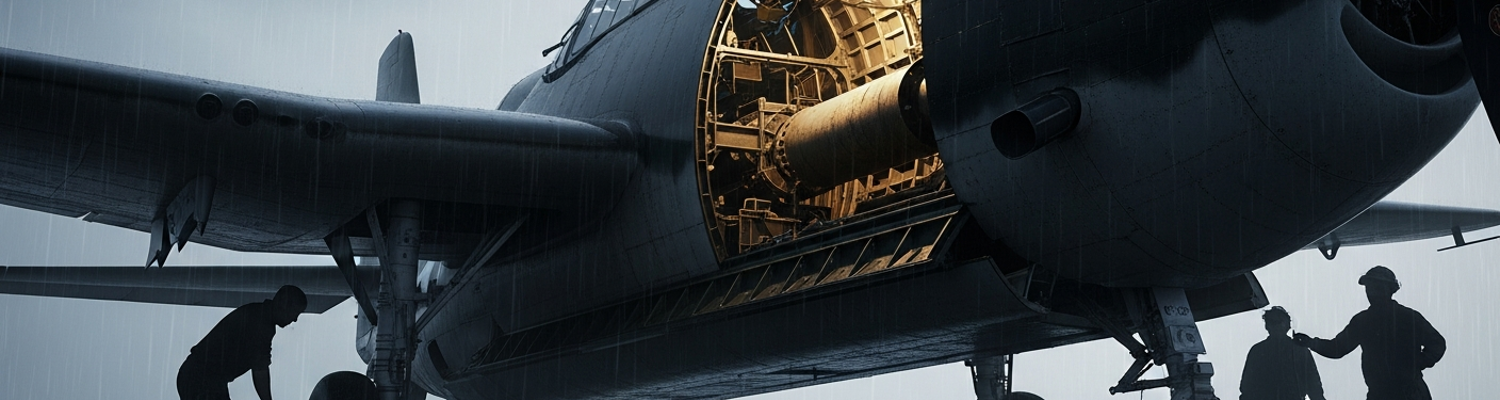
The Avenger's weapons bay was engineered to carry one Bliss-Leavitt Mark 13 torpedo. Its internal dimensions, bracing, and release gear were all built around that specific weapon. A review of the aircraft’s schematics reveals longitudinal rails and specialized torpedo crutches designed to guide and steady the weapon, with a single, central release point. To accommodate a 1,000-pound or 2,000-pound general-purpose bomb, this entire assembly had to be physically removed. On the forward airfields of the Solomon Islands and New Guinea, this was not a task for precision machinery. Maintenance crews from squadrons like Marine Torpedo Bombing Squadron 233 (VMTB-233) used hand tools, hacksaws, and brute force to cut out the torpedo-specific hardware, stripping the bay to its bare structural members.
The primary challenge was reinforcing the bay to handle the concentrated stress of a heavy bomb. A torpedo’s weight was distributed along its length. A 2,000-pound AN-M66 bomb concentrated its entire mass onto two small suspension lugs. The standard Avenger airframe was not rated for this kind of focused load. There was a real risk of the bomb tearing through the belly of the aircraft during a hard maneuver or the shock of a catapult launch. To counter this, Naval Construction Battalions, the Seabees, were called in. Working alongside the squadron’s ordnance men, these specialists applied their expertise with heavy steel. They would scrounge I-beams from captured Japanese installations or cut thick plates from wrecked ships and vehicles. These were then drilled, often with hand-cranked augers, and bolted directly to the Avenger’s central keel beam and fuselage ribs inside the weapons bay. This created new, massively reinforced hardpoints. The work was often done at night under strict blackout conditions.
Creating a secure attachment point was one problem. Ensuring the bomb could be safely released was another. The Avenger’s torpedo release was a simple mechanical system. Bomb release mechanisms required electrical solenoids and standardized shackles not part of the Avenger’s design. Ground crews became masters of battlefield cannibalization. Operational logs from the period indicate that crews would salvage the entire bomb rack assembly, including the B-7 shackles and electrical release units, from wrecked B-25 Mitchell bombers or SBD Dauntless dive bombers. The most difficult task was integrating these foreign components into the Avenger’s electrical system. An ordnance man would painstakingly splice the wiring into the pilot’s controls. A faulty connection could mean the bomb failed to drop, forcing the pilot to attempt a landing with a live two-thousand-pound bomb hung up in the bay. Each improvised system was tested relentlessly on the ground.
Wing-Mounted Ordnance and Performance Costs
The improvised bomb bay modifications solved one problem but created another. A single 2,000-pound bomb meant each Avenger could only strike one specific point per sortie. For attacking dispersed targets like anti-aircraft batteries, a single heavy bomb was an inefficient tool. The tactical demand shifted toward carrying a larger number of smaller munitions, reverting to the logic of dive bombers. The internal bay was poorly configured for multiple ejection racks. The only remaining option was to carry ordnance externally, under the wings.
Operational logs from Marine Torpedo Bombing Squadrons show the first solution involved the adoption of factory-standard wing hardpoints for carrying eight 5-inch High Velocity Aircraft Rockets (HVAR). These weapons gave the Avenger a multi-target capability. Ground crews in the field soon began experimenting with mounting bomb shackles salvaged from wrecked SBD Dauntless or SB2C Helldiver aircraft directly to the Avenger’s wing structure. This allowed a single Avenger to carry its internal 2,000-pound bomb and two additional 500-pound bombs under the wings. Other modifications were more radical, involving locally fabricated cluster bomb units, metal containers filled with dozens of 20-pound fragmentation bombs slung from these improvised wing racks.
Every pound of external ordnance altered the Avenger’s flight characteristics. The aircraft, already a heavy machine nicknamed the Turkey, became substantially more difficult to fly. The addition of wing-mounted bombs or rockets created significant parasitic drag, spoiling airflow over the wings. A clean TBF had a top speed around 275 miles per hour. Loaded with external stores, pilots reported struggling to exceed 220 mph. This made them more vulnerable to Japanese fighters and anti-aircraft fire. The increased drag also caused a massive spike in fuel consumption, which cut into the aircraft’s combat radius and loiter time over the target. Pilot debriefs from the Rabaul campaign reveal consistent complaints of handling. The external weight, positioned far from the aircraft’s center of gravity, made the controls feel heavy and unresponsive. Asymmetrical loads, occurring after firing rockets from only one wing, induced a powerful yaw and roll that a pilot had to fight constantly just to keep the aircraft flying straight.
The Erosion of the Aircrews
The psychological cost of the New Britain campaign mounted before the first bomb fell. A close review of pilot debriefs reveals a pervasive, grinding anxiety centered on the aircraft itself. Crews knew they were flying machines pushed far beyond their specified limits. The Avenger became a dangerously sluggish beast when loaded with a 2,000-pound bomb or a combination of ordnance. Takeoffs from the sodden, temporary airfields of the Solomons were a point of terror. Pilots described needing every foot of runway, the aircraft clawing for altitude at an unnervingly slow pace. The knowledge that the bomb bay doors often could not fully close, creating drag and instability, was a constant mental burden. Every mission was a flight in a semi-experimental aircraft, its structural integrity dependent on modifications made with scavenged parts in a jungle workshop.
This was a betrayal of their training. The men flying these Avengers were products of a naval aviation doctrine focused on sinking ships. Their training had revolved around over-water navigation, fleet identification, and stable torpedo runs. Suddenly, they were thrust into the role of low-level ground-attack pilots, a mission for which they had little preparation. Instead of the open ocean, the target was now a nearly invisible patch of disturbed earth on a jungle-choked ridgeline. The approach over Rabaul was a slow, agonizing flight through a dense, interlocking network of hidden guns. The shift in mission profile was psychologically jarring, replacing the calculated risk of naval warfare with the sustained terror of flying into a fixed kill-zone, day after day.
This pressure soon manifested in the crews. Medical reports and informal squadron histories from the period point to a clear rise in the symptoms of severe combat fatigue, known then as being 'flak happy' or suffering from operational exhaustion. The signs were consistent. Pilots grew irritable and withdrawn. Many suffered from insomnia or recurring nightmares. A tremor in the hands became common. The turret gunners, trapped in their exposed dorsal positions with a panoramic view of incoming tracer fire, were particularly susceptible. The constant strain led to a noticeable increase in minor operational accidents and aborted sorties for mechanical issues that, upon inspection, could not be found. This was the cumulative effect of sustained, high-stress operations with no clear end in sight.
Command Pressure and the Human Element
The decision to send men into combat with aircraft modified beyond their designed tolerances was not made in a vacuum. A review of the command structure for Allied air power in the Solomons (COMAIRSOLS) reveals a leadership group under intense pressure. The entire Allied leapfrog strategy depended on air power to neutralize Japanese strongholds and protect ground troops. When standard aerial ordnance proved ineffective against New Britain’s fortifications, the initiative from squadron-level commanders to authorize field modifications was born of desperation. The choice presented to wing and theater commanders was direct: continue with ineffective tactics and accept high casualties among the ground Marines, or approve high-risk, uncertified aircraft modifications that placed aircrews in greater peril.
They chose the latter.
This decision was a continuous calculation of risk. It was not a single order but a daily acceptance of the consequences. A squadron commander, seeing the exhaustion on his pilots' faces, also had access to frantic requests from ground units pinned down by bunker fire. The operational necessity of destroying a specific Japanese position holding up an entire infantry advance almost always outweighed the known mechanical risks to the aircrews. Archival records show a command structure that, while aware of the increased rate of in-flight emergencies and the psychological toll on the crews, saw the modified Avengers as the only available tool for the job. The alternative, allowing the ground campaign to stall, was considered a far greater failure.
Formal measures to mitigate the crushing psychological stress were almost nonexistent by modern standards. There were no deployed psychiatric care units or formalized stress-control protocols. The primary tool for maintaining morale was leadership by example. Squadron commanders who flew the same dangerous, overloaded missions as their junior pilots had a profound effect. Another critical morale-booster was the combat tour system. Aircrews knew they had a finite number of missions to fly before they could rotate home. This provided a concrete goal, a light at the end of the tunnel that made the daily terror manageable. Less formally, commanders understood the importance of basic comforts. Ensuring access to mail from home, providing the best possible food, and securing beer rations were essential acts of morale maintenance in a theater where men were being systematically ground down by the operational tempo.