
Post-Cold War Naval Doctrine Gap
The Soviet Union’s collapse left the United States Navy without its primary adversary. Its organizing principle, readiness for a massive blue-water conflict, evaporated. Archival evidence shows that in response, a new vision was rapidly formulated. A 1992 white paper, titled From the Sea, and its 1994 follow-up, Forward... From the Sea, officially shifted the Navy’s focus from open-ocean combat toward power projection in the world’s littoral regions. The core concept was no longer about fighting for sea control itself. It was about using control of the sea to influence events on land.
This doctrinal shift was built upon a powerful new theoretical framework called Network-Centric Warfare (NCW). The theory proposed that by robustly networking sensors, command authorities, and weapons platforms, a force could achieve information superiority and translate it into combat power. The objective was a shared situational awareness across all units. This would allow for faster decision-making, a higher operational tempo, and a degree of self-synchronization where units could act on a commander’s intent without direct orders. Planners believed this would allow U.S. forces to get inside an adversary’s decision cycle and dictate the pace of operations. The new doctrine envisioned expeditionary forces, built around carrier battle groups and amphibious ready groups, that could provide long-range precision strikes and insert forces. This was a direct pivot from preparing for fleet-on-fleet engagements in the North Atlantic to supporting ground operations from the sea.
A close review of operational logs from the era indicates a heavy reliance on predictable conditions to validate these new concepts. Training exercises, often held in familiar operating areas like the Southern California littoral, were designed to test the mechanics of network-centric theory under controlled circumstances. These scenarios frequently assumed an environment where key enablers were not seriously contested. Planners took for granted that satellite communications would provide high-bandwidth data links. They assumed GPS signals would be available and accurate for precision munitions, and that local air superiority could be quickly established. The opposing force in these war games was typically a known quantity with understood capabilities, allowing for scripted responses that proved the effectiveness of the network. The exercises were not designed to stress-test the system against an opponent who actively denied access to the electromagnetic spectrum. The very foundation of NCW, the network itself, was treated as a utility that would simply be there, rather than a fragile battlespace that would need to be fought for.
Satellite Communication Blackout Impact
The exercise clock ticked past 03:15 Zulu. At that moment, the entire architecture of the war game disintegrated. A simulated command from exercise controllers initiated a total loss of encrypted, beyond-line-of-sight communications across the task force. On the flag bridge of the carrier and in combat information centers across the battle group, the common operational picture vanished. Displays that had been populated with hundreds of data-linked tracks and friendly unit positions suddenly reverted to showing only what a single ship’s organic sensors could detect. The flow of data from the Defense Satellite Communications System (DSCS) through the shipboard AN/WSC-6 SHF terminals ceased. The central nervous system of Network-Centric Warfare was gone.
This was not a simple comms outage. It was a doctrinal execution. The simulation was designed to stress the fleet’s reliance on the network, and the blackout was the theoretical sledgehammer. Operational logs from the event detail a failure that rippled through the force in minutes. The primary method of coordinating the widely dispersed fleet, Super High Frequency satellite links, provided the high-capacity bandwidth necessary for the data-intensive demands of the new warfighting concept. Without it, command elements were forced to revert to legacy, line-of-sight systems and lower-bandwidth high-frequency (HF) radio. The problem was that the doctrine of NCW encouraged geographic dispersion; ships were positioned dozens, sometimes hundreds, of miles apart to maximize sensor coverage. This physical separation now became a crippling liability. Pockets of the fleet could talk amongst themselves, but they were deaf to the task force commander. The commander was blind to their status.
Nowhere was this breakdown more acute than for the designated Search and Rescue alert aircraft. A detachment of two SH-60 Seahawk helicopters, callsign Angel 31 and Angel 32, was airborne. They were executing a simulated combat search and rescue profile nearly 150 nautical miles from the carrier, operating near a hostile littoral environment. Their primary link for command and control was a secure satellite channel. When the SATCOM link died, they were instantly isolated. Archival mission records show their last received transmission was a routine position update. Their next 47 minutes were spent in total electronic silence from central command. The crew had their own GPS and navigation systems, but they had lost all awareness of the larger battle space. They were flying blind into a simulated threat zone with no ability to communicate with the assets they were tasked to support.
The scramble to regain control was a frantic, ad-hoc affair. The battle group’s airborne early warning and control aircraft, an E-2C Hawkeye with the callsign Hawkeye 605, was immediately retasked from its surveillance orbit. Its mission was no longer to scan for enemy missiles but to function as a rudimentary communications relay. Flight records show the Hawkeye flew a high-speed intercept course toward the last known position of the Angel flight. It took nearly an hour to bridge the distance and climb to an optimal altitude where its line-of-sight radios could finally raise the isolated helicopters. The contact, when it came, was a crackle of static-filled voice communication, a regression from the high-speed data that had defined the operation just an hour earlier.
Ad Hoc Underway Replenishment Scramble
The logistical plan was doctrinally sound. At 08:00 Zulu, the destroyer USS Lassen (DDG-82) and the cruiser USS Vincennes (CG-49) were scheduled to detach from the carrier’s screen. They would proceed to pre-assigned Underway Replenishment (UNREP) coordinates, designated Point Sierra and Point Tango. There, they would meet the fast combat support ship USNS Supply (T-AOE-6) for refueling. Archival evidence shows these rendezvous points were selected based on satellite weather analysis and their position outside the theoretical engagement range of shore-based anti-ship missile batteries. The UNREP tracks were long, straight lines, designed for optimal station-keeping and safe transfer operations.
That assumption was incorrect.
An intelligence inject from exercise control at 07:19 Zulu changed the entire operational geometry. A simulated adversary diesel-electric submarine had penetrated the outer anti-submarine warfare screen and deployed a dense minefield directly across the approaches to both replenishment points. The simulated mines were bottom-moored, influence-activated types. This single act rendered the carefully planned replenishment schedule impossible. The high-value USNS Supply, a critical but vulnerable asset, could not be risked on a transit through potentially mined waters. A review of operational logs shows the task force commander immediately issued a cancellation order for the scheduled UNREPs. The ships were ordered to conserve fuel, particularly JP-5 for their helicopters, but the operational tempo of the exercise meant their reserves were already approaching cautionary levels.
The minefield was compounded by a second threat. At 09:43 Zulu, long-range maritime patrol aircraft detected multiple flights of simulated fast attack craft egressing from coastal inlets. These were small, high-speed vessels with low radar cross-sections, notionally armed with sea-skimming anti-ship missiles. Their presence transformed the littoral zone from a geographic feature into a lethal battlespace. The established UNREP tracks were now exposed as predictable kill boxes. Any large, slow-moving replenishment ship attempting a traditional side-by-side transfer would be a stationary target for a swarm attack. The logistics ships, the lifeline of the fleet, were now the primary liability, drawing the carrier’s escorts away from their main defensive duties.
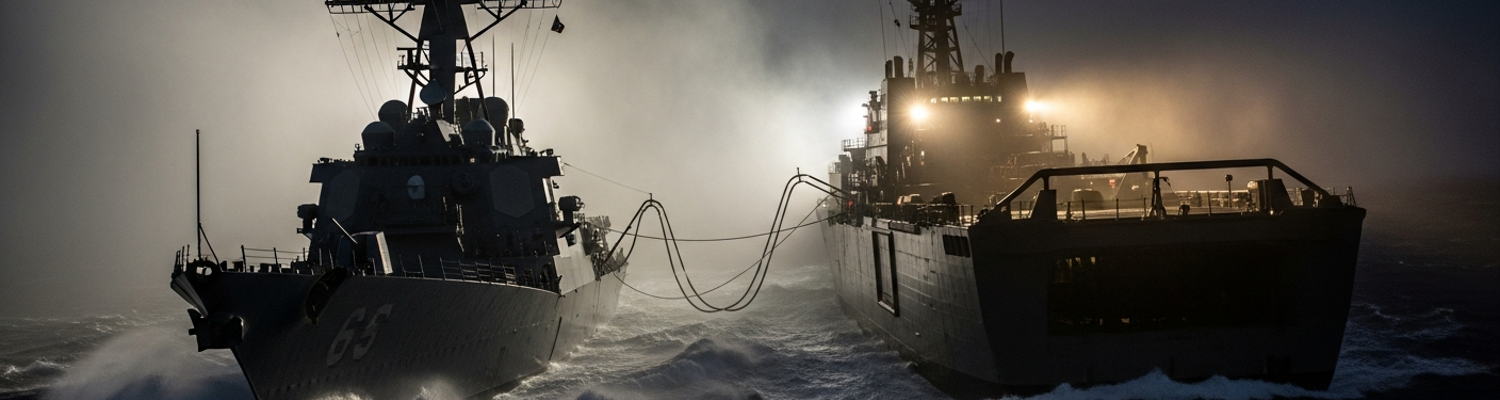
Improvisation became the only course of action. With the Supply too valuable to risk, command authority designated a secondary auxiliary vessel for a high-risk resupply mission. The fleet ocean tug USNS Catawba (T-ATF-168), a vessel designed for towing and salvage, was ordered to load a limited quantity of fuel bladders. The plan was a sprint-and-drift transfer. The Catawba and the destroyer USS Lassen would rendezvous in a randomly selected sea lane, far from the compromised UNREP points. They would conduct the transfer at night, under strict emissions control, and for the minimum possible duration. Deck logs from the Lassen detail the difficulty of the evolution. The Catawba lacked the sophisticated station-keeping equipment of a fleet oiler, making the 180-foot separation between the ships a constant struggle for the helmsmen. The fuel transfer rig was a jury-rigged assembly. The rougher seas in the unsheltered location caused the hoses to part twice, spilling simulated fuel and delaying the process. The entire evolution took over two hours to transfer just enough JP-5 to allow the Lassen’s helicopter detachment to resume surveillance flights.
Non-Doctrinal Special Operations Recovery
The communications blackout cascaded with severity into the special operations channels. Deep within the exercise’s simulated hostile archipelago, a four-man SEAL reconnaissance element, Scout Team Saber, was compromised. Their doctrinal recovery plan was straightforward: a Combat Search and Rescue package centered on MH-60 helicopters. But the systemic communications failure and the unexpected emergence of simulated advanced man-portable air-defense systems in the littoral zone rendered any aviation-based recovery a high-risk mission. The team was isolated, deep inside enemy territory, with its planned lifeline severed.
Extraordinary measures became the only option. A decision unsupported by doctrine.
The commander of the forward-deployed Naval Special Warfare Task Unit, operating from the submerged attack submarine USS Dallas, made the call. Archival mission logs show that at 04:55 Zulu, based on a single, heavily corrupted High Frequency burst transmission from Scout Team Saber, the commander authorized the launch of two SEAL Delivery Vehicles. These Mark VIII Mod 1 submersible craft were deployed from the submarine’s Dry Deck Shelter, a complex evolution involving flooding the chamber and manually launching the 22-foot vehicles into open water. The primary challenge was navigation in a GPS-denied environment. The SDV teams were forced to rely on their onboard Doppler Inertial Navigation System and dead reckoning. For over four hours, the four-man crews of each flooded vehicle navigated through treacherous, unmapped underwater terrain, entirely dependent on their compasses, depth gauges, and time-speed calculations.
This action was a case study in localized initiative. The Task Unit commander who launched the SDVs was operating in an information vacuum. He had no reliable link to the battle group commander and no way of knowing the status of other assets. His decision was based purely on commander’s intent and a special operations ethos to recover personnel at all costs. The communication architecture that was supposed to provide shared situational awareness had collapsed, forcing a regression to antiquated methods. Instead of the high-speed data links promised by Network-Centric Warfare, command and control was reduced to brief, difficult-to-decipher HF voice and data-burst transmissions from AN/PRC-117 series radios. This breakdown forced tactical leaders to assume significant risk based on incomplete intelligence, a scenario the new doctrine was designed to prevent.
The recovery itself required a second layer of improvisation. After successfully linking up with Scout Team Saber in a dense mangrove swamp, the SDVs faced a slow, vulnerable egress. It was at this point that a Special Boat Team element, having intercepted fragments of the HF traffic, took its own initiative. The SBT commander, positioned miles away, launched two Special Operations Craft-Riverine (SOC-R) boats. These 33-foot, high-speed craft were designed for riverine patrol, not open-coast recovery. Powered by twin diesel engines and Hamilton waterjets, the SOC-Rs could achieve speeds over 40 knots. Their only defense was this speed and the suppressive firepower from five weapon mounts, including M134 miniguns and Mk 19 grenade launchers. The plan was a high-speed hot extraction from the shoreline. The SOC-Rs raced toward the designated pickup point, a shallow, unprotected bay, while the SDVs brought Scout Team Saber to the rendezvous. The transfer of personnel from the slow-moving submersibles to the fast-attack craft was a complex maneuver, executed under simulated fire and with zero real-time coordination from higher headquarters. The successful recovery was the direct result of two separate commanders making independent, high-risk decisions based on fragmented information.
Doctrine Disconnect Operational Lessons
The central failure of the exercise was the collision between the theories of Network-Centric Warfare and the chaotic demands of a contested littoral battlespace. Naval Warfare Publication documents from the period were constructed around the assumption of information superiority. They depicted a battlespace of shared situational awareness where networked platforms could self-synchronize and execute complex plans. This exercise proved that the information itself was a target.
The network was a vulnerability.
Analysis of the after-action reports (AAR 94-07B) reveals a fleet that was doctrinally optimized for a fight it was not allowed to have. The pre-exercise briefs were filled with diagrams of data-link architecture and bandwidth allocation tables. The reality became a frantic scramble to find clear channels on HF radios. The UNREP plan, built on the principles of the Standard Tensioned Replenishment Alongside Method (STREAM), was designed for open-ocean safety, not for dodging minefields and fast attack craft. The system was designed to push decision-making authority upward, concentrating it with the commander who possessed the complete operational picture. When that view disintegrated, the doctrinal wiring of the entire task force short-circuited. The initiative demonstrated by the SDV and SBT teams was effective precisely because it was non-doctrinal; it was a reversion to small-unit autonomy born of necessity.
These findings triggered a significant shift in curriculum at key institutions like the Surface Warfare Officers School (SWOS). Where training had increasingly focused on managing information flows, a new emphasis was placed on operating in a communications-denied battlespace. Simulator training scenarios were rewritten to include sudden, cascading system failures. Instructors began forcing junior officers into situations where they had to make tactical decisions based on incomplete or non-existent data from higher command. There was a visible resurgence in what had been considered atrophied arts: celestial navigation, advanced HF radio wave propagation theory, and even visual signaling with flags and searchlights. The goal was not to abandon network-centric principles but to build a force that could function when those principles were violently disrupted.
This recalibration extended directly to operational procedures. The ad-hoc refueling between the USS Lassen and the USNS Catawba became a formal case study. It led to the development of new tactical memoranda (TACMEMO 3-21.1) for emergency replenishment under Emission Control (EMCON) conditions, acknowledging that textbook UNREPs were an unrealistic luxury in a high-threat zone. The successful SEAL recovery drove a far more profound change. The initiative shown by the submarine and special boat commanders, who acted independently, was held up as a model. This directly challenged the top-down command structure that NCW had favored. Subsequent revisions to naval doctrine began to explicitly empower subordinate commanders to deviate from the plan when it no longer matched the situation, provided their actions aligned with the overall mission objective. It was a shift away from rigid procedural adherence and toward a culture of disciplined disobedience, codified in the updated Naval Warfare Publication series.