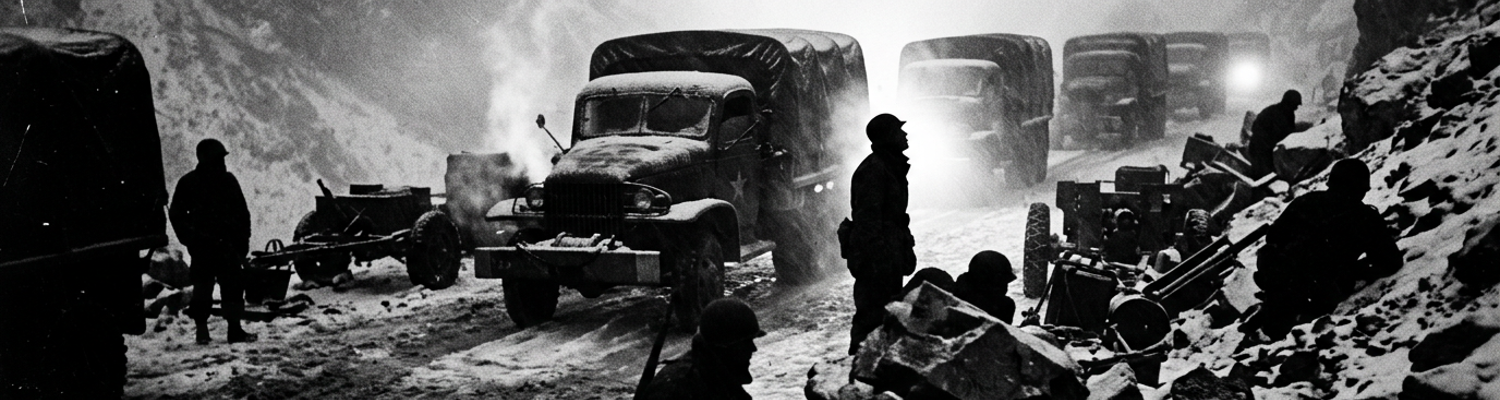

Terminal Breakdown Along the 38th Parallel
Archival evidence shows that across the jagged ridgelines of the 38th parallel in November 1945, the balance of force stood at roughly twelve to one against the Americans. North of the boundary zone, the Soviet Twenty-Fifth Army massed five rifle divisions. They deployed armored detachments and fortified border garrisons numbering over one hundred and twenty thousand personnel. To monitor this wall of manpower across one hundred and fifty miles of roadless granite terrain, the United States XXIV Corps deployed thinly stretched screening detachments from the 7th Infantry Division. Tactical intelligence screening cordons fractured almost immediately upon establishment. Battalion intelligence officers possessed no operational maps with scales finer than 1:1,000,000 captured Japanese aeronautical charts (Document File 44-A). Ground observation teams lacked functional Russian and Korean linguists. Company wire teams attempted to string communication links. Heavy sub-zero winds snapped uninsulated WD-1 field wire draped over bare rock. SCR-300 radios carried by patrol squads could not push frequency-modulated signals over high granite ridges. This created dead zones spanning thirty miles of unguarded river valleys.
The tactical screen ceased functioning before the first snow fell.
When examining the operational logs of the 32nd Infantry Regiment, the disintegration of the forward line appears as a direct mechanical breakdown. Forward observation posts situated around Yonchon and Kaesong depended entirely on single-lane dirt tracks. These dissolved into freezing mud by late October. Dodge three-quarter-ton weapons carriers stripped their transmission gears and fractured axles trying to haul supplies up thirty-degree inclines. Battery acid froze solid inside BA-70 dry cells. This silenced corps-level radio nets. Isolated forward squads faced direct pressure from Soviet border guards and armed northern partisan raiding teams. Small-arms skirmishes erupted over contested mountain saddles. Three-man American listening posts were systematically encircled and driven back. Outpost commanders along the central mountainous sector abandoned their positions under orders to avoid capture by late November. They left behind heavy water-cooled M1917 Browning machine guns. Soldiers lacked the pack animals or vehicular winches required to drag them through snow-choked ravines.
Corps commanders possessed no emergency reserve to plug the gaps.
A close review of operational logs indicates that the physical collapse along the boundary triggered a severe crisis for rear-echelon support units. At forward collection points established near Uijeongbu and Chunchon, the 56th Quartermaster Graves Registration Company detachments found themselves cut off from the main supply route to Ascom City. Frostbite, exposure, and sporadic night raids produced casualties that local aid stations could neither treat nor evacuate. Fleet mechanics reported that seventy percent of the GMC CCKW two-and-a-half-ton cargo trucks assigned to casualty evacuation sat dead on dirt tracks. They suffered from blown head gaskets and dry-rotted tires. Sub-zero temperatures froze corpses into solid masses. Medical orderlies could not fit dead personnel into standard canvas transfer bags. Battalion clearing stations stacked wooden shipping crates and frozen bodies outdoors under tarpaulins behind dirt revetments. Resupply convoys attempting to clear these backlogs ran dry of gasoline sixty miles south of the line. Mortuary personnel guarded casualties amidst recurring sniper harassment.
Medical Triage Failures at Border Outposts
The wounded died waiting for transport that never arrived.
Archival evidence shows that casualty rates spiked sharply as soon as reconnaissance squads probed the ravines north of Kaesong and along the Imjin River tributaries. Northern insurgent squads and Soviet-trained border groups laced footpaths with jury-rigged Japanese Type 93 landmines, aerial bomblets, and converted 75mm artillery shells. These were triggered by taut brass tripwires. Patrols from the 1st Battalion, 31st Infantry tripped these buried charges. The upward blast energy shattered lower extremities and severed femoral arteries. Corps surgical logs record that field medics applied standard canvas web tourniquets to traumatic double amputations. Sub-zero ambient temperatures accelerated tissue necrosis within minutes. Blood loss combined with severe hypothermia sent casualties into irreversible shock before litter bearers could negotiate the steep granite slopes. Over sixty percent of soldiers suffering blast-induced amputations perished within two hours of injury. Their vascular systems collapsed as body core temperatures dropped below eighty-six degrees Fahrenheit.
Blood supply collapsed next.
When examining the historical record of the 7th Medical Battalion, aid stations operated completely stripped of basic resuscitation fluids. Forward medical detachments supporting the 32nd Infantry Regiment near Yonchon were equipped with standard cardboard-packaged units of dried normal human plasma. Each contained a vacuum-sealed bottle of lyophilized plasma flakes and an accompanying bottle of sterile distilled water (Medical Supply Catalog Item 93421). Sub-zero mountain winds froze the liquid diluent solid inside transport crates. This cracked the glass ampoules and rendered the biological components useless. Medics attempting to reconstitute unbroken kits discovered that icy solvent could not dissolve the vacuum-dried protein cake. The solution turned into a cloudy, gelatinous mass that clogged intravenous needle filters. Resupply requisitions transmitted by courier to supply depots at Incheon went unfilled. Quartermaster depots had exhausted their pre-positioned Pacific stocks by mid-November. Isolated battalion surgeons watched men exsanguinate while pumping air into empty saline lines to clear blockages.
Evacuation chains had snapped completely.
A close review of operational logs indicates that battalion aid stations designed to hold casualties for two hours were forced to function as static field hospitals for up to three days. Single-lane evacuation tracks leading down from mountain listening posts to the regimental collection point at Dongducheon were blocked by overturned Dodge weapons carriers and heavy snowdrifts. Inside drafty canvas tents heated only by unvented kerosene lanterns, medical officers exhausted their entire allotments of sterile gauze compresses, abdominal pads, and sulfanilamide packets within forty-eight hours of steady border skirmishing. Portable Coleman instrument sterilizers failed when lead-fouled automotive gasoline gummed their burner jets. Orderly staff were unable to boil scalpel blades, hemostatic forceps, or needle holders between emergency fasciotomies. Orderlies resorted to washing blood-caked muslin dressings in melted snow over open wood fires and hanging them across tent guy-lines to dry. Without penicillin supplies or fresh antiseptics, open debrided wounds turned gangrenous inside seventy-two hours. The crowded stabilization tents filled with the stench of Clostridium perfringens infections.
Lethality of Modified Japanese Ordnance
Archival evidence shows that local partisans weaponized abandoned Japanese Imperial Army supply dumps faster than American ordnance disposal teams could map them.
A close review of operational logs indicates that partisan networks operating north of Uijeongbu scavenged thousands of Type 89 fifty-millimeter mortar rounds from underground Japanese magazines along the rail corridors. Insurgent engineers unscrewed the original percussion-primed base propellant assemblies. They replaced the standard mechanical setback fuzes with modified electric detonators. Guerrillas soldered stripped copper field wire to scavenged dry-cell batteries. They ran ignition lines over two hundred yards back to concealed firing pits behind boulder outcroppings. American reconnaissance patrols from Company B, 31st Infantry encountered these improvised weapons set inside hollowed-out tree stumps and dry stone boundary walls overlooking mountain defiles. Insurgents laid the fifty-millimeter cast-iron shells horizontally at knee level instead of firing through high-angle trajectory tubes. They packed wet clay around the baseplates to direct the blast cone across narrow rocky footpaths. The remote-triggered charges detonated instantaneously when activated by battery contact. High-velocity iron shards swept patrol columns at point-blank range before squad point men could identify the firing point.
Standard field dressings could not arrest the resulting internal hemorrhaging.
When examining the historical record of forward surgical teams, the primary trauma stemmed from altered picric acid explosive fillers. Japanese ordnance technicians originally loaded the Type 89 shell with Pressed Picric Acid. This was known as Type 88 explosive (Ordnance File 11-B). It generated a detonation velocity exceeding twenty-four thousand feet per second. Partisans modified these rounds by drilling into the explosive cores and packing supplementary black powder or ammonium nitrate mixtures to destabilize the crystalline matrix. The altered detonation dynamics shattered the brittle cast-iron casing into thousands of razor-thin, irregular metal slivers rather than uniform fragmentation bands. Surrounding tissue absorbed these sub-millimeter iron needles at supersonic speeds. Fabric fragments, toxic yellow picrate salts, and soil were driven deep into skeletal muscle beds. Surgeons at the 7th Medical Battalion clearing station near Dongducheon reported that the microscopic steel particles shredded soft tissues beyond the reach of standard surgical probes. Stainless steel forceps could not grasp or isolate the brittle slivers. They disintegrated upon contact and caused widespread secondary bleeding along deep fascial planes. The acidic chemical residue rapidly poisoned surrounding capillary networks. Unexcised wound margins turned necrotic within twelve hours of exposure.
Intelligence couriers traveled alone along the ridgeline trails.
Operational records from the 7th Counter Intelligence Corps Detachment reveal that northern infiltrators targeted the footpaths connecting isolated tactical command posts with the corps intelligence node at Ascom City. Insurgent saboteurs positioned concealed pressure-release firing devices along natural transit chokepoints. They specifically targeted routes traversed by motorcycle messengers and dismounted intelligence runners. These contraptions utilized scavenged Japanese Type 93 landmine components re-engineered with reverse-action spring strikers held under tension by surface weights. Partisans placed heavy shale slabs, fallen birch logs, or discarded American ten-in-one ration crates directly atop the release plates. Couriers attempted to clear trail obstacles or stepped onto displaced trail rocks along the ridgeline between Yonchon and Dongducheon. The removal of downward weight released spring-loaded steel firing pins into modified Japanese blasting caps. Secondary high-explosive blocks buried six inches under the topsoil detonated upward into the lower torso of the courier. The blasts obliterated leather dispatch pouches and destroyed encrypted operational overlays. Runners were killed instantly. Corps intelligence officers were left waiting for courier traffic that had vanished into the mountain passes.
Irregular Ambush Tactics and Mobile Firepower
Archival evidence shows that XXIV Corps supply lines disintegrated the moment resupply columns entered the single-lane mountain shelves north of Uijeongbu. Unarmored two-and-a-half-ton GMC CCKW trucks of the 7th Quartermaster Company operated without escort armor. Their canvas cab roofs and wooden cargo beds offered zero ballistic protection against coordinated small-arms fire. These supply trains crawled along unpaved cart tracks blasted directly into sheer granite cliffs when moving through narrow river canyons near Chunchon. The roadbed measured less than eleven feet across. Drivers had no turnaround clearance, no bypass shoulders, and vertical drop-offs exceeding two hundred feet on their flanks. Partisan spotters positioned on flanking peaks waited until convoys hit the narrowest defiles before initiating contact. A single sniper shot through an unarmored CCKW radiator core drained the engine coolant in seconds. This seized the cast-iron engine block and froze the entire twelve-vehicle column in place. Trapped drivers could neither reverse down the winding grade nor push disabled lead vehicles over the edge with underpowered bumpers.
The mountain passes became linear kill zones.
When examining the historical record of regimental maintenance detachments, American recovery teams discovered that raiders met these stalled convoys with heavy automatic weapons salvaged from abandoned Japanese military installations. Insurgent mechanics recovered Type 97 and Type 89 7.7mm flexible aircraft machine guns from dismantled Nakajima Ki-43 fighters at forward airfields. They bolted the high-rate-of-fire weapons directly to civilian cargo transports. Mechanics stripped flatbed Isuzu TX40 and pre-war Nissan commercial trucks down to bare chassis frames. They fashioned heavy pintle mounts from welded boiler pipe and reinforced the suspension leafs with scrap railroad iron to withstand violent recoil forces. Operating with cyclic rates between eight hundred and one thousand rounds per minute, these aerial guns were designed for air-to-air combat rather than ground engagements. They used high-pressure rimless ammunition that tore through American truck sheet metal. Gun crews plumbed pressurized water cans directly into custom cooling sleeves to manage extreme barrel heat generated during sustained firing passes. They fired short, five-second bursts that emptied scavenged ninety-seven-round pan magazines into the stalled convoys before rolling back behind rocky spurs.
Civilian freight trucks had been converted into armor-piercing gun platforms.
A close review of operational logs indicates that these mechanized strikes were calculated operations executed by mixed cells of northern partisans and rogue Imperial Japanese holdouts. Following the August 1945 surrender, remnants of the Japanese 17th Area Army and veteran Kempeitai field officers evaded Allied disarmament processing by melting into the rugged Taebaek mountain spine. They aligned with local communist red-guard detachments. The former Japanese personnel provided technical gunnery expertise, terrain surveying, and imperial small-unit tactical doctrine. Local partisans supplied civilian trail knowledge and village reconnaissance networks. These composite raiding units staged interlocking L-shaped ambushes from commanding rock ledges above the road bends. They communicated through bugle blasts, field runners, and mirror flashes rather than interceptable radio frequencies. The mobile gun trucks engaged the lead and trail vehicles from concealed turnouts. Dismounted assault squads armed with Arisaka Type 99 rifles and Type 99 magnetic hand grenades swept down the scree slopes to strip cargo beds of gasoline drums, winter parkas, and carbine ammunition.
Ordnance recovery details sent to extract survivors recovered nothing but stripped vehicle chassis and burned gasoline drums.
Seizure of Japanese Operational Archives
The fires had burned for three weeks before the first American search teams entered the gates.
Archival evidence shows that operatives from the 97th Counter Intelligence Corps Detachment breached the Keijo headquarters of the Japanese 17th Area Army on September 10, 1945. They found courtyards filled with smoldering incinerator pits. Japanese staff officers under the direction of Lieutenant General Yoshio Kozuki had spent the interval following the imperial surrender order carrying out systematic file purges. Soldiers fed classified paperwork into brick heating furnaces and makeshift fifty-five-gallon steel drums day and night. Carbonized paper fragments drifted across the Ryusan district, settling on nearby rooftops and clogging drainage gutters. American agents seized half-burned wooden filing crates. They pulled scorched ledger bindings directly from hot ash beds with bayonets and entrenching tools. Kerosene-soaked personnel registries, cipher matrices, and coastal radar schematics had melted into hardened clumps of tar. Chemical soot coated the stone interior corridors. Officers had destroyed room-sized wall charts detailing troop dispositions across southern Korea using benzene torches only minutes before surrender representatives arrived at the entrance gates.
Two thirds of the colonial garrison operational paperwork had been converted to ash.
When examining the historical record of XXIV Corps G-2, investigators recovered key surviving files from reinforced concrete basements beneath the staff college annex. Counter Intelligence Corps teams confiscated Kwantung Army intelligence dossiers outlining pre-war offensive plans directed against the Soviet Maritime Province and the Trans-Baikal military sector. These folders were hidden inside sealed zinc-lined dispatch footlockers. They contained operational records from the 1941 Kantokuen mobilization. The files included rail transport schedules along the South Manchuria Railway, bridge demolition blueprints along the Amur and Ussuri river corridors, and artillery range tables for static concrete emplacements overlooking Vladivostok. Staff cartographers had hand-annotated 1:50,000 scale terrain sheets with estimated Soviet Twenty-Fifth Army tank assembly zones and red-flagged ford points across frozen northern tributaries. Chemical analysts had bound these operational orders alongside technical intelligence reports detailing Soviet T-34 armor plate metallurgical weaknesses, field telephone wire tapping logs, and Red Army order of battle estimates compiled by Japanese listening posts along the border.
The seized files lay completely unread.
A close review of operational logs indicates that the recovered documents overwhelmed the administrative capacity of XXIV Corps intelligence staff. Field teams loaded eight thousand pounds of water-damaged Japanese military records into unheated boxcars on the Gyeongbu rail line. They hauled the crates south toward Ascom City supply depot. The corps possessed exactly twelve Japanese-speaking Nisei linguists certified to clear classified technical military documentation (Personnel Roster 99-J). These interrogators sat inside uninsulated supply warehouses. They used magnifying glasses to decipher handwritten kanji characters on soot-blackened paper while temperatures dropped below freezing. Damp basements caused white mold colonies to spread across brittle rice paper pages. This glued mobilization charts together into solid cellulose bricks that tore apart when handled. Translators spent five days attempting to reconstruct a single fragmented artillery grid map. Tactical units along the 38th parallel patrolled the mountains without any data on northern defensive strongpoints.
Tactical Intelligence Breakdown and Language Deficits
The language barrier blinded the corps before field units made contact with northern patrols.
Archival evidence shows that XXIV Corps G-2 possessed no organic Korean linguistic capability when the 7th Infantry Division occupied its border sector in late 1945. Field commands received fewer than twenty Japanese-American Nisei specialists from the Military Intelligence Service. These men were trained in Tokyo-dialect Japanese rather than Korean. Intelligence sections instituted a cumbersome double-translation process because colonial-era Koreans had been forced to learn Japanese under occupation. Interrogators from the 7th Counter Intelligence Corps Detachment questioned captured border crossers through local Korean intermediaries who spoke street Japanese. Nisei linguists then translated this into English for American officers. Phonetic shifts and regional differences in provincial dialects from Pyongan and Hamgyong disappeared in this two-tier filter. Technical terminology broke down constantly. Ideological definitions, military ranks of Soviet-advised units, and geographic place names were scrambled or lost. American battalion officers interrogating suspected infiltrators along the Imjin River axis could not determine if suspects belonged to Soviet-trained security battalions or village farming cooperatives.
Tactical units patrolled blind.
When examining the historical record of the 97th Counter Intelligence Corps Detachment, American agents faced an influx of unvetted local informants. Their statements could not be cross-checked against reliable civil records. Walk-in sources entered forward outposts at Yonchon and Chunchon daily. They offered intelligence on covert partisan networks operating across the 38th parallel in exchange for military script, grain rations, or factional protection. Detachment officers possessed no local police registers, no municipal family records, and no fingerprint files to confirm identities. Local political factions exploited this vacuum. Informants systematically settled regional clan rivalries and land distribution feuds by reporting political opponents as covert communist cell leaders. Corps intelligence ledgers filled up with false coordinates for phantom ammunition caches and fictitious partisan command bunkers. The 32nd Infantry Regiment dispatched two combat reconnaissance patrols into the high ridges northeast of Dongducheon in late November to destroy an alleged partisan headquarters. They discovered an abandoned silkworm barn belonging to an informant financial competitor.
Surveillance tracking along the border collapsed into administrative guesswork.
A close review of operational logs indicates that front-line sentries failed systematically to differentiate between surrendered military personnel and organized insurgent squads. Hundreds of individuals crossed the parallel every twenty-four hours across the central mountain sector between Kaesong and Uijeongbu. This stream included demobilized Imperial Japanese Army stragglers attempting to reach evacuation ships at Incheon, displaced northern refugees carrying household goods, and active partisan raiding cells dressed in civilian chogori coats. Forward checkpoints of the 31st Infantry lacked standardized identification papers or physical processing facilities. Outpost guards regularly confiscated rifles from former Japanese soldiers and released them south with handwritten travel passes. They missed the fact that former Kempeitai personnel had formed armed pacts with northern partisan teams to secure safe passage. American perimeter guards arrested large columns of unarmed Korean agricultural laborers along Route 33. They marched them into barbed-wire enclosures at Ascom City under the mistaken belief that work gangs were paramilitary infiltration units.
XXIV Corps holding pens held two thousand wrongly detained civilian laborers by December 15.
Supply Line Attrition Across Rugged Terrain
Archival evidence shows that lateral transit between 7th Infantry Division outposts collapsed as soon as the first sub-zero cold front hit the mountain corridor in November 1945. XXIV Corps supply planners relied on 1934 Japanese Imperial Army survey maps. These marked narrow timber-skidding trails and seasonal pack paths as all-weather secondary roads. Resupply columns attempted to cross the thirty-mile lateral gap between Dongducheon and the 31st Infantry Regiment outpost sector near Chunchon. Heavy clay tracks turned into impassable ruts under daytime thaws before freezing solid into jagged six-inch ice ridges overnight. Dodge three-quarter-ton trucks and quarter-ton jeeps slid sideways off steep unbanked mountain shoulders. They tumbled into hundred-foot granite ravines. Division quartermasters possessed no steel tire chains, sand stocks, or road graders to clear frozen switchbacks. Convoys carrying coal, cold-weather footwear, and dry rations halted along the single-lane pass at Sinbuk-myeon. They were unable to push uphill against twenty-five-degree grades or reverse back down the curving cliffside shelves.
The division possessed no viable lateral road network across the central ridges.
When examining the historical record of the 707th Ordnance Light Maintenance Company, the mechanical destruction of the corps transport fleet stemmed from an acute absence of spare components. Standard GMC CCKW-353 two-and-a-half-ton cargo trucks had spent years in tropical humidity across Okinawa and the Philippines before arriving at Incheon. Pacific depot dampness rotted synthetic rubber grease seals and weakened multi-leaf suspension springs. Hauling heavy cargo up rocky mountain inclines without traction threw extreme stress onto vehicle drivelines. This cracked front-axle universal joints, stripped transmission countershaft gears, and snapped Timken split-axle differential ring gears. Supply warehouses at Ascom City carried zero replacement axle shafts, clutch plates, or copper radiator cores. Anti-freeze distributions failed completely. Bulk ethylene glycol shipments were diverted to maritime operations in Japan. Truck drivers drained cooling jackets into five-gallon buckets every evening to prevent freezing ice from cracking the cast-iron engine blocks. They kept engines idling through sixteen-hour night watches. Continuous idling fouled spark plugs with lead deposits and burned through 80-octane gasoline reserves at triple the budgeted rate. Maintenance officers cannibalized dead vehicles parked along the roadside. They stripped carburetors, brake drums, and distributor caps until forty percent of the division truck inventory sat immobilized on wooden blocks.
Replacement parts sat three thousand miles away in supply depots on Oahu.
A close review of operational logs indicates that the physical severance of the road grid left forward aid stations completely isolated. Attached medical detachments of the 7th Medical Battalion operating near Yonchon and the Hantan River chokepoints found their supply channels severed when flash freezes followed late autumn downpours. High-velocity mountain runoff jammed drift logs against Japanese-built dry-stone culverts. This shattered the supporting stone masonry and washed away sixty-foot sections of raised roadbed. Partisan saboteurs blew timber trestle bridges across narrow canyon crossings with scavenged naval demolition charges, dropping log spans into rushing riverbeds. Dodge WC-54 field ambulances could not reach the forward clearing tents of the 1st Battalion, 31st Infantry with roadbeds severed. The 13th Engineer Combat Battalion lacked M2 steel Bailey bridge sections or heavy timber trestle sets in local supply staging areas. Engineering crews hauled hand-felled pine logs out of ravines using vehicle winch cables. Forward surgeons ran completely out of splinting wire, ether canisters, and dry bandages while caring for seventy-two compound fractures and frostbite amputations.
Litter bearers carried wounded infantrymen four miles on foot across frozen gravel bars to reach rear collection trucks parked on the south bank of the Hantan River.
Structural Deficiencies of Operation Blacklist Forty
Archival evidence shows that XXIV Corps entered the Korean theater with an operational template engineered for the amphibious invasion of the Japanese home islands rather than the governance of a collapsed territory. General Headquarters, Southwest Pacific Area issued Operation Plan Blacklist on August 8, 1945. Staff planners in Manila allocated sub-plan Blacklist Forty to Lieutenant General John R. Hodge and his XXIV Corps. They ordered combat divisions staging on Okinawa to divert immediately to Korea. Planners provided zero tactical doctrine for military government operations on the peninsula. The War Department failed to transmit Joint Chiefs of Staff Directive 1483 until late October. This was the basic governing guidance for civil affairs in Korea, arriving six weeks after troops of the 7th Infantry Division landed at Incheon. Hodge received only outdated copies of Field Manual 27-5. This was an operational handbook designed for the hostile military occupation of enemy nations under formal martial law. Division combat echelons arrived equipped with heavy pack howitzers, beach-assault landing gear, and high-explosive ordnance reserves. They lacked constabulary equipment, civil administrative forms, or specialized personnel trained to manage local civil infrastructure.
Assault formations had been dropped into an administrative vacuum.
When examining the historical record of XXIV Corps operational planning, the primary geographic liability stemmed directly from the diplomatic partition line established in Washington on August 11, 1945. Colonels Dean Rusk and Charles Bonesteel selected the 38th parallel north during a thirty-minute night session at the Pentagon. They worked off a small-scale National Geographic Society map that omitted local topography. The arbitrary border carved straight through natural ridgelines. It bifurcated seventy-five mountain streams, twelve rivers, and the primary rail artery between Seoul and Wonsan. Defensible terrain did not exist on the southern side of the partition line. West of the Yesong River, the line isolated the forty-mile Ongjin Peninsula from overland support. This left garrison troops dependent on sea transport across the Yellow Sea. The border ran through low river terraces along the central mountain axis between Kaesong and Chunchon. This gave Soviet Twenty-Fifth Army observation posts complete visual command of American outpost positions situated on reverse slopes below. Infiltration corridors along the Imjin and Pukhan river valleys permitted northern reconnaissance patrols to bypass forward observation posts without climbing high ridgelines.
Rifle companies held reverse-slope trenches dominated by higher ground to the north.
A close review of operational logs indicates that internal security within American installations disintegrated due to compromised screening protocols. Detachments of the 97th Counter Intelligence Corps operated with twenty-six agents for a zone containing twenty million civilians. This left corps command posts without the administrative capacity to screen domestic hires. American supply personnel at Ascom City and the Keijo municipal headquarters employed over two thousand local laborers, mechanics, and interpreters without conducting basic background investigations or verifying family registries. Official War Department inspections conducted in December 1945 revealed that partisan couriers, former Japanese colonial police officials, and northern intelligence operatives moved freely through corps staff rooms. They copied division order of battle summaries and daily radio frequency schedules directly from open administrative desks. Translators with unvetted backgrounds sat inside tactical debriefing rooms. They actively altered field interrogation transcripts and redirected counterintelligence investigations away from active infiltration routes. These security lapses forced a complete overhaul in early 1946. This culminated in the deactivation of makeshift unit vetting desks, the deployment of the centralized 441st Counter Intelligence Corps Detachment, and the retroactive invalidation of twelve thousand civilian access badges.
Unvetted civilian identification badges had been printed on ordinary mimeograph paper.