
A close review of operational logs from the summer of 1814 reveals a defensive apparatus crippled by its own structure. The American defense of the Chesapeake was not one coherent force. It was a fractured assembly of competing interests. Authority was disastrously divided between the federal government’s Tenth Military District, the governors of Maryland and Virginia with their state militias, and powerful local Committees of Vigilance and Safety. In Baltimore, this civilian committee, chaired by the mayor, possessed wide-ranging executive powers. It raised its own funds, oversaw the construction of defenses, and inspected military contractors. This created a de facto parallel command system. A regular U.S. Army officer, operating under federal orders, could arrive at a defensive point only to find a local militia captain, funded and directed by a town committee, had already dug in based on a completely different defensive theory. That captain would not yield his position.
The system guaranteed operational paralysis.
This jurisdictional chaos was not an abstract bureaucratic problem. It had tangible, debilitating effects on the ground. The federal government was empowered to use state militias to repel invasions, but the states retained the authority to appoint officers and train the soldiers. The result was a patchwork of units with wildly varying quality, loyalty, and equipment. A regular army force under federal command might be prepared for a coordinated defense. The militia unit on its flank, under the authority of a state governor, could be poorly equipped and legally unable to operate outside its home state unless specifically released for federal service. This created a defensive line of uncertain integrity. One commander’s orders could be subverted or ignored by another commander from a different authority just a few hundred yards away.
The man tasked with navigating this impossible command environment was Brigadier General William Winder. His command of the Tenth Military District put him nominally in charge, but his authority was constantly undermined by political actors and his own indecisiveness. The days leading up to the Battle of Bladensburg on August 24, 1814, became a case study in command failure. Winder, unsure if the British objective was Washington or Baltimore, issued a flurry of inconsistent orders. A review of unit movements (NARA Record Group 94) shows forces being marched and counter-marched across the Maryland countryside in the sweltering August heat. The most glaring example was the handling of Commodore Joshua Barney’s experienced flotillamen and their heavy naval artillery. These were arguably the most professional troops available. Initially ordered to guard the lower bridge over the Eastern Branch, Barney had to personally appeal to President Madison to be moved to where the main action was expected. His force of sailors and marines, dragging two massive 18-pounder and three 12-pounder naval guns on makeshift carriages, was subjected to a series of confusing directives that exhausted his men before the battle began.
This constant repositioning had devastating physical consequences. A reading of after-action reports reveals men were physically broken by the command confusion. Troops would march for miles to a designated defensive point, begin the laborious process of digging earthworks and positioning artillery, only to receive new orders to abandon their work and move elsewhere. When the British attack at Bladensburg finally came, many American militia units were already demoralized and fatigued. In the ensuing rout, Winder had no contingency plan for a retreat. He issued yet another stream of contradictory commands: to halt and reform, to fall back on the Capitol, or to retreat through Georgetown. This final failure of command dissolved the American defense into a panicked flight. The civilian drivers of the carts carrying Barney’s reserve ammunition joined the rout, leaving his guns without sustenance at the most critical moment.
A review of operational logs from August 1814 reveals a defensive apparatus that allowed British amphibious forces to land and consolidate with almost complete impunity. The initial and most damaging instance was the unopposed landing of Major General Robert Ross’s 4,500 regulars at Benedict, Maryland, on August 19. British Rear Admiral George Cockburn had identified Benedict as the ideal staging point a month prior. He noted its position on a high road just 45 miles from Washington and predicted an easy 48-hour march to the capital. American intelligence on this front was nonexistent. When the main British fleet arrived, American forces were nowhere near the Patuxent River in sufficient strength. The landing itself was a textbook example of unopposed amphibious doctrine. Barges and small craft methodically moved columns of troops to a three-mile stretch of shoreline. This allowed them to form up, establish a camp, and secure the town without facing a single volley of American fire. For two full days, Ross’s army rested and organized for its advance. It was a window of vulnerability that American commanders failed to exploit.
The failure was not one of intelligence but of response.
The core of the problem lay in a breakdown of communication and authority between federal and state commands. Brigadier General William Winder’s calls for militia were consistently late and lacked urgency. A formal call for militia mobilization was only made on July 4th. Even then, the process was hobbled. States retained the authority to appoint officers and could legally prevent their militia from crossing state lines. Winder could not simply order troops to a threatened point; he had to request them through a political process, a process that involved governors who were often his political rivals. Archival evidence shows that when Virginia’s militia was finally called, their movement was ponderous, hampered by logistical shortfalls and a lack of clear orders from a unified command structure. Units that should have been force-marching to intercept the British at the Patuxent were instead scattered across the region, awaiting instructions that came too late or not at all.
This communication lag had a direct tactical impact. As Ross’s army began its deliberate march from Benedict toward Washington, Winder remained unsure of the enemy’s ultimate objective. He was torn between defending Washington or the commercially more significant port of Baltimore. His orders became a flurry of contradictory dispatches, marching exhausted militia units back and forth across Maryland. A review of unit movements shows forces from Maryland, Virginia, and the District of Columbia arriving at the eventual battlefield of Bladensburg piecemeal, with no overarching defensive plan. The 5th Maryland, a tested unit, was posted on one flank, while other, less reliable militia units were positioned without support. The confusion was so profound that on the morning of the battle, August 24, Secretary of State James Monroe, acting on his own initiative, personally repositioned several militia regiments without informing Winder. He moved them from a concealed and defensible position to an exposed hillside, directly in the line of the British advance. This unilateral action, born of a vacuum of clear command, shattered any remaining cohesion in the American first line before the battle even began.
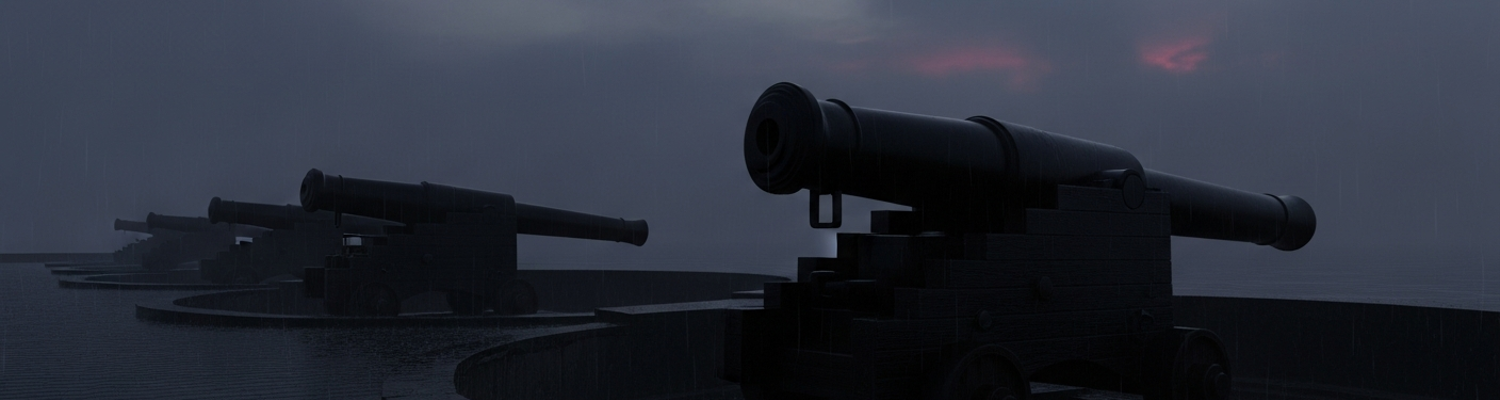
Ordnance reports from the Chesapeake theater in the summer of 1814 reveal a coastal defense system on the verge of mechanical collapse. The problem was not a lack of guns. It was a near-total failure of routine maintenance in the humid, salt-heavy environment of the bay. This decay was most evident in the prevalence of corroded cannon trunnions on shore batteries. The trunnions, two cylindrical pivots cast on the sides of a cannon barrel, were the fulcrum upon which aiming and firing depended. They allowed the heavy iron tube to be elevated or depressed. Along the Potomac and Patapsco rivers, exposure to the elements had initiated a disastrous chemical reaction. The cast iron of the trunnions and the carriages was aggressively attacked by oxidation. This created deep pitting and a crust of rust that effectively fused the components together or severely restricted their movement. An artillery crew attempting to adjust elevation on such a weapon would find their handspikes and screw mechanisms useless against the seized metal. The gun was locked into a single elevation, capable of firing only at a fixed distance.
This single point of failure had cascading tactical consequences. For a battery to effectively engage a moving naval target, gun crews needed to make constant, minute adjustments to elevation as the ship closed range. A frigate sailing up the Potomac toward Fort Washington would present a constantly changing targeting problem. With corroded trunnions, American gunners could not walk their fire toward the vessel. They were forced to wait until the ship sailed directly into their pre-set line of fire, a fleeting window of opportunity. Ordnance assessments from the period show that gun carriages, meant to be protected by layers of lead-based paint, had been left exposed for months. Moisture seeped into the trunnion sockets. The subsequent corrosion acted as a powerful bonding agent, rendering elevation changes that should have taken seconds an impossible task for a straining gun crew.
Compounding the crisis of seized elevation was the widespread failure of traversing mechanisms. While trunnions controlled the vertical arc of fire, the traversing system, a network of pintles, rollers, and iron tracks, allowed the entire gun and carriage assembly to pivot horizontally. This was essential for tracking a ship as it moved laterally. By August 1814, inspection reports documented traversing tracks so consumed by rust that the iron rollers on the carriages could not move across them. The once-smooth surfaces were now jagged landscapes of oxidized iron, causing rollers to jam or jump the track entirely. At Fort Washington, which guarded the primary riverine approach to the capital, Captain Samuel T. Dyson reported upon assuming command that many of his gun platforms were uneven and the implements for aiming were missing. Even if a gun crew managed to free a seized trunnion, a rusted traversing system meant they could not follow their target. The crew would have to resort to the brute-force, time-consuming method of using levers and block and tackle to physically drag the entire multi-ton carriage across the platform. This made rapid, accurate fire against a moving warship a practical impossibility.
Ordnance doctrine from the War of 1812 reveals a fundamental vulnerability woven into the very fabric of artillery operations. The propellant itself. Black powder, the universal propellant of the era, is a simple mixture of sulfur, charcoal, and potassium nitrate. It is also profoundly hygroscopic. Its components, particularly the charcoal and impure saltpeter, aggressively absorb moisture from the surrounding air. In the oppressive humidity of a Chesapeake summer, where relative humidity can hover near 75 percent or higher, this chemical property was a constant and insidious enemy. Powder stored in wooden casks or transported to the guns in cloth or paper cartridges was in a perpetual state of degradation. As moisture infiltrated the grains, the potassium nitrate could begin to separate from the mixture. The powder’s burn rate would become erratic and slow. For a gun crew, this translated into a battlefield lottery with every shot. A cartridge that felt slightly soft or spongy to the touch was a harbinger of potential failure.
The compromised powder created two distinct ignition failures: the misfire and the hang-fire. A misfire was a complete failure of the main charge to ignite after the primer in the vent flashed. A hang-fire was a delayed ignition, a terrifying pause of indeterminate length between the flash of the primer and the violent discharge of the gun. In the heat of an engagement, distinguishing between the two was an exercise in pure nerve. Period artillery manuals dictated a mandatory waiting period after a suspected misfire, often several minutes, to ensure it was not a hang-fire about to detonate. For a gun crew under enemy fire, such as Commodore Joshua Barney’s flotillamen at Bladensburg, this wait was an eternity. Every second the gun stood silent, it was a useless iron hulk drawing fire, while its crew became stationary targets.
The procedure for clearing a true misfire was a moment of supreme exposure for the gun crew. Once the gun captain made the decision that the weapon was not going to fire on its own, the work began under the full gaze of the enemy. The entire process was a gamble against a smoldering ember hidden deep within the breech. First, a gunner had to approach the vent at the rear of the cannon, a position completely exposed to counter-battery and musket fire. Using a priming wire or gimlet, he had to carefully pick the vent clear of the fouled, damp priming powder, attempting to re-establish a channel to the main charge. The terror lay in the unknown. If the weapon was experiencing a hang-fire, this action of probing the vent could introduce just enough oxygen to cause the smoldering main charge to erupt. The breech would blow apart, killing the men working on it. If the vent was cleared successfully, another crewman would pour a fresh charge of fine priming powder from a horn into the vent, his hand directly over the breech of a gun that had already failed once. Only then could they attempt to fire again, having lost precious minutes and sacrificed the safety of the crew.
An analysis of the American order of battle at Bladensburg on August 24, 1814, reveals a force predisposed to collapse. The first and second lines of defense were composed almost entirely of state militia. Many were poorly trained, untested, and exhausted from days of confused marches. When the British 85th Light Infantry launched its initial assault, it was met with a brief, staggering volley from American riflemen and artillery. This resistance quickly dissolved. The primary catalyst for the widespread panic that followed was the introduction of the Congreve rocket. These were not precise weapons, but iron tubes filled with incendiary composition, mounted on long guidance sticks that sent them shrieking through the air with an erratic trajectory. For militia soldiers who had never encountered such a weapon, the psychological effect was overwhelming. The noise and spectacle were designed to induce terror. They succeeded completely. Entire regiments of Maryland militia, positioned in an exposed line by Secretary of State Monroe’s last-minute adjustments, broke and fled without firing a shot.
It was a rout.
The flight of the first line was instantaneous and contagious, an event later derisively termed the Bladensburg Races. The panic cascaded backward, infecting the second line before many of its units could even engage the enemy. While some units, like the 5th Maryland Regiment from Baltimore, attempted to hold their ground, they were quickly outflanked by the sheer collapse of discipline around them. The sight of their countrymen streaming past them in a full-blown panic made their position untenable. They joined the retreat. This mass desertion of the defensive line had an immediate and catastrophic consequence. It left Commodore Joshua Barney’s flotillamen and their heavy naval guns completely unsupported. Barney’s force of sailors and marines had fought with disciplined fury, repulsing several British charges and inflicting significant casualties. Their stand, however, depended on a steady supply of ammunition. The civilian drivers of the reserve ammunition carts, seeing the army dissolve around them, joined the panicked flight. They carried the ordnance away from the battlefield. Without powder and shot, Barney’s guns fell silent. His position was finally overrun, and he was wounded by a musket ball and captured.
The psychological shockwave of the Bladensburg rout directly contributed to the next artillery debacle three days later at Fort Washington. The fort was the primary defensive work guarding the Potomac River approach to the capital, but its operational capacity was a fiction. Its commander, Captain Samuel T. Dyson, had only 56 men fit for duty. This was barely enough to service five of the fort’s cannons under ideal conditions. His orders from the panicked General Winder were to abandon the post if he was in danger of being overrun from the landward side. On August 27th, Dyson received an unfounded rumor that the same British army that had burned Washington was marching to attack his rear. Simultaneously, a powerful Royal Navy squadron under the command of the one-legged Captain James Gordon appeared on the river. Gordon’s squadron was a spectacle of naval power, consisting of ten vessels, including the frigates HMS Sea Horse and HMS Euryalus, three bomb vessels, and a rocket ship, mounting a combined 173 cannons.
Dyson knew his mechanically compromised and undermanned guns stood no chance. Faced with the specter of a land attack from the army that had effortlessly scattered the American militia and the undeniable reality of Gordon’s fleet on the water, Dyson’s officers voted to withdraw. Around 6:00 PM, as the first mortar shells from the British bomb ships began to arc towards the fort, Dyson acted. He ordered the American flag struck. He ordered the powder magazine lit. He ordered the entire garrison to retreat. The resulting explosion completely destroyed the fortification, leaving the river passage to the wealthy port of Alexandria undefended. Gordon’s squadron sailed past the ruins and anchored before the city. Alexandria, having been stripped of its militia for the defense of Washington, had no choice but to surrender. Over the next several days, the British systematically looted the city’s warehouses, loading 21 prize ships with over 16,000 barrels of flour, 1,000 hogsheads of tobacco, and 150 bales of cotton. The abandonment of Fort Washington, a direct result of the command panic that began at Bladensburg, provided the Royal Navy with a windfall of supplies and inflicted a profound economic humiliation. Dyson was later court-martialed and dismissed from the service for his actions.