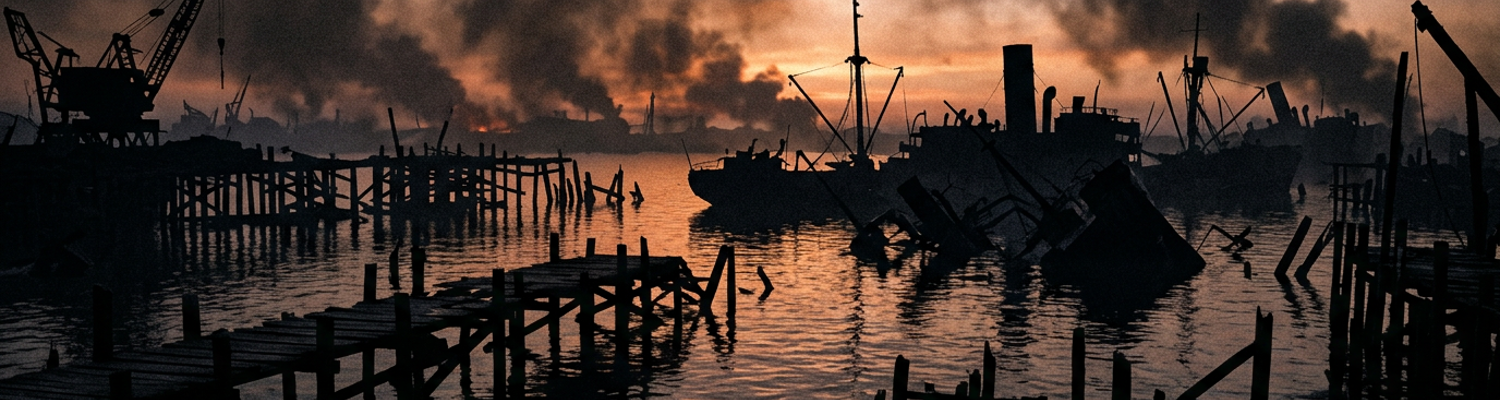

Aftermath in the Smoldering Bone Anchorage
Unloading four thousand tons of heavy war materiel per day across three bombed masonry wharves while under continuous air interdiction was physically impossible. Channel clearance problems halted port operations before sunrise on that December morning. Inside the fairway of the Grande Darse, burned merchant hulls blocked the four-hundred-yard gap between the Jetee du Lion breakwater and the inner commercial moles. A direct bomb hit had ignited the American freighter Daniel Huger. Seven thousand tons of drummed high-octane aviation gasoline smoldered as its deck plating warped under intense thermal pressure.
Near the southern wharf.
The flooded hull of the British destroyer HMS Ithuriel rested in shallow harbor mud. Its engine casings were fractured. Its keel was split by underwater concussions. Two Allied cargo freighters lay half-submerged on their port bilges across the primary access channel. They spilled timber, crushed supply crates, and severed steel hawsers into the fairway. Submerged derrick booms and shattered cargo masts jutted upward from the water at sharp angles. Usable channel draft dropped from twenty-six feet down to barely fourteen. Inbound ammunition carriers waiting outside the roadstead could not enter without shearing their hulls against jagged underwater steel.
No heavy deep-draft transport could traverse the fairway without grounding on fresh wreckage.
A sudden, dead quiet settled over the water around 0430 hours once the aircraft engines faded northward toward airfields in Sicily and Sardinia. Waves of Junkers Ju 88 bombers from Fliegerkorps II and Italian Savoia-Marchetti SM.79 torpedo bombers had pounded the anchorage for three unbroken hours. They dropped SC250 general-purpose bombs and launched torpedoes directly into the berths. The violent counter-barrage from the cruiser HMS Aurora and its 5.25-inch dual-purpose batteries had ceased entirely. Rapid fire from dozens of army 40-millimeter Bofors guns dug into the surrounding coastal ridges stopped. Heavy smoke from spent cordite hung motionless over the water. The reek of scorched bunker fuel and melted electrical wiring was trapped in the chill air. Exhausted gun crews collapsed beside empty brass shell casings on the decks of Force Q. Blast concussions deadened their ears. Lookouts watched the coastline in total silence. The water surface across the four-square-kilometer basin flattened out into a glassy sheet without a single launch moving.
The only audible sound was the hiss of salt water boiling against hot steel hull plating.
Archival evidence shows that Royal Navy port control officers and British Army Movement Control personnel pushed off from the shattered quays in wooden gigs at first light to tally the losses. Propelling these small craft required strict caution. A six-inch slick of heavy Bunker C fuel oil and volatile aviation fuel covered the inner anchorage. This created a severe fire hazard that prevented the use of inboard gasoline engines. Inspection teams rowed by hand between the listing vessels. They sounded the seabed with lead lines to confirm water depth over submerged superstructures and twisted cargo gear. Officers cataloged fractured freshwater pipelines on the western mole inside damp notebooks (NARA Record Group 338, File 44-A). Unexploded two-hundred-and-fifty-kilogram bombs were embedded against the masonry pilings of Berth Four. Three sunken lighters obstructed the coal depot. Couriers carried these raw casualty and obstruction figures directly to the naval signaling post at Cap de Garde for immediate transmission to Allied Force Headquarters. The encoded teletype reached Walter Bedell Smith in Algiers at 0645 hours. It listed eighty-four casualties and four thousand tons of munitions stranded outside the blocked roadstead.
AFHQ Signal Bureau Routing Failures
Dispatches sent from the front line took eighteen hours to travel two hundred and fifty miles.
A close review of operational logs indicates that the communications center inside the Hotel St. George in Algiers was failing under mechanical breakdown and administrative volume. Walter Bedell Smith relied on patched French civilian telephone trunks running across the Atlas mountain passes. Copper wires repeatedly broke under freezing rains or fell victim to saboteurs. Operators fed priority traffic into Typex mechanical coding units inside the cipher rooms. These machines frequently jammed. A backlog of six hundred unrouted priority cables accumulated by noon. High-frequency radio sets offered little relief. Atmospheric static over the Mediterranean basin and severe staffing shortages among Morse operators blinded the network. Signal clerks sorted through carbon-copied slips hours behind real-time events. They stamped incoming flash alerts as routine administrative traffic. Supply convoys sailing from Gibraltar and Algiers were steaming east on routing instructions that were already completely obsolete before the vessels even cleared Cape Matifou.
Paper orders could not outrun moving ships.
Archival evidence shows that harbor masters in Bone received routing chits assigning ten-thousand-ton merchant vessels directly to berths that could not physically hold them. Cargo transports drawing twenty-eight feet of water were signaled by visual lamp to steam straight toward the uncompleted wharves along the eastern inner basin. This included the British freighter Ocean Courage and several loaded American Liberty ships carrying crated artillery and tank engines. French colonial engineers had abandoned dredging operations at the Quai Ouest two years earlier. A jagged silt bank and heavy stone riprap lay beneath barely nineteen feet of murky harbor water. Captains following dated AFHQ entry schedules pushed their heavily laden hulls forward at dead slow. Their keels ground solidly into the compact mud and hidden limestone boulders two hundred yards short of the landing moles. Engine crews reversed turbines in frantic attempts to back off. They snapped drive couplings and tore open external double-bottom plating against submerged obstructions. Two fully loaded supply vessels lay pinned fast in the shallow muck. They blocked the inner turning basin while local salvage tugs lacked the bollard pull to budge them.
Two separate commands fought for control of the same ruined docks.
When examining the historical record, the breakdown between British Army Movement Control personnel and the Royal Navy convoy directors stationed ashore created constant operational paralysis. Army staff operating out of sandbagged offices in the Gare Maritime prioritized discharging thirty-ton Sherman tanks and 25-pounder field guns. They needed to support the First Army drive toward Tebourba. Navy officers under the Naval Officer in Charge at Cap de Garde operated on entirely different priorities. They focused exclusively on getting empty transports out to sea before German reconnaissance planes spotted them at dawn. No direct telephone line linked the naval signal tower with the army movement office three miles away. Messengers on motorcycles had to traverse shell-cratered coastal roads under nighttime blackout restrictions to deliver paper berthing manifests. Army officers frequently ordered incoming freighters to tie up along masonry walls. Naval demolition teams had already condemned these walls as structurally unstable from near-miss bomb concussions. Naval directors ordered merchant captains to drop anchor in the exposed outer roadstead to prevent harbor bottlenecks. Army logistics officers boarded the same ships by motor launch to demand immediate offloading at the berths.
Three priority transports loaded with three thousand tons of tank ammunition were swinging idly at single anchor in the outer bay without orders from either service by midnight on 14 December.
German 29th U-Boat Flotilla Coastal Operations
Ten miles north of the harbor breakwater.
A close review of operational logs indicates that Korvettenkapitan Fritz Frauenheim had concentrated nine Type VIIC boats from the 29th U-Boat Flotilla along the coastal shelf between Bougie and the Gulf of Bone. Commanders such as Kapitanleutnant Wilhelm Franken aboard U-565 operated from bases at La Spezia and Toulon. They exploited the shallow thermal layers off the Algerian headlands to neutralize Allied hydrophone performance. Intense surface warming generated severe temperature gradients in water depths fluctuating between fifty and eighty meters. These gradients bent the sound pulses of British Type 123 ASDIC sets upward. Submarine hulls were masked beneath the thermocline. German commanders maintained low-profile periscope watches two miles off Cap de Garde. They ran their electric drive motors at ninety revolutions per minute to minimize cavitation noise. Submarine crews routinely trimmed their ballast tanks to settle their hulls into the soft silt of the littoral seabed. They waited for Allied convoys to steer into fixed navigation channels. Battery reserves permitted these boats to lie motionless on the bottom for eighteen consecutive hours without surfacing.
Allied sonar could not cut through the thermal shelf.
Archival evidence shows that supply transports attempting to run the shallow coastal transit corridors suffered catastrophic torpedo strikes within sight of the harbor entrance markers. Steam freighters loaded with aviation fuel, artillery ammunition, and tank tracks followed narrow swept lanes between British defensive minefields. They moved slowly along the five-fathom line outside the Jetee du Lion. Submarine lookouts tracked targets through split-beam periscopes. They aligned their firing solutions against coastal landmarks and released electric G7e torpedoes at ranges under nine hundred yards. A contact pistol detonated against the hull of an inbound British freighter. The concussion fractured the steel hull plating below the water line. Four hundred tons of seawater flooded the engine room within sixty seconds. Main steam pipes ruptured instantly under the shock. Below-deck engine crews were blinded by scalding vapor. Bilge pumps were knocked out before damage control teams could isolate the compromised bulkheads. The stricken transports lost all steerage within two minutes and drifted broadside into coastal minefields.
When examining the historical record, the physical blockage of the inner berths forced the local naval officer in charge to divert incoming convoys into the outer roadstead of the Golfe de Bone. Over twenty merchant vessels dropped anchor across four square miles of open bay. Submerged channel wrecks prevented harbor entry. These vessels included deep-draft American cargo ships carrying thousands of rounds of high-explosive tank munitions. Royal Navy boom defense vessels had not yet arrived from Gibraltar to lay double-apron anti-torpedo netting across the bay entrance. Every stationary ship was completely exposed to long-range periscope attacks from open water. Cargo vessels swung unpredictably on single bower anchors as tidal currents shifted. They presented broadside targets against the coastal horizons. Submarines fired torpedo spreads from outside the bay directly into the cluster of anchored hulls. They hit loaded ammunition carriers and ignited structural fires. These fires burned uncontrollably down to the lower cargo holds. Burning oil slicks spread outward from the shattered hulls across the anchorage. Neighboring ships were enveloped before their crews could raise their anchors.
Rescue boats pulled only eleven survivors from the fuel slick.
Structural Collapse of Provisional Timber Jetties
When examining the historical record, US Army combat engineers from the 531st Engineer Shore Regiment faced immediate physical limits along the southern edge of Bone harbor. Troops operated near the mouth of the Seybouse River at coordinates 36.88 degrees North, 7.76 degrees East. They had to construct provisional offloading platforms without pre-cut dimensional lumber or steel pilings. Engineers felled green, unseasoned cork oak and Aleppo pine from the slopes of the nearby Edough mountains to assemble hasty timber jetties. Pneumatic drop-hammers mounted on pontoon rafts drove these raw posts only eight feet into unconsolidated maritime clay and unstable coastal silt. Decking crews hurried the assembly to meet delivery targets for Convoy KMS-3. They spiked twelve-by-twelve-inch timber caps across the bents without underwater diagonal sway bracing or iron tension rods. Disaster struck at 0515 hours. Four six-ton Diamond T tractor-trailers hauling crated aircraft engines rolled onto Jetty Three. Longitudinal deck stringers fractured along unseasoned wood grain under concentrated ninety-ton axle pressures. The upright pilings bent inward until the entire structure canted twelve degrees into the surf.
Untreated pine posts could not hold firm in maritime silt.
Archival evidence shows that this structural failure triggered immediate gridlock along the four-hundred-foot causeway connecting Berth Seven directly to the Seybouse rail spur. British 6th Armoured Division logistics officers had routed a column of twenty-eight-ton M3 Lee medium tanks and armored half-tracks onto the single-track wooden pier. They needed to clear the cratered masonry of the Grande Darse. Track vibrations over thirty minutes disintegrated the saturated ground around the pier foundations. Six central timber bents were forced five feet out of alignment. Steel drift pins sheared under the lateral thrust. Twenty yards of roadway deck dropped six feet onto the exposed tidal flats. Three M3 Lee tanks were left pinned mid-span. Their tracks were jammed into fractured deck planks. The armored column behind them was completely halted. Eight GMC CCKW trucks loaded with three-inch artillery shells sat trapped on an eight-foot-wide strip of planking with zero turning radius directly behind the tanks. Drivers shut off engines as brackish water rose over their wheel hubs. The frontline armor supply route of the division was immobilized.
Thirty tons of armored steel sat immobile over open water.
A close review of operational logs indicates that harbor authorities possessed no mechanical salvage equipment capable of clearing the blocked berths. French colonial authorities had once maintained four rail-mounted portal cranes on the Quai Ouest. German SC250 bombs had blasted three gantries into the water while shockwaves twisted the rails beneath the fourth. British port operating detachments held only two five-ton mobile lorry cranes. These machines lacked the counterweight balance and boom reach required to extract submerged armor. Attempts to rig heavy lift cables from the merchant ship Ocean Freedom failed. Its cargo boom fractured at the gooseneck fitting under thirty tons of deadweight strain. Allied commanders had no access to heavy floating derricks or sixty-ton shear-leg barges. The nearest salvage vessel lay docked three hundred miles west at Gibraltar. Combat engineers spent eighteen hours in hip-deep fuel-coated water. They hacked through twelve-inch wood beams with crosscut hand saws and oxyacetylene torches. Removal teams could not budge a single pinned hull before rising tidal currents completely flooded the causeway bed.
Wrecked transport chassis lay wedged across the only usable deep-water approach.
Ruptured Fuel Pipelines and Basin Fires
High-octane aviation spirit was flowing directly into the harbor water at eight hundred gallons per minute.
A close review of operational logs indicates that blast concussions from German SC250 bombs had sheared the eight-inch cast-iron fuel delivery headers along the Quai Sud at 0340 hours. Moored vessels shifted violently under the underwater shockwaves. Flexible rubber discharge hoses tore loose from their flanged shore couplings. 100-octane aviation fuel was pumped under ninety pounds of manifold pressure from the storage depot at Cap de Garde. It emptied uncontrollably onto the masonry slips. Royal Army Service Corps petroleum detachments could not reach the main manual cutoff valves. Heat from burning timber decking warped the valve spindles inside the underground shutoff pits. Over forty thousand gallons of aviation gasoline spilled over the stone aprons within sixty minutes. It spread across the calm surface of the avant-port. The volatile vapor hung three feet above the water line. It ignited into open flames whenever dangling electrical cables arced against flooded metal bulkheads.
Open flames spread across two thousand square yards of water within twenty minutes.
Archival evidence shows that combat engineers attempting to control the dock fires faced immediate mechanical breakdown at the water line. Firefighting detachments from Company B, 531st Engineer Shore Regiment dragged trailer-mounted Coventry Climax suction pumps directly onto the burning wooden wharves along the western mole. Operators lowered four-inch wire-wound suction hoses into the harbor. The intake strainers clogged almost immediately. Floating mats of coagulated Bunker C fuel oil, scorched packing timber, and harbor silt blocked the bronze mesh screens. This starved the centrifugal pumps and caused the impellers to overheat and seize. Connecting to municipal water lines proved impossible. Bomb impacts near the Gare Maritime rail depot had fractured the eight-inch cast-iron freshwater main. Line pressure dropped to zero. Engineers operated portable mechanical foam generators until their supply of foam compound ran out after forty-five minutes of continuous application. Troops watched creosote-treated pine timber pilings burn beneath the deck planking. They were completely out of reach of handheld carbon-dioxide extinguishers.
No water reached the burning pilings.
When examining the historical record, the rapid spread of wharf fires placed two ammunition freighters moored at Berth Four and Berth Five in direct danger. The British freighter Ocean Freedom and the transport Clan Macinnes were pinned hard against the blazing timber fenders by twenty-knot onshore winds. They were unable to slip their steel mooring cables because winches lacked operating steam from disabled auxiliary boilers. Four thousand tons of fused 25-pounder artillery shells, landmines, and five-hundred-pound aerial demolition bombs sat inside their holds. Naval control personnel calculated that an explosion aboard either vessel would flatten the maritime station, obliterate the dry docks, and kill every combat engineer within twelve hundred yards. Captains received instructions to prepare scuttling protocols. They were ordered to knock open Kingston valves and condenser circulating inlets to flood the lower cargo holds with harbor water. Flooding the compartments would ground the deep-draft hulls directly into the shallow silt. Thousands of tons of ammunition would be left submerged in fourteen feet of water. The primary offloading slips would be permanently blocked for the rest of the winter campaign. Damage control parties with sledgehammers stood over the manual sea-cock wheels in the lower engine flats. They awaited clearance from Allied Force Headquarters to sink their own ships at the quayside.
Orders from Algiers instructed captains to delay scuttling until flames touched the hatch coamings.
Walter Bedell Smith and AFHQ Reorganization
A close review of operational logs indicates that Walter Bedell Smith intervened inside the signal bureau at the Hotel St. George within thirty minutes of receiving the casualty tallies from Cap de Garde. He seized direct personal control over the transmission bottlenecks. He slashed routine bureaucratic communications across the entire Mediterranean theater. Staff officers were forbidden from transmitting administrative memos over the sole operational French civilian teleprinter trunk wire running along the Atlas ranges between Algiers and Constantine. Bedell Smith designated this single copper circuit exclusively for emergency logistics traffic. He prioritized forward petroleum tallies and artillery ammunition status reports originating from forward supply dumps at Souk el Arba and Guelma. Routine administrative traffic was dumped into physical courier bags. Despatch riders from the British 1st Army Signal Corps were stationed at twenty-five-mile relay intervals along Route Nationale 8. They drove motorcycle runs across freezing mountain passes on twelve-hour continuous rotations. Smith established a strict red-folder routing procedure inside the headquarters building. This stripped out the standard departmental clearing chain. Depot deficit reports were carried by hand directly to his desk. Internal message distribution lag was cut from six hours down to twenty-two minutes.
Dead communication lines left forward divisions depleted of high-explosive shells.
Archival evidence shows that Bedell Smith addressed the disastrous friction between land and naval authorities by completely restructuring the AFHQ joint logistics clearinghouse into a consolidated operations room. Royal Navy routing staff assigned to Admiral Sir Andrew Cunningham were forcibly relocated from isolated maritime offices down to the central G-4 planning floor. They shared plotting boards with US Army Services of Supply officers and British movement controllers. Smith stripped local harbor masters at Bougie, Philippeville, and Bone of their independent authority to accept or turn away incoming shipping. All coastal transport movements were subordinated to a unified daily clearing board. This board matched incoming merchant tonnage against real-time harbor soundings and bomb-damage assessments. Deep-draft Liberty ships carrying bulky rear-echelon crated vehicles were diverted west to Oran. The dangerous eastern coastal corridors were left open only to shallow-draft Tank Landing Craft and coastal motor vessels carrying fused munitions. Naval escort schedules were linked directly to the discharge rate on the battered Bone wharves. No ammunition ship dropped anchor in the vulnerable outer roadstead without a dedicated berthing crew standing by on the docks.
Paper manifests were stripped of authority while physical dock space dictated command decisions.
When examining the historical record, Bedell Smith sent outgoing encoded cables to General Dwight D. Eisenhower at his forward command post at Souk el Khemis. These messages reveal an acute organizational crisis. They were transmitted over portable radio teletypes. These daily situation reports broke down the exact logistical deficit restricting Allied offensive capability across northern Tunisia. Smith informed Eisenhower that 25-pounder field guns supporting the British 78th Infantry Division were restricted to firing only twenty rounds per day. This was due to the delivery failures at the coastal moles. Frontline tank units belonging to the British 6th Armoured Division held fewer than two days of reserve engine lubricants. French railway lines running east from Constantine delivered barely three hundred tons of supplies daily against a bare subsistence requirement of fourteen hundred tons. Smith warned his commander that an immediate allocation of four hundred six-wheel-drive cargo trucks and two commercial salvage tugs from Gibraltar was mandatory. This was required to prevent a total logistical paralysis along the Medjez el Bab sector. He documented eighty percent losses among provisional dockside fuel distribution networks. Allied airfields at Souk el Arba were left short of aviation spirit.
Supplies moving eastward over mountain roads fell eighty miles short of the front lines.
Bedell Smith concluded his 16 December dispatch by recording that forward dumps held only four hundred and fifty rounds of 105-millimeter howitzer shells for the entire central battle sector.
Emergency Logistical Revisions for the Tunisian Race
Steel anti-torpedo nets had to seal the roadstead before the next sunset.
Archival evidence shows that Royal Navy boom defense vessels HMS Barfoss and HMS Barbarian steamed into the outer fairway at 0800 hours on 15 December. They established perimeter barriers against the 29th U-Boat Flotilla. Rigging crews secured heavy spiked jackstay cables between concrete mooring buoys. These buoys were anchored with ten-ton iron clump weights along the five-fathom line. Seamen worked from open winch flats under winter rain. They dropped double-apron steel grommet anti-torpedo nets across the two-mile perimeter between the Jetee du Lion breakwater and the jagged shallows of Cap de Garde. Diver detachments in heavy brass canvas suits went down thirty feet into fuel-slicked water to clear underwater boulders. They manually bolted bottom-weighted chain bridles across the harbor approaches. This blocked acoustic tracking gear and electric torpedo runs. Boom winches struggled against surging coastal swells. Two three-inch steel perimeter hawsers snapped before riggers successfully anchored the floating gate boat directly opposite Berth One. The entrance channel shrank to an eighty-yard navigable passage by nightfall. It was controlled by manual slip-gates that took forty-five minutes to winch open for coastal supply craft.
Every forward fighter squadron sat immobilized on muddy landing strips without aviation gasoline.
A close review of operational logs indicates that the destruction of harbor pumping manifolds forced Walter Bedell Smith to divert the theater tactical aviation fuel supply onto the Algerian rail grid. Fuel tankers discharged their volatile 100-octane cargoes three hundred miles to the west at Oran and Algiers. French commercial personnel loaded the spirit into flimsy four-gallon rectangular tin containers. These containers were known to leak half their volume under vibration. Train crews loaded these leaking cans onto narrow-gauge boxcars traversing the single-track Compagnie des Chemins de Fer Algeriens line. They wound through the Tell Atlas mountains via Constantine toward the forward railhead at Souk Ahras. Baldwin steam locomotives operated on poor-quality local lignite mixed with compressed olive pulp. Boilers were caked in scale. Train speeds dropped down to six miles per hour on mountain grades exceeding two percent. Landslides blocked the tracks near the Duvivier junction twice in forty-eight hours. Sixteen fuel-laden wagons were trapped in unlit tunnels. Ground crews at Souk el Arba drained the last five-gallon drums to keep six Supermarine Spitfires of No. 242 Squadron RAF operational for defensive scrambles.
Frontline guns fell silent across the Medjerda valley.
When examining the historical record, this distribution breakdown stopped the forward elements of Lieutenant-General Kenneth Anderson and his British First Army forty miles short of Tunis. Major-General Vyvyan Evelegh and his 78th Infantry Division exhausted their forward stocks during heavy fighting around Tebourba and Djedeida. The mixed armor of Blade Force suffered the same fate. Frontline batteries were left with fewer than fifteen 25-pounder high-explosive rounds per gun per day. Mud up to the axles immobilized unassisted two-wheel-drive Bedford trucks along the single degraded macadam strip between Medjez el Bab and Souk el Khemis. Recovery teams had no spare final drive assemblies or track pins to repair broken M3 Stuart light tanks. Bedell Smith drafted emergency cables to General Dwight D. Eisenhower. He emphasized that the 6th Armoured Division could not launch an offensive push toward Massicault. Forward supply dumps held only forty-eight hours of rations and zero bridging materials to cross the flooded Medjerda River. Axis counterattacks by the 10th Panzer Division rolled over isolated Allied forward outposts. They seized high ground at Longstop Hill. Allied infantry units scavenged captured German 7.92-millimeter ammunition boxes to keep their weapons firing.
Field depots held twenty-two rounds of mortar ammunition for the entire 11th Infantry Brigade.