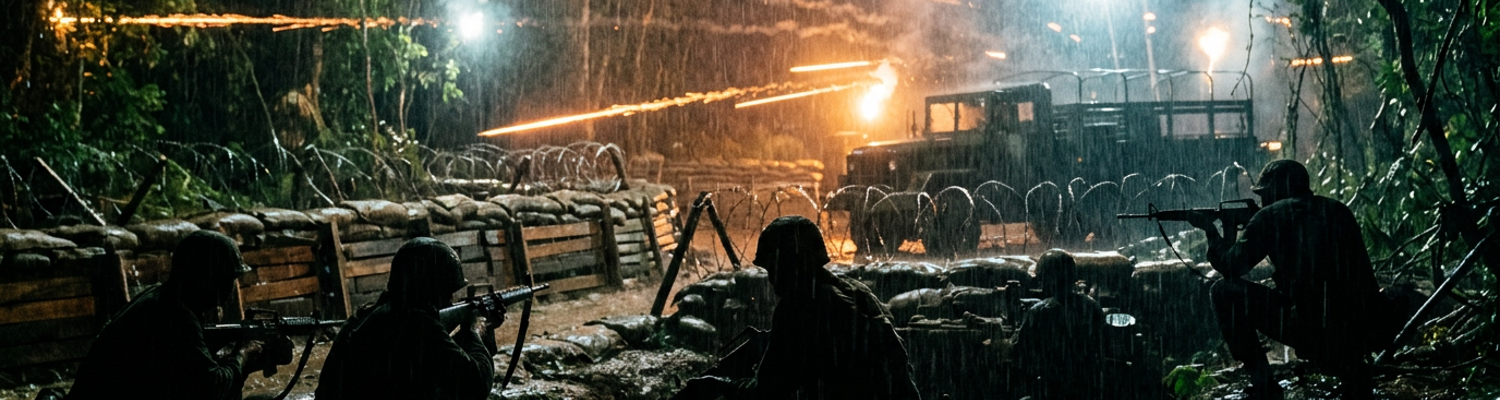

Bulldozers and the Polei Kleng Perimeter
Caterpillar D7 bulldozers ground their steel tracks into the red highland clay to carve out forward aircraft ramps while twin-rotor CH-47 Chinook helicopters churned overhead. The helicopters lowered 105mm pack howitzers and crates of interlocking steel airfield planking into the dense brush. Detachment A-241 of the 5th Special Forces Group established Polei Kleng west of Kontum in June 1966 to interdict North Vietnamese infiltration routes threading down through the rugged Plei Trap Valley. Supply clerks sheltered beneath canvas cargo tarpaulins to tally every pallet of concertina wire, timber baulks, and 81mm mortar rounds on waterlogged requisition ledgers. Flatbed trucks backed through the scrub to dump sandbags along the rising parapets while hydraulic trenchers gouged out deep circular firing pits for the artillery tubes. Heavy monsoonal downpours repeatedly collapsed the freshly cut dirt walls and clogged the traverse gears with abrasive silt before engineers could brace the positions with rough-cut logs.
Mechanics worked through the night with fuel oil and stiff wire brushes to scrub the grit from hydraulic rams and winch assemblies used to place those rough-cut logs. Construction crews kept pushing the perimeter defenses outward against the jungle tree line until steel pickets hammered deep into the shale formed an interlocking barrier system. Work details strung five successive belts of barbed concertina around the entire perimeter to anchor the outer defenses.
Wire entanglements anchored those outer defenses, but the defensive perimeter relied on indigenous Civilian Irregular Defense Group strike companies to man listening posts and bunker fighting positions along the exposed boundary. Montagnard soldiers took up positions inside log-reinforced firing bays that looked directly down the natural avenues of approach leading from the river bottoms. American Green Berets inspected each station twice daily to verify field-of-fire clearances and issue extra crates of rifle ammunition. Squad leaders signed the supply vouchers with thumbprints in blue grease pencil while supply personnel accounted for every wooden crate of trip flares, Claymore directional mines, and spare firing pins. Weapon parts shipments from logistics depots in Nha Trang often arrived with missing components and cracked shipping seals, forcing the supply sergeant to constantly update his shortage lists. Sentry outposts positioned forty yards beyond the forward trench line buried the Claymores into the dirt, rigged tripwires across animal tracks, and tested hand-cranked field telephones back to the tactical operations bunker to ensure the copper telephone cables remained intact.
Copper telephone cables ran through slit trenches into the tactical operations bunker, where staff sergeants tracked defensive coverage sectors across acetate wall maps. North Vietnamese scouts repeatedly probed these sectors during torrential evening rainstorms, using darkness to cut communication lines and search for gaps between the pre-registered mortar targets. Weapons crews countered these nocturnal intrusions by maintaining continuous illumination sweeps, dropping sixty-millimeter white phosphorus shells into blind draws. Weapons sergeants stripped carbon fouling from damp breech mechanisms under flashlight beams while supply ledgers filled with red checkmarks. High rates of expenditure depleted standard ammunition baselines and prompted emergency orders for replacement heavy machine-gun barrels that burned out during perimeter registration drills. Cargo planes dropped pallets of replacement components directly onto the camp runway strip, using parachutes to deliver vital sandbag burlap, crated mortar fuzes, and rolls of communication wire directly onto the muddy airstrip.
Tractors dragged those cargo pallets off the airstrip to stack the crated ordnance inside the main tactical redoubt. Green Beret weapons specialists immediately dispersed the fuzes and machine-gun links to the strike company bunkers to replace corroded munitions before the damp air could ruin the propellant charges. Montagnard gun crews adjusted the iron sights on their perimeter weapons and aimed across the newly cleared kill zones that separated the concertina belts from the thick jungle canopy of the Plei Trap Valley. Artillery spotters climbed the timber watchtowers to log reference benchmarks on the surrounding ridges. These fixed battery bearings channeled defensive fire right onto the boundary trenches to lock down the perimeter against incoming fire.
Cargo Pallets and Rear Depot Requisitions
Battery bearings plotted from those timber watchtowers depended entirely on solid trench lines that could hold that perimeter against incoming fire, yet the ground beneath the camp was dissolving. Pervasive tropical rot and monsoonal mud rapidly disintegrated unreinforced soil revetments along the entire fighting trench, collapsing parapets into soupy red clay that buried ammunition caches and weapon pits under feet of heavy sludge. Waterlogged sandbags burst open after only three weeks in the damp heat, spilling their contents and leaving the log bunkers stripped of overhead cover. Detachment supply sergeants scrambled through rain-slicked communications trenches to assess the structural damage and run pencil tallies across smeared field ledgers to determine how many thousands of replacement barriers the camp required before North Vietnamese gunners found their range. Every fresh slide of mud along the mortar pits choked the traverse plates with grit, forcing weapons specialists to bail out sludge with steel helmets. The supply sergeant drafted emergency procurement slips for heavy building stock, calling for massive replenishments of sandbags, rolls of concertina wire, and interlocking pierced steel planking to keep the artillery pads from sliding down the ravine.
Quartermasters at rear depots in Pleiku and Nha Trang held stockpiles of pierced steel planking, sandbags, and concertina wire to secure that ravine, but Special Forces supply sergeants contended with relentless administrative red tape to requisition even a fraction of those stores. Clerks at the rear bases regularly rejected emergency priority vouchers over minor paperwork discrepancies, demanding typed carbon copies and official signatures that were impossible to produce in a muddy forward operations bunker. Supply sergeants spent hours shouting over crackling high-frequency radio networks to justify basic fortification allotments, arguing with logistics officers who classified border camps as secondary priorities behind conventional division base areas. Inbound transport aircraft landed on the uneven runway with only partial loads of wire and cloth bags, forcing the detachment to sign receipts for cargo that rear-echelon loaders had shorted or swapped out for nonessential goods. The sergeant recorded each discrepancy in his water-stained account books, noting that delayed shipments of airfield planking left the forward trenches exposed to direct artillery impacts. North Vietnamese spotters registered their own heavy mortars on the camp perimeter while the supply clerks waited for steel plating.
Mortar rounds falling along the outer wire churned the degraded parapets into deep slush while the camp waited for that steel plating, forcing continuous ledger audits and material improvisation under artillery fire. Special Forces sergeants and Montagnard strikers stripped corrugated metal roofing from damaged storage sheds and tore down empty wooden ammo crates to revet collapsing bunker walls. Mechanics used cutting torches to slice fifty-five-gallon aviation fuel drums into flat metal sheets, and work details drove the improvised steel retainers deep into the trench mud with sledgehammers to shield machine-gun positions from incoming fragmentation. Supply clerks tallied every salvaged timber and spliced strand of concertina wire under the flickering light of tactical lanterns, updating defensive maps to mark where home-built barriers replaced standard military engineer hardware. Shrapnel tore through these patched fighting bays as enemy 82mm and 120mm shells struck the forward apron, blowing away soil bags and exposing the timber framework of the inner firing pits. Weapons crews dragged fresh coils of salvaged wire into the breaches between detonations, staking the barbed strands across the torn earth before enemy sappers could slip through the gaps.
Mortar Crews and Bunker Revetments
Mortarmen in the central weapon pit dropped eighty-one-millimeter rounds into their tubes to seal those fresh wire gaps against the crawling sappers, but the high rate of fire triggered immediate mechanical failures. Thick soot and unburned propellant rapidly coated the base caps, causing artillery crews to suffer mechanical stoppages from carbon-fouled firing pins during rapid fire missions. A gunner stripped off his canvas work gloves and knelt in the churning mud, unscrewing the hot baseplate plug with bare, blistered fingers to scrape away the baked carbon crust with a bayonet tip while jagged metal splinters whined off the sandbag revetment. The detachment supply sergeant crouched beside the pit with his waterlogged requisition ledger balanced across his knees, crossing out expended firing-pin assemblies with a leaking ballpoint pen while red pencil ticks marked the dwindling balance of spare parts crates. Searing heat from the mortar barrel singed the gunner's sleeves as he wiped the pin clean on his greasy trouser leg. The gunner slammed the firing assembly back into the base and called for the next round before the tube cooled.
Shells from North Vietnamese gun pits slammed into the ramparts just as the cleared tube sent its first round whistling toward the perimeter wire. Incoming mortar bombardments from North Vietnamese gun pits regularly collapsed waterlogged earthen parapets across the primary bunker line, dumping tons of soaked clay into the firing bays and burying ammunition boxes before gunners could unlatch their lids. Montagnard strikers scrambled through the waist-deep muck with trenching shovels to dig out trapped squad mates, heaving broken pine logs and ruptured sandbags off the buried firing steps. The supply sergeant lunged across the crumbling revetment to grab a crate of waterproof fuzes as sheets of red silt slid over his official shipment manifests and turned the requisition tallies into illegible purple smears. Radio operators inside the command shelter screamed over static-choked handsets as the line collapses severed field-telephone circuits to the outer listening posts. The severed wires cut off all voice communication with the forward defensive wire.
Pilots serving as forward air controllers banked their spotter aircraft through the low rain clouds above the camp, hunting for visual markers through the blinding static after the perimeter telephone lines to that forward defensive wire died. Observers in the aircraft could see North Vietnamese sappers crawling through the breached concertina belts toward the collapsed bunkers, dragging satchel charges across the churned mud to widen the gaps in the defensive perimeter. The supply sergeant shoved his ruined ledger into his flak jacket and hauled two heavy cans of belted ammunition up the communication trench, passing Montagnard riflemen who were beating jammed bolt carriers against the trench timbers to clear abrasive silt from their receivers. Heavy machine guns opened up from the surviving revetments, their barrels clattering in sustained bursts that threw smoking brass casings into the mud around the supply crates. Gun crews leaned into the shuddering recoil as twenty-millimeter cannon fire from diving strike aircraft tore through the outer wire apron. The aerial cannon shells churned the earth only yards ahead of the breached firing bays.
Napalm canisters tumbled from the wings of the low-flying fighter-bombers, erupting into sheets of orange flame along the shattered concertina apron to seal those breached firing bays. Scorching backblasts washed over the collapsed bunker line, baking the wet mud into cracked crusts while surviving mortar crews swabbed their reassembled tubes with kerosene-soaked rags to prepare for the next defensive barrage. The supply sergeant dragged fresh wooden crates of mortar fuzes into the center pit, kicking away smoldering timber splinters and tearing open zinc ammunition liners with his bare hands to distribute the high-explosive payloads. Green Berets and Montagnard strikers reloaded their weapons without waiting for formal fire commands, stacking rounds along the trench floor while enemy rifle fire cracked through the rising smoke. Sapper teams hesitated in the flaming wire as the detachment locked every operational barrel onto the breach point. The defenders opened fire into the charred slope to hold the inner perimeter before the next artillery barrage struck.
Bangalore Torpedoes and Sapper Assaults
Combat engineers and sappers from the PAVN 24th and 66th Regiments deployed bangalore torpedoes under that artillery barrage, shoving the long explosive pipes directly through the detachment fire on the charred slope. Detonations from the packed steel tubes blasted the barbed barrier strands into fragments and threw up curtains of red dirt that smothered the flaming grass. Explosive shockwaves slammed against the bunker logs as the detachment supply sergeant crouched in the communication trench, clutching his water-stained field ledger to his chest while accounting for rolls of barrier wire that had taken three weeks of depot requisitions now vanishing in smoke. Shrapnel from the torpedoes shredded sandbag parapets across the forward fighting bays, forcing Civilian Irregular Defense Group gunners to duck beneath the parapet rim as debris rained down on their weapon receivers. Blast concussions ripped twenty-yard gaps clear through the remaining perimeter belts. The massive explosions exposed the main camp trench network directly to the jungle edge.
Montagnard riflemen along the exposed trench network fired their carbines into the darkness of that jungle edge as infiltrating sappers exploited flooded drainage trenches and low-visibility sectors to slip satchel charges into forward CIDG defensive firing apertures. Explosive satchels detonated inside the cramped log fighting positions, blowing out rear blast doors and throwing timber baulks and Montagnard strikers into the muddy communication alleys. The detachment supply sergeant staggered through the waist-deep muck to catch a sliding crate of thirty-caliber ammunition before the sludge swallowed the metal container. Searing gas and black cordite smoke billowed through the shattered firing ports, blinding the surviving strikers as they tried to aim their jammed weapons toward the drainage culverts. Shouts from North Vietnamese assault leaders echoed through the shattered bays. Enemy automatic riflemen rushed the collapsed positions to widen the breach.
Browning machine guns opened up from the surviving support bunkers to check the enemy rush attempting to widen the breach, laying down interlocking fire that cut through the North Vietnamese automatic riflemen. Strikers dragged damaged weapons out of the sludge and hammered stuck bolt carriers with bayonet handles to clear the gritty highland silt from their firing chambers. The supply sergeant scrambled past burning timber posts to heave open ammo cans directly into the gun bays, ignoring incoming mortar shrapnel to log emergency crate disbursements on a grease-smeared clipboard. North Vietnamese troops hurled stick grenades over the broken dirt parapets, puncturing water drums and collapsing the last intact telephone wire leads to the command bunker. Radio operators inside the tactical operations center had to switch entirely to battery-powered radios. The operators yelled emergency grid coordinates to airborne forward air controllers circling overhead.
Aviators guiding the forward air control planes circling overhead followed the emergency radio coordinates through the low rain squalls, firing white phosphorus marking rockets directly into the breached concertina wire. Attack aircraft responded immediately to the white smoke markers, dropping cluster munitions and heavy high-explosive ordnance only yards beyond the forward CIDG trench line. Concussion waves from the aerial ordnance blew the supply sergeant backward against the trench revetments, tearing requisition invoices from his clipboard and scattering the paper fragments into the mud. Firestorms from the exploding munitions seared the breached apron, killing the remaining PAVN sappers caught in the open wire and tearing up the flooded drainage ditches. Green Beret advisers and Montagnard strikers reloaded their weapons in the sudden silence, training their sights on the smoldering wire gaps while incoming North Vietnamese artillery shells began pounding the airstrip.
Spotter Planes and Close Air Support
Artillery craters multiplied across the crushed-rock landing strip as Airborne Forward Air Controllers operated over the camp to direct ordnance onto breached wire aprons within danger-close distances of friendly revetments. The detachment supply sergeant pressed his back against the shuddering timber revetment, clutching an oilcloth-wrapped ledger while radio operators struggled through deafening static to relay coordinates to the Cessna O-1 Bird Dog circling through the low cloud deck. White phosphorus marking rockets hissed down from the light spotter plane, punching into the tangled concertina wire barely thirty yards ahead of the Montagnard fighting bunkers. Fighter-bombers roared down through the cloud break on steep dive angles, releasing heavy ordnance that exploded along the breached wire in violent blasts of heat, soil, and fragmented steel. Concussion waves slammed into the forward revetments, knocking strikers off their firing steps. The blasts showered the supply sergeant with scorching dirt that coated his pencil point and smeared his casualty replacement ledgers.
Dirt and heavy black smoke billowed across the torn parapets, coating those casualty replacement ledgers as enemy infantry echelons advanced through the tree line to reinforce the surviving sappers inside the wire. Orbiting AC-47 gunships provided high-volume minigun suppression and aerial illumination flares to isolate penetrating sappers from following infantry echelons. Three side-mounted six-barrel miniguns roared in continuous bursts of four thousand rounds per minute, sending solid streams of red tracer fire directly into the tree line to shred the advancing North Vietnamese reserve formations. The supply sergeant listened to the deafening drone of the twin radial engines overhead, grimly noting on his clipboard that every three-second burst consumed more linked ammunition than his entire camp had received in three months of supply flights. Magnesium parachute flares drifted below the clouds on small silk canopies. The flares cast harsh white light across the torn concertina belts where trapped sappers struggled to cut their way through the tangled coils under the harsh magnesium glare.
Magnesium glare exposed the crawling North Vietnamese sappers directly in front of the remaining bunker apertures. Green Beret weapons sergeants directed Montagnard machine gunners to sweep the illuminated kill zone with crossing bursts of fire, trapping the enemy infiltration teams against the churned earth. The supply sergeant hauled another heavy crate of linked thirty-caliber ammunition up the slick trench boards, prying open the metal seal with a screwdriver while hot shell casings clattered around his boots. Radio operators shouted updated range corrections into their microphone handsets, urging the airborne forward air controller to bring aerial rockets directly onto the lip of the forward drainage trench. Rockets fired from diving attack aircraft slammed into the drainage culvert with deafening detonations, throwing shattered weapons, mud, and severed barbed wire high into the night air.
Debris rained down from the night air onto the collapsed fighting positions as the surviving North Vietnamese assault troops broke contact and withdrew into the secondary jungle. Airborne spotters shifted their attention outward toward the tree line, calling in trailing artillery missions and remaining gunship runs to hammer the retreat routes leading back toward the Plei Trap Valley. The supply sergeant wiped a layer of red highland grit from his requisition ledger, penning emergency tallies for thousands of rounds of expended small-arms ammunition, replacement sandbags, and salvageable mortar parts. Montagnard defenders used trenching tools and bayonets to scrape thick carbon fouling from their rifle actions while Green Beret advisers dragged fresh spools of concertina wire toward the smoldering gaps in the perimeter revetment. The supply sergeant snapped his ledger shut and hoisted a crate of mortar fuzes onto his shoulder to begin restocking the central firing pit.