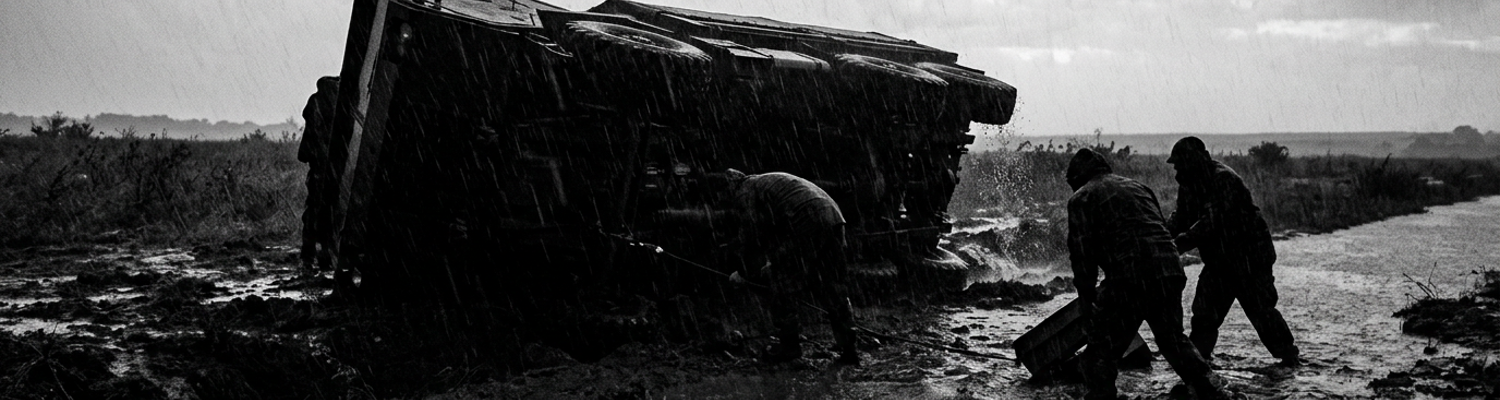

Lead M998 Rollover Near Gonaives
Static tore through the single-channel ground and airborne radio system before the vehicle commander could complete his call sign.
A close review of operational logs from Task Force 2-27 Infantry indicates that at 0342 hours, the lead truck of a four-vehicle patrol dropped off the western shoulder of Route Nationale 1. The incident occurred approximately eight kilometers south of Gonaives. The asphalt along this corridor had deteriorated after seasonal rain saturated the loose silt of the Artibonite flood basin. This left the roadbed undercut by irrigation runoff. Driving at under twenty miles per hour with blackout drive markers active, the driver steered slightly right to yield space to an unlit civilian stake-bed truck. The five-quarter-ton truck passenger-side Goodyear Wrangler tires sheared the crumbling embankment. Right-side weight distribution shifted outward over the soft berm. The vehicle inverted as it slid down a six-foot drop. It wedged upside-down into a concrete-reinforced agricultural culvert channeling stagnant drainage water between rice paddies. When the vehicle commander keyed his handset, ditch water had already submerged the communications mount. He shouted broken grid coordinates into the AN/PRC-119 transceiver while reporting an overturned truck and soldiers trapped beneath the surface.
Turbid irrigation runoff filled the cab in less than forty seconds.
When examining the historical record from the 25th Infantry Division deployment during early 1995, soft-top M998 configurations created severe survival hazards during low-speed rollovers. Canvas roof panels and vinyl troop covers lacked structural roll cages. They collapsed inward under the five-thousand-pound curb weight of the chassis. Inside the inverted crew compartment, three infantrymen found themselves pinned against the floorboards by shifting field equipment. This included two five-gallon water cans, steel ammunition crates containing 5.56mm linked belts, and their own ALICE rucksacks. Silt-laden water rapidly filtered through torn vinyl seams. It carried agricultural runoff and raw sewage into the submerged cabin. Trapped by the heavy cargo and the crushed tubular frame of the cargo cover, the rear gunner could not free his legs from under the inverted pedestal mount. The pinned soldiers pressed their faces against a six-inch air pocket forming along the floorboards. They breathed fuel-scented vapor while the squad leader used an M9 bayonet to slash through the saturated canvas from the outside.
The battalion quick-reaction force had no heavy recovery vehicles within thirty miles.
Archival evidence (NARA Record Group 338) shows that second lieutenant William Vance halted the remaining three trucks along the crowning center of the roadbed. He trailed three vehicle lengths behind in the patrol sequence. This prevented additional shoulder collapses. Vance immediately directed his remaining riflemen into the waist-deep canal to secure the wreck manually. The patrol hooked an electric recovery winch cable from the second M998 to the rolled frame. The single five-sixteenth-inch wire rope snapped under the suction of the canal sediment. It whipped across the roadbed and dented the hood of the recovery truck. Mechanical failure compounded the emergency when the idling recovery vehicle sheared a rear half-shaft while attempting to pull in reverse against the greasy mud bank. At the tactical operations center at Camp D Enghien (grid coordinate VF310190), dispatchers noted Vance repeated requests for an M816 five-ton wrecker. Washed-out culverts north of Saint-Marc had already stranded heavy maintenance elements hours to the south.
Peacekeeping Metrics and the UNMIH Transition
Archival evidence shows that throughout late March and early April 1995, official briefings issued by the White House and the Department of Defense depicted the transition from the United States-led Multinational Force to the United Nations Mission in Haiti as an orderly administrative milestone. Pentagon spokesmen stood before briefing maps in Arlington to announce that Operation Uphold Democracy had successfully neutralized paramilitary resistance. This established an environment secure enough for international peacekeepers to manage without friction. Slides distributed to congressional oversight committees documented the recovery of over thirty thousand weapons. They detailed the formal demobilization of the heavy weapons company of the Forces Armees d Haiti. Zero combat fatalities occurred among American personnel over the preceding five months. In policy summaries drafted for ambassadorial review, the National Security Council asserted that seventy-four civilian police monitors and three thousand international blue helmets could maintain public order through routine presence patrols. White House press packages distributed on March 31 recorded an uncomplicated transfer of tactical authority to incoming foreign contingents. They documented ceremonial handshakes on the tarmac at Port-au-Prince International Airport alongside charts indicating declining criminal violence in the capital.
Washington measured stabilization through filed forms.
A close review of operational logs indicates that two hundred miles to the north, the 1st Battalion, 21st Infantry Regiment, 25th Infantry Division, encountered conditions that canceled every administrative projection within forty-eight hours of the handover. Deployed to establish operational control across the lower Artibonite Department, the Gimlet battalion found itself stranded. Peak spring cloudbursts broke over the Montrouis mountain passes and saturated the alluvial basin. Tropical squalls dropped four inches of precipitation in six-hour windows. This turned dirt supply tracks between Saint-Marc, Pont-Sonde, and Petite Riviere de l Artibonite into knee-deep corridors of liquid silt. The unit sixty-eight soft-top M998 utility trucks repeatedly bottomed out. Transfer cases dragged through eighteen-inch ruts carved by commercial transport buses. Silt-laden floodwater poured past axle seals. It contaminated geared wheel hubs with quartz grit and stripped internal lubrication from the differentials. Whole convoys sat immobilized on raised agricultural berms.
Winch cables snapped before the vehicles moved an inch.
When examining the historical record of Task Force 1-21 Infantry, field reports reveal an unrelenting cycle of mechanical triage in isolated sectors. Rifle platoons occupying austere schoolhouse compounds in Gros-Morne and Desdunes lost ground contact with supply elements. Swollen irrigation canals washed out stone culverts along Route 100. This left American personnel without dry uniforms or clean drinking water for seventy-two consecutive hours. Corrugated shipping containers holding Meal, Ready-to-Eat field rations dissolved into pulp beneath the downpours. Meal sleeves lay exposed to standing water, raw agricultural runoff, and diesel fuel on open truck beds. Engine temperatures surged past two hundred and sixty degrees Fahrenheit when aluminum radiators choked on suspended river silt during required fordings. This cracked the cylinder heads of the 6.2-liter Detroit Diesel engines. Forward support mechanics quickly exhausted their authorized stock of replacement half-shafts, fan belts, and 24-volt starter motors. Battalion maintenance teams stripped functional hardware from deadlined vehicles parked along the mud perimeter of Camp D Enghien. Medical logs from Charlie Company aid station recorded sixteen cases of severe immersion foot and three secondary staphylococcal infections during the third week of April. These required systemic intravenous antibiotic treatment while rainwater dripped through canvas shelter tents directly onto open wire litters.
Artibonite Valley Route Reconnaissance Deficits
A close review of operational logs indicates that brigade-level intelligence summaries generated for the 2nd Brigade Combat Team routinely omitted soil mechanics data across the lower Artibonite basin. Staff officers at the brigade tactical operations center relied on outdated 1980s Defense Mapping Agency topographic sheets. These categorized secondary supply corridors branching off Route Nationale 1 toward Dessalines and Petite Riviere de l Artibonite as all-weather dirt thoroughfares. Military intelligence summaries failed to account for seasonal water-table saturation. They evaluated the agricultural basin as compact clay suitable for wheeled vehicular movements. Seasonal deluges struck between late March and mid-April 1995. The montmorillonite clay subsoil liquefied beneath standard military traffic. Unpaved secondary routes between grid coordinates VF340200 and VF420350 dissolved into continuous twenty-inch troughs of liquid silt. Patrols from Company A, 1st Battalion, 21st Infantry Regiment found their five-quarter-ton utility trucks bottoming out directly onto their differential casings within minutes of departing asphalt corridors. Suspended quartz grit stripped protective grease from steering tie rods and jammed transfer case linkages.
The official operational maps depicted passable transit corridors that existed only as submerged drainage canals.
Archival evidence shows that brigade route overlays consistently conflated dry agricultural levees with uncompacted canal embankments. During an attempted resupply run on April 4 toward agricultural hamlets outside Grande Saline, Company B of Task Force 2-27 Infantry advanced along an axis marked by brigade intelligence as an improved aggregate gravel trail. Saturated by agricultural irrigation overflow, the path lacked gravel ballast. Three soft-top M998s slipped sideways into an unmapped four-foot drainage trench when the waterlogged shoulder sheared beneath their passenger-side tires. Vehicle recovery crews burned out three Warn nine-thousand-pound electric winches fighting the dense suction of the Artibonite silt. This destroyed 24-volt electrical harnesses and drained tactical batteries. Drivers attempting to reverse under full throttle twisted Dana 44 rear half-shafts clean off inside the geared hub assemblies. The stranded convoy consumed forty-five gallons of JP-8 fuel per vehicle while laboring for nine continuous hours to cover barely four miles of terrain.
Division planners conducted zero engineering load surveys along the primary road network.
When examining the historical record, American supply lines connecting Saint-Marc to Gonaives along Route Nationale 1 relied entirely on stone drainage culverts. These were constructed during the French colonial administration of the late eighteenth century. Brigade engineer estimates contained no structural load assessments, compressive strength data, or Military Load Classifications for these masonry spans. Decades of heavy tropical runoff had dissolved the original lime-and-sand mortar between the rough river stones. This opened hollow structural pockets beneath the fragile asphalt crust. Task Force 1-21 routinely routed ten-vehicle convoys of M939 six-by-six five-ton trucks and M978 heavy fuel tankers over these vaulted passages. They subjected them to dynamic gross vehicle weights exceeding twenty-six thousand pounds across bridges originally erected for wooden ox carts. On April 11, near the Pont-Sonde river crossing at grid coordinates VF289144, the masonry barrel arch of a French colonial culvert collapsed beneath the rear bogie of an M923 five-ton truck loaded with bottled water pallets. The stone vault gave way under the eleven-ton tandem axle load. It dropped the chassis three feet into the irrigation ditch and sheared the vehicle rear pneumatic brake lines. Responding mechanics from Company B, 725th Main Support Battalion found that water flowing through agricultural feeder ditches had scoured the stone abutments down to the bare subgrade. This left adjacent culvert spans along Route 100 fractured and unsupported without a single structural warning marker posted by divisional engineering staff.
Culvert Failures and Route Nationale 1 Paralysis
The highway broke under an axle load it was never engineered to carry.
Archival evidence shows that during a forty-eight-hour cloudburst beginning on April 14, 1995, over five inches of rain fell across the Artibonite plain. This inundated the unreinforced masonry culverts carrying Route Nationale 1 over the Estere canal network. French colonial-era lime mortar dissolved as hydraulic head pressure surged against the sub-surface arches. Two centuries of uncontrolled water saturation had degraded the material. At kilometer marker 104, five miles north of Pont-Sonde, the barrel arch of a double-vaulted stone drainage span sheared completely. The lead M923A2 five-ton cargo truck of a resupply convoy from Company A, 725th Main Support Battalion crossed the structure at the exact moment of failure. A dynamic single-axle weight of 13,800 pounds crushed the crown stones inward. The rear tandem bogie dropped thirty inches into the resulting void. It wedged the differential housing against jagged limestone ballast and severed the dual-circuit air brake lines. Hydraulic back-pressure flooded the breach. The entire fifteen-foot road shoulder eroded into the drainage ditch. This cut the primary paved artery connecting Port-au-Prince to Gonaives into two isolated sectors. Engineers from the 65th Engineer Battalion dispatched to assess the break found six adjacent culvert crowns bowed downward under the asphalt. They threatened immediate failure under standard twenty-ton tactical convoy weights.
No civilian or military bypass existed along the coastal marsh.
A close review of operational logs indicates that Task Force 2-27 Infantry attempted to route thirty-four vehicles around the collapsed culvert using an unpaved agricultural levee. This flanked the eastern edge of the Artibonite irrigation grid. Heavy cloudbursts had already transformed the top twelve inches of montmorillonite clay into an adhesive sludge that defeated every mechanical advantage of the motorized infantry. High-clearance four-wheel-drive configurations offered sixteen inches of ground clearance. The M998 utility trucks sank until their flat belly pans made solid contact with the submerged levee surface. Suction exerted by the water-saturated clay held the undercarriages fast. It lifted the Goodyear 36x12.50R16.5 tires off firm purchase so that all four wheels spun without forward movement. Drivers engaging low gear ranges in their New Process 242 transfer cases exerted peak torque against locked wheel hubs. They snapped half-shaft universal joints and burned out friction plates in three-speed automatic transmissions. Within two hours, nine consecutive trucks high-centered in identical twenty-two-inch ruts. This formed an immovable bottleneck that paralyzed the battalion northern resupply axis.
When examining the historical record of the 2nd Brigade Combat Team, field mechanics found that the Artibonite clay acted as an abrasive grinding compound inside planetary wheel hubs and brake calipers. Spindle seals failed on seven M998s after quartz-heavy mud forced past rubber dust boots. It contaminated synthetic gear oil and seized the geared hub assemblies within forty minutes of continuous spinning. Recovery crews deployed an M816 five-ton wrecker from Camp D Enghien to pull the lead utility truck out by its front pintle hook. The recovery vehicle sank through the saturated road shoulders before the crew could extend the outriggers. It buried both tandem drive axles up to the frame rails. Lieutenant Vance stranded riflemen spent twelve hours in continuous tropical downpours attempting to dig out vehicle hulls with entrenching tools. Liquid silt sloughed back into the excavations with every shovel pass. Company commanders reported that five thousand gallons of diesel fuel and eight pallets of rations sat immobilized fifteen miles south of their forward positions. Infantrymen guarded the supplies standing in knee-deep mud with waterlogged boots and deadlocked recovery gear.
Mechanical Failures and Tactical Recovery Limits
Steel cables sheared under loads the technical manuals insisted they could bear.
A close review of operational logs indicates that during recovery operations along the levee grid between Dessalines and Route Nationale 1, crews from Company B, Task Force 2-27 Infantry attempted standard self-recovery. They spooled out their vehicle-mounted 24-volt Warn electric winches. Rated for nine thousand pounds of straight-line pull, the winches lacked internal thermal cutoff switches and auxiliary cooling fans. They drew over four hundred amperes from the dual Hawker lead-acid batteries within ninety seconds of continuous load. Motor casings heated past three hundred degrees Fahrenheit. This melted the armature insulation, vaporized internal grease, and welded the planetary gear assemblies before the trapped M998s broke ground suction. Drivers attempting to assist the winches by shifting into low gear applied sudden rotational torque across locked drivetrain components. Hardened steel half-shafts twisted along their splines. Engineered to transmit power from the central differential out to the geared planetary hub assemblies at each wheel, they sheared off flush against the output flanges with sharp metallic snaps. Battalion maintenance records logged eleven catastrophic axle fractures within forty-eight hours across Task Force 2-27. This exhausted every replacement half-shaft assembly held in forward supply stocks at Camp D Enghien.
The Army recovery manual assumed soil that did not exist in Haiti.
Archival evidence shows that standard recovery doctrine outlined in Field Manual 9-43-2 instructed crews to anchor snatch blocks to mature trees or construct deadman anchor systems using buried timber balks and steel pickets. Across the deforested agricultural flats bordering the Estere River, decades of commercial charcoal harvesting had stripped every deep-rooted tree from the canal banks. This left only shallow banana stalks and brittle scrub brush that pulled out under fifty pounds of line tension. Soldiers attempting doctrine-prescribed deadman anchors drove clusters of five-foot steel pickets into the soil at forty-five-degree angles. They lashed them together with towing chains to establish solid purchase for a two-to-one mechanical advantage rigging. Saturated by irrigation runoff from adjacent rice paddies, the montmorillonite silt possessed zero shear strength. The moment a recovery cable tensioned, the buried pickets sliced straight through the liquefied mud without holding. They erupted from the ground and hurtled loose iron across the irrigation ditch toward the recovery teams. Buried spare tires and timber planks surfaced immediately under five hundred pounds of tension. They floated up through the liquid silt as the suction held the immobilized trucks fast.
Winch hooks recoiled through windshields when anchors gave way.
When examining the historical record of recovery attempts on the night of April 16 at grid coordinates VF312218, second lieutenant William Vance attempted a tandem pull using two functional M998s coupled on a narrow strip of crown asphalt. Traction failed the moment both vehicles applied throttle on the algae-coated road surface. Rather than dislodging the submerged five-quarter-ton truck from the drainage culvert, the pulling vehicles slid backward on locked tires toward the five-foot embankment drop-off. Vance severed the tensioned steel tow strap with an ax before both recovery trucks rolled into the canal. Forward support elements from Company B, 725th Main Support Battalion reported that forty percent of their organic recovery gear lay broken, drowned, or abandoned in the Artibonite mud by April 18. This left twenty-six vehicles deadlined across an eight-mile stretch of Route Nationale 1 without a single operational heavy wrecker able to cross the fractured northern bridges.
Overland Logistics Paralysis and Cut Patrol Bases
Isolated outposts ran dry forty-eight hours after the bridges dropped.
A close review of operational logs indicates that by the morning of April 17, 1995, four forward tactical assembly areas operated by Task Force 1-21 Infantry and Task Force 2-27 Infantry were entirely severed from the division support area at Saint-Marc. Patrol Base Delta had received no scheduled logistics packages for three consecutive operational cycles. It was established in an abandoned agricultural warehouse near Petite Riviere de l Artibonite at grid coordinates VF384192. The collapse of the twin stone culverts along Route Nationale 1 trapped an eight-vehicle resupply column from Company A, 725th Main Support Battalion fourteen miles to the south. Twenty-four inches of standing water across the unpaved trace of Route 100 compounded the blockage. Three M923A2 five-ton cargo trucks loaded with five-hundred-gallon water blivets and crated Class I provisions sank past their wheel hubs along the canal shoulders. They cracked steering knuckles and punctured high-pressure pneumatic transfer valves under the weight of the cargo. The battalion maintenance officer prohibited all non-tactical movement across the saturated alluvial basin. Staff officers at Camp D Enghien canceled two planned supply runs to Gros-Morne. This stranded ninety-four riflemen from Company C without replenishment convoys for five consecutive days.
The forward troops were down to half-canteen limits.
Archival evidence shows that temperatures across the lower Artibonite basin reached 101 degrees Fahrenheit with relative humidity surpassing ninety-four percent. This turned open concrete patrol compounds into suffocating heat traps. Forward elements faced strict ration controls. Platoon leaders ordered soldiers to consume only one Meal, Ready-to-Eat pouch per day. Stored on open truck beds and saturated by continuous downpours, the cardboard exterior cases disintegrated into damp mush. This allowed fungal spores to breach the outer polyethylene foil packaging. Exposure to standing water and engine exhaust fumes contaminated the interior foil meal bags. Freeze-dried entrees fermented inside sealed wrappers and rendered meal heaters useless. Riflemen suffered severe gastrointestinal cramps from spoiled pork chow mein and wet crackers. The division mechanized Reverse Osmosis Water Purification Units sat completely immobile thirty miles away. Two trailer-mounted 600-gallon-per-hour purification systems operated by the 54th Quartermaster Company remained parked on the paved tarmac at Saint-Marc. The cracked masonry bridges along Route Nationale 1 could not support their gross operational towing weight of twelve thousand pounds.
Unpurified surface water was the only liquid left.
When examining the historical record of Company B, Task Force 2-27 Infantry outside Dessalines, junior leaders attempted emergency expedient hydration. They collected runoff from corrugated sheet-metal schoolhouse roofs into five-gallon jerrycans. Silt from the surrounding agricultural fields coated the water in an opaque gray film. It clogged individual ceramic filter pumps within minutes of hand operation. Riflemen resorted to treating water from adjacent irrigation ditches using chemical iodine tablets. They ingested high levels of agricultural pesticide runoff and suspended sediment. Company medical logs recorded twenty-two cases of acute waterborne gastroenteritis, four cases of heat exhaustion, and six soldiers suffering heat stroke within a seventy-two-hour window ending at 1800 hours on April 19. Forward aid stations exhausted their entire stock of Lactated Ringer intravenous solution bags. Medics had twelve five-hundred-milliliter saline packs to treat eighteen dehydrated infantrymen presenting resting core body temperatures above one hundred and three degrees.
Emergency Field Triage Inside Waterlogged Vehicles
The water inside the inverted cab was scalding, black, and rising against the floorboards.
A close review of operational logs indicates that at 0410 hours, two combat medics from Company B, Task Force 2-27 Infantry wriggled through the slashed vinyl cargo flap into the submerged crew space. Ambient cabin air exceeded 104 degrees Fahrenheit. It was trapped beneath the rubber-insulated transmission tunnel and heated by the slowly cooling 6.2-liter diesel engine block. Medics worked with their shoulders wedged against the inverted ceiling while canal water reached their chins. Inside the passenger compartment, the weight of a collapsed M1025 weapons ring and three shifting steel ammunition cans had pinned the truck commander lower extremities against the crushed dash panel. This resulted in open compound fractures of the left femur and bilateral tibia. The bone ends had pierced the uniform trousers. They were exposed directly to stagnant agricultural water laden with fecal coliforms. Operating with angled penlights held between their teeth, the medics cut away soaked ripstop fabric. They applied malleable SAM splints secured with elastic wraps under the waterline. They immobilized the unstable skeletal fractures using improvised cravats lashed to the steering column. They attempted to stabilize the limbs before shifting wreckage caused catastrophic arterial lacerations.
The crew compartment smelled of sulfur and boiling mineral oil.
Archival evidence shows that structural deformation from the rollover ruptured both 12-volt 6TMF lead-acid batteries. These were housed in the companion compartment beneath the right-front passenger seat. Approximately twelve quarts of thirty-five percent sulfuric acid drained directly into the eighteen inches of standing water trapped inside the footwells. Concurrently, the impact severed the high-pressure power steering return hose. It expelled MIL-H-5606 petroleum-base hydraulic fluid under sixty pounds per square inch of residual line pressure into the enclosed liquid basin. This created an acidic, oil-slicked emulsion that covered the skin of the trapped infantrymen. The three pinned soldiers sustained severe second-degree chemical contact burns across their torsos, groins, and armpits where contaminated water soaked into duty uniforms. Epidermal tissue began sloughing off in sheets when medics attempted to shift the soldiers positions. Treating the chemical injuries required rapid surface decontamination inside the flooded compartment. The medics possessed only nine one-liter plastic pour bottles of sterile 0.9 percent sodium chloride solution. They poured saline directly across raw dermis and chemical-burned corneas. They exhausted their entire external irrigation supply within twelve minutes while acidic water continued to seep past the vehicle door seams.
Clean water did not exist within six miles of the ditch.
When examining the historical record from the 2nd Brigade Combat Team, field triage records show that medics struggled to establish intravenous lines. Peripheral veins collapsed under hypovolemic shock. Cannulating veins required working by touch beneath the opaque canal surface. Medics secured 18-gauge catheter needles to skin slick with hydraulic petroleum and peeling epidermis. Second Lieutenant Vance detailed four riflemen to physically brace the M998 exterior frame with timber planks recovered from a nearby ditch. This kept the chassis from settling deeper into the canal mud. Medics administered 10-milligram doses of morphine sulfate through salvageable intravenous ports. They monitored the pinned gunner shallow respiration as his core body temperature dropped toward hypothermia despite the sweltering ambient heat. The aid station at Camp D Enghien had no burn dressings or specialized chemical neutralization packets available for immediate dispatch. Forward medics bound exposed subcutaneous tissue with dry field dressings that adhered directly to the chemical burns.
Tropical Ulcers and Stranded Medical Evacuation
Riflemen could peel the dead skin off the soles of their feet with their bare hands.
A close review of operational logs from the 2nd Brigade Combat Team indicates that forty-eight hours of continuous immersion in 85-degree agricultural runoff destroyed the epidermal barrier of soldiers feet. Standard issue black leather combat boots and olive-drab canvas jungle boots trapped silt-saturated water directly against the skin. This saturated the stratum corneum until foot tissue softened into pale, heavily corrugated folds. Plantar surfaces turned into spongy gray mush. Within three days of patrolling along the flooded dikes of the Estere River, soldiers developed warm-water immersion foot complicated by deep bacterial soft-tissue necrosis. Pathogens including Pseudomonas aeruginosa and Aeromonas hydrophila penetrated microscopic skin fissures. These bacteria were endemic to the stagnant rice paddies and raw sewage channels crisscrossing the Artibonite valley. Medics at forward aid stations noted that when men cut off waterlogged wool socks, sheets of plantar skin sloughed away in unbroken layers. This exposed raw subcutaneous beds and bleeding fascia. Localized cellulitis spread rapidly across the dorsal surface of the foot. It swelled metatarsal joints and produced foul-smelling, purulent tropical ulcers that eroded toward underlying tendon sheaths. Company medics possessed twenty tubes of silver sulfadiazine and minimal topical bacitracin. They painted necrotic lesions with povidone-iodine solutions while soldiers elevated their limbs on wooden ration crates to air-dry in ninety-eight percent relative humidity.
Flying through the cloudburst meant flying blind into mountain ridgelines.
Archival evidence shows that aviation elements of the 68th Medical Company stood completely grounded. Tasked with supporting Task Force 2-27 from Port-au-Prince and Saint-Marc, the aircrews watched a line of tropical squalls roll across the Montrouis pass and slam into the lower Artibonite. Instrument flight rules proved impossible through localized convective storms that dropped cloud ceilings below fifty feet and cut forward visibility to zero over the coastal plains. Divisional UH-60A Black Hawk medical evacuation helicopters faced severe wind shear and downdrafts exceeding forty knots off the Chaine des Matheux ridge line. Aircrews attempting to penetrate the weather front south of Pont-Sonde at 0515 hours encountered blinding sheets of rain that overwhelmed windshield wiper systems. Pilots aborted and executed immediate instrument recoveries back to the paved apron at Saint-Marc. Operations staff at the airfield logged ceiling and visibility measurements as zero-zero across the entire route corridor north of kilometer marker 80. This prohibited all aeromedical launches under division peacetime risk mitigation directives despite priority-one surgical requests transmitted from the rollover site.
No helicopter could set its wheels down without tipping into the mud.
When examining the historical record of Task Force 1-21, attempts to designate alternate emergency pick-up points along Route Nationale 1 failed. Every prospective landing zone consisted of unreconnoitered, oversaturated alluvial silt. The downwash from a twenty-two-thousand-pound UH-60A four-bladed main rotor generated a blinding brownout vortex of liquid clay and pulverized agricultural waste. This denied pilots visual contact with the surface during final descent. Saturated by river overflows, the topsoil offered less than two pounds per square inch of bearing capacity. An unreconnoitered rice paddy marked by forward observers at grid coordinates VF334188 proved completely liquid to a depth of three feet. Flight leads warned that setting a Black Hawk landing gear onto the liquefied berm risked uneven settling, ground resonance, and immediate dynamic rollover into the drainage canal. Without dry, gravel-ballasted ground or surveyed concrete pads, flight crews could only hover out of ground effect with rescue hoists. Continuous forty-knot surface gusts swept hoist cables dangerously close to thirty-foot high-voltage electrical wires running parallel to the highway. Trapped infantrymen with open compound fractures and advancing sepsis waited nine hours under soaking rain ponchos while flight dispatchers at Camp D Enghien canceled three consecutive evacuation sorties.