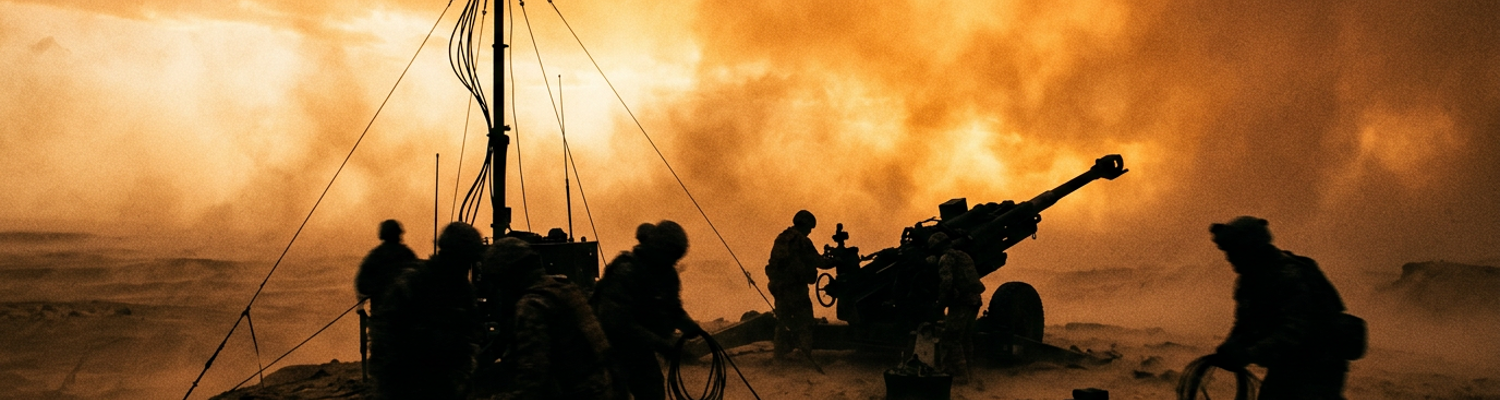

Operation Buster-Jangle Artillery Observer Deployments
November 1, 1951. 0730 hours Pacific Standard Time. Grid coordinates 37 05 05 N, 116 01 15 W. Yucca Flat, Nevada Proving Ground.
Archival evidence shows that the Provisional Army Field Forces dispatched specialized forward observer details across the dry playa floor. Their objective was specific. Command elements needed to determine whether conventional fire direction could function inside atomic battle spaces. Personnel drawn from artillery training centers at Fort Sill and Fort Bragg occupied survey control points. These points were scattered along the forward edges of the desert floor. Crews wrestled with M49 observation telescopes and Battery Commander M65 periscopes. They anchored heavy tripod mounts directly into the alkaline silt.
Communications technicians unreeled miles of heavy WD-1/TT twin-conductor field wire from weapons carriers.
They spliced copper strands by hand to connect primitive observer foxholes back to tactical Fire Direction Centers miles to the rear. Dust clogged the fine mechanical azimuth micrometers and elevation screws before the countdown even commenced. Command elements at Desert Rock required these forward teams to track round dispersion. They also had to measure burst heights and compute target coordinates while operating without heavy protective shelters.
Nobody in the forward pits had ever witnessed a tower shot from five miles away.
When examining the historical record of Shot Dog, an aerial burst yielding twenty-one kilotons, the exposure profiles of the open revetments demonstrate severe mechanical stress on the observer teams. Forward trenches dug six feet into the desert soil subjected artillery personnel to a violent overpressure pulse. This pulse struck the trench parapets within seconds of the flash. Compressed air packed with pulverized limestone sheared off surface-mounted whip antennas. Unreinforced trench walls collapsed directly onto signal personnel. Thermal radiation scorched exposed canvas pack covers and field coats before the shockwave arrived.
Radiac operators equipped with AN/PDR-T1B ionization chambers recorded immediate spikes in direct gamma radiation.
Airborne particulate settled over the trench lips. Men buried up to their waists in loose earth clawed their way out. They found their optical sights caked in calcified dirt. Their EE-8 field phones were dead on the wire.
Wire lines running south were severed in dozens of locations across the desert floor.
A close review of operational logs indicates that surviving observer parties received direct radio orders to conduct live-fire registration missions. They executed these missions directly through the lingering radioactive cloud. Batteries of 105mm and 155mm howitzers positioned far behind the blast line began lobbing high-explosive ordnance. They targeted designated impact grids blanketed by low-yield tactical fission products and neutron-activated desert minerals. Observers peered through dust-choked optics toward ground zero. They attempted to distinguish conventional shell detonations from the suspended radioactive particulate.
Visibility dropped below five hundred yards.
Thermal updrafts pulled blinding particulate into the observation lanes. This forced forward spotters to calculate deflections using sound-ranging microphones and dead-reckoning azimuths. Radiation monitors repeatedly registered dosages climbing past five roentgens per hour in the impact corridors. Observers stayed in their pits. They shouted battery corrections through SCR-536 hand-held radios to align fire on target markers located inside the hot zone. The SCR-536 operated on a fixed frequency of 3.5 megacycles. The signal barely penetrated the atmospheric ionization.
By noon, the registration targets in Area 7 were confirmed bracketed by four salvos of high-explosive shells.
Thermal Flash and Radio Hardware Failures
Archival evidence shows that the thermal flash and initial burst of ionizing radiation delivered an immediate shock to frontline electronic hardware. Signal Corps crews assigned to the forward observation posts had positioned vehicular SCR-508 radio sets inside open M38 utility trucks. They also distributed portable AN/PRC-10 backpack transceivers among the artillery spotters.
Within milliseconds of the detonation, radiant heat charred external antenna leads.
The heat melted neoprene weatherproofing seals and warped unshielded casing covers. Simultaneous pulses of prompt gamma rays and fast neutrons saturated the vacuum tubes inside the BC-604 transmitter units. The subminiature pentode tubes within the AN/PRC-10 chassis absorbed massive radiation doses. This intense radiation field ionized internal residual gases. The ionization produced runaway grid current surges that tripped plate circuit breakers and burnt out filament windings.
Solder joints along intermediate frequency stages softened under extreme heat differentials.
Signal personnel grabbing hand microphones heard only dead carrier hiss before receiver tubes failed entirely.
Every frontline transmitter ceased operation at once.
When examining the historical record of equipment inspections at Yucca Flat, operational logs show that the returning ground shock propelled thousands of tons of pulverized alkali silt across the observation lines. This fine white particulate was rich in abrasive calcium salts and sodium carbonate. The dust penetrated through cabinet vent louvers and seized up internal mechanical linkages. Relays inside the dynamotor power supplies accumulated thick coatings of alkaline powder. This separated the silver contact points and arrested spring return bars mid-stroke.
Ceramic rotary band-switches on the AN/PRC-10 transceivers jammed solid.
Desert grit wedged between the rotating wafers and stationary terminal lugs. Technicians frantically opened chassis covers. They discovered that the conductive dust had settled across high-voltage bus bars and terminal strips. Sweating operators attempting to brush away the residue with dry field brushes generated static charges. These charges further disrupted the delicate tuning capacitors. Resistance readings across relay points climbed from negligible fractions of an ohm to complete open circuits within minutes.
Not a single field radio could cycle power.
A close review of operational logs indicates that command-link communication between forward artillery observers and rear firing batteries broke down completely following the burst. Tactical fire control centers located nine miles to the south at Camp Desert Rock lost all radio contact with spotters assigned to register the 105mm howitzer positions. Field Artillery officers stood over silent receiver banks. They were unable to verify round impacts, adjust coordinate deviations, or transmit cease-fire instructions to gun line commanders.
Out in the trenches, forward observer teams could not signal their survival.
They could not report radiation readings or call in defensive smoke screens to shield exposed infantrymen from drifting fallout. Safety regulations strictly prohibited live salvos into forward zones without continuous observer confirmation. This forced battery officers to halt gun line schedules. Three planned artillery fire missions were scrubbed on the spot while signal repairmen checked broken junction boxes with handheld volt-ohm meters.
Component Shortages and Supply Chain Diversions
Supply lines failed completely before the test series began.
Archival evidence shows that a multi-agency federal probe conducted in mid-1951 uncovered a systemic network of civilian contractors and logistics personnel siphoning military-grade electronics into the black market. Investigators from the Federal Bureau of Investigation and the Army Counter Intelligence Corps tracked thousands of crates bound for military depots. These crates had been quietly intercepted and relabeled at rail freight hubs in Chicago and San Francisco. Civilian radio and television manufacturers paid black-market brokers exorbitant premiums for specialized components. They were grappling with severe raw material freezes under the National Production Authority during the Korean conflict.
Infiltrators targeted high-reliability JAN-specification vacuum tubes.
These included the ruggedized 1L4, 3S4, and 1R5 miniature pentodes engineered for portable tactical transceivers. They also targeted spools of RG-8/U military shielded coaxial cabling. Federal indictments filed across three states confirmed that these hardened tubes and heavy multi-pair shielded lines were funneled away from military supply depots. They ended up in private radio assembly plants across the Midwest. A single crate of 1L4 tubes weighed forty-two pounds. Black market brokers paid three hundred dollars per crate in Chicago. By late summer, procurement officers at the Signal Corps Supply Agency discovered that nearly forty percent of contracted replacement runs for ruggedized front-end radio tubes had simply disappeared from physical inventories.
Las Vegas supply docks stood practically empty.
When examining the historical record of Exercise Desert Rock I, requisition manifests from Camp Desert Rock confirm that replacement inventory never reached forward staging areas in the Nevada desert. Depot officers assigned to the 127th Signal Technical Company had submitted high-priority supply requests through the Sacramento Signal Depot and the Ogden General Depot in Utah. They needed to build up reserve stocks prior to the November detonations. Federal priority directives funneled every available crate of sealed communications parts directly to the Eighth Army fighting in Korea. This left domestic atomic test exercises with the lowest shipping classifications.
Train shipments arriving at the Union Pacific rail spur in Las Vegas repeatedly carried bills of lading marked fulfilled.
Supply officers uncrating the deliveries found empty dunnage, mismatched civilian parts, or stripped radio chassis. Shelves in the temporary corrugated-iron depot buildings at Camp Desert Rock lacked spare quartz crystal units. They also lacked replacement vibrator power supplies and intermediate frequency transformers. Operational logs from the Desert Rock Signal Section indicate that by late October 1951, on-hand stocks for AN/PRC-10 transceivers and vehicular SCR-508 sets stood at less than eight percent of the authorized operational reserve.
Field repairmen were left entirely on their own.
A close review of operational logs indicates that mobile maintenance units stationed at Yucca Pass faced extreme electronic failure rates without access to standardized factory replacement wiring harnesses. Technicians operating out of two-and-a-half-ton M109 shop trucks had to support forward artillery fire direction nets. Daily vibration, alkaline silt, and detonation overpressures cracked cable jackets and burned out terminal connectors. Factory wiring assemblies for the BC-604 transmitter and the mounting bases of SCR-528 vehicle sets were completely unavailable across the proving ground.
Rather than swapping out entire harness assemblies according to standard Signal Corps technical manuals, field technicians unbraided frayed neoprene sleeves from damaged artillery tractors.
They salvaged individual copper strands by hand. Repair teams stripped burnt insulation using pocket knives. They re-insulated exposed copper lines with adhesive friction tape. They soldered brittle leads onto broken multi-pin Cannon plugs over gasoline-fired field stoves. Technicians kept battery-powered volt-ohm meters running continuously to test salvaged resistors and hand-wound chokes cannibalized from discarded SCR-284 radio sets. They improvised individual wiring circuits to keep battered observer communications functioning through the blast schedules.
Improvised Field Repairs in Contaminated Zones
The fallout drifted south across Area 7.
Archival evidence shows that radio operators from the 127th Signal Technical Company faced severe ionization around vehicular SCR-508 receiver masts. Secondary radiation from the decaying cloud ionized ambient air particles along the dry lake bed. This induced parasitic currents across external whip antennas that overwhelmed receiver circuits with continuous static roar. Factory-issued attenuators and rubber insulation boots were completely absent from field inventories. Operating frequencies drifted due to thermal shifting across local inductors.
This forced technicians to adjust tuning coils with wooden alignment tools whittled from discarded tent pegs.
Moving between vehicles without protective aprons, signalmen cut sheets of lead foil from crated photographic plates. They also sourced foil from medical film packets and discarded calibration canisters found inside M109 shop trucks. Mechanics flattened the lead strips using entrenching tool blades. They wrapped the heavy metal tightly around porcelain antenna base insulators, coaxial feedlines, and transmitter housing seams. Grounding straps fabricated from salvaged bailing wire clamped the lead foil assemblies directly to chassis tie-down bolts.
Signal receivers running on 24-volt vehicle power registered an immediate twenty-decibel reduction in atmospheric radiation noise.
This allowed operators to detect weak amplitude-modulated signals at 38.5 megacycles. Exposure meters registered four roentgens per hour outside the vehicle cabs.
Field wire was scorched into the brush.
When examining the historical record of wire maintenance teams along the target sectors, artillery repairmen assigned to the 537th Field Artillery Battalion crawled through forward gullies. They needed to locate severed runs of WD-1/TT twin-conductor wire. Intense heat from the initial burst had carbonized the outer nylon and polyethylene insulation into brittle black crusts across two miles of open desert terrain. Repairmen stripped away burnt synthetic jackets with pocket knives. They isolated undamaged interior copper and steel strands.
They joined the broken ends using standard Western Union splices sealed with black friction tape.
Inside cramped canvas command tents pitched in dry washes, radio repairmen confronted damaged subminiature tube sockets inside AN/PRC-10 transceivers. These sockets had failed during the thermal pulse. Work surfaces consisted of upturned wooden ammunition crates covered in alkaline silt. Technicians ignited portable gasoline torches to melt lead-tin solder. Technicians used standard 60/40 rosin-core solder. The ambient heat made the flux highly volatile. They cleared charred resin from ceramic wafers before manually re-soldering cracked socket lugs back onto main chassis ground points.
Using dental picks and scribes, repair crews reshaped warped beryllium-copper contact pins.
This re-established continuous physical connections for surviving 1L4 and 1R5 pentode tubes.
The primary gun line link was restored.
A close review of operational logs indicates that these improvised hardware fixes reconnected forward observation stations to Fire Direction Center Number Two at Yucca Pass. Gun crews standing by batteries of M101A1 105mm howitzers eight thousand yards south of Ground Zero Dog immediately resumed live registration fire into the radioactive impact grid. Forward spotters peering through M49 observation telescopes identified shell bursts against surveyed wooden marker stakes set in the alkaline soil. They transmitted elevation and deflection data back over the spliced wire loops.
Plotting officers corrected coordinates for atmospheric temperature shifts and pressure differentials caused by the rising blast plume.
Battery plotting teams adjusted firing azimuths based on forward spotter readings. They walked shell impacts across the target sector in fifty-yard increments. Artillerymen fired eighteen high-explosive shells into Area 7 between 1315 and 1345 hours. They confirmed target registration before radiation monitors recorded fallout levels exceeding six roentgens per hour across the forward pits.
Medical Triage and Radiological Exposure Casualties
Casualties arrived before the dust cloud cleared the ridge.
When examining the historical record of Shot Dog, forward aid stations established along the southern rim of Area 7 handled an immediate stream of incapacitated forward observers and signal repairmen. Medical officers from the 537th Field Artillery Battalion pitched battalion aid tents in dry washes four miles south of the detonation point. They received dozens of soldiers transported on the flatbeds of M37 utility trucks. Thermal radiation had inflicted first-degree and second-degree flash burns across exposed wrists, necks, and ears. This occurred wherever field jacket buttons had pulled loose during the initial countdown.
The blast wave propelled pulverized limestone at near-sonic velocities across the trench lines.
This scoured unprotected retinas and embedded caliche particles deep within conjunctival tissue. Periscope mirrors and binocular lenses inside M49 observation posts shattered inward under peak overpressures. This peppered the faces and forearms of artillery observers with high-velocity glass shards. Hospital corpsmen flushed blinded eyes with sterile saline drawn from five-hundred-milliliter glass bottles. They scraped abrasive alkaline sediment off swollen eyelids using moistened cotton swabs.
Medics administered half-grain morphine syrettes to signalmen suffering from severe blast lacerations.
These lacerations were caused by flying antenna sections and fragmented wooden revetment bracing.
Nobody in the aid tents had protective suits.
Archival evidence shows that medical orderlies and signal technicians worked inside the fallout path without standardized radiological personal protective gear. Army procurement agencies had not yet developed impermeable chemical-biological-radiological overgarments or canister respirators for tactical field units. Both corpsmen and wire technicians operated in standard herringbone-twill cotton fatigues. They wore canvas M-1943 field jackets and porous leather combat boots. Soldiers improvised protection by pulling wool knit caps low over their ears.
They tied dry cotton triangular bandages across their mouths and noses to filter airborne fission fragments.
Ambient radiation readings around the casualty clearing pits climbed toward seven roentgens per hour on AN/PDR-27A survey meters. Stretchers arrived coated in neutron-activated surface silt. Technicians handled hot field-wire reels barehanded. This contaminated their fingers with beta-emitting isotopes that evaded detection on personal pocket dosimeters clipped inside their jacket linings. Field decontamination consisted of sweeping uniforms with stiff straw shop brooms. Personnel wiped bare skin with kerosene-soaked rags and dumped wash basins of cold water directly onto the alkaline ground.
The tactical data transformed combat training doctrine.
A close review of operational logs indicates that this intersection of medical emergencies and hardware failure guided future tactical nuclear doctrine for forward-deployed Army units. Research teams from the Army Medical Service Graduate School observed that blinding eye injuries and severed communication links degraded forward artillery operations far more rapidly than direct gamma radiation sickness among gun line crews. Operational test reports submitted to the Continental Army Command prompted an immediate overhaul of defensive equipment standards for frontline personnel.
New standing operating procedures published by the Department of the Army mandated the issue of M1944 protective goggles.
These goggles featured darkened, high-density lenses for all forward observers deployed within fifteen miles of an atomic impact area. Signal Corps field doctrine was altered to require that all WD-1/TT communications lines be buried eighteen inches deep beneath natural soil cover. This depth was calculated to prevent blast displacement and thermal melting. Technical coordination teams established formal radiological decontamination transfer points. They required forward combat elements to strip off their outer cotton uniforms and complete multi-stage monitor sweeps before entering divisional fire direction centers.
Field Artillery units at Fort Sill adopted these trench-clearing protocols in early 1952.