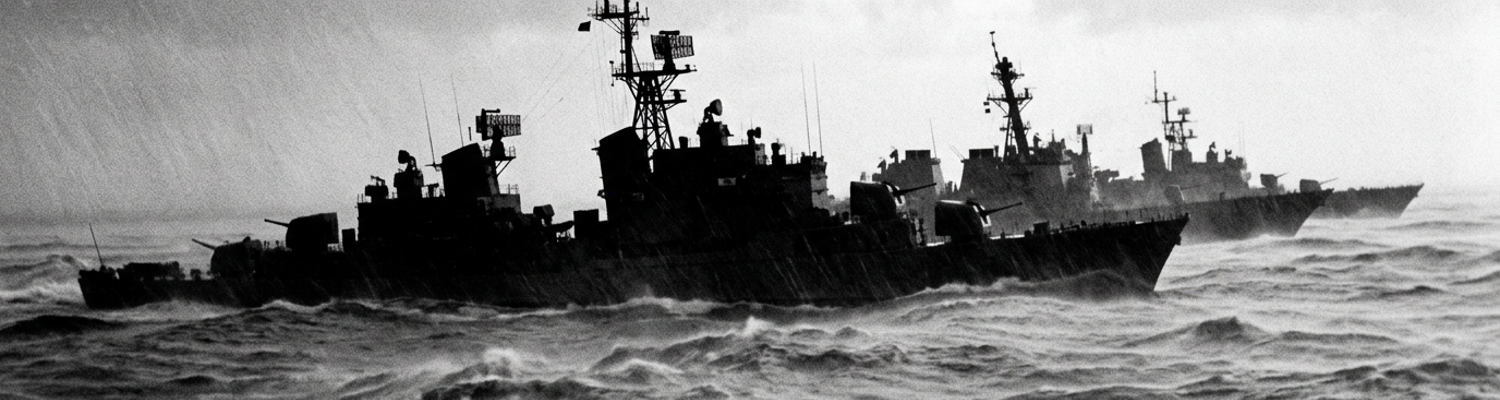

Post Uruguay Round Commerce in the Red Sea
Flash transmission intercept. Commander Fifth Fleet maritime tactical circuit. 0214 hours local. October 17, 1996. An emergency breakaway was declared. The primary span wire parted under heavy mechanical tension. A high-pressure diesel fueling rig tore loose between the replenishment oiler and the lead cruiser. Steering gear degraded instantly. Coordinates read twelve degrees thirty-six minutes North by forty-three degrees nineteen minutes East. A commercial container vessel crossed dead ahead on a collision bearing.
The sea lane was completely saturated with commercial hulls.
When examining the historical record, this naval convergence stemmed directly from international economic agreements signed two years earlier in Morocco. The conclusion of the Uruguay Round of the General Agreement on Tariffs and Trade in 1994 dismantled multi-fiber arrangements. It slashed industrial import duties. It generated rigid commercial delivery timelines. Container lines operated between Northern Europe and East Asia. They restructured their scheduled sailings around tight twenty-four-hour port turnaround windows. Shipping firms routed Panamax container vessels through the narrow confines of the southern Red Sea at sustained speeds above twenty knots. They had to comply with these contractual arrival mandates. Archival evidence shows that daily commercial transits through the Bab-el-Mandeb strait surged past sixty vessels per day by late 1996. The international Traffic Separation Scheme west of Perim Island crammed these deep-draft merchant ships into a navigable channel barely two miles wide. Underwater shoals bordered the western edge. Yemeni coastal artillery batteries sat to the east. Every ship had to push through the exact same geographic pinch point.
Washington committed its navy to guarantee that speed.
A close review of operational logs indicates that the United States Fifth Fleet shouldered direct responsibility for keeping these corridors clear. The fleet was reactivated in July 1995 under Vice Admiral John Scott Redd. Headquarters operated out of Naval Support Activity Bahrain. Fleet commands executed continuous surge operations through Task Force 50. They pushed carrier battle groups directly into the central shipping lanes of the strait. Guided-missile cruisers and fleet oilers followed. Warships enforced Operation Southern Watch. They routinely conducted complex underway replenishment operations in the middle of these commercial thoroughfares to maintain uninterrupted flight operations. Operating capital warships alongside civilian commercial traffic created immediate mechanical and maneuvering friction. Surface search radars like the AN/SPS-49 struggled to filter out dense clusters of commercial surface returns. Destroyers and oilers maintained fifty-yard station-keeping distances during nighttime fuel transfers in fifteen-knot wind chop. Bridge crews frequently had to hold course during high-risk fuel pump cycles. Heavy cargo vessels bore down on their flank at high speed.
Local commerce complicated the maritime theater even further.
Horn of Africa bilateral trade with Arabian Peninsula markets expanded rapidly across 1995 and 1996. This followed the end of the Eritrean War of Independence and the restructuring of Ethiopian transport routes. Livestock carriers and break-bulk freighters routinely sailed from the ports of Massawa and Assab. They ferried over two million head of live sheep and cattle annually across the southern Red Sea to Jeddah and Mokha. Most of these regional wooden dhows carried rudimentary running lights. Many ran completely dark at night to evade regional customs patrols. These local vessels moved along irregular east-west axes. They cut directly across the north-south international shipping lanes at right angles. Radar operators on American naval vessels regularly lost track of these wooden hulls in sea clutter off Ras Siyyan. On the night of the incident, thirty-two civilian vessels were tracked within a twelve-mile radius of the replenishment track.
Airborne Tactical Control via Hawkeye Platforms
Archival evidence shows that at 0218 hours, an E-2C Hawkeye assigned to Airborne Early Warning Squadron 125 maintained an orbit at seventeen thousand feet. The aircraft circled directly over the southern maritime bottleneck. Severe temperature inversions and heavy surface spray completely blinded the AN/SPS-55 surface search radars aboard the guided-missile cruisers below. Low-altitude salt crusting degraded shipboard optical gear. Operating under radio call sign Tigertail 602, the twin-turboprop aircraft assumed positive control of the underway replenishment task unit. The crew initiated blind radar vectoring over encrypted High Frequency tactical circuits. Naval flight officers operated the Hawkeye display consoles. They bypassed degraded surface tracks to issue continuous course adjustments directly to warship bridges. Surface combatants had to align within ninety yards of one another at fourteen knots in near-zero visibility. Bridge personnel steered strictly by the coordinates transmitted from the flight officers above. They were unable to visually confirm the positions of approaching ships until searchlights cut through forty yards of sea spray.
Total darkness enveloped the channel.
A close review of operational logs indicates that the aircrew utilized the AN/APS-145 radar system to construct survivable transit corridors through convective weather cells. High-energy October monsoonal squalls stretched along the Yemeni coast. These storms generated localized downdrafts exceeding forty knots. Barometric pressure dropped precipitously between Zuqar Island and the mainland. Shipboard radars read these massive rain bands as impenetrable solid walls of sea return. The AN/APS-145 relied on advanced pulse-Doppler processing and digital pulse compression to strip away water-mass clutter. Air tactical operators tracked over six hundred discrete surface targets simultaneously. They isolated pockets of clear air within the storm front. Flight officers traced a narrow three-mile-wide geographic seam where wind shear fell below twenty knots. They guided the fleet oiler USNS Walter S. Diehl and its trailing surface combatants directly through the gap. Course corrections were fed every forty-five seconds to keep ships clear of both the heavy storm cells and submerged shoals near the Hanish archipelago.
Every turn ran dangerously close to shallow water.
When examining the historical record, the tactical coordination between the Hawkeye combat information center and the civilian mariners of the Military Sealift Command exposed immediate procedural friction. Bridge watchstanders aboard the fleet oiler relied on Link 11 tactical data streams to plot the approach trajectories of incoming warships. Air tactical controllers on the aircraft transmitted closure rates and lateral drift estimates directly to the oiler master. The civilian master calculated a required approach track of one hundred sixty-two degrees true. He balanced fifteen knots of engine output against hydrodynamic hull suction. Sudden microburst turbulence threw the receiving cruiser off course by eight degrees. This caused the primary tension span wire on station four to rip from its deck padeye with three tons of mechanical force. Hawkeye radar operators detected the lateral deviation within two seconds. They ordered an immediate heading change of zero-nine-five degrees to prevent the steel hulls from grinding against each other.
Records from Commander Fifth Fleet confirm that diesel fuel sprayed across the main deck during the parting.
Night Refueling Failures in Maritime Squalls
Wind vectors shifted across the southern Red Sea without warning.
Archival evidence shows that at 0222 hours, localized atmospheric subsidence triggered an asymmetric microburst. It fell directly over the replenishment track at twelve degrees thirty-four minutes North by forty-three degrees eighteen minutes East. Downburst winds spiked from twelve knots to fifty-four knots within four seconds. The gust slammed into the high freeboard of the fleet replenishment oiler USNS Walter S. Diehl. It caught the starboard bow of the guided-missile cruiser USS Vella Gulf. This sudden broadside differential shoved the steel hulls apart at an instantaneous opening rate of nine feet per second. The force immediately exceeded the mechanical recovery threshold of the ram-tensioned winches on station five. High-tensile carbon steel strands inside the three-quarter-inch span wire frayed. They snapped under twelve thousand pounds of shock loading. Shrapnel from the parting cable whipped across the fueling sponson. The metal sheared the bronze fittings on the fuel line saddles and severed electrical grounding cables. Pressurized NATO F-76 marine diesel erupted out of severed seven-inch delivery hoses. The fuel atomized into an aerosol mist that swept across the replenishment deck.
Metal cables parting under tension kill sailors instantly.
A close review of operational logs indicates that the deck officer on the fleet oiler sounded the general emergency breakaway alarm forty-six seconds after the primary wire parted. Rig teams on the replenishment deck struck the manual release pins on the Burton rig. They tripped the quick-release pelican hooks securing the secondary fuel saddle. Aboard USS Vella Gulf, bridge watchstanders engaged the emergency tension-disconnect system. They blew the pneumatic trip dogs on the receiver probe to physically separate the unseated fuel assembly from the warship receiving bell. Civilian merchant mariners on the oiler dropped five-inch polypropylene messenger lines directly into the water. This kept trailing ropes clear of the twin screw propellers. Damage control parties isolated the fueling manifolds by slamming shut the hydraulically operated quick-closing valves on the main transfer risers. Both ships executed breakaway procedures without standard acoustic signals or visual line markers. They operated strictly across the encrypted tactical net while clearing forty-two yards of horizontal separation amidst forty-knot crosswinds.
Heavy rain blanked the bridge windows completely.
When examining the historical record, tropical downpours reduced horizontal visibility from one thousand yards to zero within thirty seconds of the line separation. USS Vella Gulf suffered an immediate hydraulic pressure drop in its port steering gear power unit. Fuel spray choked an auxiliary ventilation intake. The rudder froze at fifteen degrees right rudder directly toward the oiler. Hydrodynamic suction drew the cruiser forty-foot draft toward the oiler displacement wash. The force pulled the ships closer by two yards every second. Watchstanders on the warship bridge ordered an immediate back-full on the starboard gas turbine. They maintained two-thirds ahead on the port shaft. The crew executed a radical split-plant maneuver to pivot the stern clear of the oiler counter. Over four thousand gallons of raw F-76 diesel coated the forward forecastle. The fuel spilled across the oiler starboard walkway before the hulls cleared each other by thirty-two yards off the southern shoals of Perim Island. Bridge personnel had no optical confirmation of their true heading until the cruiser passed through the oiler stern wake into open water.
Territorial Friction Across the Hanish Dispute
Currents dragged thirty thousand tons of crippled American steel straight toward a war zone.
Archival evidence shows that after the hydraulic lock pinned the rudder of USS Vella Gulf, the warship could not maintain steerageway in the thirty-five-knot gusts. Bridge watchstanders secured both gas turbine propulsion shafts to prevent structural damage. Severed high-pressure fuel lines drained across the deck machinery spaces. Without shaft revolutions, the vessel fell under the direct influence of the south-to-north surface drift. The drift carried the cruiser at two point four knots toward the shallow bank surrounding the Hanish archipelago. The task group crossed the thirteen-degree-forty-minute North parallel at 0248 hours. They slid past the recognized western edge of the international transit fairway. Hydrographic soundings dropped rapidly from two hundred fathoms to under thirty fathoms. The hull drifted toward the submerged basalt reefs off South West Rocks. Tactical plotters inside the combat information center watched the ship penetrate the twelve-nautical-mile maritime boundary claimed by both Sana'a and Asmara. The disabled cruiser and its accompanying fleet oiler were now uninvited interlopers. They floated inside waters where ownership was contested by two heavily armed rivals.
Ten months earlier, those same reefs had seen open combat.
A close review of operational logs indicates that the regional balance of power around the Hanish Islands was exceptionally volatile following the three-day shooting war of December 1995. Eritrean amphibious commandos used commercial ferries and wooden skiffs to storm Yemeni garrisons on Greater Hanish Island. They killed fifteen Yemeni troops and captured over two hundred personnel before securing complete control of the high ground. Bilateral negotiations in Paris produced an agreement in May 1996 to submit the sovereignty dispute to the Permanent Court of Arbitration. Frontline military commanders on both coastlines rejected de-escalation on the water. Sana'a fortified Jabal Zuqar with field artillery and anti-aircraft batteries. They kept strike aircraft at Al-Hudaydah Air Base on fifteen-minute strip alert. Asmara reinforced its garrison on Greater Hanish with machine-gun emplacements and surface-to-surface coastal batteries. Neither government recognized the baseline claims of the other. Rules of engagement authorized immediate hostile fire against unidentified military intrusions.
Electronic warfare consoles on the adrift warship lit up across the S-band and X-band frequencies.
When examining the historical record, the AN/SLQ-32(V)3 electronic surveillance array aboard USS Vella Gulf detected high-frequency radar locks originating from both shores at 0254 hours. Soviet-designed Square Tie and Sheet Bend targeting radars operated by Yemeni coastal defense installations at Ras Isa and Al-Khawkha began active pulse tracking on the wallowing combatant. Moments later, Eritrean mobile coastal radar batteries deployed along the ridgelines of Greater Hanish locked their fire-control beams onto the auxiliary hull of USNS Walter S. Diehl. Naval command centers in Yemen dispatched two Soviet-built Osa-II missile boats from the naval base at Al-Hudaydah. They vectored them south at twenty-eight knots with P-15 Termit anti-ship missile tubes elevated. Eritrean maritime authorities launched four armed Swiftships coastal patrol craft from the port of Assab. They established an interception vector toward the drifting American vessels. Bridge officers on the cruiser registered audio threat warnings of missile targeting locks. Repair technicians struggled with manual hand pumps to restore port-side hydraulic steering pressure.
National Security Council Diplomatic Interventions
Panic traveled faster than the storm.
Archival evidence shows that secure flash teletypes jolted the White House Situation Room awake at 1932 hours Eastern Standard Time. National Security Advisor Anthony Lake convened an unscheduled emergency deputies committee session over encrypted defense teleconference circuits within eight minutes of the initial flash message. Representatives from the Joint Chiefs of Staff and directorate officers from Middle East affairs gathered around real-time radar feeds piped directly from Fifth Fleet tactical nodes in Manama. Those screens displayed a dangerous tactical sequence. USS Vella Gulf drifted at two point four knots toward the shallow littoral shelf of South West Rocks. Twenty-knot surface currents swept the vessel broadside. Targeting pulses from Yemeni Square Tie radars and Eritrean mobile shore batteries bathed the disabled superstructure. National security staff recognized that an unauthorized missile launch or a defensive salvo from the cruiser Mark 41 vertical launch system would instantly ignite open combat. This would shatter the fragile French-mediated arbitration accord signed in Paris five months prior. Tactical directives were flashed to Vice Admiral John Scott Redd. Fifth Fleet combatants were ordered to disable all offensive illuminator radar slaving on the SPG-62 fire control directors. They locked weapons in standby and refrained from firing unless hostile rounds impacted a hull.
Washington had less than ninety minutes before the missile boats closed within gun range.
When examining the historical record, the State Department bypassed normal diplomatic channels to prevent armed escalation on the water. Acting Secretary of State Peter Tarnoff authorized simultaneous backchannel demarches to both Asmara and Sana'a at 2004 hours Eastern Standard Time. American ambassador to Yemen David G. Newton delivered an urgent memorandum directly to the office of President Ali Abdullah Saleh in Sana'a. Ambassador Robert G. Houdek bypassed diplomatic couriers to place secure telephone calls to Eritrean President Isaias Afwerki in Asmara. Both transmissions carried an identical message. The American guided-missile cruiser suffered catastrophic hydraulic steering failure and severed fueling lines during a routine replenishment exercise. This left the vessel temporarily non-maneuverable without propulsion control. American diplomats explicitly confirmed that the disabled cruiser held no aggressive posture toward either nation sovereign waters or contested baselines. Each government received notice that the opposing side had been provided identical information. This prevented either military command from misinterpreting the drifting warships as an offensive asset supporting a rival amphibious assault. Eritrean naval headquarters recalled four armed patrol boats to the port of Assab thirty-five minutes later. Yemeni shore commanders shifted their coastal batteries into passive search mode.
The tactical drift had revealed an operational flaw.
A close review of operational logs indicates that Commander Fifth Fleet executed a formal revision of fleet operational navigation boundaries across all Red Sea operating areas on October 19. Vice Admiral Redd issued an immediate update to Seventh Fleet and Fifth Fleet joint operational instructions. The order designated the waters within thirty nautical miles of the Hanish and Zuqar archipelagos as restricted casualty replenishment zones. Naval vessels conducting underway replenishment were strictly prohibited from initiating fuel or ammunition transfers within twenty nautical miles of any disputed littoral chokepoints or international traffic separation schemes. Surface combatants assigned to Task Force 50 were instructed to establish minimum ten-mile safety buffers seaward of all contested territorial baseline claims. This applied regardless of whether Washington formally recognized those claims under international maritime law. The revised doctrine mandated that all high-risk engineering evolutions take place exclusively in open water north of latitude fifteen degrees North. Designated fleet ocean tugs were pre-positioned along the transit route before any alongside hookup commenced. The final fleet directive was logged and transmitted at 0400 hours local time.