
Washington's March into Contested Territory
The Ohio Country of 1754 was a geopolitical fault line where the imperial ambitions of Britain and France were destined to collide. British claims, aggressively promoted by speculative ventures like the Ohio Company of Virginia, pushed westward into a vast wilderness the French considered their own. This territory formed an indispensable strategic corridor connecting New France in the north with Louisiana in the south. When French forces began constructing a chain of forts south from Lake Erie, Virginia’s Lieutenant Governor Robert Dinwiddie, himself an investor in the Ohio Company, resolved to act. In the autumn of 1753, he dispatched a young Major George Washington of the Virginia militia on a diplomatic mission to deliver an ultimatum for French withdrawal. The French commander at Fort Le Boeuf received Washington with courtesy but rejected the demand outright. The diplomatic channel was closed. A military response became inevitable.
Dinwiddie secured authorization from the Virginia General Assembly to raise a provincial military force, the Virginia Regiment. He promoted the 22-year-old Washington to Lieutenant Colonel and placed him in command of this new unit. The regiment was a far cry from a professional European army. It was composed of around 300 volunteers and conscripts, many drawn from the lower rungs of colonial society, poorly equipped and with no experience in frontier warfare. Their contracts were short, their pay was inconsistent, and their blue coats did little to distinguish them from the wilderness they entered. Washington's orders were clear but ambitious. He was to march his small force from Alexandria, Virginia, to the Forks of the Ohio, the strategic confluence of the Allegheny and Monongahela rivers, and assist in the construction of a British fort. Before his column could even reach its objective, however, intelligence arrived that a much larger French force of over 1,000 men had descended the Allegheny, captured the unfinished British post, and begun erecting a formidable bastion they named Fort Duquesne. Washington’s primary mission was already compromised.
Despite this setback, Washington chose to press forward. He led an advance element of about 160 men deep into the contested region, establishing a base camp in a wide, marshy clearing called the Great Meadows. Here, on May 27, 1754, his Mingo Seneca ally, Tanacharison, known as the 'Half King', brought news of a French party concealed in a nearby ravine. Tanacharison, whose authority was being undermined by French encroachment, had his own reasons for forcing a conflict. Acting on this intelligence, Washington led a detachment of 40 soldiers on a difficult overnight march through thick woods and driving rain. At dawn on May 28, his men, guided by Tanacharison and a dozen of his warriors, surrounded the French encampment. The ensuing fight, known as the Battle of Jumonville Glen, was a chaotic and brief affair. The French detachment of 35 men, led by Ensign Joseph Coulon de Villiers de Jumonville, was caught completely by surprise. After a short exchange of fire, the French surrendered. The aftermath, however, proved far more significant than the skirmish itself. As Washington attempted to interrogate the wounded Jumonville, Tanacharison stepped forward, declared “Thou art not yet dead, my father,” and split the French officer's skull with a tomahawk. This single, brutal act transformed a frontier incident into an undeniable act of war. A powerful French response was now a certainty.
The Fort of Necessity and its Flaws
Expecting swift retaliation, Washington withdrew his force to the relative safety of the Great Meadows. He ordered his men to begin constructing a fortification, a structure he aptly named Fort Necessity. The project was one of desperation, not sound military engineering. The primary defense was a small, circular palisade, just 53 feet in diameter, built from split logs stood on end. Inside this cramped stockade stood a single small hut for storing gunpowder and provisions. It was too small to shelter his entire command, which soon swelled to nearly 400 men with the arrival of the rest of the Virginia Regiment and a company of 100 British regulars from South Carolina under the command of Captain James Mackay. To accommodate the extra men, Washington had his troops dig shallow trenches and throw up earthen breastworks around the palisade.
The choice of location betrayed Washington's profound inexperience in field fortification. The Great Meadows was a natural basin, a low-lying, boggy pasture surrounded on three sides by higher, wooded ground. The tree line was less than 100 yards away, well within the effective range of the smoothbore muskets of the era. Any hostile force occupying the high ground could pour a devastating, plunging fire directly into the exposed British position. The fort's tactical vulnerability was so obvious that Washington’s Native allies, including Tanacharison, judged the position a deathtrap. They quietly abandoned his command, depriving him of their invaluable reconnaissance and skirmishing skills. Compounding the poor location was a critical command problem. Captain Mackay, holding a royal commission as a regular officer, considered himself superior to Washington, a mere colonial officer. Mackay’s regulars refused to participate in the manual labor of improving the fort's defenses alongside the Virginians unless they received extra pay, creating friction and hampering unit cohesion at a critical moment. Logistical support, a timeless challenge in expeditionary campaigns, completely broke down. Promised convoys of food and supplies from Virginia failed to arrive, leaving the garrison with dwindling rations and failing morale.
The Battle of July 3 and Capitulation
The French counterstroke fell on July 3, 1754. Captain Louis Coulon de Villiers, the brother of the slain Ensign Jumonville, arrived at the Great Meadows seeking vengeance. He commanded a formidable force of approximately 600 French marines and Canadian militia, bolstered by around 100 of their own Native allies. De Villiers immediately recognized the tactical advantage offered by the terrain. He bypassed a direct assault and instead had his men disperse along the wooded high ground overlooking Fort Necessity. From the cover of the trees, they initiated a heavy and sustained fire down into Washington's trapped command. The Virginians and British regulars were pinned in their crude, waterlogged trenches, offering easy targets.
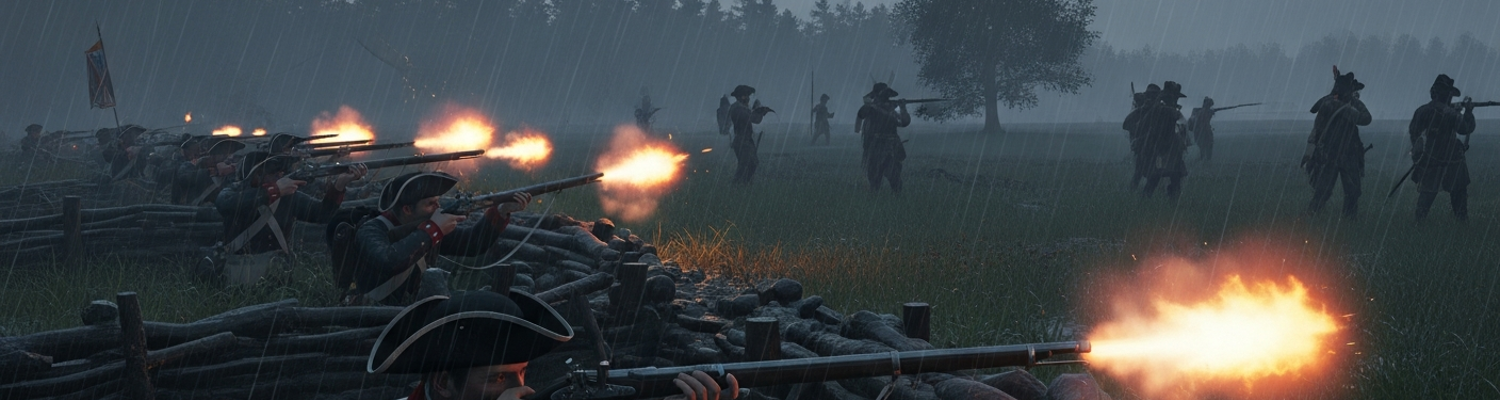
As the battle raged, a cold, relentless rain began to fall. The downpour turned the meadow into a muddy quagmire, flooding the trenches and soaking the soldiers. Critically, the rain ruined the garrison's gunpowder. The paper cartridges dissolved, and the powder in the pans of their flintlock muskets became a useless paste. While the French and their allies kept their powder relatively dry under the forest canopy, Washington’s men found it nearly impossible to return effective fire. The engagement devolved into a one-sided slaughter that lasted for nine hours. The tactical situation was hopeless. Washington's command was outgunned, outmaneuvered, and exposed to the elements. Discipline began to fray, with some provincial soldiers breaking into the fort's rum supply. By nightfall, 31 of Washington's men were dead and another 70 were wounded, representing nearly a quarter of his force. The French and their allies suffered only a handful of casualties.
Around 8 p.m., a French officer approached the battered fort under a flag of truce. De Villiers, perhaps concerned about his own dwindling ammunition and false rumors of British reinforcements, offered terms of surrender. Washington and Mackay had no viable alternative. They accepted the offer to negotiate. The articles of capitulation were handwritten in French and brought to the fort. In the darkness and driving rain, Washington relied on his Dutch subordinate, Captain Jacob van Braam, to provide a verbal translation. A crucial clause in the document described Jumonville's death with the French word 'l'assassinat'. Van Braam, either through poor translation or a desire to soften the blow, rendered this as 'the death of' or 'the killing of'. Unaware of the grave political implication, Washington signed the document. He had inadvertently confessed to the assassination of a French diplomatic envoy, a massive propaganda victory that France would exploit across the courts of Europe. The terms allowed the garrison to withdraw with the honors of war, but they had to leave two of their captains, van Braam and Robert Stobo, as hostages. On July 4, 1754, Washington led his defeated column away from the Great Meadows as the French burned Fort Necessity to the ground. It was his first experience of command, his only formal surrender, and a brutal lesson that served as the opening shot of the global conflict known as the Seven Years' War.